

A singer can have excellent breath control and still sound thin, muddy, or swallowed by the band if the microphone is wrong. The bigger problem is that “compatible” can mean anything from a proper XLR stage microphone to a karaoke handset that only works with a particular receiver.
Our Best microphones for singers picks cover that whole range, but they are not interchangeable. The Shure SM58 is the one we'd choose for most live vocalists, while the list also includes wireless duets, PartyBox setups, karaoke microphones, and distinctive stage designs.
The Shure SM58 is the best overall pick, with options below for wireless freedom, two-singer performances, casual karaoke, and retro presentation setups.
| # | Product | Award | Pickup | Connection | Standout feature | Best for |
|---|---|---|---|---|---|---|
| 1 | Shure SM58 | Best overall | Cardioid dynamic | XLR | Rugged metal build | Live singers |
| 2 | Shure SM58S | Best with mute switch | Cardioid dynamic | XLR | Integrated on/off switch | Vocalists who need quick muting |
| 3 | HUACAM Dual Wireless | Best simple duet system | Cardioid dynamic | 6.35mm or 3.5mm receiver | 200-foot line-of-sight range | Karaoke duets |
| 4 | FIFINE K6 | Best wired karaoke mic | Cardioid dynamic | 6.35mm | 14.8-foot cable | Karaoke machines and PA speakers |
| 5 | JBL PartyBox Wireless Mics | Best for PartyBox owners | Cardioid dynamic | 2.4GHz dongle | Up to 20 hours of play time | JBL PartyBox performances |
| 6 | BONAOK Q37 | Best all-in-one karaoke mic | Dynamic | Bluetooth or cable | Built-in speaker and effects | Phone-based karaoke |
| 7 | ECHOMUSSY Dual Wireless | Best long-battery duet system | Cardioid dynamic | 2.4GHz receiver | Up to 40 hours | Frequent karaoke events |
| 8 | Phenyx Pro PTU-71-2H | Best adjustable wireless system | Cardioid dynamic | UHF receiver | Auto scan and 200 selectable frequencies | Small-stage performers |
| 9 | Shure Super 55 | Best statement microphone | Supercardioid dynamic | Wired | Integrated swivel mount | Styled stage and studio setups |
| 10 | YIOWNER Wired Mic | Best simple wired option | Dynamic | Wired cable | 2.5-meter cable and switch | Basic karaoke systems |
1. Shure SM58: Best Overall

Pros
- Warm, articulate vocal presentation
- Cardioid pickup helps reject surrounding sound
- Built-in pop protection
- Rugged metal construction
- Reinforced stand adapter
Cons
- Requires an XLR setup
- No integrated on/off switch
- Wired operation limits movement
Best for: singers who want a dependable vocal microphone for live performance, rehearsal, or recording.
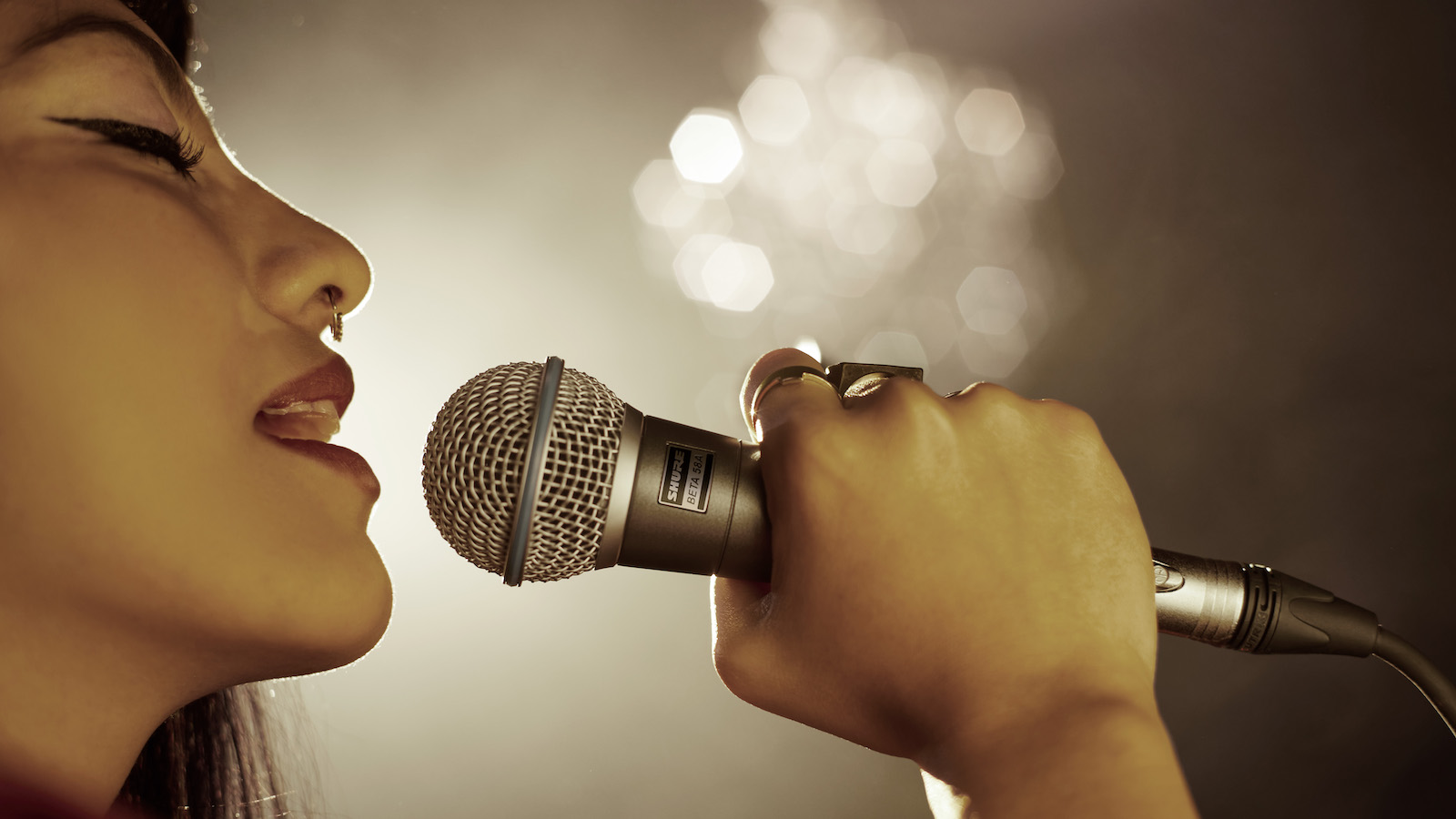
The Shure SM58 is the sensible microphone to hand to a singer when you do not yet know the venue, PA system, or vocal style. It has the familiar handheld shape, a solid metal body, and a spherical grille that feels ready for repeated stage use. It is not flashy, but it avoids the distracting quirks that make cheaper microphones frustrating.
Its finely tuned frequency response has a subtle midrange lift, which helps vocals stay articulate when guitars, keyboards, and drums fill the mix. The cardioid pattern focuses on sound from the front while reducing unwanted pickup behind the microphone. That matters in a live setup because it can help limit monitor feedback and room noise, though placement and gain settings still matter.
The integrated pop protection handles plosives, breath noise, and some wind noise without requiring an extra accessory. It is a dynamic microphone, so it does not require phantom power, but it does need an XLR cable and a mixer, interface, or compatible input. Singers moving from a casual karaoke speaker into a proper PA should understand that connection requirement before buying.
Compared with the Shure SM58S, this model gives up the convenience of a physical mute switch. Compared with the wireless systems here, it gives up freedom of movement but gains a simpler signal path and no transmitter battery to monitor. Those trade-offs are exactly why it remains the strongest all-purpose choice.
The main weakness is not sound quality. It is the need for supporting gear and a cable. If you want to roam around a room or plug directly into a small consumer speaker, choose the HUACAM or JBL system instead. For singers who want a durable, predictable wired microphone, the SM58 is still the one we'd keep.
2. Shure SM58S: Best With Mute Switch

Pros
- Clear, warm vocal character
- Focused cardioid pickup
- Convenient on/off switch
- Hardened grille and internal filtering
- Durable handheld design
Cons
- Still needs XLR equipment
- Switch can be moved accidentally
- Wired rather than wireless
Best for: singers, presenters, and rehearsal spaces where quick muting matters.
The Shure SM58S is the SM58 for people who regularly need to silence the microphone without reaching for a mixer. That small difference has real value during rehearsals, between songs, announcements, or shared stage performances. The switch is easy to understand and much more useful than a collection of extra controls that singers rarely touch.
The core vocal design remains familiar. Its cardioid pattern picks up sound primarily from the front and rejects some off-axis sound from instruments, monitors, and the audience. The tuned response gives voices warmth and presence, while the grille and internal filtering help manage breath sounds, plosives, and handling noise during close-mic singing.
The SM58S weighs about 0.66 pounds according to the listed product information, making it slightly lighter than the standard SM58. Its hardened grille and metal construction are suited to regular performance use. Like the standard version, it is a wired XLR microphone, so it is aimed at a mixer, PA, or audio interface rather than a Bluetooth speaker.
It is a close match for the Shure SM58, and the choice comes down almost entirely to the switch. The standard model is cleaner for singers who never want a switch under their hand. The SM58S is the better fit for anyone who handles their own muting, while the FIFINE K6 offers a similar control in a more casual 6.35mm karaoke setup.
The drawback is that the switch does not turn this into a plug-and-play microphone for phones or portable speakers. It also introduces one more physical control that can be bumped during a busy performance. Pick it when muting is part of your routine, not simply because the model looks similar to the standard SM58.
3. HUACAM Dual Wireless: Best Simple Duet System

Pros
- Includes two handheld microphones
- 200-foot line-of-sight range
- Rechargeable microphones and receiver
- Works with 6.35mm and 3.5mm microphone inputs
- Automatic pairing
Cons
- Not compatible with phones, computers, or tablets
- Charging takes over seven hours
- Fixed-frequency operation
Best for: two singers using a karaoke machine, amplifier, or PA with a dedicated microphone input.
The HUACAM Dual Wireless makes the most sense when two people need microphones quickly and the sound system already has a suitable input. The package includes two handheld dynamic microphones, a receiver, a 3.5mm adapter, covers, and a charging cable. That makes it a practical duet kit rather than a single microphone with wireless accessories sold separately.
Both microphones and the receiver use built-in 1200mAh rechargeable lithium-ion batteries. The listed operating range reaches 200 feet in line-of-sight conditions, which is plenty for many living rooms, halls, classrooms, and small outdoor gatherings. The automatic pairing is straightforward, but the charging time is listed as over seven hours, so this is a system to charge well before the event.
The microphones use a cardioid capsule intended to emphasize the singer and reduce some background noise and feedback. The system is specified for distortion below 0.2 percent, though the real result will also depend on the connected amplifier and room. It accepts 6.35mm or 3.5mm microphone inputs, but the listing explicitly says it is not compatible with mobile phones, computers, or tablets.
That limitation separates it sharply from the BONAOK Q37, which is designed around phones and Bluetooth. The HUACAM is also less flexible than the Phenyx Pro PTU-71-2H, which offers UHF frequency selection and auto scanning. Its appeal is simpler: two microphones, a small receiver, and no AA batteries.
The weakness is the fixed-frequency design and the narrow compatibility. It is not the right pick for a phone-based singer or a venue with a crowded wireless environment. For home karaoke, weddings, church events, and small gatherings with a real microphone input, it offers the most direct route to a two-person setup.
4. FIFINE K6: Best Wired Karaoke Mic

Pros
- Cardioid pickup for live use
- 50Hz to 18kHz frequency range
- 14.8-foot cable
- Metal construction
- Built-in pop filter and on/off switch
Cons
- Only works with a 6.35mm input
- Not compatible with 3.5mm connections
- Cable limits movement
Best for: singers using a karaoke machine, amplifier, or powered speaker with a 1/4-inch microphone input.
The FIFINE K6 is a straightforward wired microphone that gets the important karaoke details right. It has a comfortable handheld shape, an external on/off switch, and a long cable that gives a singer room to move around a small performance area. There is no battery, receiver, or pairing process to manage.
Its stated frequency range is 50Hz to 18kHz, a broad range for a dynamic vocal microphone used with a live speaker or karaoke system. The cardioid pattern is intended to increase usable gain while reducing feedback, and the built-in pop filter helps keep hard consonants from becoming distracting bursts of air. It can also handle high sound pressure levels, which matters when a singer gets close and loud.
The included cable is described as an XLR to 1/4-inch cable and measures 14.8 feet. That wording is important because the microphone is intended for equipment with a 6.35mm input. The listing specifically warns that a 3.5mm adapter does not make it compatible with a 3.5mm connection, so buyers should check the actual microphone input on the speaker or amplifier.
The YIOWNER Wired Mic is simpler and lighter, but the FIFINE gives more explicit audio information and a longer stated cable. The Shure SM58 is the more serious choice for a conventional XLR PA, while the K6 is easier to place into a karaoke machine with a quarter-inch input. Readers considering a home setup may also want to compare how a microphone handles recording vocals in a quieter room before assuming a stage-oriented dynamic mic is ideal.
Its real weakness is connection flexibility. The K6 is not a universal microphone, and the repeated 6.35mm warning should not be ignored. Choose it for a compatible karaoke or PA input, and skip it if your equipment only accepts USB, Bluetooth, or 3.5mm audio.
5. JBL PartyBox Wireless Mics: Best for PartyBox Owners

Pros
- Two digital wireless microphones
- Compatible with all PartyBox speakers
- Stable 2.4GHz connection
- Up to 20 hours of play time
- Pop filter and shock mount system
Cons
- Best suited to JBL PartyBox equipment
- Wireless dongle play time is listed as up to 12 hours
- Less flexible than a general-purpose XLR system
Best for: singers using a JBL PartyBox Encore, Ultimate, or another compatible PartyBox speaker.
The JBL PartyBox Wireless Mics are the cleanest match for a singer who already performs through a PartyBox. The package provides two digital wireless microphones, so duets and group events do not require a second compatible system. Plug in the wireless dongle, connect to the speaker, and the setup is designed to stay out of the way.
JBL lists up to 20 hours of play time, or up to 12 hours when using the digital wireless dongle. The microphones can be charged through the PartyBox charging port, and 10 minutes of charging is stated to provide another two hours of play time. That quick top-up is useful before a performance, although the exact result will depend on how the microphones are being used.
The 2.4GHz connection operates within 30 meters of the PartyBox, which is roughly 98 feet. The cardioid pickup pattern is tuned for warm, clear vocals, while a built-in pop filter reduces breath sounds. A shock mount system is intended to reduce handling noise as microphones pass between singers.
This is a more polished PartyBox solution than the HUACAM Dual Wireless, but it does not compete with the Phenyx Pro PTU-71-2H as a general wireless stage system. The JBL is easier when the rest of the setup is JBL. The Phenyx Pro is more adaptable when a mixer or conventional PA is involved.
The weakness is ecosystem dependence. These microphones are not the right choice for a singer building an XLR recording rig or a wireless system for varied venues. If your performances revolve around a PartyBox, though, the simple pairing, dual microphones, and rechargeable design make the JBL system the obvious fit.
6. BONAOK Q37: Best All-in-One Karaoke Mic

Pros
- Bluetooth and cable connections
- Built-in speaker
- Echo and separate volume controls
- Supports microSD cards up to 32GB
- Portable handheld design
Cons
- Not a conventional stage microphone
- Bluetooth range is listed as 10 meters
- Only one microphone is included
Best for: casual singers who want phone-based karaoke without a separate speaker system.
The BONAOK Q37 is less a traditional vocal microphone and more a compact karaoke machine shaped like one. It includes a built-in speaker, Bluetooth, cable connection, and controls for microphone volume, music volume, and echo. For a child, a family party, or an impromptu singalong, that self-contained design is more approachable than an XLR microphone and mixer.
Bluetooth supports a listed distance of 10 meters, while the cable offers a second connection method. The microphone can also act as an MP3 player and recorder, and it supports a microSD card up to 32GB, although the card is not included. Song switching and multi-function buttons make it practical for casual use, but the controls are not a substitute for a proper vocal channel on a PA.
The built-in echo control is one of the main reasons to choose it. Singers can adjust the vocal effect and music separately, which creates the familiar karaoke presentation without extra equipment. That convenience comes with a different sound goal from the Shure SM58, whose job is to put a clean vocal into a larger audio system.
The BONAOK Q37 is also the natural companion for readers who want a microphone that works with a phone during a singalong. It is more self-contained than the JBL PartyBox system, but the JBL produces a better fit for owners of that speaker family and provides two microphones rather than one.
The weakness is that the built-in speaker and effects make it unsuitable for serious stage work. It also requires more attention to its controls than a simple wired dynamic mic. Choose it when portability and fun matter more than a clean signal into a mixer.
7. ECHOMUSSY Dual Wireless: Best Long-Battery Duet System

Pros
- Two all-metal handheld microphones
- Up to 40 hours of use
- 200-foot open-area range
- Individual volume controls
- LCD battery and frequency displays
Cons
- Requires a dedicated microphone input
- Not compatible with Bluetooth-only speakers
- Open-area range can change indoors
Best for: frequent duet performances using a karaoke machine, powered speaker, amplifier, or mixer.
The ECHOMUSSY Dual Wireless is built around convenience for two singers. Its all-metal microphones have contrasting finishes, making it easy to tell them apart during a duet, while the receiver handles one-to-one pairing automatically. The result is a system that feels more organized than passing around a single microphone.
The stated battery life reaches up to 40 hours for the microphones and receiver, and charging uses USB-C. Each microphone has an LCD showing battery status and operating frequency, along with independent plus and minus volume buttons. Those controls are particularly useful when two singers have different vocal levels and do not want one adjustment to affect both channels.
The 2.4GHz connection is rated for up to 200 feet, or 60 meters, in an open, unobstructed environment. The cardioid dynamic heads focus on the singer, and the built-in DSP noise reduction is intended to keep vocals natural while reducing surrounding noise. The receiver includes a 3.5mm adapter, but the system needs a dedicated microphone input and will not work with phones, tablets, laptops, televisions, Bluetooth-only speakers, or AUX/headphone ports.
Compared with the HUACAM Dual Wireless, the ECHOMUSSY offers a longer stated battery duration, USB-C charging, LCD information, and separate volume controls. The JBL PartyBox Wireless Mics are a better fit for JBL speakers, while the ECHOMUSSY is more suitable for varied karaoke and PA equipment.
Its biggest weakness is compatibility confusion. A 3.5mm plug does not mean every 3.5mm socket will work, since the socket must be a microphone input. Check the equipment first. If it passes that check, this is the dual wireless system to choose for repeated events where charging frequency matters.
8. Phenyx Pro PTU-71-2H: Best Adjustable Wireless System

Pros
- Auto scan finds a lower-interference frequency
- Two UHF handheld microphones
- 200 selectable frequencies
- Up to 328-foot line-of-sight range
- Replaceable microphone heads
Cons
- Uses four AA batteries
- Receiver package is relatively bulky
- More setup than the simpler wireless kits
Best for: singers and small venues that need more control over wireless frequencies.
The Phenyx Pro PTU-71-2H is the most configurable wireless system in this group. It is aimed at performances where interference, multiple microphones, or longer distances make a basic fixed-frequency kit less reassuring. Auto Scan identifies a lower-interference frequency, and a lock function helps prevent accidental changes once the system is set.
The two channels provide 100 selectable UHF frequencies each. Channel 1 covers 536.57 to 561.32MHz, while Channel 2 covers 562.37 to 587.12MHz. The listed operating range is 290 to 328 feet line of sight. Those figures are useful for a church, wedding, DJ setup, or small stage, but walls, people, and other wireless equipment can reduce real-world range.
The handheld microphones use cardioid pickup and a tuned response with fuller low frequencies, brighter high frequencies, and a balanced midrange. The metal construction should stand up to regular handling, and the replaceable microphone head gives the system a maintenance path that the simpler wireless products do not. The package includes a dual-channel receiver, two microphones, a quarter-inch cable, adapter, power supply, antennas, and four AA batteries.
This system is more capable than the ECHOMUSSY Dual Wireless when frequency management matters. It is less convenient because it uses AA batteries and has a more involved receiver setup. For an uncomplicated party, the JBL or HUACAM systems are easier. For a small venue where wireless reliability deserves attention, the Phenyx Pro is the stronger tool.
The weakness is bulk and setup time. Its receiver and accessories ask more from the owner, and the listed battery duration is 16 hours rather than the rechargeable durations of newer systems. Choose it when control and range matter more than a minimal setup.
9. Shure Super 55: Best Statement Microphone

Pros
- Distinctive vintage-inspired design
- Supercardioid dynamic capsule
- Shock-mounted cartridge
- Integrated swivel mount
- Rugged die-cast construction
Cons
- Large visual presence
- Wired operation
- Better suited to fixed-position use
Best for: singers who want a polished visual centerpiece for a stand-based performance.
The Shure Super 55 is the microphone to buy when appearance is part of the performance. Its satin chrome-plated housing and blue accents bring a deliberately vintage look to a stage, studio, or video setup. Unlike a standard handheld microphone, it reads as part of the set design.
The sound is not merely decorative. The supercardioid dynamic capsule focuses pickup more tightly than a typical cardioid design, helping reduce ambient sound and feedback when the microphone is positioned correctly. Its tailored response is intended to produce clear, natural vocals and speech, while the shock-mounted cartridge helps reduce handling noise and vibration.
The integrated self-tensioning swivel mount allows positioning without a separate microphone clip. That makes it particularly convenient on a stand, though the design is less natural for singers who hold a microphone and move constantly. Its rugged die-cast body supports regular performance use, but the shape and visual weight make it a different tool from the compact Shure SM58.
The SM58 remains the more practical choice for a working singer who moves around the stage. The Shure Super 55 is better when the microphone stays in one place and the camera or audience can appreciate its design. It also has a tighter pickup pattern, which can reward careful positioning but punish singers who drift away from the front of the capsule.
The weakness is flexibility rather than construction. This is a wired, stand-oriented statement piece, not a general-purpose wireless or handheld karaoke microphone. Pick it for a styled stage, studio corner, or on-camera performance where the microphone should look as considered as it sounds.
10. YIOWNER Wired Mic: Best Simple Wired Option

Pros
- Plug-and-play operation
- No battery required
- On/off switch
- 2.5-meter cable
- Built-in pop filter
Cons
- Basic dynamic design
- Compatibility depends on the connected equipment
- Cable movement is limited
Best for: casual karaoke and simple speaker, amplifier, mixer, or DVD setups.
The YIOWNER Wired Mic is the uncomplicated option in this roundup. Plug it into compatible equipment, switch it on, and sing. There is no receiver to pair, battery to charge, or wireless range to manage, which makes it useful for a spare microphone or a basic home karaoke setup.
Its 2.5-meter cable gives a little room to move, and the listed cable uses oxygen-free copper with shielding to reduce hum and noise. The microphone has a built-in pop filter and a handheld shape intended to be comfortable during parties, conferences, and outdoor activities. It is a dynamic microphone, so it does not require a separate power source.
The built-in on/off switch is useful when the microphone is being shared or when the singer needs to mute between songs. The product is described as compatible with power amplifiers, outdoor audio, mixers, DVD equipment, and karaoke systems, but buyers still need to verify the actual input and connector on their equipment.
The FIFINE K6 is the stronger wired karaoke choice when a 6.35mm input and longer 14.8-foot cable are important. The Shure SM58 is the better pick for repeated stage work and a conventional XLR setup. The YIOWNER belongs here because some singers need a simple microphone that can be kept as a spare rather than a more involved system.
Its weakness is the lack of detailed pickup and frequency information. That makes it harder to predict how it will behave in a demanding PA or recording environment. Choose it for uncomplicated singing, and move up to the FIFINE or Shure when the microphone will be part of a more serious vocal setup.
How to choose best microphones for singers
The right microphone depends less on the word “vocal” in a listing and more on the connection, pickup pattern, movement, and equipment already in the room.
Pickup pattern
Cardioid microphones focus on sound from the front and reduce some sound from the sides and rear. That is helpful for singers because it can reduce room noise and feedback from a monitor behind the microphone. Supercardioid designs such as the Shure Super 55 narrow the focus further, but they require more careful positioning.
Wired and wireless connections
XLR microphones such as the Shure SM58 and SM58S suit mixers, interfaces, and conventional PA systems. Quarter-inch microphones such as the FIFINE K6 require a compatible 6.35mm input. Wireless systems add movement, but they require a receiver and may have specific compatibility limits.
Range and interference control
A wireless range figure usually assumes open, unobstructed space. Walls and other wireless devices can reduce it. Fixed-frequency systems are simple, while the Phenyx Pro's auto scan and selectable UHF frequencies provide more control in crowded performance spaces.
A microphone cannot fix an incompatible input, so check the socket before comparing vocal sound.
Battery and charging
Rechargeable microphones remove the need for disposable batteries, but charging habits still matter. The HUACAM, JBL, and ECHOMUSSY systems all use rechargeable designs, while the Phenyx Pro uses AA batteries. Look at the receiver as well as the microphone because a wireless kit can stop working when either part needs power.
Handling and vocal technique
A built-in pop filter helps with breath and plosive noise, while shock mounting can reduce bumps and handling sounds. Dynamic microphones are common for live singing because they can tolerate close, loud vocals and do not need phantom power. Singers who move should also consider cable length, microphone weight, and how easily the capsule maintains a clear signal when the mic position changes.
Frequently asked questions
What type of microphone is best for singing live?
A cardioid dynamic microphone is usually the safest starting point for live singing. It focuses on the singer, handles loud sound levels, and can reduce some feedback and background noise. The Shure SM58 is the strongest general-purpose example in this list.
Is the Shure SM58 good for singers?
Yes. Its tuned midrange, cardioid pickup, integrated pop protection, and rugged construction suit live vocals particularly well. It requires an XLR cable and compatible audio equipment, so it is not a direct-connect microphone for a phone or Bluetooth speaker.
Do wireless microphones sound as good as wired microphones?
A well-matched wireless system can sound clear, but it introduces a transmitter, receiver, battery, and connection environment into the setup. Wired microphones are simpler and do not have wireless range or battery concerns. Wireless is the better choice when movement or two-singer performance matters.
Can these microphones connect directly to a phone?
Most cannot. The HUACAM and ECHOMUSSY listings specifically exclude phones, tablets, and computers, while the BONAOK Q37 is designed for Bluetooth and cable connections with mobile devices. Always check whether a port is a microphone input rather than an AUX or headphone socket.
Is a cardioid microphone better than a supercardioid microphone?
Neither pattern is automatically better. Cardioid pickup is easier for most singers to use, while supercardioid pickup can offer tighter isolation when the microphone and monitor are positioned carefully. The Shure Super 55 rewards controlled stand-based singing, while the SM58 is more forgiving for handheld performance.
Do singers need a microphone with an on/off switch?
Not always. A switch is useful during rehearsals, presentations, shared performances, and song breaks. The Shure SM58S, FIFINE K6, and YIOWNER Wired Mic include on/off controls, while a mixer or receiver can handle muting in other setups.
Are karaoke microphones suitable for serious singing?
Some can work well for casual performances, but karaoke products vary widely in connection and sound design. The FIFINE K6 is a conventional wired dynamic microphone for a 6.35mm input, while the BONAOK Q37 adds a speaker and echo effects for convenience. Neither replaces a complete recording or stage system by itself.
The bottom line
The Best microphones for singers start with the Shure SM58 because it combines focused cardioid pickup, useful vocal presence, pop protection, and a rugged wired design. Choose the Shure SM58S instead if quick muting is part of your normal performance routine.
For two singers, the Phenyx Pro PTU-71-2H is the most configurable wireless system, while the JBL PartyBox Wireless Mics are the easiest match for PartyBox owners. Casual phone karaoke is a different job, and the BONAOK Q37 handles that better than any conventional stage microphone here.
If you are undecided, buy the Shure SM58 for a proper wired vocal setup, or choose the wireless system that matches the input and speaker you already own.
As an Amazon Associate we earn from qualifying purchases.