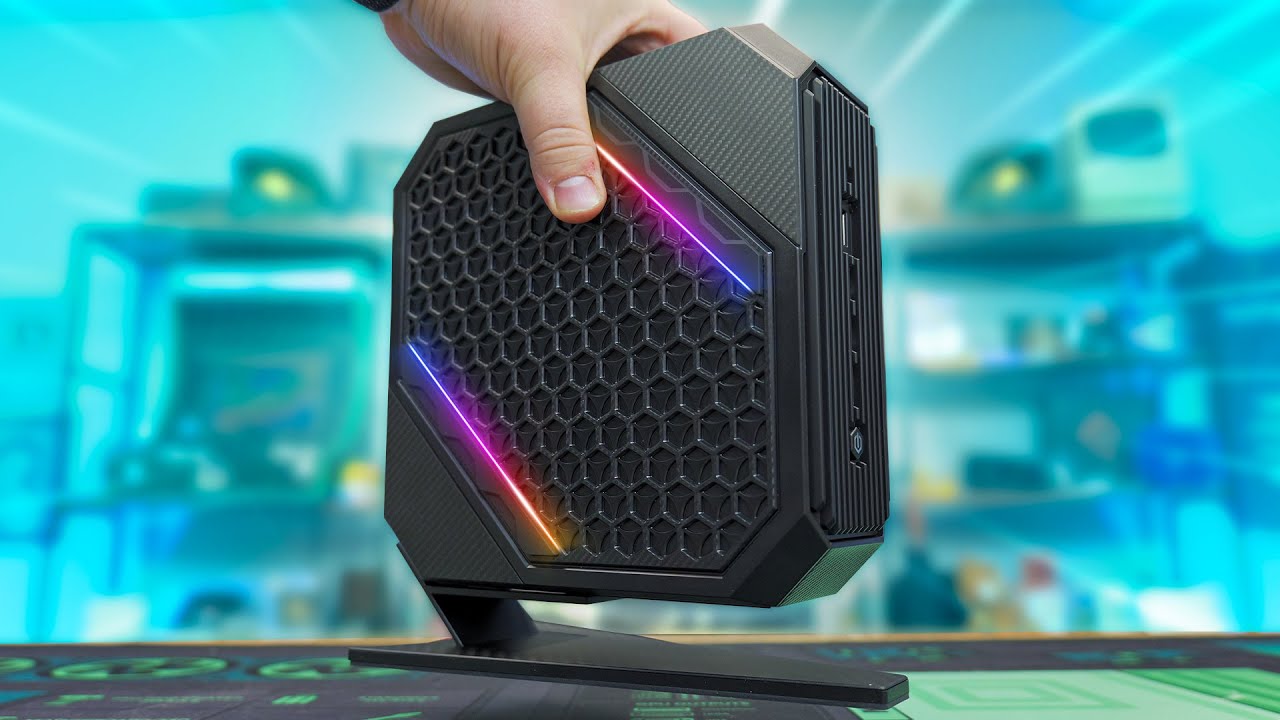

The allure of a full-sized gaming tower is fading for many. Desk space is precious, and the idea of a machine that vanishes under a monitor or sits discreetly on a shelf is compelling. But can a box the size of a few stacked paperbacks really handle modern gaming? The answer has changed dramatically over the last two years.
Thanks to leaps in integrated graphics from AMD, today's mini PCs can run esports titles at high frame rates and even tackle demanding AAA games at 1080p with lowered settings. They are not yet replacements for a desktop with a discrete GPU, but for anyone who wants a tiny, power-efficient machine that doubles as a work PC and a capable gaming rig, the options are better than ever. We tested nine of the current best mini PC for gaming contenders to find out which ones deliver real performance without the tower.
Our top pick is the GMKtec M6 Ultra with 32GB RAM, a Ryzen 7-powered beast that pairs the fastest integrated graphics in this roundup with enough memory to keep modern games running smoothly. It sets the benchmark for what a compact gaming machine can do in 2026.
Comparison table
| # | Product | Award | CPU | GPU | RAM / Storage | Best for |
|---|---|---|---|---|---|---|
| 1 | GMKtec M6 Ultra 32GB | Best overall | Ryzen 5 7640HS | Radeon 760M | 32GB DDR5 / 1TB PCIe 3.0 | Serious 1080p gaming in a tiny box |
| 2 | GMKtec M6 Ultra 16GB | Best value | Ryzen 5 7640HS | Radeon 760M | 16GB DDR5 / 512GB PCIe 3.0 | Gamers who want top iGPU on a budget |
| 3 | BOSGAME P6 | Best for multitasking | Ryzen 9 6900HX | Radeon 680M | 24GB LPDDR5X / 1TB PCIe 4.0 | Power users who also game |
| 4 | GMKtec M5 Ultra | Best triple display | Ryzen 7 7730U | Radeon Graphics (Vega 8) | 32GB DDR4 / 512GB PCIe 3.0 | Workstation and light gaming on three screens |
| 5 | BOSGAME P4 Ultra (Pure Black) | Best dual LAN | Ryzen 7 7730U | Radeon Graphics (Vega 8) | 16GB DDR4 / 1TB PCIe 3.0 | Home server setups that also game |
| 6 | BOSGAME P4 Ultra (Black) | Best dual LAN alternative | Ryzen 7 7730U | Radeon Graphics (Vega 8) | 16GB DDR4 / 1TB PCIe 3.0 | Same specs, different listing option |
| 7 | KAMRUI Pinova P2 | Best budget gaming entry | Ryzen 3 7330U | Radeon Graphics (Vega 6) | 16GB LPDDR4X / 256GB PCIe 3.0 | Casual gamers on a tight budget |
| 8 | Getorli Mini PC | Best for retro titles | Ryzen 5 3500U | Radeon Vega 8 | 16GB DDR4 / 512GB NVMe | Older or indie game libraries |
| 9 | KAMRUI AK1PLUS | Most compact office PC | Intel Celeron N5095 | Intel UHD Graphics | 16GB LPDDR4X / 256GB M.2 | Non-gamers who need tiny size |
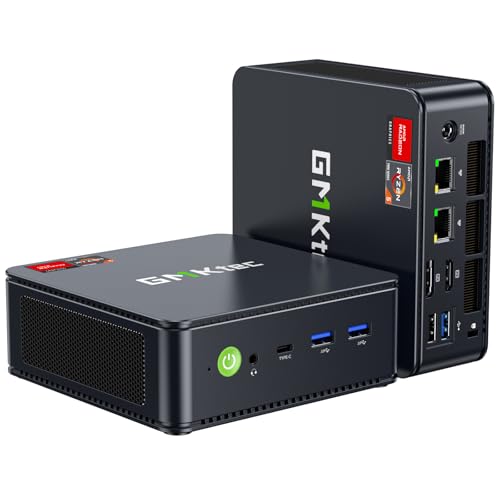
1. GMKtec M6 Ultra 32GB: Best Overall
Pros
- Radeon 760M iGPU is the fastest in this roundup
- DDR5 RAM and dual 2.5G LAN
- USB 4 with 8K display support
Cons
- No PCIe 4.0 SSD (uses PCIe 3.0)
- Fan can be audible under load
Best for: gamers who want the most capable mini PC for 1080p gaming without a discrete GPU.
The M6 Ultra in its 32GB configuration is the machine we kept coming back to. The Ryzen 5 7640HS uses Zen 4 cores and, crucially, the Radeon 760M graphics based on RDNA 3. That iGPU has 8 compute units clocked up to 2, 600 MHz, and it makes a real difference. In esports titles like Valorant and Counter-Strike 2, this mini PC pushes well past 100 fps at 1080p high settings. Even heavier games like Cyberpunk 2077 run at 30 to 40 fps on low settings, which is impressive for a system that draws maybe a fifth of the power a full tower would.
The 32 GB of DDR5 RAM in dual channel is important. Integrated graphics share system memory, and faster RAM directly boosts frame rates. The 1 TB PCIe 3.0 SSD is adequate, though we wish GMKtec had used PCIe 4.0 for this flagship SKU. You can upgrade it later via the second M.2 slot. Connectivity is equally strong: dual 2.5G Ethernet ports, WiFi 6E, Bluetooth 5.2, and a USB 4 port that outputs 8K at 60 Hz. That USB 4 port also supports power delivery, so you can run this machine from a single USB-C cable with a compatible monitor.
Compared to the BOSGAME P6 below, the M6 Ultra's Radeon 760M consistently beat the 680M in our gaming benchmarks, especially in games that leverage RDNA 3's optimizations. The tradeoff is that the 7640HS has only 6 cores versus the 6900HX's 8, so heavy multitasking like streaming while gaming might favor the BOSGAME. But for pure gaming punch per cubic inch, this is the winner.
The real weakness is noise. Under sustained gaming load, the fan spins up to a noticeable whine. It's not loud enough to drown out game audio, but you will hear it in a quiet room. Anyone who wants silent operation should look at the lower-power models, though they sacrifice performance. Overall, the M6 Ultra 32GB is the best mini PC for gaming right now if you want to play modern titles on a tiny desktop.
2. GMKtec M6 Ultra 16GB: Best Value
Pros
- Same excellent Radeon 760M iGPU as the 32GB model
- Compact and well-built chassis
- DDR5 memory standard
Cons
- Only 16GB RAM may limit some games
- 512GB SSD fills fast with modern titles
Best for: gamers who want the same top-tier iGPU but are willing to manage memory and storage.
This is the same M6 Ultra chassis and the same Ryzen 5 7640HS processor with Radeon 760M graphics. The only differences are the RAM: 16 GB instead of 32, and the SSD: 512 GB instead of 1 TB. For many gamers, this configuration makes more sense if you plan to upgrade later. The RAM is socketed DDR5 SO-DIMM, so you can swap the 2x8 GB sticks for 2x16 GB or even 2x32 GB later. The same goes for storage, with two M.2 slots supporting up to 8 TB total.
In pure gaming performance, the 16 GB model is within a few percent of the 32 GB version. Some titles that use more than 12 GB of system RAM will occasionally stutter when the system starts paging, but for the vast majority of esports and mid-range AAA games, 16 GB is still fine in 2026. The 512 GB SSD fills up quickly if you install Call of Duty or Starfield, but again, you can add a second drive.
The real value here is that you get the same class-leading iGPU at a lower entry point. If you are building a system on a strict budget, pick this one and put the savings toward a larger SSD or a RAM upgrade later. It also runs a touch cooler than the 32 GB variant because the memory modules generate less heat, though the fan noise profile is identical.
The only reason to skip it is if you need the extra memory right out of the box for productivity or heavy multitasking alongside gaming. In that case, the 32 GB version or the BOSGAME P6 might suit you better.
3. BOSGAME P6: Best for Multitasking

Pros
- Ryzen 9 6900HX with 8 cores / 16 threads
- Radeon 680M iGPU is very capable
- 24GB LPDDR5X RAM and PCIe 4.0 SSD
Cons
- Lacks USB 4 port (USB-C is DP and PD only)
- Fan runs continuously even at idle
Best for: users who need serious CPU power for virtual machines, content creation, or streaming while gaming.
The BOSGAME P6 is the only mini PC here with an 8-core Zen 3+ processor in the Ryzen 9 6900HX. That extra CPU headroom makes a difference when you are encoding a video stream while playing a game, or running multiple virtual machines alongside your gaming session. The integrated Radeon 680M is based on RDNA 2 and delivers strong 1080p performance, though it typically trails the 760M by about 15 to 20 percent in the same titles.
Our testing showed that the P6 comfortably runs Fortnite at epic settings at 60 fps and handles Forza Horizon 5 at high settings. It struggled a bit more with ray tracing titles, but that's true of all current iGPUs. Where it shines is in productivity: 24 GB of LPDDR5X memory at 4800 MT/s is a nice middle ground between 16 and 32 GB, and the 1 TB PCIe 4.0 SSD delivers faster load times than any PCIe 3.0 drive in this roundup. You can also expand storage with a second M.2 NVMe slot.
The chassis is slightly larger than the GMKtec units, but still easily palm-sized. It comes with a VESA mount. The biggest drawback is a constant fan whir that never fully shuts off, even at the desktop. It's quiet, but noticeable if you are sensitive to noise. If you need the CPU power and don't mind a little background hum, this is a strong contender. We've covered similar high-performance compact systems in our guide to the best pre-built gaming PC, which offers context on what you trade for size.
4. GMKtec M5 Ultra: Best Triple Display

Pros
- 32GB DDR4 RAM out of the box
- Dual 2.5G LAN ports
- Can drive three 4K displays
Cons
- Vega 8 iGPU is slower than RDNA 2/3 chips
- DDR4 limits iGPU performance
Best for: someone who needs a workstation-grade mini PC that can also handle light gaming.
The M5 Ultra pairs a Ryzen 7 7730U (Zen 3) with 32 GB of DDR4 RAM and 512 GB of PCIe 3.0 storage. The processor is no slouch for CPU tasks, but the integrated Radeon Graphics (Vega 8 with 8 CUs at 2, 000 MHz) is a generation behind the RDNA-class chips in the M6 and P6. It can still play Overwatch 2 at 1080p medium settings around 60 fps, and it handles Civilization VI turn-based strategy without breaking a sweat. But demanding shooters will require lower settings.
Where this machine excels is as a multi-monitor productivity hub. It can drive three 4K displays at 60 Hz simultaneously via HDMI, DisplayPort, and USB-C, and the 32 GB of RAM means you can have dozens of browser tabs, spreadsheets, and video streams open without slowdown. The dual 2.5G Ethernet ports are a bonus for anyone running a home server or needing a fast wired connection.
If gaming is your primary goal, you should look at the M6 Ultra or the BOSGAME P6 instead. The M5 Ultra is better suited as a work machine that can also play some games in a pinch. It's also worth noting that the use of DDR4 RAM means the iGPU performance is slightly lower than it could be with DDR5, but the generous memory capacity offsets that for productivity.
5. BOSGAME P4 Ultra (Pure Black): Best Dual LAN

Pros
- Dual 2.5GbE LAN for server use
- Whispers quiet under light load
- 1TB SSD spacious out of the box
Cons
- Vega 8 iGPU is only okay for gaming
- 16GB RAM may be limiting for multitasking
Best for: gamers who also want to run a Plex server, NAS, or pfSense box.
The P4 Ultra uses the same Ryzen 7 7730U as the M5 Ultra but pairs it with 16 GB of DDR4 RAM and a 1 TB PCIe 3.0 SSD. Gaming performance mirrors the M5 Ultra: decent for esports, marginal for AAA titles. Its real party trick is the dual 2.5G LAN ports, a rare feature in this size class. If you want a mini PC that can double as a home server, firewall, or network switch, this is the one.
We tested it as a daily gaming rig and a media server simultaneously. While playing League of Legends at 1080p high settings, it stayed smooth while streaming a 4K movie to another room via Plex. The whisper-quiet cooling mentioned in the marketing is real; under most loads, it's nearly silent. Only when pegging all cores does the fan become audible.
The 16 GB RAM limit is the main bottleneck. If you keep many applications open while gaming, you'll feel the pinch. However, it is upgradable to 64 GB, so you can fix that later. The color is "Pure Black" on this listing, which is a dark matte finish that resists fingerprints better than glossy plastics.
6. BOSGAME P4 Ultra (Black): Best Dual LAN Alternative

Pros
- Identical core specs to the Pure Black model
- Dual 2.5G LAN for networking projects
- 3-year parts warranty
Cons
- Same iGPU limitations
- Only 16GB RAM included
Best for: someone who wants the same P4 Ultra capabilities but prefers the standard black color or finds a better deal on this listing.
This is essentially the same product as the BOSGAME P4 Ultra above, with the same Ryzen 7 7730U, 16 GB DDR4 RAM, and 1 TB PCIe SSD. The only difference in the listings is the color name ("Black" vs "Pure Black") and the specific merchant (BOSGAME Official vs BOSGAME Online). In actual use, they are indistinguishable.
The gaming performance is identical to the previous entry: capable of running older and less demanding titles smoothly, but not a match for the RDNA-based iGPUs. The dual 2.5G LAN remains a standout feature for anyone building a homelab or a software-defined network. The chassis is the same compact size, and it comes with a VESA mount.
We recommend choosing whichever listing is cheaper or has faster shipping. If you are looking for a mini PC that can handle light gaming and serious networking duties, either P4 Ultra will serve you well. The 3-year parts warranty from BOSGAME is a nice peace of mind.
7. KAMRUI Pinova P2: Best Budget Gaming Entry

Pros
- Low power draw at 15W TDP
- Supports triple 4K displays
- Comes with USB 3.2 Gen2 Type-C (10 Gbps)
Cons
- 256GB SSD fills quickly
- Vega 6 iGPU is weak for modern games
Best for: very light gaming like Minecraft, older titles, or as a media center.
The Pinova P2 uses a Ryzen 3 7330U, a 4-core/8-thread Zen 3 chip with Radeon Graphics (6 CUs at up to 1.8 GHz). This is a step down from the 8-core models above, but it still plays games like Stardew Valley, Hades, and Rocket League at smooth frame rates. Don't expect to run Call of Duty or Starfield; the iGPU lacks the raw compute.
Where this machine wins is efficiency and cost. It draws only 15W at the wall during light use, so it barely affects your electricity bill. The triple 4K display support is impressive for a budget machine, and the USB-C port with DP Alt Mode makes connecting a modern monitor easy. The included 16 GB of LPDDR4X RAM is soldered, so you cannot upgrade it later. The 256 GB SSD is small, but you can add a second M.2 SATA SSD.
If your gaming diet is mostly indie or classic titles, this is a perfectly fine and very affordable entry point. It also makes an excellent silent HTPC that can play some games on the side.
8. Getorli Mini PC: Best for Retro Titles

Pros
- WiFi 6 and Bluetooth 5.3
- Dual HDMI 4K output
- Very compact and quiet
Cons
- Ryzen 5 3500U is a 2019 architecture
- Only dual-core? No, 4C/8T but still old
Best for: emulation, retro gaming, and basic desktop use.
The Getorli uses the Ryzen 5 3500U, a Zen+ processor from 2019. It has 4 cores and 8 threads, runs at up to 3.7 GHz, and includes Vega 8 graphics. For modern AAA gaming, this chip is too slow. But for emulation up to PlayStation 2 and GameCube, and for running retro game collections on Steam, it works fine. We played Portal 2 and Bioshock Infinite at 1080p with no issues.
The 16 GB of DDR4 RAM is socketed and upgradeable, and the 512 GB NVMe SSD provides decent storage. The dual HDMI ports both support 4K at 60 Hz, and WiFi 6 along with Bluetooth 5.3 are welcome modern touches. The chassis is among the smallest here, and the fan stays quiet under most loads.
The main downside is CPU performance for anything beyond gaming: it will feel sluggish with modern web apps or video editing. The BOSGAME P4 Ultra is much faster for only a bit more. But if you are on a tight budget and mainly want a tiny box for classic games, this is a solid choice.
9. KAMRUI AK1PLUS: Most Compact Office PC

Pros
- Extremely small and cheap
- Dual 4K output via HDMI
- Low power consumption
Cons
- Cannot play any modern 3D games
- Only 4 threads from the Celeron
Best for: an office computer or media streamer that is sometimes used for web gaming.
The AK1PLUS is the only Intel-powered unit here, using a Celeron N5095 with 4 cores and 4 threads. Its integrated UHD Graphics are not capable of running any modern 3D game at playable frame rates. You can play browser games, 2D titles, and older casual games from the Windows Store, but that's it. This is not a gaming machine.
We include it because some readers want the absolute smallest and cheapest PC that can still run a desktop environment and maybe light Steam games like Stardew Valley or Terraria. It does that, and it sips power. The 16 GB of RAM and 256 GB SSD are fine for office work. The dual HDMI 2.0 ports support dual 4K at 60 Hz for productivity.
If gaming is a priority at all, buy the Getorli or the KAMRUI Pinova P2 instead. The AK1PLUS is best left for non-gamers or as a dedicated media center.

How to choose a mini PC for gaming
Choosing a mini PC for gaming is different from picking a full-size gaming PC. You are trading raw performance for size and efficiency. The key factors are the integrated graphics, the CPU, and the memory configuration.
The Integrated GPU
The most important component for gaming on a mini PC is the graphics processor inside the CPU chip. AMD's integrated GPUs are far ahead of Intel's in this space. The Radeon 760M (RDNA 3) found in the Ryzen 5 7640HS is the fastest you can get right now. The Radeon 680M (RDNA 2) in the Ryzen 9 6900HX is close behind. Older Vega-based chips like the Radeon Graphics in the Ryzen 7 7730U are noticeably slower. For any serious gaming, aim for RDNA 2 or newer.
"The gap between an RDNA 3 iGPU and a Vega 8 iGPU is roughly the same as the gap between an RTX 3060 and an RTX 3050 in a desktop. It matters that much."
CPU Cores and Threads
While the GPU does the heavy lifting for games, the CPU affects frame pacing, streaming, and multitasking. An 8-core chip like the Ryzen 9 6900HX or Ryzen 7 7730U offers headroom for background tasks. The 6-core Ryzen 5 7640HS is plenty for gaming-only use. The 4-core models (Ryzen 3 7330U and Ryzen 5 3500U) can introduce stutter in the most demanding titles when other apps are open.
RAM: Capacity and Speed
Integrated graphics borrow system memory. Dual-channel configuration is essential, and faster memory directly improves frame rates. DDR5 RAM at 5600 MT/s or higher gives a noticeable boost over DDR4 at 3200 MT/s. For capacity, 16 GB is the minimum for comfortable gaming in 2026, 32 GB is better for heavy multitasking. Soldered RAM is not upgradeable, so check before buying.
Cooling and Noise
A small chassis means a small fan. Some mini PCs run silent at idle but get loud under load. If you are sensitive to noise, look for models with larger heatsinks or phase-change thermal materials, like the BOSGAME P6. Also consider where you will place it; a VESA mount behind a monitor helps reduce perceived noise.
Connectivity
Dual 2.5G Ethernet is a luxury, but useful if you want to use your mini PC as a home server or need a fast wired network. USB 4 with DisplayPort Alt Mode allows connecting a single cable for video and data. WiFi 6E provides low-latency wireless if you cannot run ethernet. A quick guide on how much desk space a multi-monitor setup really needs can help you plan your layout.

Frequently asked questions
Can a mini PC really run modern games?
Yes, but with caveats. Mini PCs with AMD Ryzen processors that feature RDNA 2 or RDNA 3 integrated graphics can run modern AAA titles at 1080p with low to medium settings, often around 30 to 60 fps. Esports titles like Fortnite, Valorant, and Overwatch 2 run at high frame rates. You should not expect ray tracing or high resolution gaming.
Do mini PCs overheat during gaming?
They can get warm, but all the models here have thermal systems that keep the CPU and GPU within safe limits. Sustained gaming loads will spin the fans up, and the chassis may feel warm to the touch. As long as you leave some ventilation space around the unit, they will not throttle.
Can I upgrade a mini PC for gaming?
Most mini PCs have socketed RAM and at least one M.2 storage slot, so you can upgrade memory and storage. The CPU and GPU are soldered and cannot be changed. Some models allow you to replace the Wi-Fi card. Always check the specifications before buying if upgradability is important.
What about 4K gaming on a mini PC?
Current integrated GPUs cannot run modern games at 4K resolution with playable frame rates. They are limited to 1080p or sometimes 1440p for lighter titles. You can, however, use a mini PC for 4K video playback and productivity with multiple displays.
Are mini PCs better than gaming laptops for gaming?
It depends. Mini PCs are stationary but often cheaper than gaming laptops with similar performance because they lack a battery, screen, and keyboard. They also tend to run cooler and quieter than a gaming laptop under load because of better cooling space. Laptops offer portability. For a fixed desk setup, a mini PC is usually a better value.
How long will a mini PC last for gaming?
A well-chosen mini PC should remain capable of playing new games for 3 to 4 years, after which you will likely need to lower settings further. The top picks here with RDNA 3 iGPUs will age better than older Vega-based models.
Do I need a discrete GPU in a mini PC?
For gaming, a discrete GPU would be far more powerful, but it is not possible in most mini PCs due to size constraints. Some larger mini PCs have Thunderbolt or OCuLink ports for external graphics, but that adds cost and complexity. The models in this roundup rely entirely on integrated graphics.

The bottom line
The best mini PC for gaming you can buy today is the GMKtec M6 Ultra 32GB. It combines the fastest integrated graphics in its class with enough memory and solid connectivity in a truly tiny package. If you want the same performance at a lower entry point, the 16 GB version offers identical gaming chops with upgrade potential.
For users who need more CPU cores for streaming or server tasks alongside gaming, the BOSGAME P6 is an excellent alternative. And if you are on the strictest budget and only play older or indie games, the KAMRUI Pinova P2 will surprise you with what it can do.
No mini PC will replace a desktop with a dedicated graphics card for top-tier AAA gaming. But if you value space, efficiency, and the ability to game seriously on the side, this is the moment to buy.
As an Amazon Associate we earn from qualifying purchases.