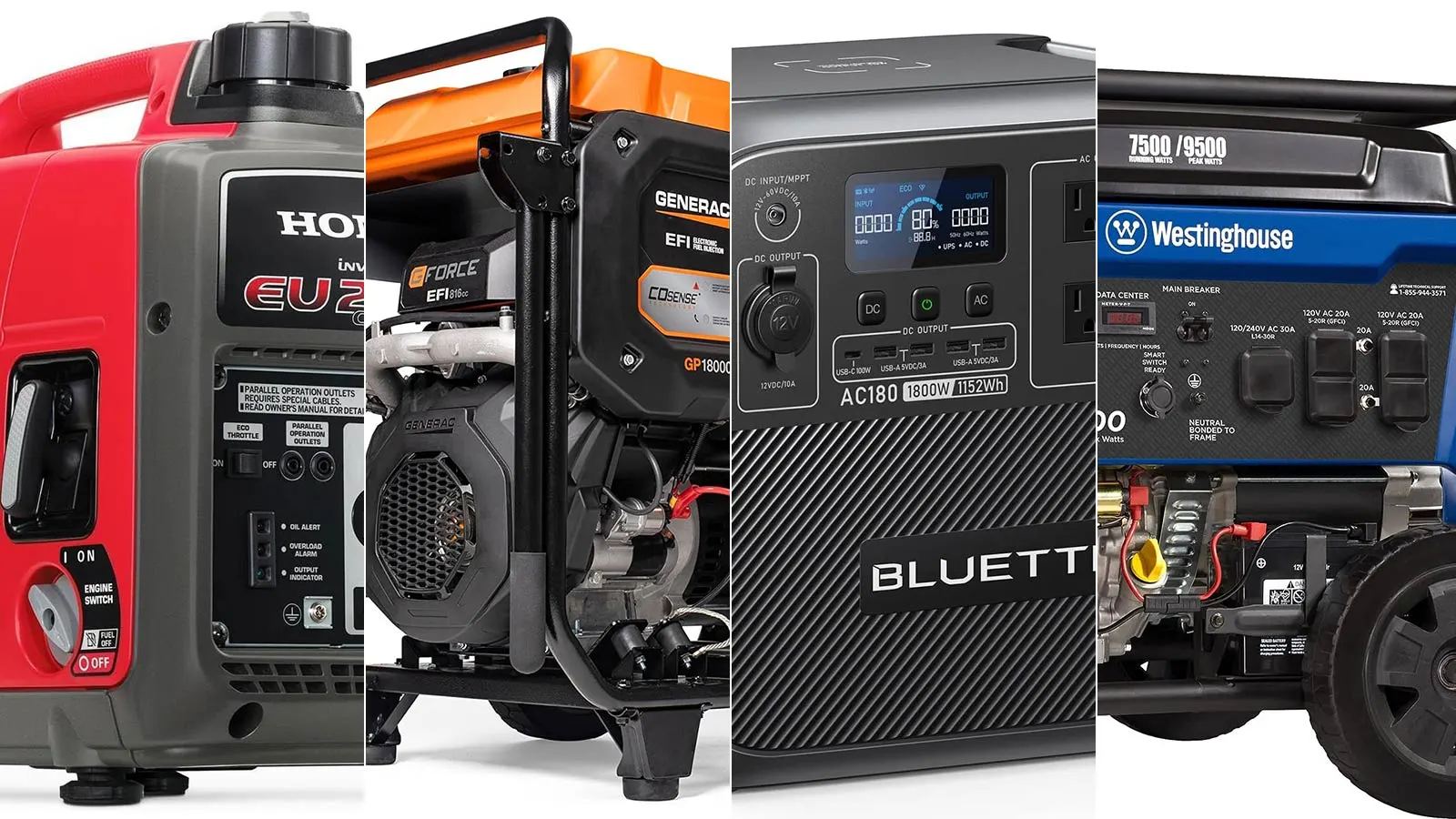

A refrigerator, sump pump, furnace, or air conditioner can turn a short outage into a serious problem. The hard part is choosing a generator that can start those loads without becoming too heavy, loud, or complicated to use. The Best portable generators in this guide range from 39-pound inverter models for electronics and camping to large dual-fuel machines intended to keep much of a home running.
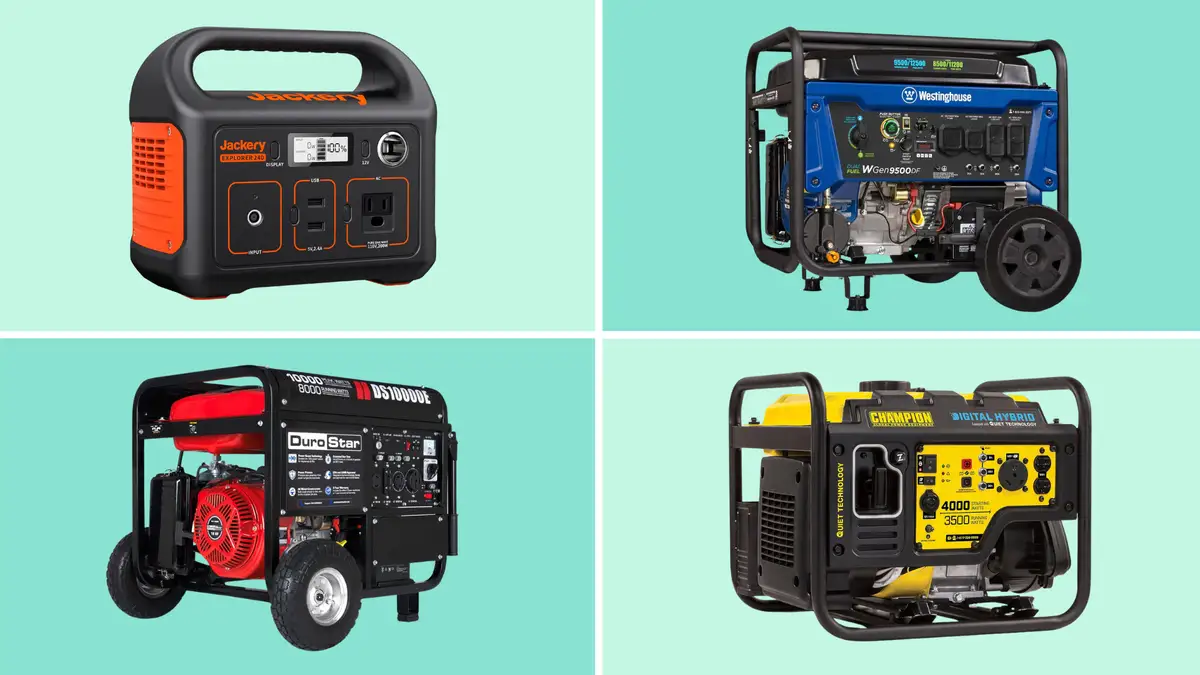
The Westinghouse 12500 Watt Dual Fuel is our top pick because it combines substantial output, remote starting, useful 120/240V outlets, and a practical dual-fuel design. The rest of the list includes quieter inverter generators, tri-fuel models for homes with natural gas, and smaller options for RVs and essential devices.
Comparison table
| # | Product | Award | Output | Fuel | Weight | Best for |
|---|---|---|---|---|---|---|
| 1 | Westinghouse 12500 Watt Dual Fuel | Best overall | 9, 500 running, 12, 500 peak watts on gas | Gasoline, propane | 210 pounds | Whole-home backup |
| 2 | DuroStar DS13000MX | Best heavy-duty build | 13, 000 watts | Gasoline, propane | 220 pounds | Storm preparedness |
| 3 | WEN DF680iX | Best inverter for RVs | 5, 100 running, 6, 800 surge watts on gas | Gasoline, propane | 99.2 pounds | RVs and EV support |
| 4 | DuroMax XP13000EH | Best rugged option | 13, 000 watts | Gasoline, propane | 234 pounds | Jobsites and home backup |
| 5 | Westinghouse 6500 Watt Dual Fuel | Best mid-size backup | 5, 300 running, 6, 500 peak watts on gas | Gasoline, propane | 135.6 pounds | Essential home circuits |
| 6 | Oxseryn 4400 Watt Inverter | Best lightweight open-frame model | 3, 400 running, 4, 400 peak watts | Gasoline | 56 pounds | RV camping |
| 7 | SIOKIUU 2500W Inverter | Best quiet compact model | 1, 900 running, 2, 500 peak watts | Gasoline | 39.46 pounds | Camping and electronics |
| 8 | Westinghouse 13500 Watt Tri-Fuel | Best tri-fuel capacity | 10, 500 running, 13, 500 peak watts on gas | Gasoline, propane, natural gas | 230 pounds | Long home outages |
| 9 | Generac 12500 Watt Tri-Fuel | Best voltage regulation | 9, 500 running, 12, 500 starting watts | Gasoline, propane, natural gas | 219 pounds | Sensitive home loads |
| 10 | WEN 56235i | Best ultra-light inverter | 1, 900 rated, 2, 350 surge watts | Gasoline | 39 pounds | Small loads and travel |
1. Westinghouse 12500 Watt Dual Fuel: Best Overall
Pros
- Strong 9, 500-watt continuous output on gasoline
- Remote, electric, and recoil starting
- 120/240V outlets include a 50A RV-ready connection
- Digital display reports voltage, frequency, and hours
Cons
- Heavy at 210 pounds
- Conventional generator design is louder and bulkier than an inverter
- Large fuel tank adds to the overall footprint
Best for: homeowners who want a capable dual-fuel generator for broad backup coverage.
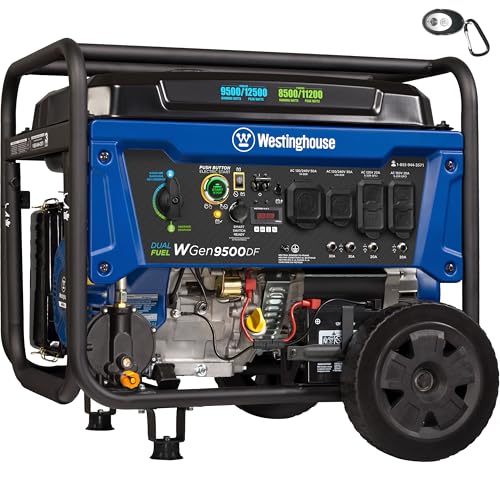
The first thing to know about the Westinghouse 12500 Watt Dual Fuel is that it is a serious piece of equipment, not a generator you casually carry to a campsite. Its wheels and frame make repositioning possible, but at 210 pounds it is best treated as a planned home-backup appliance. Once it is in a suitable outdoor location, the remote key fob makes starting it much less of a chore during a storm.
On gasoline, the 457cc four-stroke OHV engine produces 9, 500 running watts and 12, 500 peak watts. That distinction matters when a refrigerator, pump, or other motor starts and briefly demands more power than it uses continuously. Propane output drops to 8, 500 running watts and 11, 200 peak watts, but having both fuels gives you more flexibility when one supply is inconvenient. The 6.6-gallon tank is rated for up to 12 hours of runtime, though actual runtime depends on the connected load.
The outlet selection is unusually useful for a portable home generator. Two GFCI-covered 120V household receptacles handle ordinary extension cords, the L14-30R outlet is ready for a transfer-switch connection, and the 14-50R outlet supports 120/240V use and RV connections. The VFT display showing voltage, frequency, and lifetime hours is more informative than a simple light, especially when checking the generator before an outage. Automatic low-oil shutdown adds another layer of engine protection.
Compared with the smaller Westinghouse 6500 Watt Dual Fuel, this model has enough headroom for more circuits and larger startup loads. It also avoids the natural-gas limitation of the Westinghouse 13500 Watt Tri-Fuel, since its two-fuel setup is simpler. The weakness is its conventional open-frame format. If you need quieter operation near a campsite or want to power sensitive electronics with an inverter, the WEN DF680iX or SIOKIUU 2500W Inverter is a better fit.
The Westinghouse 12500 Watt Dual Fuel is the generator we would choose for a homeowner who wants broad capability without moving into an even larger tri-fuel chassis. Plan the outdoor placement carefully, arrange the transfer-switch installation with a qualified electrician, and this is the most balanced choice here.
2. DuroStar DS13000MX: Best Heavy-Duty Build

Pros
- 13, 000 watts of stated output
- Dual-fuel operation with a front-facing selector
- Remote electric start
- Steel construction and 50A transfer-switch-ready outlet
- Automatic carbon monoxide shutdown
Cons
- Weighs 220 pounds
- Conventional design is not the quietest choice
- Less flexible than a tri-fuel generator
Best for: storm preparation when rugged construction and high output matter most.
The DuroStar DS13000MX takes the familiar large-frame generator approach and leans into durability. Its all-metal construction and reinforced power panel should appeal to anyone who expects the machine to live in a garage, move around a jobsite, or be pulled out for difficult weather rather than occasional light camping. At 220 pounds, it is firmly in the rollable category, so moving it will take a clear path and a little planning.
DuroStar lists 13, 000 watts of output and supports gasoline or propane. The appeal of dual fuel is not just the ability to choose between two fuels. Gasoline is useful when you need the generator's full capability, while propane can be easier to store for emergency use and can keep the machine running when gasoline supplies are limited. The front-facing selector makes changing fuel types more straightforward than reaching around the frame.
A push-button electric start simplifies startup, and the 50A outlet is the connection to pay attention to if you are planning a properly installed transfer switch. The generator also includes a CO Alert system that shuts it down when dangerous carbon monoxide levels are detected. That safety system does not make indoor operation acceptable. It still needs to run outdoors, far from doors, windows, and vents.
The DS13000MX is a close alternative to the DuroMax XP13000EH. Both are large dual-fuel generators with all-metal construction, electric starting, and whole-home backup ambitions. The DuroMax has a longer list of mobility and winding details, while the DuroStar offers a similarly direct control layout and a slightly lighter frame. The Westinghouse 12500 Watt Dual Fuel remains easier to recommend for its more informative display and clearly specified outlet mix.
This is not the model for someone who wants a compact generator for an RV or a quiet unit for a neighborhood campsite. It is a better match for a homeowner who values a sturdy frame, high output, and a simple fuel choice. Anyone considering it should also confirm that the home's transfer-switch setup matches the generator's outlet and electrical requirements.
3. WEN DF680iX: Best Inverter for RVs
Pros
- Inverter design in a manageable 99.2-pound body
- Dual-fuel operation
- RV receptacle and 120/240V outlet
- CO Watchdog and fuel shutoff
- Supports low-power Level 2 EV charging
Cons
- Less continuous output than the large home-backup models
- Still heavy for one-person carrying
- EV charging capability is limited to low-power use
Best for: RV owners who want cleaner inverter power and more output than a small camping generator.
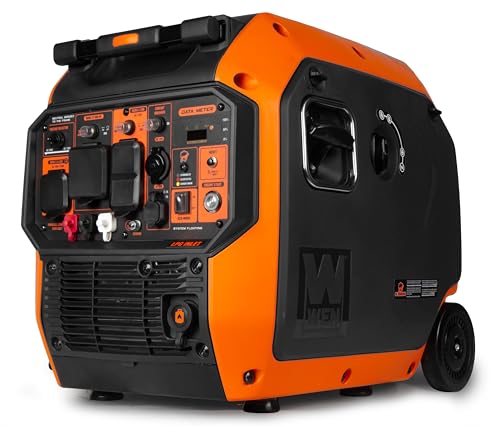
The WEN DF680iX occupies the most useful middle ground in this group. It is too large to call effortless to carry, but its 99.2-pound weight is far more manageable than the 200-plus-pound home-backup machines. The telescoping pull handle and onboard wheels make it practical for an RV or a storage area where the generator cannot stay permanently staged.
This is an inverter generator, which changes the way it handles electronics and lighter loads. On gasoline, it produces 5, 100 rated watts and 6, 800 surge watts. Propane output is 4, 500 rated watts and 6, 000 surge watts. Those figures are not enough to match the Westinghouse 12500 Watt Dual Fuel for whole-home coverage, but they are well suited to RV equipment, appliances, lights, and selected emergency circuits.
The control panel is particularly well suited to mobile use. It includes an L14-30R 120/240V receptacle, two 120V three-prong outlets, an RV TT-30R outlet, a 12V DC receptacle, and two 5V USB ports. Its bonded-neutral 240V configuration is also designed for low-power Level 2 charging of battery and hybrid electric vehicles. That is a specialized feature, and buyers should confirm the vehicle and charging setup before relying on it.
WEN adds a CO Watchdog sensor that shuts the generator down if carbon monoxide reaches dangerous levels. The fuel shutoff is just as useful for storage because it uses the remaining fuel in the carburetor before the engine stops. That can reduce stale-fuel problems during long periods between uses. The three-year warranty is reassuring, though routine fuel and maintenance planning still matter.
The main compromise is capacity. The Westinghouse 6500 Watt Dual Fuel has more conventional home-backup output, while the WEN is quieter and easier to place around an RV. The WEN DF680iX makes sense for the buyer who wants inverter behavior, dual-fuel flexibility, and a real RV receptacle in one machine, not for someone trying to power every major appliance in a large home.
4. DuroMax XP13000EH: Best Rugged Option

Pros
- 13, 000-watt class output
- Push-button start and front-facing fuel controls
- 50A transfer-switch-ready outlet
- All-metal frame and power panel
- No-flat tires for easier relocation
Cons
- Heaviest model in this group at 234 pounds
- Conventional generator noise and footprint
- Dual fuel only, without natural-gas support
Best for: demanding home or jobsite use where a tough chassis matters more than compact size.
The DuroMax XP13000EH is built around the idea that a generator should survive being moved, stored, and used in unpleasant conditions. Its steel-tube frame and all-metal power panel avoid plastic parts, and the no-flat tires are a practical touch when the route from storage to the operating location includes rough ground. That ruggedness comes with a clear tradeoff: at 234 pounds, this is not a casual lift.
Its headline capacity is 13, 000 watts, enough to put it in the same broad class as the DuroStar DS13000MX and Westinghouse 13500 Watt Tri-Fuel. It runs on gasoline or propane, with a front-facing interface that makes the fuel change quick to access. Electric starting handles the normal startup, while the heavy-duty engine and copper windings are intended for sustained use.
The 50A outlet is the key connection for whole-home backup planning, and the control panel has a wide variety of outlets for other equipment. A transfer switch remains essential for safe home connection. Plugging a generator directly into a home outlet is not a substitute for a proper transfer-switch installation, regardless of the generator's capacity.
The XP13000EH has a stronger mobility story than the DuroStar DS13000MX, but it is heavier and less compact than the Westinghouse 12500 Watt Dual Fuel. It also lacks the WEN DF680iX's inverter design, so RV users who prioritize quieter operation and cleaner power have better alternatives. For a worksite or a home where the generator may face frequent relocation, the DuroMax's frame and tires are more compelling than its sheer wattage alone.
Skip this model if one person must regularly carry the generator or if natural gas is part of your backup plan. Choose it when durability, high output, and a broad outlet selection matter more than easy storage. It is a substantial machine for buyers who would rather overbuild the backup system than find themselves short on starting capacity.
5. Westinghouse 6500 Watt Dual Fuel: Best Mid-Size Backup

Pros
- More compact than the large whole-home models
- Gasoline and propane operation
- 30A transfer-switch and RV-ready outlets
- CO and low-oil shutdown
- Fuel gauge and 120/240V selector
Cons
- Not enough output for every large appliance at once
- Weighs 135.6 pounds
- No remote start listed
Best for: essential-circuit backup in a smaller home or apartment setup.
The Westinghouse 6500 Watt Dual Fuel is a more sensible physical match for many homes than the biggest generators here. At 135.6 pounds, it still needs wheels and a clear operating area, but it takes up less space than the 200-pound class machines. Its role is not to run everything at once. It is for choosing the circuits that matter most, such as refrigeration, lighting, internet equipment, and selected heating or pumping loads.
On gasoline, the 274cc four-stroke OHV engine produces 5, 300 running watts and 6, 500 peak watts. Propane output is 4, 800 running watts and 5, 800 peak watts. The 4.7-gallon tank is rated for up to 14.5 hours, with runtime varying according to load. A 120/240V selector lets the owner configure the output for compatible equipment, but it does not increase the generator's total available power.
The outlet layout is straightforward. There is a 120V household duplex receptacle, an RV-ready TT-30R 30A outlet, and an L14-30R 30A outlet ready for a transfer-switch connection. Rubber outlet covers provide useful protection when the generator is outdoors. Westinghouse also includes oil, an oil funnel, a propane hose, a tool kit, and a wheel kit, which reduces the amount of setup work before the first planned use.
Compared with the Westinghouse 12500 Watt Dual Fuel, this model gives up output and remote starting but is easier to accommodate. Compared with the Oxseryn 4400 Watt Inverter, it offers more backup capacity and a more direct transfer-switch path, though the Oxseryn is much lighter and uses an inverter design. That makes the choice less about a single number and more about whether the generator will serve a home panel or travel with an RV.
The absence of a listed remote start is its most noticeable convenience limitation. It is also not the right choice if your backup plan includes several high-draw appliances running together. For essential circuits and a manageable dual-fuel chassis, though, it is one of the clearest fits in the lineup.
6. Oxseryn 4400 Watt Inverter: Best Lightweight Open-Frame Model

Pros
- 56-pound portable design
- 3, 400 running watts and 4, 400 peak watts
- ECO mode and fuel gauge
- RV outlet plus 12V DC output
- Up to 14 hours at 25 percent load
Cons
- Gasoline only
- Open-frame design is less enclosed than compact inverters
- Output is limited for whole-home backup
Best for: RV trips and light emergency use when portability is a priority.
The Oxseryn 4400 Watt Inverter is the kind of generator people are more likely to move before they need it. At 56 pounds, it is still a two-handed lift for many users, but it is dramatically easier to load, store, and position than the larger home-backup units. Its open-frame layout helps explain the relatively small footprint, though it does not have the enclosed shape associated with the quietest camping inverters.
The generator produces 3, 400 running watts and 4, 400 peak watts. That is enough for many RV applications and selected home essentials, but not a full set of large household loads. The 2-gallon fuel tank is rated for up to 14 hours at 25 percent load when ECO mode is active. That light-load figure is important because runtime falls as the connected demand rises.
Output options include two 120V AC ports, a 12V DC port, and an RV port. The fuel gauge gives a quick read of the remaining gasoline, which is useful when the generator is operating away from the house. The product is gasoline powered only, so there is no propane option for storage flexibility or fuel switching during an outage.
The SIOKIUU 2500W Inverter is lighter and quieter, but it has considerably less continuous output. The WEN DF680iX has more capacity and dual-fuel capability, but it is nearly twice the weight. Oxseryn sits between those two ideas, offering enough output for more demanding RV equipment without becoming a large home generator.
The stated noise level is under 72 dBA from 23 feet, so this is not the first model we would choose for a quiet campsite. It is also not a transfer-switch-focused whole-home solution. Buyers who need a movable generator for an RV, tools, lights, or a small collection of essential devices should find its balance more useful than its peak-watt figure suggests.
7. SIOKIUU 2500W Inverter: Best Quiet Compact Model

Pros
- 39.46-pound body with carrying handle
- Quiet operation rated under 59 dBA
- Clean inverter output with less than 3 percent THD
- CO sensor and ECO mode
- Long light-load runtime
Cons
- Gasoline only
- 1, 900 running watts limits appliance choices
- Not intended for whole-home backup
Best for: campers and households that need quiet power for electronics and small appliances.
The SIOKIUU 2500W Inverter is small enough to carry without wheels, which changes where it can be used. At 39.46 pounds, it is suited to camping, outdoor work, and emergency charging when a large wheeled generator would be excessive. Its rated noise level of under 59 dBA from 23 feet also makes it a more considerate choice around other campers.
Its 80cc four-stroke engine produces 1, 900 running watts and 2, 500 peak watts. That is a good match for laptops, televisions, lights, fans, phones, cameras, and small tools, but the limited continuous capacity means you need to plan around startup demands. The inverter output is listed at less than 3 percent THD, which is the type of specification that matters when connecting sensitive electronics.
Runtime is rated at up to 17 hours at 25 percent load or 8.6 hours at 50 percent load from the 1.06-gallon tank. Those figures show why load planning matters. ECO mode can help when the generator is only charging devices or running a few small loads, while heavier demand naturally reduces the time between refueling.
A CO sensor automatically shuts the unit down when carbon monoxide becomes too high, and a three-year warranty with lifetime technical support is included. These features improve ownership confidence, but they do not change the basic safety rule that gasoline generators must operate outdoors with generous clearance from openings. The unit's small size should never tempt anyone to use it indoors.
The WEN 56235i has the same 1, 900-watt rated output and is also 39 pounds, making it a close alternative. The SIOKIUU offers a lower stated noise figure and longer light-load runtime, while the WEN provides fuel shutoff and a clearly specified outlet set. Choose the SIOKIUU when quiet operation and carrying weight come first, and skip it if you need to run a refrigerator, pump, or heating system with substantial startup demand.
8. Westinghouse 13500 Watt Tri-Fuel: Best Tri-Fuel Capacity

Pros
- Runs on gasoline, propane, or natural gas
- 13, 500 peak watts on gasoline
- Remote, electric, and recoil starting
- Up to 19 hours from the 9.5-gallon tank
- 50A RV-ready outlet and 30A transfer-switch outlet
Cons
- Weighs 230 pounds
- Large footprint
- Natural-gas output is lower than gasoline output
Best for: homeowners who want multiple fuel choices during extended outages.
The Westinghouse 13500 Watt Tri-Fuel is the most flexible generator here when fuel availability is the central concern. It can run on gasoline, propane, or natural gas, so a homeowner with a suitable natural-gas connection has a way to reduce dependence on stored liquid fuel. That flexibility adds setup considerations, but it can be valuable during a prolonged outage.
Gasoline output is 10, 500 running watts and 13, 500 peak watts. Propane produces 9, 500 running watts and 12, 500 peak watts, while natural gas produces 8, 500 running watts and 10, 000 peak watts. Those differences are substantial enough that buyers should size their expected loads around the chosen fuel rather than assuming the headline figure applies in every mode.
The 9.5-gallon tank is rated for up to 19 hours, and the generator includes a fuel gauge for quick checks. Remote electric start is available through the included key fob, with recoil start as another option. The 500cc OHV engine has a cast iron sleeve, automatic low-oil and CO shutdown, and a digital hour meter that helps track use and maintenance.
For connections, there are two GFCI 120V household receptacles, an L14-30R 30A transfer-switch-ready outlet, and a 14-50R 120/240V RV-ready outlet. Rubber covers are useful for outdoor operation. The Westinghouse 12500 Watt Dual Fuel is smaller and simpler, while the Generac 12500 Watt Tri-Fuel offers automatic voltage regulation and a more detailed maintenance schedule. The Westinghouse wins when maximum fuel flexibility and long gasoline runtime are the priority.
At 230 pounds, this generator needs a permanent staging plan and a safe, accessible outdoor operating location. It is also more generator than most campers need. Choose it for a home with substantial loads and a realistic natural-gas or propane backup plan, not merely because tri-fuel sounds versatile.
9. Generac 12500 Watt Tri-Fuel: Best Voltage Regulation

Pros
- Gasoline, propane, and natural-gas support
- Automatic voltage regulation
- Electric start with included 12V battery
- COsense shutdown system
- 120/240V 30A and 50A outlets
Cons
- Heavy at 219 pounds
- Natural-gas runtime depends on an available connection
- Larger than needed for light portable use
Best for: homeowners who want tri-fuel operation with stabilized output for varied loads.
The Generac 12500 Watt Tri-Fuel focuses on the details that matter when a generator is connected to a mix of household equipment. Automatic voltage regulation continuously stabilizes output, which is useful for motor-driven tools, pumps, and appliances that do not respond well to inconsistent voltage. It is still a conventional portable generator, but its electrical management gives it a more considered role in home backup.
On gasoline, the 500cc OHV engine produces 9, 500 running watts and 12, 500 starting watts. Generac specifically describes the starting capacity as useful for high-surge loads such as air conditioners, sump pumps, and power tools. Propane and natural gas are also supported through a simple fuel selection process, with output and runtime depending on the selected fuel.
The 7.5-gallon tank is rated for up to 14 hours at 25 percent load or 9.5 hours at 50 percent load on gasoline. Natural gas can provide virtually unlimited runtime when connected to a suitable line, but that depends on the home's installation and local conditions. An onboard fuel gauge, electric start, and included battery make normal operation less demanding.
The outlet selection covers two 120V 20A GFCI duplex outlets, a 120/240V 30A twist-lock outlet, and a 120/240V 50A outlet. The steel-tube cradle, folding handle, and 9.5-inch never-flat wheels help with relocation, although 219 pounds still makes this a two-person planning job in many situations. Generac also specifies a first oil change at 20 hours, followed by changes every 100 hours, which is useful guidance for owners preparing a maintenance schedule.
The Westinghouse 13500 Watt Tri-Fuel produces more peak output and has a larger fuel tank, while the Generac counters with automatic voltage regulation and a clear service schedule. The Westinghouse 12500 Watt Dual Fuel is simpler if natural gas is not part of the plan. Pick the Generac when tri-fuel flexibility and regulated output are more important than keeping the generator as compact as possible.
10. WEN 56235i: Best Ultra-Light Inverter

Pros
- Only 39 pounds
- Quiet inverter design
- 1, 900 rated watts for electronics and small appliances
- Fuel shutoff for storage
- USB and 12V outputs
Cons
- Gasoline only
- No CO sensor is listed in the provided features
- Limited output for motor-heavy appliances
Best for: anyone who needs a lightweight source of clean power for small loads.
The WEN 56235i is the easiest generator in this group to store and carry. Its 39-pound body is compact enough for a vehicle, closet, or camping setup, and the inverter design is intended to provide clean power for phones, tablets, televisions, computers, and similar electronics. It is not a miniature whole-home system, and treating it as one would lead to disappointment.
The generator produces 1, 900 rated watts and 2, 350 surge watts. That gives it enough capacity for small appliances and charging equipment, but not the large startup loads that define the 13, 000-watt class. A refrigerator may be possible depending on its starting demand and what else is connected, while air conditioners, electric heaters, and pumps require careful load calculations or a larger machine.
WEN lists two three-prong 120V receptacles, one 12V DC receptacle, and two 5V USB ports. Fuel shutoff uses the remaining fuel in the carburetor before shutdown, an important storage feature for a generator that may sit unused between trips or outages. The product is gasoline powered and does not offer the dual-fuel flexibility of the WEN DF680iX.
The WEN 56235i is closely matched to the SIOKIUU 2500W Inverter in weight and running output. SIOKIUU lists a CO sensor and a lower noise figure, while this WEN emphasizes fuel shutoff and a straightforward output layout. The SIOKIUU is the stronger pick for quiet camping, but the 56235i remains a sensible compact choice for electronics and modest emergency loads.
Skip it if your backup plan centers on a transfer switch or several large appliances. Choose it when carrying effort, storage space, and clean inverter power matter more than maximum capacity. This is the portable generator to keep ready for small, clearly defined jobs.
How to choose best portable generators
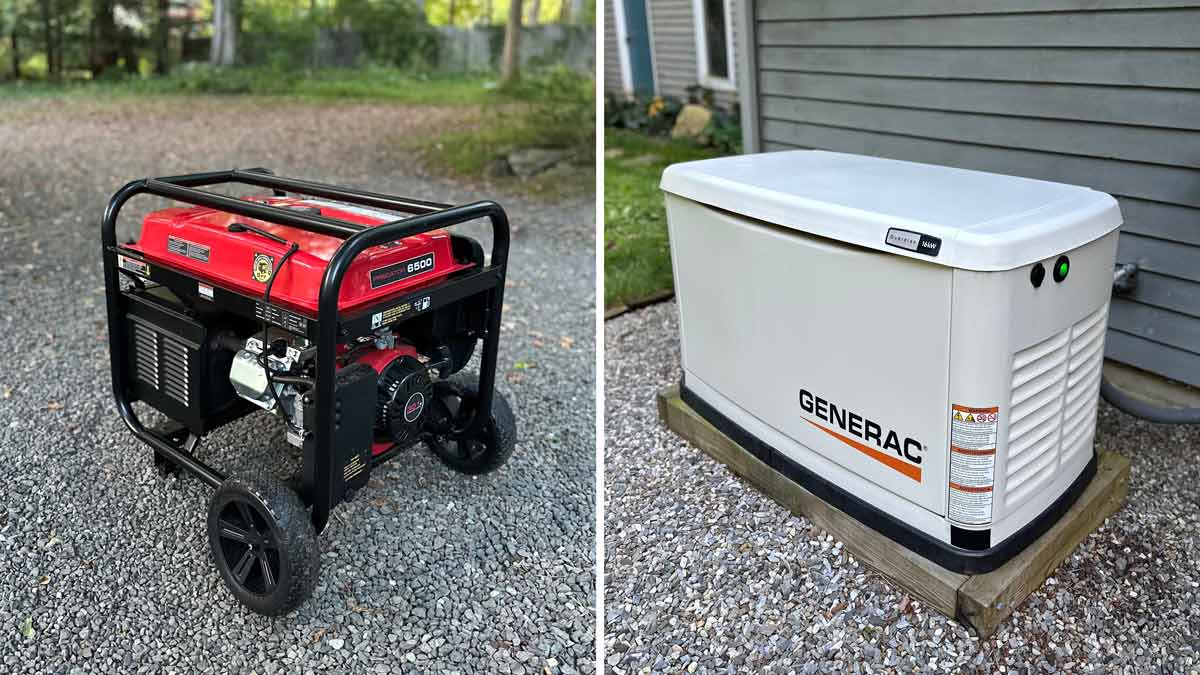
The right generator depends on the loads you need to run, the fuel you can store or connect, and how often you will move the machine. These are the factors that separate a useful backup system from an oversized or underpowered purchase.
Running and starting watts
Running watts describe the power a generator can provide continuously. Starting or peak watts cover the brief surge required by motors in refrigerators, pumps, air conditioners, and power tools.
Write down the running demand of every device you expect to use, then account for the largest startup surge that may occur at the same time. A generator such as the Westinghouse 12500 Watt Dual Fuel has substantial headroom, while the SIOKIUU 2500W Inverter is intended for electronics, lights, and smaller appliances.
Size a generator around the loads that start together, not the number printed largest on the box.
Fuel configuration
Gasoline is common and usually provides the highest listed output. Propane can be stored for emergencies and may be convenient when gasoline is unavailable. Tri-fuel models add natural gas, which can be useful for extended home outages when a suitable connection is already available.
Fuel choice changes output on several models. The Westinghouse 13500 Watt Tri-Fuel, for example, lists different running and peak figures for gasoline, propane, and natural gas. Read the figures for the fuel you are most likely to use rather than relying on the gasoline headline.
Inverter design
Inverter generators produce electronically managed power and are generally better suited to sensitive electronics. They also tend to be quieter and more compact, although large inverter models can still be heavy.
The WEN DF680iX brings inverter operation to a higher-output RV-focused design. The SIOKIUU 2500W Inverter and WEN 56235i are much lighter, but their lower running wattage limits the appliances they can support. Conventional models such as the DuroMax XP13000EH are usually the better match for large home loads.
Outlets and transfer-switch compatibility
Look for the outlets that match your actual equipment. An RV receptacle, household 120V outlets, a 30A twist-lock, and a 50A outlet each serve different purposes. A 120/240V selector can also matter for compatible tools and appliances.
A generator cannot safely power a home's wiring through an ordinary wall outlet. If home circuits are part of the plan, have a qualified electrician install a compatible transfer switch. Readers planning a more permanent backup setup may also want to compare the generator features that matter most for home use.
Portability, runtime, and noise
Weight is often the deciding factor. The WEN 56235i weighs 39 pounds, while the Westinghouse 13500 Watt Tri-Fuel weighs 230 pounds. Wheels and handles help, but they do not make a large generator easy to lift into a vehicle or move over stairs.
Runtime figures are usually tied to a light or moderate load, so do not assume the longest advertised time applies while running several appliances. Noise also varies sharply. The SIOKIUU is listed under 59 dBA from 23 feet, while the open-frame Oxseryn is listed under 72 dBA from the same distance.
Carbon monoxide protection
CO sensors and automatic shutdown systems are useful safety features, but they are not permission to run a gasoline generator indoors, in a garage, or near open windows. Place the generator outdoors, away from openings, and follow the manufacturer's clearance instructions.
A safety sensor is one part of the setup. Carbon monoxide alarms inside the home, correct extension cords, dry placement, and a clear refueling procedure matter just as much.
Frequently asked questions
What size portable generator is needed for a house?
That depends on which circuits you want to operate and the starting demands of their appliances. A 5, 000 to 6, 500-watt generator can suit selected essential circuits, while larger homes with pumps, heating equipment, or air conditioning may need a generator in the 9, 000-watt class or above. Add running watts and account for motors starting together before choosing.
Are dual-fuel generators better than gasoline-only models?
Dual-fuel generators offer more flexibility because they can run on gasoline or propane. Gasoline often provides the higher listed output, while propane can be convenient to store for emergencies. A dual-fuel model is not automatically better if you only need a small, lightweight generator for electronics.
What is the difference between an inverter generator and a conventional generator?
An inverter generator electronically produces and regulates its output, making it a strong fit for sensitive electronics and quieter operation. Conventional open-frame generators are often larger and better suited to high-output home or jobsite use. The WEN DF680iX shows that inverter models can reach useful RV capacity, but small inverter models still have limited wattage.
Can a portable generator power a whole house?
A sufficiently powerful generator can support many home circuits when connected through a properly installed transfer switch. It may not run every appliance at once, especially electric heating, central air conditioning, and large pumps. A qualified electrician should assess the panel, transfer equipment, and expected loads.
How far should a generator be from the house?
The provided product information does not specify one universal clearance distance for every model. Follow the manual for the exact generator and place it outdoors, away from doors, windows, vents, and other openings. Never operate a gasoline generator inside a home, garage, shed, or other enclosed area.
Do portable generators need maintenance?
Yes. Check oil, fuel condition, connections, and the battery or starting system before an outage. Fuel shutoff systems such as those on the WEN DF680iX and WEN 56235i help clear fuel from the carburetor before storage, but they do not eliminate all maintenance.
Is natural gas useful in a portable generator?
Natural gas can be useful during a long outage because it may provide a continuous fuel source when a suitable line and connection are available. Output is often lower than with gasoline, and installation requirements vary. The Westinghouse 13500 Watt Tri-Fuel and Generac 12500 Watt Tri-Fuel are the models here designed for gasoline, propane, and natural gas.
The bottom line
The Best portable generators in this group start with the Westinghouse 12500 Watt Dual Fuel. Its 9, 500 running watts on gasoline, 120/240V outlets, remote starting, digital display, and dual-fuel operation make it the strongest all-around choice for planned home backup. The WEN DF680iX is the better alternative for RV owners or anyone who wants inverter power in a substantially smaller package.
For tri-fuel flexibility, choose the Westinghouse 13500 Watt Tri-Fuel if maximum capacity and long gasoline runtime matter most, or the Generac 12500 Watt Tri-Fuel if automatic voltage regulation and a defined maintenance schedule are more important. For camping and electronics, the SIOKIUU 2500W Inverter and WEN 56235i are far easier to carry than the large home models.
If you are undecided, choose the smallest generator that safely handles your largest starting load, then confirm the fuel, outlet, and transfer-switch requirements before ordering.
As an Amazon Associate we earn from qualifying purchases.