

A power station is easy to misunderstand until the electricity goes out and you need to keep a refrigerator, CPAP machine, laptop, or phone alive. Capacity tells you how long the battery can run something, while output determines what it can start in the first place. Those are separate decisions.
Our Best power station picks range from the featherweight DaranEner for phones and laptops to the Jackery HomePower 3600 Plus for serious household backup. The Jackery Explorer 1000 v2 is the best all-around choice, while EcoFlow's Delta 3 Classic is the stronger alternative for UPS use and fast charging.
Comparison table
| # | Product | Award | Capacity | AC output | Weight | Best for |
|---|---|---|---|---|---|---|
| 1 | Jackery Explorer 1000 v2 | Best overall | 1, 070Wh | 1, 500W | 23.8 lb | Camping and general backup |
| 2 | EcoFlow Delta 3 Classic | Best UPS | 1, 024Wh | 1, 800W | 26.7 lb | Home-office backup |
| 3 | BLUETTI Elite 30 V2 | Best compact generator | 288Wh | 600W | 9.5 lb | Short trips and CPAP use |
| 4 | Anker SOLIX S2000 | Best long-runtime backup | 2, 010Wh | 1, 500W | 35.7 lb | Refrigerator backup |
| 5 | Anker SOLIX C1000 Gen 2 | Best fast-charging 1kWh model | 1, 024Wh | 2, 000W | 24.9 lb | Camping and remote work |
| 6 | Anker SOLIX C1000 | Best proven 1kWh option | 1, 056Wh | 1, 800W | 27.6 lb | Outages and RV use |
| 7 | DaranEner Portable Power Station | Best lightweight option | 192Wh | 300W | 5.73 lb | Phones, laptops, and lights |
| 8 | Anker SOLIX C300 | Best small USB-C hub | 288Wh | 300W | 9.1 lb | Camera and laptop kits |
| 9 | BLUETTI Elite 100 V2 | Best quiet 1kWh model | 1, 024Wh | 1, 800W | 25 lb | Indoor backup |
| 10 | Jackery HomePower 3600 Plus | Best whole-home capacity | 3, 584Wh | 3, 600W | 77.16 lb | Extended home outages |
1. Jackery Explorer 1000 v2: Best Overall

Pros
- Strong 1, 500W continuous output
- 1, 070Wh capacity in a 23.8-pound body
- Emergency charging can reach full capacity in one hour
- Quiet overnight charging mode
- Useful selection of AC, USB, and DC ports
Cons
- One-hour charging must be enabled in the app
- Solar panels are not included
- Solar charging works only with Jackery panels
Best for: someone who wants one portable unit for camping, travel, and routine outage backup.
The Jackery Explorer 1000 v2 gets the fundamentals right without becoming a chore to move. Its 23.8-pound weight and foldable handle make it practical to carry from a car to a campsite or from a closet to the kitchen. The 1, 070Wh battery is large enough for meaningful backup, yet the unit remains much more manageable than the two-kilowatt-hour models lower on this list.
Its 1, 500W pure sine wave AC output handles the appliances most people actually want to keep running during an outage, and the 3, 000W surge rating gives motors and compressors extra startup headroom. Three AC outlets sit alongside two USB-C ports, a USB-A port, and a DC car port. The USB-C output reaches 100W, so many laptops can charge without their separate power brick.
Jackery's charging behavior is unusually flexible. The normal full charge takes 1.7 hours, which is intended to reduce battery strain, but emergency charging can cut that to one hour through the Jackery app. The app also provides a 30dB quiet overnight mode and an energy-efficiency mode. That combination makes the Explorer 1000 v2 easier to leave near a desk or bedside than a station that constantly runs its fans at full speed.
The LFP battery is rated to retain more than 70% of its original capacity after 4, 000 cycles, with a stated lifespan beyond 10 years. That is reassuring for a unit intended to spend most of its life waiting for a storm. The weakness is the solar ecosystem. The Explorer 1000 v2 is compatible only with Jackery solar panels, and a panel is not included. Buyers who want broader solar flexibility should look at the EcoFlow Delta 3 Classic or BLUETTI Elite 100 V2.
For most people, this is the Best power station because its weight, output, capacity, charging options, and controls are balanced rather than optimized around one narrow use. It is the model we'd keep for a mixed camping and emergency kit.
2. EcoFlow Delta 3 Classic: Best UPS

Pros
- 1, 800W output with 3, 600W surge capacity
- Under-10ms UPS switchover
- Reaches 80% charge in 45 minutes
- App includes schedules and backup modes
- Optional 500W solar input
Cons
- Not compatible with specified Delta 2 or Delta 3 extra batteries
- Heavier than the Jackery Explorer 1000 v2
- X-Boost behavior needs attention with demanding appliances
Best for: home-office users who need a quick transition to battery power during an outage.
The EcoFlow Delta 3 Classic is the most convincing choice here when uninterrupted operation matters more than carrying comfort. Its 26.7-pound frame is still portable, but the emphasis is clearly on keeping equipment running at home. The under-10ms UPS switch is designed for PCs, servers, medical equipment, and networking gear, reducing the chance of a sudden shutdown when the grid drops.
The 1, 024Wh battery is close to the Jackery's capacity, but the Delta 3 Classic raises continuous AC output to 1, 800W. Its 3, 600W surge rating gives it more starting headroom for refrigerators and other motor-driven appliances. EcoFlow also lists X-Boost support that can extend operation to loads up to 2, 600W, although buyers should treat that as a special operating mode rather than a replacement for the station's rated output.
Charging is one of its defining advantages. X-Stream AC charging reaches 80% in 45 minutes, and a compatible 500W solar panel can recharge the station in about 2.5 hours. The EcoFlow app adds charging schedules, usage monitoring, Storm Alert, and Self-Powered Mode. Those controls make more sense for a home backup setup than for a unit that is only taken outside a few weekends each year.
EcoFlow says the LiFePO4 cells are rated for more than 10 years of daily use and use an EV-grade cell-to-cell design with a battery management system. The key limitation is expansion compatibility. This model does not work with the Delta 2 Smart Extra Battery or the Delta 3 Series Smart Extra Battery, so anyone planning a larger modular setup should confirm the exact battery ecosystem before buying.
Compared with the Jackery Explorer 1000 v2, the Delta 3 Classic is heavier and less appealing as a grab-and-go camping unit, but it is more capable as a UPS and charges faster in normal use. It is the right pick for a home office, networking cabinet, or outage kit where a quick handoff matters.
3. BLUETTI Elite 30 V2: Best Compact Generator

Pros
- Very light 9.5-pound design
- 600W continuous output
- 1, 500W Power Lifting mode
- 10ms UPS support
- Fast AC charging
Cons
- 288Wh capacity limits long appliance runtime
- Power Lifting is not the same as a higher continuous output
- Solar panel is not included
Best for: campers and emergency-kit owners who need a light station for electronics and smaller appliances.
The BLUETTI Elite 30 V2 is the first model in this roundup that feels genuinely easy to carry with one hand. At 9.5 pounds, it is dramatically lighter than the 1kWh stations, and its 288Wh battery is enough for phones, lights, laptops, car refrigerators, and other modest loads. That makes it a sensible companion for a short trip where a large battery would spend more time being transported than used.
Its rated output is 600W, with a 1, 500W Power Lifting mode for certain resistive loads. That distinction matters. Power Lifting can help with equipment that behaves differently under reduced voltage, but it does not turn this into a 1, 500W general-purpose generator. BLUETTI specifically lists small kettles and toasters among possible uses, while the more predictable fit is lights, speakers, laptops, CPAP machines, and car fridges.
The Elite 30 V2 supports eight charging methods and accepts up to 380W of AC input. BLUETTI lists a 45-minute charge to 80% and a 70-minute full charge in its battery-safe mode. It also supports solar and car charging, giving road-trip users more than one way to refill it. The 10ms UPS feature is useful for a router or CPAP machine, though the small capacity still limits how long those devices can run.
BLUETTI says its UltraCell design and smart cooling system reduce consumption, with standby draw listed at 4.5W, DC draw at 5W, and AC draw at 8W. Those figures can help preserve runtime when the station is powering small electronics. The catch is straightforward: 288Wh disappears quickly with a heater, cooking appliance, or other sustained high load.
If your definition of the Best power station is the one that is easiest to bring along, this BLUETTI deserves attention. Choose it over the Anker SOLIX C300 when lower weight matters most and over the DaranEner when you need more AC output and UPS capability.
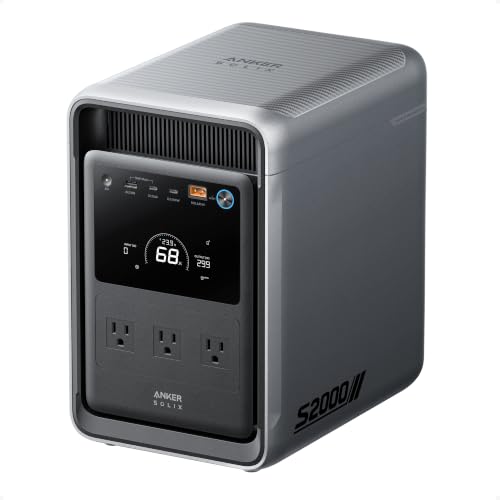
4. Anker SOLIX S2000: Best Long-Runtime Backup
Pros
- 2, 010Wh battery
- Up to 35 hours of refrigerator backup
- 10, 000-cycle LFP battery rating
- Eight front and rear outlets
- Under-10ms UPS switchover
Cons
- No 12V DC port
- 35.7 pounds is substantial for outdoor use
- AC output is lower than several similarly sized competitors
Best for: keeping a refrigerator and home-office equipment running through a longer outage.
The Anker SOLIX S2000 makes a different argument from the first three picks. Instead of chasing minimum weight, it puts 2, 010Wh of storage into a body that is still smaller than many two-kilowatt-hour stations. At 35.7 pounds, it is not something most people will carry far, but it is a practical size for moving between a garage, living room, and refrigerator.
Anker lists up to 35 hours of refrigerator backup, based on a 6W idle draw and higher efficiency than comparable systems. Actual runtime will depend heavily on the refrigerator, ambient temperature, and how often the compressor cycles, but the larger battery is the important point. It gives this model more reserve than the 1, 024Wh and 1, 070Wh stations when the outage lasts overnight or longer.
The S2000 provides 1, 500W of continuous output and 3, 000W peak output, enough for most everyday essentials. Eight outlets are split between the front and rear, which can make a semi-permanent setup neater. The rear outlets suit appliances that remain connected, while the front outlets keep phones and laptops accessible. There is no 12V DC port, however, so users with DC refrigerators or other car-style equipment should check their adapters carefully.
Its LFP battery is rated for 10, 000 cycles and a stated 15-year lifespan. The S2000 also supports six recharge methods, including up to 400W of solar input, AC plus solar, a generator, an alternator charger, and a car outlet. Under-10ms UPS switching gives it a clear home-office role, especially when the station will stay connected to a computer, router, or other always-on equipment.
The Jackery Explorer 1000 v2 is easier to transport, and the EcoFlow Delta 3 Classic offers more AC output in a smaller battery class. The Anker SOLIX S2000 wins when runtime is the priority. Skip it if your trips involve frequent carrying or if a 12V output is central to your setup.
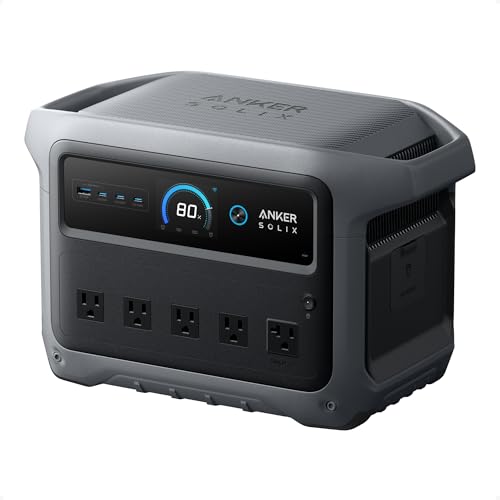
5. Anker SOLIX C1000 Gen 2: Best Fast-Charging 1kWh Model
Pros
- 2, 000W output with 3, 000W peak capacity
- Full recharge in 49 minutes with HyperFlash
- Ten ports
- 600W solar input
- Under-10ms UPS support
Cons
- HyperFlash requires the Anker app
- Solar charging requires suitable panels
- Heavier than the smallest 1kWh models
Best for: campers, remote workers, and outage planners who want high output in a mid-size battery.
The Anker SOLIX C1000 Gen 2 is built around speed. Its 1, 024Wh battery can fully recharge at up to 1, 600W in 49 minutes when HyperFlash is enabled, which is useful if a storm is approaching or a campsite stop is short. That feature is controlled through the Anker app, so the fastest mode is not simply a matter of plugging it in and walking away.
Output is unusually generous for this capacity class. The C1000 Gen 2 provides 2, 000W continuously and 3, 000W at peak, giving it more headroom than the Jackery Explorer 1000 v2 and the original Anker SOLIX C1000. Ten ports let it run several devices at once, while the 10ms UPS feature covers laptops and CPAP machines during a sudden power interruption.
Solar input reaches 600W, with a stated full solar recharge time of 1.8 hours. That is a strong fit for an off-grid setup, provided the solar array matches the station's input requirements. The app also includes TOU Mode for managing energy use and monitoring the station remotely. Those tools are particularly useful for a remote work setup where the battery may be left connected for long periods.
Anker rates its InfiniPower battery to retain at least 80% capacity after 4, 000 cycles, with a stated 10-year lifespan. The station is 14% smaller and 11% lighter than similar models, though its listed weight is still 24.9 pounds. It is portable in the practical sense, not in the backpack sense. The BLUETTI Elite 100 V2 is quieter, while the EcoFlow Delta 3 Classic has a more mature UPS-focused feature set.
The C1000 Gen 2 is for buyers who would rather reduce recharge waiting than shave every pound from the chassis. It is especially compelling for repeated camping trips, mobile work, and short outages where fast recovery matters.
6. Anker SOLIX C1000: Best Proven 1kWh Option

Pros
- 1, 056Wh capacity
- 1, 800W output and 2, 400W SurgePad peak
- Full AC charge in under an hour
- Up to 600W solar input
- App control and 11 ports
Cons
- Older battery cycle rating than the Gen 2 model
- Fast charging requires the app
- Nearly 28 pounds
Best for: home backup, camping, and RV users who need a capable 1kWh station with broad connectivity.
The original Anker SOLIX C1000 remains a capable middle ground. Its 1, 056Wh battery is slightly larger than the newer C1000 Gen 2, and the 1, 800W output handles a broad range of appliances. The 2, 400W SurgePad peak rating is designed to help with demanding loads, while 11 ports make it easy to charge a mixture of AC equipment, USB devices, and RV accessories.
Anker lists a charge to 80% in 43 minutes and a full charge in under an hour, but UltraFast mode must be enabled in the Anker app. The station accepts up to 600W of solar input and can fully recharge from solar in about 1.8 hours under the stated conditions. That combination works well for an outage kit that may alternate between wall charging and a solar panel.
The LiFePO4 battery is rated for 3, 000 cycles over a 10-year lifespan. That is a solid longevity claim, though it is lower than the Gen 2's listed 4, 000-cycle rating and the BLUETTI Elite 100 V2's more than 4, 000 cycles to 80% capacity. The C1000 is also 15% smaller than comparable 1kWh units, but its 27.59-pound weight makes it more suited to car camping than long walks.
The app lets you customize charging speed and monitor power statistics in real time. That is helpful when deciding which appliances can run together, but it also means some of the station's most important behavior is hidden behind a smartphone. Users who want a simpler manual experience may prefer the Jackery Explorer 1000 v2.
The C1000 Gen 2 has higher output, a lighter body, and a longer stated cycle rating, while this model has a little more capacity and remains a well-rounded choice. Pick the original when its combination of 11 ports, strong solar input, and established feature set fits your setup.
7. DaranEner Portable Power Station: Best Lightweight Option

Pros
- Only 5.73 pounds
- 300W pure sine wave output
- Two AC outlets
- 60W USB-C PD port
- Built-in LED with SOS mode
Cons
- 192Wh capacity is limited
- Cannot run high-power appliances
- Solar input is limited to 60W
Best for: carrying a small emergency battery for phones, laptops, lights, and cameras.
The DaranEner Portable Power Station is refreshingly honest about its role. At 5.73 pounds, it is the easiest model here to keep in a car, carry to a picnic table, or store beside an emergency kit. The 192Wh battery is not intended to power a refrigerator for a day. It is meant to keep smaller essentials alive without the bulk of a full-size station.
Its 300W pure sine wave output, with a 600W surge rating, supports phones, tablets, laptops, fans, lights, cameras, and CPAP machines within the output limit. Two AC outlets sit alongside a 60W USB-C PD port, two USB-A ports rated at 18W, and a 12V DC output. That selection is more useful than the capacity number alone suggests, particularly for a small camera or laptop kit.
The LiFePO4 battery is listed at more than 3, 500 cycles, and the battery management system protects against overcharging, overheating, and short circuits. Recharging can happen through a wall outlet at up to 100W, a car charger, or compatible solar input up to 60W. Solar panels and car charging cables are not included, so the small station is not a complete off-grid kit on its own.
The limitations are clear and should not be ignored. DaranEner says it is not suitable for rice cookers, hair dryers, mini-fridges, or other equipment above 300W or with high startup surges. The 192Wh capacity also means that sustained AC use will drain it quickly. The BLUETTI Elite 30 V2 costs more in practical capability, while the Anker SOLIX C300 provides more capacity and much stronger USB-C charging.
Still, this is a smart choice when carrying weight is the main concern. It is the Best power station in this group for a lightweight emergency bag, small electronics, and short outdoor trips, not for household appliance backup.
8. Anker SOLIX C300: Best Small USB-C Hub

Pros
- 288Wh capacity in a compact body
- Two 140W USB-C ports
- Eight charging ports
- 25dB operating noise
- 80% wall charge in 50 minutes
Cons
- 300W AC output limits appliance use
- Carry strap is sold separately
- Solar compatibility is restricted
Best for: photographers, laptop users, and travelers carrying several USB-C devices.
The Anker SOLIX C300 is shaped around modern electronics rather than kitchen appliances. Its 288Wh battery and 9.1-pound body make it portable enough for travel, hunting, and camping, while the two USB-C ports can each provide up to 140W. That is a meaningful advantage for laptops and high-draw camera equipment that would otherwise need a separate AC charger.
It also includes three 300W-total AC outlets, a 120W car socket, a 15W USB-C port, and a 12W USB-A port. The 300W AC output, with a 600W surge rating, is enough for small accessories and chargers but not for heating appliances or a refrigerator with a difficult startup load. The C300 is therefore more useful as a charging hub than as a miniature home generator.
Anker says it can reach 80% from a wall outlet in 50 minutes. It can also recharge through a car, solar panel, or its PD 3.1 USB-C port. Solar input is designed around a 100W panel, and Anker lists specific compatible panels while excluding several others. Buyers should check that detail before building a solar kit.
The C300 operates at a stated 25dB from 3.3 feet away, which should make it less intrusive in a tent or quiet room. Its LiFePO4 cells are rated for 3, 000 cycles and a decade of use, with smart temperature control and impact resistance. The optional strap could make it easier to carry, but it is sold separately, so the built-in shape is the main carrying method.
Compared with the BLUETTI Elite 30 V2, the C300 gives you a larger capacity and much better USB-C output, while the BLUETTI provides more AC output for small appliances. Choose the Anker when laptops, phones, cameras, and USB-C accessories are the center of the kit.
9. BLUETTI Elite 100 V2: Best Quiet 1kWh Model

Pros
- 1, 800W rated output
- 1, 024Wh capacity
- 30dB silent mode
- 70-minute full recharge
- 25-pound body with hidden handle
Cons
- Larger footprint than the Jackery Explorer 1000 v2
- Fast charging uses a high-power input
- App control may be more than casual users need
Best for: quiet overnight use, indoor backup, and camping with a full-size battery.
The BLUETTI Elite 100 V2 stands out when noise matters. Its silent mode is listed at 30dB, and the station's 25-pound body remains reasonable to move between a home office and a campsite. That makes it a strong alternative to the Jackery Explorer 1000 v2 for anyone who expects to sleep near the battery or use it in a quiet room.
The 1, 024Wh capacity and 1, 800W rated AC output put it in the same practical class as the EcoFlow Delta 3 Classic and Anker SOLIX C1000 Gen 2. BLUETTI adds an 2, 700W Power Lifting mode and 11 ports, so it can handle multiple smaller devices while still providing useful headroom for everyday appliances. The 10ms UPS feature is aimed at routers and PCs, not only outdoor equipment.
Charging is especially quick when using the 1, 200W TurboBoost AC input. BLUETTI says a full recharge takes about 70 minutes, while solar input can reach 1, 000W. That is a high solar ceiling for a 1kWh station, though actual performance depends on the panel array and conditions. The unit also supports fast car charging with the optional BLUETTI Charger 1.
The Elite 100 V2 uses LiFePO4 batteries rated for more than 4, 000 cycles to 80% capacity and a stated 10-year lifespan. Wi-Fi and Bluetooth app control provide remote monitoring, power management, and firmware updates. Its hidden handle helps portability, but the 17-liter form factor is less compact than the Jackery's 23.8-pound design and may occupy more shelf depth.
The Jackery is simpler and lighter, while the EcoFlow has particularly strong UPS software and fast AC charging. The BLUETTI is the one to choose when a quiet night, high solar input, and a strong 1kWh feature set matter more than the smallest footprint.
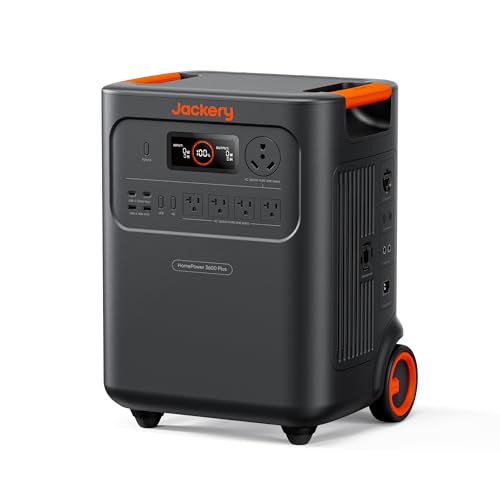
10. Jackery HomePower 3600 Plus: Best Whole-Home Capacity
Pros
- 3, 584Wh capacity
- 3, 600W AC output
- Expandable storage
- Dual-voltage operation when units are used in parallel
- Wheels and telescoping handle
Cons
- 77.16-pound weight
- Much less convenient for ordinary camping
- Larger home backup setup needs careful planning
Best for: households that need extended backup for several appliances and essential circuits.
The Jackery HomePower 3600 Plus belongs in a different part of the conversation from the compact stations above. Its 3, 584Wh LFP battery and 3, 600W AC output are designed for serious home backup, including pumps, heaters, dryers, and multiple household loads. It is not the station to throw into a car for a weekend campsite.
The large battery can expand to 21kWh per unit, or 43kWh with multiple units, according to Jackery. Parallel operation also supports 7, 200W output and 120V plus 240V dual-voltage operation. Those capabilities can cover far more of a household than a 1kWh station, although users should understand which appliances can safely share the available output and how a transfer setup will be connected.
Despite its size, the HomePower 3600 Plus is designed to move on wheels with a telescoping handle. It weighs 77.16 pounds and measures 19.3 by 15.2 by 12.2 inches, so the wheels are essential rather than decorative. Jackery lists a hybrid AC and DC recharge time of two hours, AC charging in 2.5 hours, solar charging in four hours, and generator charging in 2.5 hours.
The battery uses ceramic membrane cells tested at 302 degrees Fahrenheit, with a listed 6, 000-cycle rating and a 10-year lifespan. Jackery also describes operation in temperatures as low as -4 degrees Fahrenheit. Those claims point toward a station intended to remain ready through difficult weather, but the scale and expansion options mean this deserves more planning than a small outage battery.
The Anker SOLIX S2000 is easier to place and is better suited to a refrigerator or home office, while the HomePower 3600 Plus is the clear choice when the backup requirement extends across multiple high-draw appliances. Skip it if portability means lifting the unit rather than rolling it.

How to choose best power station
The right power station is determined by the loads you need to run, how long you need them running, and how often the battery has to move.
Battery capacity
Capacity is measured in watt-hours, or Wh. A 1, 000Wh station can theoretically supply 100W for 10 hours, but inverter losses and the device's own consumption reduce the usable figure. Small 192Wh and 288Wh units suit phones, lights, cameras, and laptops, while 1, 000Wh models offer more meaningful outage coverage. For multi-day refrigerator or household backup, look toward 2, 000Wh and above.
Continuous and surge output
Continuous output determines the load a station can run after startup. Surge output covers the brief demand from motors and compressors when they begin. A 300W station is appropriate for electronics and small accessories, while 1, 500W to 2, 000W units can handle a much wider range of appliances. Do not confuse a Power Lifting or X-Boost mode with a higher normal output. Check the appliance's running and startup requirements first.
Capacity keeps a device running. Output determines whether the device can start.
Battery chemistry and cycle life
Every model in this roundup uses an LFP battery, also called LiFePO4. LFP cells are favored in power stations for their stated cycle life and thermal characteristics. The listed cycle claims vary, from 3, 000 cycles in some Anker models to 10, 000 cycles in the Anker SOLIX S2000. Cycle ratings are useful for comparison, but they do not predict exact runtime or guarantee a particular service life in every environment.
Charging speed and solar input
Fast AC charging matters when an outage warning leaves little preparation time. Solar input matters when the station must operate away from a wall outlet. The products here range from the DaranEner's 60W solar input to the BLUETTI Elite 100 V2's 1, 000W ceiling. Check panel compatibility, cable requirements, and whether an app must enable the fastest charging mode.
Ports, UPS, and portability
Count the ports you will actually use, not just the total number. USB-C output is important for modern laptops, while a 12V DC port matters for car refrigerators and other vehicle accessories. A UPS with a switchover under 10ms is useful for computers, routers, and CPAP machines. Finally, compare weight and handling: a 5.73-pound station can travel in a car kit, while a 77.16-pound model needs wheels and a fixed place in the home.
For longer outdoor trips, the choice changes when portability becomes the main constraint. Our guide to keeping essential devices powered away from the grid covers the camping-specific trade-offs. If you are comparing these units with smaller battery products, the difference between a compact charger and a full power reserve is a useful place to start.

Frequently asked questions
How many watt-hours should a power station have?
For phones, lights, cameras, and occasional laptop charging, 192Wh to 288Wh can be sufficient. A station around 1, 000Wh is more suitable for extended laptop use, CPAP operation, small refrigerators, and general outage preparation. Larger household loads need more capacity and may require expansion batteries.
Can a power station run a refrigerator?
Yes, if its continuous output and surge rating can handle the refrigerator's startup demand. Capacity determines how long it runs, while the refrigerator's compressor cycle and ambient temperature affect the actual runtime. The Anker SOLIX S2000 is specifically listed for up to 35 hours of refrigerator backup under stated conditions.
Are power stations safe for laptops and other electronics?
The models in this roundup provide pure sine wave AC output or direct USB charging options designed for common electronics. USB-C can be preferable for a compatible laptop because it avoids the extra conversion of an AC adapter. Use the correct port and stay within the station's output limits.
Can these power stations be used as UPS devices?
Several can. The EcoFlow Delta 3 Classic, BLUETTI Elite 30 V2, Anker SOLIX C1000 Gen 2, Anker SOLIX S2000, and BLUETTI Elite 100 V2 list UPS switching under 10ms. A UPS feature is useful for routers, computers, and CPAP machines, but it does not remove the need to check device compatibility and runtime.
Can a power station be recharged with solar panels?
Yes, but the allowed solar input varies considerably. The DaranEner accepts up to 60W, while the BLUETTI Elite 100 V2 lists up to 1, 000W. Panel compatibility also varies, and the Jackery Explorer 1000 v2 is listed as compatible only with Jackery solar panels. Confirm connectors, voltage, and the maximum input before buying a panel.
How long do LFP power station batteries last?
The products list different cycle and lifespan claims. Examples include 3, 000 cycles for the Anker SOLIX C1000 and Anker SOLIX C300, more than 4, 000 cycles for the BLUETTI Elite 100 V2, and 10, 000 cycles for the Anker SOLIX S2000. Actual longevity depends on temperature, storage, charging habits, and how frequently the station is used.
The bottom line
The Jackery Explorer 1000 v2 is the Best power station for most mixed-use buyers because it combines a useful 1, 070Wh battery, 1, 500W output, manageable weight, quiet charging, and a straightforward portable design. Choose the EcoFlow Delta 3 Classic instead when fast UPS switching and home-office controls matter more than carrying weight.
For a smaller kit, the DaranEner Portable Power Station is remarkably easy to carry, while the BLUETTI Elite 30 V2 adds more output and UPS support. For serious home backup, the Anker SOLIX S2000 provides much longer runtime, and the Jackery HomePower 3600 Plus is the step up for large household loads and expandable storage.
If you are undecided, choose the smallest station whose continuous output and watt-hour capacity both exceed your real needs.
As an Amazon Associate we earn from qualifying purchases.