

A heat press has one job, but the wrong design makes that job surprisingly awkward. Uneven pressure, a cramped platen, a hot loading area, or a machine that needs constant supervision can turn a simple shirt transfer into a slow production bottleneck. The Best professional heat press machine should match the size, materials, and rhythm of the work you actually do.
We compared 10 machines spanning automatic 15 by 15 presses, oversized 16 by 24 models, swing-away designs, and multi-function presses for hats, mugs, and plates. The range includes machines for batch apparel work as well as models better suited to a varied craft workspace.
Our top pick is the HTVRONT Auto Heat Press 2, with Delclynee and the automatic HTVRONT models close behind for different kinds of production.
| # | Product | Award | Platen | Standout feature | Best for |
|---|---|---|---|---|---|
| 1 | HTVRONT Auto Heat Press 2 White | Best overall | 15 by 15 inches | Adjustable pressure up to 170 lb | DTF and repeat apparel work |
| 2 | Delclynee 16 by 24 Slide Out | Best oversized press | 16 by 24 inches | 12.25 inch slide-out platen | Large transfers and layered garments |
| 3 | HTVRONT Auto Release 15 by 15 | Best automatic press | 15 by 15 inches | Auto-adjusts up to 1 inch | Hands-free batch pressing |
| 4 | HTVRONT Smart Auto Press | Best for mixed materials | 15 by 15 inches | Four fast modes and two custom modes | Apparel, signs, and coasters |
| 5 | VEVOR 16 by 24 Clamshell | Best large clamshell | 16 by 24 inches | 1, 700W heating system | Oversized textile projects |
| 6 | HTVRONT Auto Press Pink | Best lighter automatic press | 15 by 15 inches | Automatic pressure and release | Small apparel businesses |
| 7 | HTVRONT Auto Heat Press 2 Blue | Best adjustable auto press | 15 by 15 inches | Seven-position screen angle | DTF work with thicker garments |
| 8 | Fancierstudio Digital 15 by 15 | Best traditional press | 15 by 15 inches | 1, 800W power | Manual transfer control |
| 9 | VEVOR 8 in 1 Swing Away | Best multi-function press | 15 by 15 inches | 360-degree swing arm | Shirts, caps, mugs, and plates |
| 10 | VEVOR 2 in 1 Shirt and Hat Press | Best compact hat option | 15 by 15 inches | 6 by 3 inch cap platen | Apparel and occasional hats |
1. HTVRONT Auto Heat Press 2 White: Best Overall

Pros
- Adjustable pressure up to 170 lb
- Automatic pressing and release
- Handles materials up to 1.77 inches high
- Screen angle adjusts through seven positions
Cons
- Heavy at 47.49 pounds
- Takes up more room than a basic 15 by 15 press
- Maximum heat takes 5 minutes and 30 seconds
Best for: DTF and apparel work where repeatable pressure matters.
The HTVRONT Auto Heat Press 2 White is the machine we would choose when a press needs to feel like a production tool rather than a craft-room gadget. Its main advantage is control. You can set the pressure instead of relying entirely on the feel of a closing lever, then let the machine press and release the design automatically. That combination is especially useful when several garments need the same treatment and your attention needs to move to preparation or trimming.
The 15 by 15 inch platen covers the normal front or back graphic without making the machine as unwieldy as an oversized press. The machine accepts items up to 1.77 inches high, which gives it more breathing room for hoodies and other thicker pieces than the standard automatic HTVRONT presses. Pressure can be adjusted up to 170 pounds, and that is the detail that separates it from the HTVRONT Auto Release 15 by 15. The latter is simpler, while this model gives the operator more say when a transfer needs a firmer or lighter application.
Heat reaches 410 degrees Fahrenheit in 5 minutes and 30 seconds, according to the listed specifications. NTC thermistor technology and a dual-tube heating engine are intended to keep the heating area even, which matters more than a headline temperature when a large graphic has to adhere consistently from edge to edge. The seven-position screen adjustment, covering 0 to 75 degrees, is a small but useful touch when the press is placed on a high or low workbench.
There are drawbacks. At 47.49 pounds, this is not a press you will want to move between rooms often, and the 5 minute 30 second warm-up is not the fastest here. Delclynee is the better fit for genuinely oversized transfers, while the lighter HTVRONT Auto Press Pink is easier to position. Skip this model if you only make occasional small designs and have no need to tune pressure. For a serious apparel workflow, though, its adjustable pressure and automatic release make it the most complete machine in the group.
2. Delclynee 16 by 24 Slide Out: Best Oversized Press

Pros
- Large 16 by 24 inch platen
- Slide-out lower platen extends 12.25 inches
- Threadable workspace for shirts
- Automatic leveling helps with uneven substrates
Cons
- Large footprint
- Clamshell design still needs overhead clearance
- Not an automatic press
Best for: large apparel graphics and users who want safer, easier loading.
The Delclynee 16 by 24 Slide Out solves the problem that smaller presses cannot: placing a large transfer without repeatedly repositioning the garment. Its platen is 16 by 24 inches, giving considerably more working area than every 15 by 15 model here. That makes it a natural choice for oversized shirt designs, wide panels, and projects where the edges of the transfer need to sit flat without crowding the platen.
The slide-out lower platen is the feature that makes this size manageable. It extends 12.25 inches, creating a loading surface away from the hot upper section. The pull rod has an automatic locking mechanism, with a click indicating that the lower plate is fully retracted. A threadable workspace also lets you pull a shirt over the lower platen instead of pressing across multiple fabric layers, which helps keep pressure focused on the transfer area.
This machine uses a 1400W heating system on a 110V connection. Its temperature range runs from 32 to 455 degrees Fahrenheit, and the timer covers 0 to 999 seconds. Those controls suit a broad mix of heat transfer work, while the auto-leveling flotation feature is designed to balance pressure over thicker or uneven materials. The five-beep audible alarm announces when the target temperature or timer has been reached.
Compared with the VEVOR 16 by 24 Clamshell, the Delclynee offers a more useful loading experience and a more thoughtfully specified lower platen. The VEVOR has more listed heating power and a higher maximum temperature, but the Delclynee's slide-out drawer is the feature we would notice every day. It is not the right choice for a compact bench, and it does not press or release automatically like the HTVRONT machines. Choose it when oversized graphics and safe, repeatable loading matter more than hands-free operation.
3. HTVRONT Auto Release 15 by 15: Best Automatic Press

Pros
- Automatically adjusts to material thickness
- Releases and rises when the timer ends
- Reaches 320 degrees Fahrenheit within 4 minutes
- Four fast modes and two custom modes
Cons
- Limited to a 15 by 15 inch platen
- Pressure control is less hands-on than the Auto Heat Press 2
- Heavy for a compact press
Best for: repeat shirt work where unattended pressing saves time.
The HTVRONT Auto Release 15 by 15 is built around reducing the number of steps between loading a garment and starting the next one. Put the project on the tray, slide it into position, select the settings, and press the R button. The machine lowers itself, adjusts to material thickness up to 1 inch, then releases and rises when the timer finishes. That is a more meaningful convenience than a decorative smart feature because it keeps the hot platen away from the operator while the transfer is running.
Its 15 by 15 inch platen is the familiar size for shirt fronts, tote bags, and ordinary apparel graphics. The machine reaches 320 degrees Fahrenheit in 4 minutes and is listed as reaching 410 degrees Fahrenheit faster than comparable automatic presses. The NTC thermistor system and dual-tube heating engine are intended to hold a stable, even temperature, which is important when the transfer occupies most of the platen.
Four fast modes and two customer-defined modes make this model easy to configure for recurring projects. There is also an automatic mode that handles the pressing and release cycle after the settings are entered. The drawer-style tray keeps hands away from the heating plate, H-Cooling and multilayer insulation help manage heat after operation, and the machine shuts off after 15 minutes without activity. The listed warranty period is one year.
The weakness is flexibility. Unlike the HTVRONT Auto Heat Press 2 White, it does not advertise adjustable pressure up to 170 pounds, so users with demanding DTF work may prefer the newer model. It is also not large enough for the wide transfers that make the Delclynee worthwhile. The HTVRONT Auto Release 15 by 15 is the better pick for a small apparel workflow that values consistent automatic cycles over manual experimentation.
4. HTVRONT Smart Auto Press: Best for Mixed Materials

Pros
- Auto-adjusts for items up to 1 inch thick
- Four fast modes and two custom modes
- Works with apparel, wood signs, and ceramic coasters
- Automatic release and 15-minute shutoff
Cons
- 15 by 15 inch platen limits oversized work
- No user-adjustable pressure rating is listed
- Bulky 40.3 pound design
Best for: crafters moving between garments and hard, flat substrates.
The HTVRONT Smart Auto Press is the most approachable option for a workspace that presses more than shirts. Its sliding ironing board keeps the project separate from the hot plate, and the machine automatically adjusts to a project up to 1 inch thick. That makes the workflow less intimidating for someone moving between apparel, totes, wood signs, and ceramic coasters.
The 15 by 15 inch platen is large enough for the usual shirt graphics and broad enough for many flat craft pieces. The machine reaches 320 degrees Fahrenheit within 4 minutes, with a dual-tube heating engine and NTC thermistor technology intended to distribute heat evenly. The controls include four fast modes, two custom modes, and an automatic mode, so repeated jobs can be set up without entering every parameter from scratch.
The design also pays attention to handling. The tray keeps the operator's hands away from the heated area, and the machine automatically shuts off after 15 minutes without use. Its listed dimensions are 22.05 inches high, 13.39 inches long, and 17.32 inches wide, with a weight of 40.3 pounds. That is substantial enough to feel stable, but it also means a permanent work surface makes more sense than a shelf or folding table.
The HTVRONT Auto Release 15 by 15 is closely related and may be the cleaner choice when apparel batches are the priority. This Smart Auto Press makes more sense when the same machine needs to handle several substrate types. It cannot compete with Delclynee's 16 by 24 working area, and the lack of a listed manual pressure adjustment will bother experienced operators. For a mixed craft setup, its automatic thickness adjustment is the reason to choose it.
5. VEVOR 16 by 24 Clamshell: Best Large Clamshell

Pros
- Extra-large 16 by 24 inch heating area
- 1700W heating system
- Temperature range up to 570 degrees Fahrenheit
- Adjustable pressure knob
Cons
- 50-pound machine is difficult to relocate
- Clamshell loading is less protected than a drawer
- No automatic release
Best for: wide transfers and operators who prefer direct manual control.
The VEVOR 16 by 24 Clamshell is a straightforward large-format press for people who do not want to work around the boundaries of a standard shirt platen. Its 16 by 24 inch heating pad gives large designs room to sit flat, and the 1700W power rating is the highest listed among the oversized machines in this group. The machine is clearly meant to stay in one place, though, with a 50-pound weight and a 24 inch length.
The digital control board handles temperature and time, with a temperature range from 0 to 570 degrees Fahrenheit and a timer from 0 to 999 seconds. That broad range covers ordinary heat transfer work and leaves room for specialized processes that require more heat. The machine sounds an alarm when heating is complete, and it also sounds after the timed cycle, so the operator does not need to watch the display continuously.
Pressure is set with a full-range knob. Turning it clockwise or counterclockwise lets the user match the force to the material, while the non-slip rubber grip makes repeated adjustments easier. The platen uses a soft heating liner, and the listed Teflon coating is meant to reduce sticking between the garment and the hot surface. Those details favor an operator who wants to tune the press manually instead of relying on automatic thickness detection.
The Delclynee 16 by 24 Slide Out is safer and more convenient to load because its lower platen extends away from the heat source. The VEVOR counters with higher listed power and a broader temperature range. Neither replaces a 15 by 15 automatic press for fast small-batch work. Choose the VEVOR when large graphics are routine and you have the bench space to leave a heavy clamshell permanently set up.
6. HTVRONT Auto Press Pink: Best Lighter Automatic Press

Pros
- Automatic pressure adjustment up to 1 inch
- Automatic release after pressing
- Four fast modes and two custom modes
- Listed weight of 31.9 pounds
Cons
- Still occupies a large work area
- No manual pressure range is listed
- Limited to 15 by 15 inch projects
Best for: users who want automatic operation in a lighter HTVRONT design.
The HTVRONT Auto Press Pink is the easiest automatic model here to recommend when moving the machine occasionally matters. Its listed weight is 31.9 pounds, substantially less than the HTVRONT Auto Heat Press 2 models and lighter than the other automatic HTVRONT presses. It still uses a drawer-style placement area, so loading a shirt does not require reaching beneath an exposed hot platen.
The machine detects the thickness of the material and adjusts pressure automatically for items up to 1 inch thick. Once the temperature and time are set, it presses and releases the project without requiring the operator to lift the handle. Four fast modes, two custom modes, and an automatic mode support both occasional projects and repeated shirt runs.
Its dual-tube heating engine and NTC thermistor technology are listed as reaching 320 degrees Fahrenheit within 4 minutes. The heating system is designed to keep the temperature consistent across the 15 by 15 inch area. H-Cooling and multilayer heat insulation help manage residual heat, while the machine shuts off after 15 minutes without activity.
The lighter body is useful, but it does not make the press small. The listed dimensions are 13.39 inches high, 17.32 inches long, and 22.05 inches wide, so it still needs a dedicated surface. The HTVRONT Auto Heat Press 2 White is better for operators who need to tune pressure for DTF work, and the HTVRONT Smart Auto Press is better for mixed substrates. Pick this one when automatic apparel pressing is the main job and easier repositioning has real importance.
7. HTVRONT Auto Heat Press 2 Blue: Best Adjustable Auto Press

Pros
- Adjustable pressure up to 170 lb
- Handles projects up to 1.77 inches high
- Automatic pressing and release
- Seven screen positions
Cons
- Heavy at 47.62 pounds
- 5 minute 30 second warm-up to 410 degrees Fahrenheit
- Large projects still require a larger platen
Best for: DTF operators who want automatic cycles and pressure control.
The HTVRONT Auto Heat Press 2 Blue is functionally the same kind of machine as the White version, but its separate listing makes it a distinct option in this group. The important reason to consider this model is not the finish. It is the combination of automatic operation, adjustable pressure, and extra clearance for thicker projects. That gives it a more professional feel than a press that simply applies one automatically determined force.
The 15 by 15 inch platen is suited to standard apparel graphics, while the clearance reaches 1.77 inches. Pressure can be adjusted up to 170 pounds, which lets the operator respond to the material rather than hoping automatic detection gets every project exactly right. After the settings are entered, the press runs the cycle, sounds when the timer ends, and releases the material.
The heating system reaches 410 degrees Fahrenheit within 5 minutes and 30 seconds. NTC thermistor technology and a dual-tube heating engine are listed as helping the platen heat quickly and evenly. The screen angle can be adjusted through seven positions across a 0 to 75 degree range, a useful detail when a press is used for hours at a time rather than for one project on a kitchen table.
The 47.62 pound body is the trade-off for that hardware. The HTVRONT Auto Press Pink is much easier to shift, and the Delclynee 16 by 24 Slide Out covers more fabric in one cycle. The Blue Auto Heat Press 2 makes sense when those compromises are acceptable because adjustable pressure is central to the work. It is a strong alternative to the White model, though there is no functional reason to choose one over the other beyond the separate listing and finish.
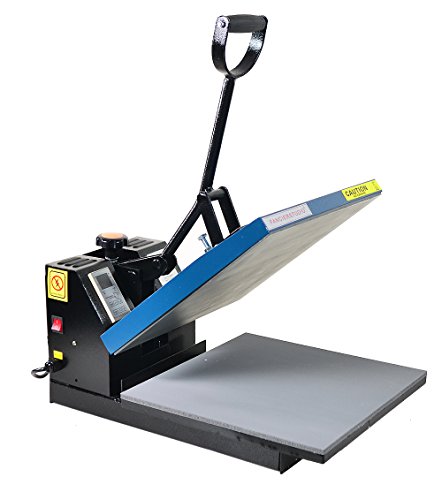
8. Fancierstudio Digital 15 by 15: Best Traditional Press
Pros
- 15 by 15 inch heat platen
- 1800W power rating
- Adjustable pressure
- Teflon-coated platen and silicone-gel base
Cons
- Manual clamshell operation
- Heavy 53-pound construction
- Older-style controls lack automatic release
Best for: operators who want familiar manual control for shirts and embellishments.
The Fancierstudio Digital 15 by 15 is the traditional choice in a field dominated by automatic and swing-away machines. It has the familiar clamshell format, a 15 by 15 inch platen, and a manual pressure adjustment. There is no automated release sequence to learn. The operator places the garment, closes the press, and controls the cycle directly.
Its 1800W power rating is notable, and the electronic controls handle both heat and time. The listed temperature range runs from 0 to 699 degrees Fahrenheit, while the timer runs from 0 to 999 seconds. The wide controls offer plenty of room for different transfer processes, although most apparel projects will use only a portion of that range.
The silicone-gel base board gives the lower work surface some compliance, and the heat platen has a Teflon coating intended to reduce sticking. Those are practical features when pressing vinyl, sublimation work, or rhinestone designs. The machine weighs 53 pounds and measures 33 inches long, 23 inches wide, and 20 inches high, so it is better regarded as a permanent workstation than a portable press.
The design feels less refined than the HTVRONT automatic machines. It does not release the garment on its own, and the clamshell arrangement puts the hot upper section directly over the loading area. VEVOR's 8 in 1 Swing Away is more versatile, while the HTVRONT Auto Heat Press 2 offers more controlled automation. The Fancierstudio remains a reasonable fit for someone who specifically prefers manual pressure and direct timing, but it is not the easiest machine for a high-volume workflow.
9. VEVOR 8 in 1 Swing Away: Best Multi-Function Press

Pros
- 360-degree swing-away arm
- 15 by 15 inch platen
- Supports shirts, caps, mugs, and plates
- Dual-tube heating with a listed 5 degree Celsius center-to-edge difference
Cons
- More involved than a dedicated shirt press
- Takes substantial bench space
- No automatic release
Best for: makers who need one press for several item shapes.
The VEVOR 8 in 1 Swing Away earns its place by covering jobs that a standard shirt press cannot. Its 15 by 15 inch platen handles clothing and flat pieces, while the included configuration is designed for caps, mugs, and plates. If the workspace needs to move between different blanks, that range is more useful than another nearly identical shirt-only machine.
The 360-degree swing-away arm moves the heating element to the side before loading. That creates more room around the garment and reduces the chance of touching the hot platen while positioning a design. It also helps distribute pressure across the transfer. The main platen is Teflon coated, and the digital controller uses a dual-screen display with buttons designed to be easy to press.
VEVOR lists a dual-tube heating system with a temperature difference of around 5 degrees Celsius between the center and edge, compared with more than 10 degrees for older single-tube designs. The machine also uses dual insulation, with a listed outer surface temperature of 50 to 70 degrees Celsius when the working temperature is 210 degrees Celsius. Those details are relevant when the press is used repeatedly in a busy craft area.
The downside is the extra hardware. A dedicated automatic press such as the HTVRONT Auto Release 15 by 15 is quicker to operate for shirt batches, and the VEVOR 2 in 1 Shirt and Hat Press is a simpler alternative if hats are the only shape beyond flat garments. The 8 in 1 is the one to choose when mugs, plates, caps, and shirts all belong in the same workflow. It is less compelling for someone who only needs flat apparel transfers.
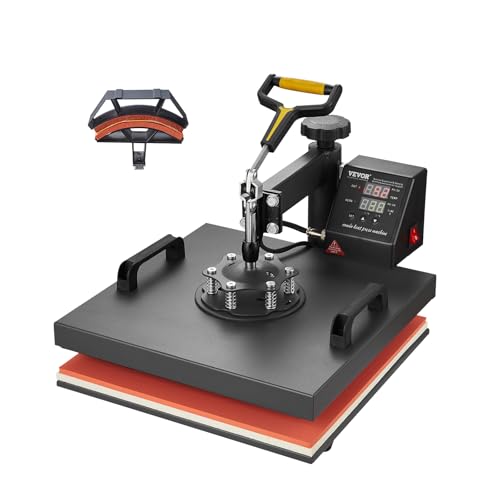
10. VEVOR 2 in 1 Shirt and Hat Press: Best Compact Hat Option
Pros
- Includes 15 by 15 inch flat platen
- Includes 6 by 3 inch curved cap platen
- 360-degree swing-away design
- Digital temperature and time control
Cons
- Less versatile than the 8 in 1 VEVOR
- Manual operation
- Changing between flat and curved work adds setup time
Best for: apparel makers who also press hats regularly.
The VEVOR 2 in 1 Shirt and Hat Press is a focused alternative to the larger multi-function VEVOR. It pairs a 15 by 15 inch flat platen with a 6 by 3 inch curved cap platen, covering the two product types many small apparel operations produce most often. The narrower purpose is a benefit if mugs and plates would only add unused attachments and setup.
The 360-degree swing-away arm moves the hot assembly away from the work before loading. A non-slip rubber grip makes the arm easier to rotate, and the supplied silicone-gel and sponge heating pads are intended to accommodate different materials. The digital control panel handles temperature and time, then sounds an alarm when the cycle is complete.
The Teflon insulation coating is designed to reduce adhesion between the garment and platen and to keep the surface more comfortable to touch. The flat platen supports shirts, pillows, bags, phone cases, and other flat items listed by the manufacturer, while the curved attachment is the reason to choose this machine over a basic 15 by 15 press. Its listed dimensions are 15 inches in each direction, with a weight of 29.1 pounds.
The 8 in 1 Swing Away is the stronger choice for a broader assortment of blanks, and the HTVRONT automatic models are easier for unattended apparel batches. This VEVOR is a manual press, so it suits an operator who is comfortable managing each cycle. Choose it when hats are a recurring part of the work and the machine must remain relatively manageable to move.
How to choose the best professional heat press machine
The right press comes down to the relationship between platen size, pressure, loading style, heat control, and the materials you expect to use most often.
Platen size
A 15 by 15 inch platen is the practical middle ground for shirt fronts, backs, tote bags, and many flat craft blanks. It keeps the machine more manageable while covering the designs most people produce. A 16 by 24 inch platen, as found on the Delclynee and VEVOR large-format presses, is the better choice for oversized graphics and wide textile panels.
A larger platen is not automatically better. It takes more bench space, makes the machine heavier, and can be unnecessary if every design fits comfortably within 15 by 15 inches.
Pressure control
Pressure affects how consistently a transfer bonds, especially across thicker garments and layered materials. Manual pressure knobs let the operator tune the machine directly. Automatic models detect or adjust for thickness, which is convenient, but the HTVRONT Auto Heat Press 2 goes further by allowing pressure adjustment up to 170 pounds.
For occasional shirts, automatic adjustment may be enough. For DTF work, hoodies, and repeated production, adjustable pressure gives the operator more control over difficult materials.
A large platen solves placement problems, but controlled pressure solves consistency problems.
Loading and press movement
Clamshell presses close over the garment and generally need clear space above the lower platen. Slide-out designs create a safer loading area, while swing-away presses move the hot element aside before the garment is positioned. The Delclynee's 12.25 inch drawer extension is particularly useful for large garments.
Automatic drawer-style machines also reduce the need to reach near the hot plate. If the press will be used around children, pets, or a busy shared workspace, the loading design deserves as much attention as the temperature range.
Temperature and timing
Digital controls should make it easy to set and repeat both temperature and duration. Look for a clear display, an audible alarm, and a timer that covers the processes you use. The machines here list time ranges up to 999 seconds, while temperature ranges vary considerably.
The top temperature number matters less than stable heat across the platen. Dual-tube heating systems are designed to reduce the gap between the center and edges, which is useful when a transfer fills most of the available area.
Materials and attachments
A shirt-only press is simpler and often easier to operate. A multi-function unit adds support for caps, mugs, and plates, but changing attachments takes time and consumes storage space. The VEVOR 8 in 1 covers the broadest range, while the VEVOR 2 in 1 concentrates on flat garments and hats.
If sublimation work includes drinkware, a separate tumbler setup for curved sublimation projects may make more sense than choosing a shirt press solely for an occasional mug job. The printer and blank materials matter just as much as the press, so beginners should also understand which printer features make sublimation easier to start.

Frequently asked questions
What platen size is suitable for professional shirt pressing?
A 15 by 15 inch platen handles most standard shirt graphics, tote bags, and flat apparel work. Choose 16 by 24 inches when oversized designs or wide textile panels are routine. The larger size is useful only if the workspace and production needs justify the machine's added footprint.
Is an automatic heat press better for batch work?
An automatic press can make batch work easier because it closes, times, and releases the garment with less supervision. The HTVRONT automatic models also use drawer-style loading, which keeps hands farther from the hot platen. Manual presses remain useful when the operator needs to adjust pressure or change settings frequently.
Do I need adjustable pressure for DTF transfers?
Adjustable pressure is useful for DTF work because garments vary in thickness and some projects contain several layers. The HTVRONT Auto Heat Press 2 models list pressure adjustment up to 170 pounds. A machine with automatic thickness adjustment can still work well, but it gives the operator less direct control.
What is the benefit of a swing-away heat press?
A swing-away press moves the heated element to the side before loading. This provides more working room and reduces the chance of touching the hot platen while positioning a garment. It can also make pressure distribution more even, though the arm requires clearance around the machine.
Can a 15 by 15 inch press handle hoodies?
A 15 by 15 inch press can handle many hoodie designs if the graphic fits within the platen. Clearance is also important because hoodies are thicker than shirts. The HTVRONT Auto Heat Press 2 models list support for materials up to 1.77 inches high, while several other automatic HTVRONT models list up to 1 inch.
Should I choose a multi-function press for mugs and hats?
Choose a multi-function press when caps, mugs, or plates are regular parts of the work, not just occasional experiments. The VEVOR 8 in 1 supports the broadest range here, while the VEVOR 2 in 1 focuses on shirts and hats. A dedicated shirt press is usually simpler when flat apparel is the main output.
What other equipment affects sublimation results?
The press cannot correct poor artwork, unsuitable blanks, or inconsistent printing. A suitable sublimation printer, compatible transfer paper, and correctly prepared substrate all affect the final result. For a wider production setup, it also helps to consider how printing equipment fits a small business workflow.

The bottom line
The Best professional heat press machine in this group is the HTVRONT Auto Heat Press 2 White because it combines automatic pressing with adjustable pressure, useful clearance for thick garments, and a 15 by 15 inch platen that suits most apparel work. The Delclynee 16 by 24 Slide Out is the stronger specialist pick for oversized graphics, thanks to its large platen and safer drawer loading.
The HTVRONT Auto Release 15 by 15 is the simpler choice for hands-free shirt batches, while the VEVOR 8 in 1 Swing Away makes more sense when caps, mugs, and plates are part of the same workspace. Buyers who remain undecided should choose platen size first, then decide whether automatic release or attachment flexibility matters more.
As an Amazon Associate we earn from qualifying purchases.