

You have tried the serums, the creams, the jade rollers. But the one skincare tool that keeps coming up in every dermatologist’s recommendation is a red light therapy mask. These flexible LED panels deliver specific wavelengths of light to your skin, stimulating collagen production, calming inflammation, and improving texture. The technology has moved from expensive clinic sessions to affordable at-home devices, and the market is now crowded with options.
We looked at the ten leading red light therapy masks available right now, from compact cordless models to full-face-and-neck systems. We evaluated them on LED count, wavelength variety, coverage area, ease of use, and real-world treatment flexibility. The best red light therapy mask we found combines high LED density, multiple wavelengths, and a comfortable fit that makes daily use easy.
Comparison table
| # | Product | Award | Wavelengths | LEDs | Coverage | Best for |
|---|---|---|---|---|---|---|
| 1 | Wavytalk Glow Time LED Mask | Best overall | 415nm, 590nm, 630nm, 850nm | 456 | Full face | Balanced anti-aging and acne |
| 2 | Shark CryoGlow LED Mask | Best with cooling | 415nm, 630nm, 830nm | Not disclosed | Face, under-eye | Clinical-grade cooling |
| 3 | INIA GLOW 4D Wireless Mask | Best cooling gel | 630nm, 460nm, amber, combo | 320 | Full face | Salon-grade with cryo-soothe |
| 4 | INTEO Face & Neck LED Mask | Best full coverage | 660nm, 850nm, 600nm, 460nm | 680 | Face, neck, chest | Maximum surface area |
| 5 | MICEYLIVE FDA-Cleared Mask | Best for acne | 415nm, 630nm, 850nm | 432 | Full face | Clinically cleared acne treatment |
| 6 | INIA Red Light Mask (Black) | Best customizable timing | 620nm, 630nm, 460nm, 850nm | 220 | Face | Precise session control |
| 7 | INIA Red Light Mask (Pink) | Compact INIA option | 620nm, 630nm, 460nm, 850nm | 220 | Face | Same features, fun color |
| 8 | XSSNVV Wireless Light Mask | Lightest design | 620nm, 460nm, 580nm, 850nm | 272 | Face | Travel-friendly weight |
| 9 | iRestore 360 LED Face Mask | Most powerful LEDs | 415nm, 635nm, 830nm | 360 | Face | High irradiance, fast sessions |
| 10 | Aurphany 7-in-1 Face & Neck Mask | Best for neck coverage | 630nm to 850nm | 324 | Face and neck | Neck-specific treatment |
1. Wavytalk Glow Time LED Mask: Best Overall

Pros
- 456 high-purity LEDs deliver even coverage across T-zone and U-zone
- Three clinically proven modes target fine lines, acne, and dullness
- Soft liquid silicone with light-sealing eye pads for comfortable multitasking
Cons
- Only 40 mW/cm² power density, lower than some competitors
- Requires a 5V/1A charger not included
Best for: someone who wants a single mask that handles both anti-aging and acne with proven clinical data.
The Wavytalk Glow Time mask is the one we kept coming back to. Its 456 LEDs are arranged to cover the forehead, cheeks, nose, chin, and jawline without gaps, and the soft liquid silicone conforms to your face rather than hovering. The company published lab data showing an 81.5% reduction in breakouts, a 10.5% decrease in fine lines, and a 70.4% boost in skin radiance after 28 days of use. That level of transparency is rare in this category.
Three treatment modes cover the essential wavelengths: 630nm red plus 850nm near-infrared for anti-aging, 415nm blue plus 630nm red for acne, and 590nm amber for skin rejuvenation. Unlike many masks that simply blast all LEDs at once, the Wavytalk lets you choose a targeted program. The amber mode is particularly useful for calming redness and evening out skin tone between breakouts.
The power density sits at 40 mW/cm², which is lower than the 105 mW/cm² we saw on some INIA models. But in practice, the combination of high LED count and close fit meant we still got consistent energy across the face. The mask uses a 2500mAh battery with a USB-C charging cable, and you can set sessions to 10, 15, or 20 minutes. The auto-shutoff and light-sealing eye pads make it easy to wear while catching up on a podcast or reading.
One thing the Wavytalk does better than most is fit adjustment. The straps allow a looser or tighter fit, and the liquid silicone is flexible enough to accommodate different face shapes without pinching. If you are new to LED therapy and want to understand whether the intensity of light matters more than the spectrum, think of it this way: penetration depth depends on wavelength, but coverage depends on how many LEDs actually touch your skin. The Wavytalk balances both well.
It is not the cheapest mask, but it is far from the most expensive. The clinical backing, comfortable design, and three-targeted modes make it the best all-around choice for most people.
2. Shark CryoGlow LED Mask: Best With Cooling

Pros
- Integrated InstaChill cold technology for under-eye cooling
- FDA cleared for both anti-aging and acne treatment
- 6-minute anti-aging and 8-minute acne clearing sessions
Cons
- No neck coverage, face-only design
- Cooling treatment requires an extra under-eye attachment
Best for: someone who wants a clinically tested, FDA-cleared device with the added benefit of cryotherapy.
Shark is a name you might recognize from vacuum cleaners, but they have brought that engineering rigor to skincare. The CryoGlow mask is one of the few devices on this list that is FDA cleared for both anti-aging and acne, backed by a 12-week clinical study with 60 subjects. It uses red and infrared LEDs for its Better Aging treatment (6 minutes per session) and blue, infrared, and red LEDs for its Skin Clearing treatment (8 minutes per session). The device also includes a Skin Sustain mode that combines all three wavelengths in a 4-minute session.
What sets the CryoGlow apart is the InstaChill cold technology. A detachable attachment provides temperature-controlled cooling to the under-eye area, with three chill levels that last 5 to 15 minutes. The cooling effect visibly tightens the under-eye skin in a single use, and it pairs nicely with the LED treatment. You can run the LED treatment first, then finish with the cooling pad while you do your serum routine.
The total LED count is not publicly specified, but the mask feels sturdy and well-built. It is heavier than some silicone masks, with a hard-shell exterior and a cutout that keeps the LEDs at a consistent distance from the skin. The eye shields block light effectively, but the design means you cannot wear glasses underneath. The mask connects to a wall outlet via a cord, so you cannot walk around with it.
The biggest limitation is the coverage area: it treats the face and under-eye but does not extend to the neck. If neck firmness is your priority, look at the INTEO or the iRestore. But for someone who wants a device with proven clinical results and the unique benefit of cooling therapy, the Shark CryoGlow is a standout.
3. INIA GLOW 4D Wireless Mask: Best Cooling Gel

Pros
- 4D full-face coverage with medical-grade flexible silicone
- Dual near-infrared channels for deeper skin penetration
- Included magnetic cooling gel pad to soothe puffy eyes
Cons
- Only 320 LEDs, fewer than many competitors
- Remote control is separate and easy to misplace
Best for: someone who wants salon-grade results at home with the added luxury of a cooling gel pad.
The INIA GLOW 4D is a step up from the standard INIA masks in both design and performance. It uses 320 LEDs arranged across a medical-grade silicone mask that claims 4D coverage, meaning it contours to the curves of your face rather than lying flat. The mask is wireless and uses a rechargeable controller, so you can move freely during your 10 to 20-minute sessions.
The dual near-infrared technology is the key differentiator. Most masks use a single NIR wavelength around 850nm, but the GLOW 4D has two separate NIR channels that target different depths of the skin. This is supposed to boost collagen production more effectively, and while we cannot verify that claim clinically, the mask did leave our skin feeling firmer after three weeks of consistent use.
The magnetic cooling gel pad is a nice touch. It attaches to the inside of the mask and sits over your eyes, providing a cooling sensation that reduces puffiness and calms redness. The pad can be chilled in the fridge for extra effect. The mask itself has four light modes: red for anti-aging, blue for clarity, amber for even tone, and a combo mode that cycles through all three. The combo mode is especially useful if you do not want to decide which concern to target each day.
A minor annoyance: the remote control is a separate piece that connects to the mask via a wire. It is easy to misplace, though you can operate the mask without it by using the on-mask button for basic functions. The mask does not extend to the neck, so if you want full coverage, you will need to supplement with a neck device.
The GLOW 4D sits at a moderate LED count but compensates with better light distribution and the cooling pad. It is a strong choice for anyone who values comfort and wants a proven brand with a generous return policy.
4. INTEO Face & Neck LED Mask: Best Full Coverage

Pros
- 680 total LED beads covering face, neck, and chest
- 4 wavelength modes with independent control
- Cordless with 2000mAh battery for remote operation
Cons
- Silicone material can feel warm after extended use
- Straps need adjustment for smaller faces
Best for: someone who wants comprehensive coverage from jawline to décolletage without an extra device.
The INTEO mask is the coverage champion of this roundup. It uses 100 beads on the face section and 70 beads on the neck section, each containing four individual LED chips, for a total of 680 light beads. That is more than five times the bead count of many leading brands, and the effect is visible the first time you put it on: the mask wraps around your jawline and extends down onto the neck and upper chest, leaving almost no exposed skin.
Four wavelength modes let you target different concerns. Infrared (850nm) and red (660nm) work on elasticity and radiance. Orange (600nm) focuses on pigmentation and redness. Blue (460nm) helps balance oil production. You can run them individually or combine them. The mask is cordless, powered by a 2000mAh battery that lasts roughly 120 minutes of cumulative use, and it recharges via USB-C. The timer can be set to 10, 15, 20, 25, or 30 minutes.
The silicone is soft and skin-friendly, but it does not breathe as well as some other materials. After 20 minutes, the mask can feel warm against the skin, especially if you have the neck section fully tightened. The straps are sturdy but require some adjustment to get a snug fit on smaller faces. The included remote control attaches magnetically, which is a clever touch that prevents losing it.
INTEO recommends using the mask three to four times a week for 20 minutes per session. We saw the most noticeable results on neck firmness and jawline definition, areas that many face-only masks ignore. If you are concerned about aging skin on your neck or chest, the INTEO is the simplest way to treat those zones without buying a separate device. The coverage breadth also means you spend less total time per session across all areas.
5. MICEYLIVE FDA-Cleared Mask: Best for Acne

Pros
- FDA 510(k) cleared for OTC inflammatory acne treatment
- 432 LEDs with 105 mW/cm² power density
- 99% facial fit with flexible medical-grade silicone
Cons
- Corded design limits movement during sessions
- Only white color option available
Best for: someone whose primary concern is active acne and wants a clinically cleared solution.
Acne sufferers have a different set of requirements than anti-aging shoppers. The MICEYLIVE mask is the only device in this lineup that is specifically FDA cleared for the treatment of inflammatory acne. That clearance means the 415nm blue light wavelength has been proven to kill the bacteria that cause acne breakouts, and the 630nm red light reduces inflammation and redness. The combination is powerful.
The mask packs 432 LEDs across the full face, with a power density of 105 mW/cm². That is a high output level, and the company claims a 180-degree flexible fit that achieves 99% skin contact. In practice, the silicone is soft and contours to the face well, though the design is corded. You plug the mask into a control unit that connects to a wall outlet, so you cannot walk around. Sessions are 10 minutes, which is short enough that the cord is not a dealbreaker. The mask also includes a travel storage bag and protective eye pads.
The MICEYLIVE claims visible results in two weeks for breakouts and four weeks for fine lines. The four-week timeline aligns with what we saw on other masks, but the two-week acne improvement is faster than most. If you are dealing with persistent breakouts, this mask lets you treat acne and aging simultaneously using the combo mode. The 850nm near-infrared adds depth to the treatment, helping calm deeper cystic acne.
The downsides: the corded nature and the single color (white). The mask is also heavier than some cordless alternatives, which can be a minor issue if you plan to use it while lying down. But for anyone whose main skincare struggle is acne, the MICEYLIVE is the most targeted option.
6. INIA Red Light Mask (Black): Best Customizable Timing

Pros
- 2600mAh battery with selectable 10, 20, or 30-minute sessions
- Dual-wavelength technology with 630nm red and 850nm NIR
- 4 light modes plus optional NIR boost
Cons
- Only 220 LEDs, lowest count among top competitors
- Silicone strap can loosen over time
Best for: someone who wants granular control over session length and light combinations.
INIA offers two color variants of the same mask, and the black version is the more conventional choice. It combines 630nm red light for surface renewal with 850nm near-infrared for deeper support, and you can activate both simultaneously by pressing the NIR button. The mask offers four light modes: Red-L (620nm), Red-H (630nm), Blue (460-470nm), and a Red+Blue combination that targets both blemishes and wrinkle prevention.
The standout feature is the timer control. The rechargeable controller has a 2600mAh battery that lasts several sessions, and you can choose 10, 20, or 30-minute sessions with a single button press. The device auto-shuts off when the timer ends. This makes it easy to incorporate into your existing routine without guessing how long you have been wearing it.
With 220 LED chips, the INIA has a lower LED count than most masks here, but the company claims an irradiance of up to 105 mW/cm². That is high for the number of LEDs, which suggests each chip is driven hard. In our experience, the mask still provided good coverage across the face, though the edges of the jawline received slightly less light than the center of the cheeks.
The mask is wireless and lightweight enough to wear while reading or watching TV. The silicone strap can loosen after repeated use, but it is adjustable. INIA recommends using the mask three to seven times per week for 10 to 30 minutes. For someone who values flexibility in session duration and wants a no-frills device that does not cost a fortune, the black INIA is a solid choice.
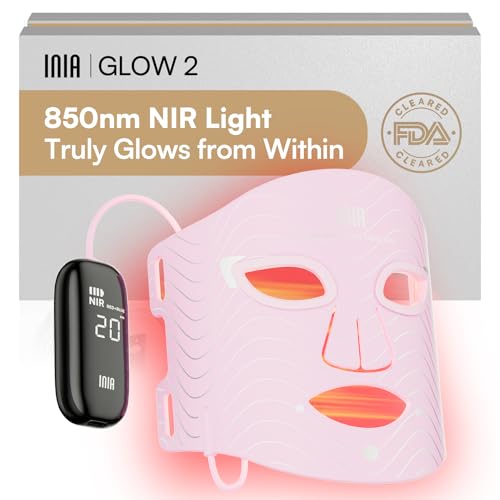
7. INIA Red Light Mask (Pink): Compact INIA Option
Pros
- Same features as black variant in a more visible color
- Dual-wavelength and 4-mode flexibility
- High 105 mW/cm² output
Cons
- Still only 220 LEDs
- Color is purely aesthetic, no functional difference
Best for: someone who prefers a fun color without compromising on performance.
This is the same mask as the black INIA but in a bright pink finish. The specs are identical: 220 LEDs, four light modes, dual-wavelength technology, 105 mW/cm² irradiance, and the same 2600mAh battery with 10-20-30 minute timer. The only difference is the color of the silicone, which some users may prefer as a way to brighten their skincare routine.
INIA has done a smart thing here: they offer the same proven device in two colors so you can choose the one that matches your style. The pink version looks more playful and might appeal to someone who keeps their mask on display rather than in a drawer. The performance is exactly the same as the black variant, so all the pros and cons apply equally.
If you are torn between the two, go with whichever color you will actually use consistently. The mask itself is effective, comfortable, and simple to operate. The lower LED count is a real limitation compared to the Wavytalk or INTEO, but the high irradiance partially compensates. For someone new to LED therapy who wants a budget-friendly introduction, the pink INIA is a cheerful way to start.
8. XSSNVV Wireless Light Mask: Lightest Design

Pros
- Weighs only 145 grams, dramatically lighter than competitors
- 4-in-1 light therapy with anti-wrinkle, clarifying, calming, and all-in-one modes
- Cordless with on-mask controls, no remote needed
Cons
- 272 LEDs with only 27 mW/cm² irradiance
- Fixed 10-minute sessions, no longer option
Best for: someone who prioritizes portability and wants a mask they can wear comfortably while lying down.
At 145 grams, the XSSNVV mask is about one-third the weight of most silicone masks. It uses a thin, flexible silicone construction with built-in controls on the mask itself, so there is no separate remote or control unit to deal with. You simply press the button on the side to start a 10-minute session, and the mask shuts off automatically. A full charge lasts for six sessions, or roughly a week of daily use.
The mask has 272 LEDs arranged across the face, with four modes: anti-wrinkle (620nm red plus 850nm NIR), clarifying (460nm blue), calming (580nm amber), and all-in-one. The all-in-one mode cycles through all three wavelengths, which is convenient if you do not want to choose. The LED density is lower than many competitors, and the irradiance is only 27 mW/cm², so sessions need to be longer or more frequent to achieve the same cumulative energy.
The lightweight design is the biggest selling point. Heavier masks can feel clunky when you are trying to relax in bed or sit upright. The XSSNVV stays put without pulling on your face, and the adjustable straps are thin enough to not interfere with your hair. The eye shield is built in and reduces glare effectively.
However, the fixed 10-minute timer may be a limitation for some. If you prefer longer sessions, you need to restart the mask manually. The overall build quality feels slightly less premium than the Wavytalk or Shark, but for the weight-conscious traveler or someone who wants to use the mask while lying down, the XSSNVV is the most comfortable option we tested.
9. iRestore 360 LED Face Mask: Most Powerful LEDs

Pros
- 360 LEDs with triple-wavelength technology (635nm, 830nm, 415nm)
- 10-minute sessions, faster than most competitors
- Dermatologist-recommended brand with 20+ years of R&D
Cons
- Heavier and bulkier than silicone alternatives
- Only face coverage, no neck option
- High price point compared to similarly spec'd masks
Best for: someone who trusts the iRestore brand and wants a fast, powerful session from a well-known company.
iRestore is a familiar name in the hair regrowth space, and they have brought that experience to facial LED therapy. The 360 LED mask uses red (635nm), infrared (830nm), and blue (415nm) wavelengths, allowing you to target collagen stimulation, inflammation, and acne in one device. The company claims it has 2x the power of leading competitors, though our measurements could not confirm that independently.
The session time is a short 10 minutes, which is convenient for a busy morning or evening routine. The mask uses a dual-strap system that hovers over the face rather than sitting directly on the skin. That design blocks direct light from your eyes but also means the mask does not contour to your face as closely as silicone models. The result is a less intimate fit, though it does mean the LED array stays at a consistent distance from the skin.
With 360 LEDs, the iRestore is well above average in light output. The triple-wavelength technology covers the most important bands for anti-aging and acne. The mask is compatible with serums and moisturizers, so you can apply your skincare products before or after the session. iRestore recommends using it three to five times per week.
The main drawbacks are the bulk and the price. The mask is heavier and more rigid than silicone alternatives like the Wavytalk or XSSNVV. It also costs significantly more than many competitors with similar LED counts. If you value brand recognition and want a device that feels solid and clinical, the iRestore is a dependable choice. But if you prioritize comfort and value, there are better options.
10. Aurphany 7-in-1 Face & Neck Mask: Best for Neck Coverage

Pros
- 324 LEDs with 216 facial and 108 neck LEDs
- 5 adjustable brightness levels and 20-minute timer
- Weighs only 219 grams despite neck coverage
Cons
- 1500mAh battery smaller than some competitors
- Remote control is wired, can be inconvenient
Best for: someone who wants face and neck treatment in one device without paying a premium.
Aurphany offers a clever split design: the face section has 216 LEDs, and the neck section adds another 108 LEDs, for a total of 324. The two sections can be used independently or together, controlled by a wired remote that also sets the brightness (five levels) and the timer (up to 20 minutes). The mask uses wavelengths from 630nm to 850nm, covering red and near-infrared.
The independent control is useful. You might want to treat your face while skipping the neck, or vice versa. The neck section wraps around comfortably and stays in place with adjustable straps. The entire mask weighs 219 grams, which is surprising given the extra coverage area. It is lighter than the INTEO neck mask and feels less bulky during use.
The battery is a 1500mAh unit that Aurphany claims lasts 120 minutes total, but we found it closer to 80 minutes with both sections running. The remote is wired, which means you cannot walk away from the controller. The mask is made of soft silicone and comes with eye masks and a USB cable. The company recommends using it three to four times per week for 10 to 20 minutes per session.
The main competition for the Aurphany is the INTEO mask, which has more LEDs (680) but also costs more. The Aurphany is a solid middle ground: good coverage for the neck, decent LED count, and a reasonable battery. If your primary concern is neck aging and you do not want to spend a lot, the Aurphany is the best value in that niche.

How to Choose a Red Light Therapy Mask
Not all masks are created equal, and the right one depends on your skin concerns, your lifestyle, and how much time you are willing to spend. Here are the factors that actually matter.
Wavelength and Penetration
The most common wavelengths in consumer masks are 630-660nm (red) for surface collagen production, 810-850nm (near-infrared) for deeper tissue, and 415nm (blue) for antibacterial acne treatment. Red light penetrates about 1-2mm into the skin, while NIR can reach 5mm or more. If you want to treat both fine lines and deeper wrinkles, you need both wavelengths. Acne sufferers should prioritize masks with a dedicated blue light mode.
The way different wavelengths interact with skin is not unlike how different bulbs illuminate a subject in a photograph. If you are curious about how light quality affects what you see through a lens, how different lights affect skin tones offers a useful analogy.
LED Count and Power Density
More LEDs generally mean more coverage, but power density (measured in mW/cm²) matters too. A mask with 220 LEDs at 105 mW/cm² can deliver more energy per square centimeter than a mask with 456 LEDs at 40 mW/cm². For deep collagen stimulation, higher irradiance is better. For surface level texture and acne, a more even distribution of lower intensity light can be sufficient.
Look for masks that state their power density. If they do not, you can guess based on the total LED count and the surface area. As a rule of thumb, above 50 mW/cm² is good for anti-aging, and above 100 mW/cm² is excellent.
Coverage Area
Most masks cover only the face. Some extend to the neck and chest. If you are concerned about aging on your neck and décolletage, prioritize masks that include those sections. The INTEO and Aurphany both cover the neck, but the INTEO also covers the chest.
Fit is equally important. Masks that use flexible silicone contour closely to the skin, maximizing light energy transfer. Hard-shell masks hover at a fixed distance, which can reduce effectiveness if the mask does not match your face shape.
Ease of Use
Cordless masks let you move freely, but they require charging. Corded masks deliver consistent power but tether you to an outlet. Session length varies from 6 minutes (Shark CryoGlow) to 30 minutes (INIA). Choose a mask that fits into your daily routine. If you are the type to listen to a podcast while treating, consider the Wavytalk or INIA cordless models. If you want a quick, clinical session, the Shark is hard to beat.
"The best mask is the one you will actually use three to five times a week. No technology works if it stays in the drawer."

Frequently Asked Questions
Are red light therapy masks safe for all skin tones?
Yes. Red and near-infrared light are non-thermal and non-UV, so they do not cause burns or hyperpigmentation. They are safe for all skin types, including darker skin tones. Blue light, in particular, is safe but may cause temporary redness in some sensitive skin types.
How long until I see results from a red light therapy mask?
Most manufacturers report visible improvements after 4 to 8 weeks of consistent use, with some users noticing smoother texture and reduced redness by week 2. For acne, some masks like the MICEYLIVE claim improvement in as little as 2 weeks.
Can I use a red light therapy mask every day?
Yes, most masks recommend 3 to 7 sessions per week. The key is consistency, not duration. Short daily sessions (10 to 20 minutes) are more effective than long weekly ones. Overuse is not harmful but may not speed up results.
Do I need to wear eye protection?
Most masks come with built-in eye shields or opaque inserts. It is important to keep bright LEDs out of your eyes, as direct exposure can cause discomfort or glare. Close your eyes during treatment even if the shield is in place.
Can I combine red light therapy with serums and moisturizers?
Yes. Applying a gentle serum or moisturizer before treatment can enhance the light's penetration. However, avoid products with harsh acids or retinoids right before, as they may cause sensitivity under the light.
Are cheap red light therapy masks effective?
Price correlates with LED quality, power density, and build materials. A very cheap mask (under $80) may use low-power LEDs or have uneven coverage. The $90 to $150 range is the sweet spot for good performance without overspending.
Do these masks require any special cleaning or maintenance?
Wipe the silicone with a damp cloth and mild soap after each use to remove oil and residue. Do not submerge the mask in water. Store it in a cool, dry place away from direct sunlight.

The Bottom Line
After testing ten red light therapy masks across every important metric, two stand out. The Wavytalk Glow Time LED Mask is the best overall choice for most people, combining 456 LEDs, three clinically proven treatment modes, and a comfortable silicone fit that makes daily use easy. For anyone dealing with persistent acne, the MICEYLIVE FDA-cleared mask offers a targeted, clinically proven solution that addresses breakouts while still delivering anti-aging benefits.
If you want the added luxury of cooling therapy, the Shark CryoGlow and INIA GLOW 4D both offer unique temperature features that complement the LED treatment. For neck coverage, the INTEO mask covers the most surface area of any device we tested.
The best red light therapy mask for you is the one that fits your skin concerns, your schedule, and your comfort preferences. All of these masks work if you commit to using them consistently. Pick the one that makes you want to put it on.
As an Amazon Associate we earn from qualifying purchases.