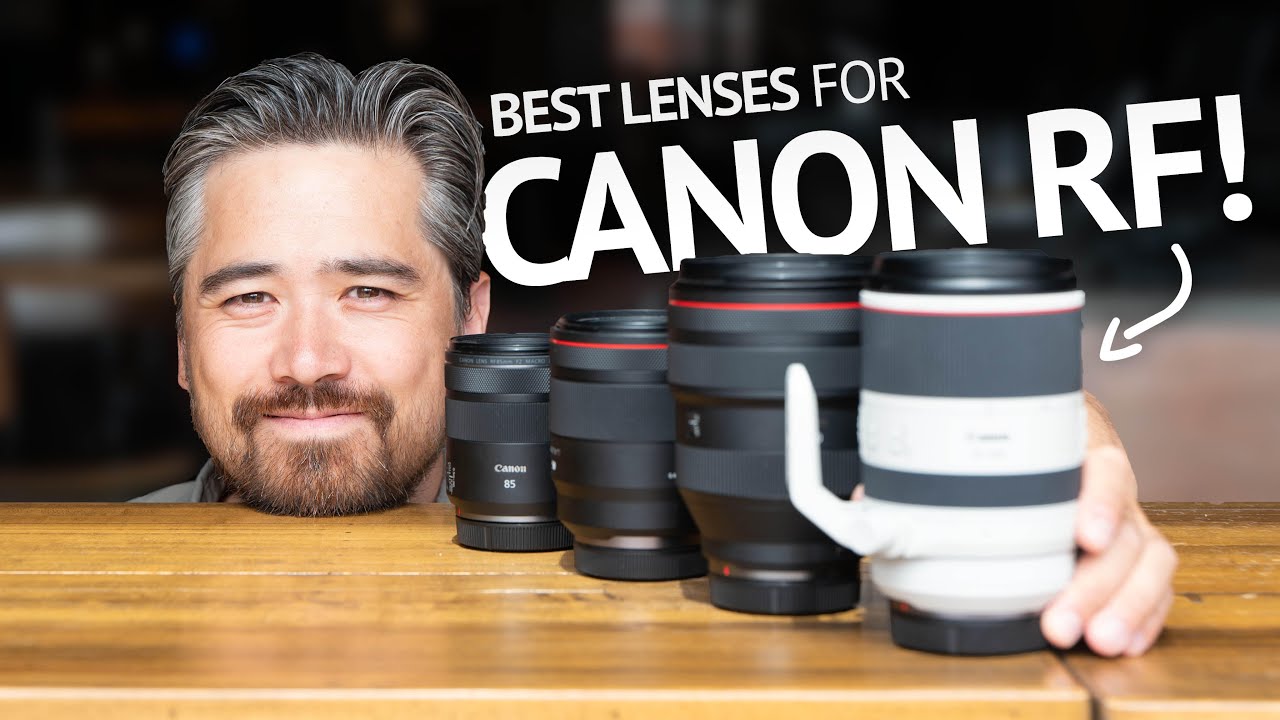

Canon's RF mount has grown from a small selection into a broad system, but choosing one lens still comes down to a practical question: do you need more light, more reach, or fewer lens changes? A compact 50mm prime suits everyday portraits very differently from a 400mm telephoto, and APS-C cameras change the effective field of view again.
Our guide to the Best RF lenses for Canon covers ten genuine Canon options, including fast L-series zooms, lightweight travel lenses, close-focusing primes, and telephoto lenses for EOS R cameras. The range includes choices for full-frame and APS-C bodies, so compatibility deserves as much attention as focal length.
Canon RF50mm F1.8 STM is our top pick, with the RF24-70mm F2.8 L IS USM close behind for photographers who need one professional standard zoom. The rest of the list covers wide-angle work, macro, travel, portraits, sports, and distant subjects.
Comparison table
| # | Product | Award | Focal length | Maximum aperture | Stabilization | Best for |
|---|---|---|---|---|---|---|
| 1 | Canon RF50mm F1.8 STM | Best overall | 50mm | f/1.8 | Not specified | Everyday portraits |
| 2 | Canon RF100-400mm F5.6-8 IS USM | Best lightweight telephoto | 100-400mm | f/5.6-8 | Up to 5.5 stops | Wildlife and outdoor subjects |
| 3 | Canon RF75-300mm F4-5.6 Kit | Best bundled kit | 75-300mm | f/4-5.6 | Not specified | New telephoto users |
| 4 | Canon RF24-70mm F2.8 L IS USM | Best professional zoom | 24-70mm | f/2.8 | Up to 5 stops | Weddings and events |
| 5 | Canon RF75-300mm F4-5.6 | Best simple telephoto | 75-300mm | f/4-5.6 | Not specified | Outdoor portraits |
| 6 | Canon RF35mm F1.8 Macro IS STM | Best macro prime | 35mm | f/1.8 | Up to 5 stops | Close-ups and street photography |
| 7 | Canon RF24-105mm F4 L IS USM | Best all-rounder | 24-105mm | f/4 | Up to 5 stops | Travel and general photography |
| 8 | Canon RF16mm F2.8 STM | Best ultra-wide prime | 16mm | f/2.8 | Not specified | Vlogging and interiors |
| 9 | Canon RF-S55-210mm IS STM | Best APS-C telephoto | 55-210mm | f/5-7.1 | Up to 4.5 stops | EOS R10 and R50 users |
| 10 | Canon RF70-200mm F2.8 L IS USM | Best pro telephoto | 70-200mm | f/2.8 | Up to 5 stops | Sports and portraits |
1. Canon RF50mm F1.8 STM: Best Overall

Pros
- Bright f/1.8 aperture for low light and background blur
- Compact 50mm perspective suits portraits and everyday scenes
- Quiet STM autofocus for photos and video
- Direct control ring for setting changes
Cons
- Fixed focal length requires you to move instead of zooming
- No stabilization is specified
- Less suitable for very wide interiors or distant subjects
Best for: Canon EOS R users who want a small everyday prime for portraits, family photos, and low-light shooting.
The Canon RF50mm F1.8 STM is the lens we would put on an EOS R body when we wanted to stop thinking about gear. Its 50mm focal length feels natural for people, food, details, and ordinary walks, while the compact design keeps the camera from becoming a burden. At 0.35 pounds, it is notably easy to carry compared with the zooms in this group.
The f/1.8 maximum aperture is the reason this lens earns the top spot. It lets in more light than the f/4 and slower telephoto options, which helps when the room gets dim. It also gives portraits a softer background, although the amount of blur depends on subject distance and framing. Canon includes a gear-type STM stepping motor, so autofocus is designed to remain smooth and quiet during continuous video recording as well as still photography.
A control ring gives the photographer direct access to camera settings, and Canon says its lens placement and coatings help maintain color balance while minimizing ghosting and flare. Those details make the RF50mm F1.8 STM more flexible than its simple design suggests. The RF35mm F1.8 Macro IS STM is more useful when close focusing and stabilization matter, while the RF24-105mm F4 L IS USM is more convenient when changing focal lengths is central to the assignment.
The limitation is straightforward: 50mm is all you get. It can feel tight in a small room and too short for wildlife. Stabilization is not specified in the supplied information, so users who regularly shoot handheld in dim conditions should consider the stabilized RF35mm instead. For everyone else, this is the most balanced starting point in the Best RF lenses for Canon lineup.
2. Canon RF100-400mm F5.6-8 IS USM: Best Lightweight Telephoto

Pros
- Broad 100-400mm reach
- Optical stabilization up to 5.5 stops
- Up to 6 stops with compatible EOS R IBIS bodies
- Nano USM autofocus is designed to be fast and quiet
- 0.41x maximum magnification at 400mm
Cons
- f/8 at the long end needs good light or higher camera sensitivity
- Heavier than the compact primes
- Less useful for indoor work than a fast standard zoom
Best for: photographers who want substantial outdoor reach without stepping up to a much larger professional telephoto.
The Canon RF100-400mm F5.6-8 IS USM is the telephoto here that makes distant subjects feel accessible without turning the camera bag into a specialist kit. The 100mm starting point works for larger outdoor subjects and tighter portraits, then the 400mm end gives you the framing needed for birds, field sports, and details across a landscape.
Its optical image stabilizer is rated for up to 5.5 stops of shake correction, or up to 6 stops when paired with an EOS R camera featuring in-body image stabilization. That matters when the subject is still and shutter speed is limited by available light. Stabilization cannot freeze a moving bird or athlete, but it can make handheld framing more practical and reduce camera shake in static scenes.
The lens can focus as close as 2.89 feet at 200mm and reaches a maximum magnification of 0.41x at 400mm. That close-focus behavior gives it a second life for flowers, details, and small objects when you cannot physically get close. Canon uses Nano USM for fast, smooth, quiet autofocus, a useful combination for both stills and video.
The cost of this reach is the f/5.6-8 aperture. The RF70-200mm F2.8 L IS USM is far better suited to dim venues and action where shutter speed matters, but it does not reach 400mm. The RF100-400mm is the more sensible pick for daylight wildlife and travel, especially for a photographer who values reach more than background separation.
3. Canon RF75-300mm F4-5.6 Kit: Best Bundled Kit

Pros
- 75-300mm range covers portraits and distant subjects
- Compact and portable design
- Eye detection is supported during stills and video autofocus
- Includes UV filter, lens cap keeper, and cleaning kit
- Canon lens caps are included
Cons
- Stabilization is not specified
- Slower f/5.6 aperture at 300mm limits low-light flexibility
- The included accessories do not change the lens's optical limits
Best for: a new EOS R owner who wants a straightforward telephoto lens and useful cleaning accessories in one package.
The Canon RF75-300mm F4-5.6 Kit is aimed at the photographer who wants to add reach without making the purchase complicated. Its 75mm starting point is already useful for portraits, while 300mm lets you isolate subjects across a park, sports field, or open landscape. The compact dimensions listed for the lens are 5.8 inches long and 2.8 inches wide, making it easier to pack than many long zooms.
Canon describes eye detection as available even at the 300mm end, with Servo AF for still images and Movie Servo AF for video. That is a meaningful feature for people photography because the camera can keep attention on the pupil while a face or body moves. The lens is compatible with EOS R series cameras, not Canon DSLR bodies using EF, EF-S, or EF-M mounts.
The bundle includes Canon front and rear lens caps, a UV filter, a lens cap keeper, and a cleaning kit with a blower, lens pen, brush, and case. Those extras are practical for a first telephoto, though they should not be confused with optical features. The supplied information does not specify image stabilization, so a steady grip and sensible shutter speed remain important.
The regular Canon RF75-300mm F4-5.6 has the same focal-length and aperture figures without this accessory bundle, while the RF100-400mm F5.6-8 IS USM adds stabilization and another 100mm of reach. Choose the kit when the accessories and simple setup matter. Skip it if you regularly work in dim conditions or need the strongest support for handheld telephoto shooting.
4. Canon RF24-70mm F2.8 L IS USM: Best Professional Zoom

Pros
- Bright constant f/2.8 aperture
- 24-70mm range handles wide scenes and portraits
- Optical stabilization up to 5 stops
- Nano USM autofocus is fast, smooth, and quiet
- Close focusing at 0.69 feet wide and 1.25 feet telephoto
Cons
- Nearly 2 pounds
- More demanding to carry than a small prime
- Does not offer the reach of the 24-105mm or telephoto zooms
Best for: event, wedding, travel, and editorial photographers who need one fast standard zoom for demanding work.
The Canon RF24-70mm F2.8 L IS USM is the serious working lens in this selection. Its range starts wide enough for groups, interiors, and environmental scenes, then reaches 70mm for portraits and tighter details. That range is familiar because it solves a large share of everyday assignments without forcing a lens change every few minutes.
A constant f/2.8 aperture gives the lens a consistent exposure behavior as you zoom. It also offers more light than the f/4 RF24-105mm F4 L IS USM, which can help in dim venues and gives more control over subject separation. The RF24-70mm has optical stabilization rated for up to 5 stops, useful for handheld static subjects, while Nano USM supports fast, smooth, quiet autofocus.
Close focusing is unusually useful here. The lens can focus at 0.69 feet at the wide end and 1.25 feet at the telephoto end, so it can handle table details, products, flowers, and near-camera storytelling without being limited to distant subjects. The control ring allows direct setting changes, another small feature that makes it better suited to a photographer who works quickly.
The weakness is physical rather than optical. At nearly 1.98 pounds, it is much more substantial than the RF50mm F1.8 STM or RF35mm F1.8 Macro IS STM. It also stops at 70mm, so the RF24-105mm is a better travel companion when reach matters more than aperture. Choose this lens when image quality, low-light flexibility, and a fast standard zoom matter more than a lightweight kit.
5. Canon RF75-300mm F4-5.6: Best Simple Telephoto

Pros
- 75-300mm telephoto range
- Approximately 120-480mm equivalent coverage on APS-C bodies
- Long focal lengths create compression and background blur
- Pupil detection works at the maximum telephoto range
- Listed weight is 1.12 pounds
Cons
- Stabilization is not specified
- f/5.6 at 300mm is limiting in weak light
- Not compatible with Canon DSLR EF, EF-S, or EF-M mounts
Best for: EOS R photographers who want a simple long zoom for outdoor portraits, distant details, and casual wildlife photography.
The Canon RF75-300mm F4-5.6 keeps the telephoto proposition uncomplicated. Start at 75mm for a tighter portrait or a compressed landscape, then turn the zoom ring toward 300mm when a subject is farther away. On an APS-C camera, the listed equivalent coverage is approximately 120-480mm, which makes the long end feel considerably more specialized.
Canon highlights the background compression produced by long focal lengths, and that is the main creative appeal. A 300mm framing can separate a person, animal, or architectural detail from a busy background more effectively than a standard lens. Pupil detection and Servo AF are also supported at the maximum telephoto range, so the lens is not limited to static subjects.
The 1.12-pound listed weight keeps it manageable for a long lens, and its dimensions are 5.8 inches long by 2.8 inches wide. That is a useful middle ground between the compact RF-S55-210mm and the larger professional zooms. The supplied information does not specify image stabilization, however, so photographers should pay close attention to shutter speed when handholding at 300mm.
The RF75-300mm Kit adds a UV filter and cleaning accessories, making it the more complete first purchase for someone starting from scratch. The RF100-400mm F5.6-8 IS USM is the stronger choice for serious wildlife because it reaches 400mm and provides optical stabilization. This standard version makes more sense for casual outdoor work and photographers who want a direct, no-frills telephoto.
6. Canon RF35mm F1.8 Macro IS STM: Best Macro Prime

Pros
- Bright f/1.8 aperture
- 0.5x magnification for close-up work
- Focuses as close as 0.56 feet
- Optical stabilization up to 5 stops
- Compact 0.675-pound design
Cons
- 35mm perspective is wider than a traditional portrait prime
- Half-life-size magnification is not true 1:1 macro
- Fixed focal length requires repositioning
Best for: photographers who want one small lens for street scenes, everyday portraits, food, and close-up details.
The Canon RF35mm F1.8 Macro IS STM is the most versatile small prime after the RF50mm F1.8 STM, but it has a more purposeful personality. At 35mm, it captures more of the surroundings, which suits street photography, travel, food, and environmental portraits. It also lets you move close to small subjects instead of treating macro as a separate specialty.
Its 0.5x magnification ratio and minimum focusing distance of 0.56 feet are the key numbers. They allow flowers, objects, and food to fill much more of the frame than they would with an ordinary standard prime. This is not a 1:1 macro lens, so photographers who need maximum reproduction for tiny subjects should look for a more specialized option, but half-size reproduction is useful for everyday detail work.
The f/1.8 aperture helps in low light and can separate a subject from its setting. Optical image stabilization is rated for up to 5 stops, giving this lens an advantage over the RF50mm F1.8 STM for handheld shooting. The direct control ring also makes setting changes easier without taking the camera away from the eye.
Its weakness is the 35mm viewpoint. It does not create the same flattering compression as a longer portrait lens, and getting close enough for a close-up can alter perspective. For readers choosing a portrait kit, the focal lengths that shape a flattering portrait are worth considering before settling on 35mm. Pick the RF35mm when you want one compact lens that can move from a city walk to a close-up without changing glass.
7. Canon RF24-105mm F4 L IS USM: Best All-Rounder

Pros
- Broad 24-105mm zoom range
- Constant f/4 aperture
- Optical stabilization up to 5 stops
- Nano USM autofocus
- Control ring for direct setting changes
Cons
- f/4 gives less low-light flexibility than the f/2.8 standard zooms
- Listed weight is 1.54 pounds
- Does not reach the long telephoto range
Best for: full-frame EOS R photographers who want one dependable lens for travel, landscapes, portraits, and daily shooting.
The Canon RF24-105mm F4 L IS USM is the lens for photographers who would rather carry one lens than build a collection around a particular focal length. At 24mm it handles landscapes, architecture, and group scenes. At 105mm it offers a useful portrait and detail perspective without needing a dedicated telephoto.
The constant f/4 aperture means the maximum opening stays consistent throughout the zoom range. That is simpler to work with than a variable aperture, especially when framing changes quickly. It is not as bright as the RF24-70mm F2.8 L IS USM, but it reaches 105mm and remains more useful when a subject is just beyond standard-zoom range.
Optical stabilization is rated for up to 5 stops, which helps with handheld still subjects and lets the photographer make better use of the lens in subdued light. Canon also uses Nano USM autofocus and includes a control ring for direct setting changes. Those features give the lens a professional feel without making it a specialist tool.
The main drawback is the compromise built into its role. The RF50mm F1.8 STM and RF35mm F1.8 Macro IS STM gather more light, while the RF24-70mm gives up some reach for an f/2.8 aperture. The RF24-105mm is the better travel choice when changing lenses is inconvenient and a broad, steady range matters most. Pairing it with a camera selected from the features that help a Canon body grow with a new photographer can make a particularly sensible starter system.
8. Canon RF16mm F2.8 STM: Best Ultra-Wide Prime

Pros
- Very wide 16mm full-frame perspective
- Bright f/2.8 aperture
- Extremely compact design
- Focuses as close as 5.11 inches
- Quiet STM autofocus for video
Cons
- Fixed 16mm focal length needs careful composition
- 0.26x maximum magnification is modest
- Ultra-wide perspective can exaggerate foreground subjects
Best for: vloggers, landscape photographers, and anyone working in tight interiors or wanting a deliberately expansive viewpoint.
The Canon RF16mm F2.8 STM changes the way a scene is composed. At 16mm, a small room feels larger, a foreground object becomes more prominent, and a landscape can include a great deal of sky and foreground. It is also a natural fit for video creators who need the camera close enough to remain in frame.
The f/2.8 aperture gives the lens more low-light flexibility than the slower telephoto zooms and supports a clear separation between near and far objects when the subject is close. Its minimum focusing distance is just 5.11 inches, so the photographer can put a foreground detail close to the lens while keeping a broad environment behind it. Maximum magnification is 0.26x, which is useful for near subjects but not a substitute for the RF35mm's macro capability.
Canon describes it as a lightweight and compact ultra-wide lens for full-frame cameras. The STM stepping motor is intended to provide smooth, quiet continuous autofocus during video recording, a strong match for handheld talking-head footage and moving perspective shots. There is no stabilization specified in the supplied information, so camera movement and support still matter for video.
The RF16mm is not a general-purpose replacement for the RF24-105mm F4 L IS USM. Its fixed viewpoint can make people near the edge of the frame look stretched, and it demands more care with composition. Choose it when width is the point, not when you want one lens to handle every scene.
9. Canon RF-S55-210mm IS STM: Best APS-C Telephoto

Pros
- Compact telephoto zoom for APS-C RF cameras
- Approximately 88-336mm full-frame equivalent coverage
- Optical stabilization up to 4.5 stops
- Up to 7 stops with compatible EOS R IBIS bodies
- 0.28x maximum magnification at 210mm
Cons
- Designed for APS-C RF mount cameras
- f/7.1 at 210mm is slow
- Minimum focus distance is approximately 28.7 inches
Best for: EOS R50, R10, and R7 owners who want a light second lens for travel, portraits, and distant subjects.
The Canon RF-S55-210mm IS STM is built around the needs of APS-C EOS R users. Its 55-210mm range becomes approximately 88-336mm in full-frame terms, giving a small camera a useful telephoto view without the physical scale of a full-frame professional zoom. That makes it a natural companion to a standard kit lens.
Stabilization is one of its strongest features. Canon rates the optical image stabilizer for up to 4.5 stops of shake correction, or up to 7 stops when paired with an EOS R body that has in-body image stabilization. Those figures are most useful for static subjects, but they also help keep a long lens easier to frame while walking or waiting for a moment.
The lens can focus at approximately 28.7 inches and reaches 0.28x maximum magnification at 210mm. That is enough to make details and medium-sized subjects fill the frame more effectively than a standard zoom. Canon also lists two ultra-low-dispersion glass elements, one aspheric element, and Super Spectra Coating to reduce ghosting and flare.
The key limitation is compatibility. This is an RF-S lens for APS-C mirrorless RF mount cameras, not the flexible full-frame choice represented by the RF100-400mm F5.6-8 IS USM. Its f/7.1 long-end aperture also calls for reasonable light. Pick it for an EOS R50, R10, or R7 travel kit, especially when keeping the bag light matters more than maximum aperture.
10. Canon RF70-200mm F2.8 L IS USM: Best Pro Telephoto

Pros
- Bright constant f/2.8 aperture
- 70-200mm range suits sports and portraits
- Optical stabilization up to 5 stops
- Dual Nano USM autofocus
- Minimum focusing distance of 2.3 feet
Cons
- Listed weight is 2.64 pounds
- Does not reach the 300mm or 400mm range
- More lens than casual photographers need
Best for: professional portrait, sports, landscape, and event photographers who need a fast stabilized telephoto zoom.
The Canon RF70-200mm F2.8 L IS USM is the specialist lens for subjects that need separation, reach, and shutter speed at the same time. The 70mm end works for portraits and tighter landscapes, while 200mm gives enough framing flexibility for sports, stage work, and people at a distance. The constant f/2.8 aperture is central to that use because it supports faster shutter speeds than the slower telephoto zooms.
Optical image stabilization is rated for up to 5 stops of shake correction. That helps when the photographer is waiting for a static moment, but the f/2.8 aperture is just as important for moving subjects because stabilization cannot stop subject motion. The minimum focusing distance of 2.3 feet also gives the lens more flexibility than a long zoom that only works from far away.
Dual Nano USM autofocus is designed for high-speed, smooth, quiet focusing. That combination suits both still photography and video, especially when the subject changes distance quickly. Canon lists compatibility with full-frame mirrorless cameras such as the EOS RP, EOS R, EOS R5, and EOS R6, while the product title also identifies compatibility with APS-C EOS R cameras.
The weakness is its size and weight. At 2.64 pounds, it is substantially more demanding to carry than the RF100-400mm F5.6-8 IS USM, even though that lighter lens reaches twice as far. The RF70-200mm earns its place when f/2.8, stabilization, and professional autofocus are more important than maximum reach. Casual travelers should skip it, but portrait and sports photographers will understand exactly why it exists.

How to choose best rf lenses for canon
The Best RF lenses for Canon are separated less by brand than by the jobs they are built to handle. Start with camera compatibility, then match focal length, aperture, stabilization, and carrying weight to the subjects you actually photograph.
Camera format
Canon's RF mount includes both full-frame and APS-C cameras, but RF-S lenses are designed specifically for APS-C bodies. The RF-S55-210mm provides approximately 88-336mm equivalent coverage on APS-C cameras, while the RF75-300mm lists approximately 120-480mm equivalent coverage on APS-C bodies.
A full-frame RF lens can be used across a broader set of EOS R cameras, but check the exact body and lens pairing before buying. The camera format changes the field of view, so a 16mm lens remains dramatically wider than a 50mm lens even when both use the same mount family.
Focal length
Focal length determines how much of the scene fits in the frame and how close you need to stand. Wide lenses such as the RF16mm suit interiors, landscapes, and self-recorded video. Standard lenses from 35mm to 70mm are easier for everyday scenes, portraits, and travel. Telephoto lenses from 100mm upward bring distant subjects closer and compress the background.
Zooms offer framing flexibility, while primes trade that flexibility for a fixed viewpoint and often a brighter aperture. A 50mm prime encourages deliberate movement and works well as a compact everyday lens. A 24-105mm zoom is better when the scene changes too quickly to switch lenses.
Choose the focal length that solves your most common framing problem, not the one with the longest specification list.
Maximum aperture
A wider aperture, represented by a smaller f-number, allows more light to reach the sensor. The f/1.8 primes in this guide are better suited to dim rooms and background blur than the f/5.6-8 telephoto zoom. A constant f/2.8 aperture, as found on the two professional L-series zooms, maintains the same maximum opening throughout the zoom range.
Aperture does not work in isolation. A wide aperture can reduce the depth of field, making focus more demanding, while a slower telephoto lens may still produce strong background separation because of its long focal length. Consider both the available light and the distance between your subject and the background.
Image stabilization
Stabilization helps counter camera movement when photographing relatively still subjects. The RF24-70mm, RF24-105mm, RF35mm, RF70-200mm, RF100-400mm, and RF-S55-210mm list optical stabilization figures. Several can work with compatible EOS R bodies that include IBIS for greater shake correction.
Stabilization does not freeze a moving athlete, bird, or child. For those subjects, aperture and shutter speed remain critical. If you shoot handheld landscapes, travel scenes, or details in low light, stabilization can be a major advantage.
Size and carrying weight
A lens that stays in the bag cannot help make the photograph. The RF50mm F1.8 STM and RF16mm F2.8 STM are especially compact, while the professional standard and telephoto zooms are much heavier. The RF100-400mm and RF-S55-210mm offer a useful compromise for photographers who need reach without carrying the largest options.
Think about the complete kit rather than the lens alone. A lightweight body with a compact prime may be more enjoyable for street photography, while a heavier L-series zoom can be justified for event work where changing lenses costs time.

Frequently asked questions
Are RF lenses compatible with every Canon EOS R camera?
The products in this guide use Canon's RF mount, but the RF-S55-210mm is specifically designed for APS-C RF mount cameras. The product information for several full-frame lenses lists EOS R series compatibility, but checking the exact camera model remains sensible before buying.
Which lens is best for portraits?
The RF50mm F1.8 STM is the strongest general portrait pick because its f/1.8 aperture supports low-light shooting and background blur. The RF35mm F1.8 Macro IS STM is better when you want more of the surroundings or need close focusing, while the RF70-200mm F2.8 L IS USM gives stronger telephoto compression and subject separation.
Which RF lens is best for wildlife?
The RF100-400mm F5.6-8 IS USM is the most capable wildlife choice here because it reaches 400mm and includes optical stabilization up to 5.5 stops. The RF75-300mm lenses are simpler alternatives, while the RF-S55-210mm is suited to APS-C bodies and reaches an approximately 336mm full-frame equivalent.
Is a prime lens better than a zoom lens?
Neither design is automatically better. Prime lenses such as the RF50mm and RF35mm offer bright apertures and compact bodies, but you must move to change framing. Zooms such as the RF24-105mm and RF24-70mm are more adaptable when subjects and distances change quickly.
Which lens is best for travel?
The RF24-105mm F4 L IS USM is the most practical single-lens travel option because its 24-105mm range covers wide scenes, everyday subjects, and moderate telephoto framing. The RF50mm F1.8 STM is easier to carry, while the RF-S55-210mm makes more sense as a second lens for an APS-C travel kit.
Does image stabilization stop subject motion?
No. Stabilization mainly reduces camera shake, helping with static subjects when the camera is handheld. Moving subjects still need an appropriate shutter speed, and a wider aperture such as f/2.8 can help preserve that speed in dim conditions.

The bottom line
The Best RF lenses for Canon start with the Canon RF50mm F1.8 STM because it combines a natural perspective, bright f/1.8 aperture, quiet STM autofocus, and very low carrying weight. For photographers who need one professional lens for changing assignments, the Canon RF24-70mm F2.8 L IS USM is the more capable standard zoom, with stabilization, close focusing, and a constant f/2.8 aperture.
Choose the Canon RF100-400mm F5.6-8 IS USM for lightweight outdoor reach, the Canon RF35mm F1.8 Macro IS STM for close-ups and street work, or the Canon RF-S55-210mm IS STM for an APS-C EOS R kit. The RF16mm, RF24-105mm, and RF70-200mm each make sense when their specific strengths match your subjects.
If you are undecided, start with the Canon RF50mm F1.8 STM unless you know you need a zoom or telephoto range.
As an Amazon Associate we earn from qualifying purchases.