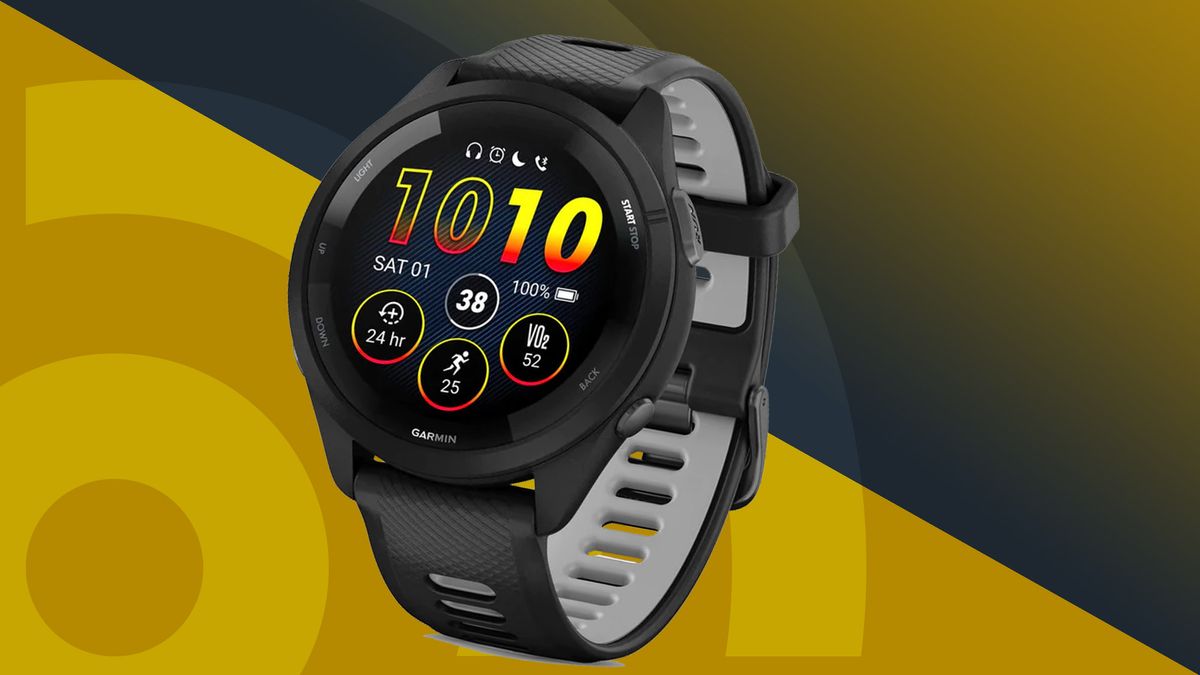

A running watch should make the next mile easier to understand, not bury pace, distance, and recovery behind a maze of menus. The right model can also remove the phone from a morning run, guide a race plan, or tell you when yesterday's workout still matters.
The Best running watch for most people is the Garmin Forerunner 165 Black, thanks to its bright AMOLED display, adaptive training guidance, practical safety features, and compact 43mm design. The ten picks below range from focused running tools to full fitness watches with navigation, music, calls, and extensive health tracking.
Comparison of the best running watches
| # | Product | Award | Display | GPS battery | Best for |
|---|---|---|---|---|---|
| 1 | Garmin Forerunner 165 Black | Best overall | AMOLED touchscreen, 43mm | Up to 19 hours | Most runners |
| 2 | Garmin Forerunner 265 | Best for structured training | AMOLED touchscreen, 46mm | Up to 20 hours | Training plans and racing |
| 3 | COROS PACE 3 | Best battery life | 1.2-inch transflective touchscreen | Up to 38 hours | Long GPS sessions |
| 4 | Garmin Forerunner 55 Black | Best simple running watch | Not specified | Up to 20 hours | New runners |
| 5 | Garmin Forerunner 970 | Best for advanced metrics | AMOLED touchscreen, 47mm | Up to 26 hours | Serious multisport athletes |
| 6 | Garmin vívoactive 5 | Best for all-day wellness | AMOLED, 1.2 inches | Not specified | Fitness and recovery |
| 7 | Amazfit Bip 6 | Best large display | 1.97-inch AMOLED | Not specified | Readable workout data |
| 8 | Garmin Forerunner 165 Whitestone | Best light Garmin alternative | AMOLED touchscreen, 43mm | Up to 19 hours | Smaller wrists |
| 9 | Amazfit Active Max | Best for maps and endurance | 1.5-inch AMOLED | Not specified | Navigation and long routines |
| 10 | Garmin Forerunner 55 Aqua | Best colorful option | Not specified | Up to 20 hours | Runners who want a bright finish |
1. Garmin Forerunner 165 Black: Best Overall
Pros
- Bright AMOLED touchscreen with physical button controls
- Adaptive daily workouts and Garmin Coach plans
- Morning report, recovery data, and HRV status
- Incident detection and Garmin Pay
Cons
- GPS battery life is shorter than the COROS PACE 3
- Smartphone pairing is required for safety messaging and notifications
- The touchscreen is less focused than the Forerunner 55 interface
Best for: runners who want training guidance and smartwatch features in a compact case.
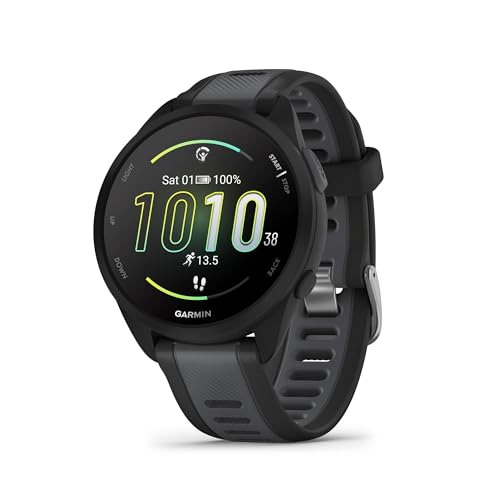
The Forerunner 165 Black is the easiest watch here to recommend to a runner who wants useful coaching without stepping into a specialist training device. It feels like a running watch first, but the 43mm case, touchscreen, traditional buttons, notifications, and Garmin Pay make it comfortable as an everyday smartwatch too. The small, lightweight design is a sensible fit for runners who do not want a bulky computer on the wrist.
Its AMOLED display is the feature you notice immediately. Pace and distance are easier to read at a glance than on a basic screen, while the button controls still give you a reliable way to start and stop activities when your fingers are sweaty. Built-in GPS and wrist-based heart rate cover the essentials, and the battery lasts up to 11 days in smartwatch mode or up to 19 hours in GPS mode.
The training features are unusually helpful for this class of watch. Daily suggested workouts adapt to performance and recovery, while Garmin Coach and race-adaptive plans can shape sessions around a specific event. Training effect and recovery time help explain what a workout did rather than merely recording it. The morning report brings sleep, recovery, training outlook, weather, and HRV status together, though Garmin describes some of these health metrics as close estimations rather than medical measurements.
Compared with the Forerunner 55 Black, the 165 is more polished and informative, especially when you want to read data or follow a training plan from the wrist. The Forerunner 265 adds more advanced training status tools and multi-band GNSS, while the COROS PACE 3 lasts much longer during GPS tracking. The 165 sits in the useful middle: more approachable than the 265 and more capable day to day than the 55.
Its weakness is the dependence on a compatible smartphone for incident detection, Assistance, notifications, and some connected features. The GPS endurance is also not the strongest in this group. For most runners, though, the Forerunner 165 Black has the right balance of display, coaching, size, and everyday convenience. Readers comparing Garmin's running lineup can also see how training guidance changes across different running-focused watches before choosing.
2. Garmin Forerunner 265: Best for Structured Training

Pros
- Multi-band GNSS with SatIQ technology
- Detailed training readiness and training status
- Race-aware daily suggested workouts
- More than 30 built-in activity profiles
Cons
- Larger 46mm case than the Forerunner 165
- Battery life is shorter than the COROS PACE 3
- Several connected features require a smartphone
Best for: runners who train toward races and want their watch to adjust the plan after each workout.
The Forerunner 265 is the more serious training instrument in the Garmin part of this roundup. Its 46mm case gives the data room to breathe, and the AMOLED touchscreen is paired with traditional controls so you can interact with it without relying entirely on taps. It is still described as lightweight, but runners with smaller wrists should compare its dimensions with the 43mm Forerunner 165.
The battery runs for up to 13 days in smartwatch mode and up to 20 hours in GPS mode. That is enough for ordinary training and many long races, though the COROS PACE 3 is the obvious alternative for runners who routinely spend all day tracking outdoors. Multi-band GNSS with SatIQ is the more important distinction for difficult routes, since it is designed to improve positioning in challenging environments while managing battery use.
Garmin makes the 265 particularly useful for a planned training block. You can enter a race and course in Garmin Connect, then see a race widget and personalized daily suggestions on the watch. Those suggestions change after every run to reflect performance and recovery. Training readiness uses sleep quality, recovery, training load, and HRV status, while training status helps frame whether recent work is productive, peaking, or strained.
This is also a better multisport choice than the 165, with more than 30 activity profiles including running, triathlons, cycling, and open-water swimming. Safety and tracking features are available during select outdoor activities when the watch is paired with a compatible phone. Garmin Pay and notifications add convenience, but they do not turn the 265 into a phone replacement.
The main drawback is that its extra training depth can be unnecessary for someone who only wants pace, distance, and occasional heart-rate data. The 165 gives most casual runners a friendlier experience in a smaller case, while the 970 goes much further for athletes who want running dynamics and maps. Choose the 265 when training structure is the reason you are buying a watch, not simply an extra feature.
3. COROS PACE 3: Best Battery Life

Pros
- Up to 38 hours of continuous GPS tracking
- Up to 24 days of daily use
- Dual-frequency satellite chipset
- Route planning and breadcrumb navigation
- Very light 30g design with nylon band
Cons
- Transflective display is less vivid than the Garmin AMOLED models
- Less emphasis on smartwatch extras
- Listed dimensions are not a useful guide to wrist fit
Best for: runners who prioritize low weight, long GPS endurance, and route tracking.
The PACE 3 is the watch for runners who would rather charge less often and carry less on every run. COROS lists a 30g weight with the nylon band and an 11.7mm ultra-slim profile. That combination suits 24-hour wear, especially for people who find larger watches distracting during faster sessions or sleep.
Its always-on 1.2-inch transflective touchscreen takes a different approach from Garmin's bright AMOLED screens. It is designed to remain visible without making the watch feel like a miniature phone, and the backlight has settings for always on, navigation and activity, or navigation only. The display is not as colorful as the Forerunner 165 or 265, but the restrained interface makes the PACE 3 feel purpose-built.
Endurance is its defining advantage. Continuous GPS tracking can last up to 38 hours, while daily use can reach up to 24 days on one charge. That is a substantial step beyond the Garmin Forerunner 55 and Forerunner 165. Its dual-frequency satellite chipset is also intended to maintain accurate tracks in high-rise cities, and the watch records air pressure and elevation gain.
Route planning is handled through the COROS app, where you can build a route or search for a destination before syncing it to the watch. Breadcrumb navigation keeps the path visible alongside activity data. Run, trail run, cycling, swimming, strength, snowboarding, skiing, and cross-country skiing are all supported activity modes, giving it more range than a narrowly focused running device.
The compromise is the surrounding smartwatch experience. The Garmin models offer richer recovery reports, safety tools, notifications, or payments depending on the model, while the PACE 3 keeps attention on sport. Its transflective display will also disappoint anyone expecting the saturated look of an AMOLED panel. For long-distance runners, trail runners, and athletes who dislike frequent charging, those are reasonable trade-offs. Route-focused buyers may also want to compare how navigation features affect an outdoor fitness watch before deciding.
4. Garmin Forerunner 55 Black: Best Simple Running Watch

Pros
- Straightforward running controls
- Up to 20 hours of GPS use
- Suggested workouts based on training history and recovery
- PacePro guidance and race time predictions
- Multiple activity profiles
Cons
- Display technology is not specified in the supplied data
- Lacks the richer AMOLED presentation of newer Garmin models
- Some customization requires Garmin smartphone apps
Best for: new or returning runners who want reliable training basics without a complicated interface.
The Forerunner 55 Black is refreshingly direct. It records how far, how fast, and where you run, monitors heart rate at the wrist, and avoids making every workout feel like a data-analysis project. The watch supports running, track running, virtual running, cycling, pool swimming, Pilates, HIIT, breathwork, and other activities, so it can remain useful after a first training plan is complete.
Battery life is up to two weeks in smartwatch mode and up to 20 hours in GPS mode. That GPS figure matches the Forerunner 265 and exceeds the Forerunner 165 by a small margin, although it cannot match the PACE 3. PacePro offers GPS-based pace guidance for a selected course or distance, with the supplied data noting that it is not compatible with on-device courses. Race time predictions and finish-time estimates add useful context for someone preparing for a first event.
The most valuable feature is its suggested workout system. Recommendations vary in intensity and use training history, fitness level, and recovery time to take some of the guesswork out of a week of running. Advanced wellness features include intensity minutes, fitness age, and all-day respiration. They are useful for spotting patterns, but the watch is not a medical device.
The Forerunner 165 Black is the obvious upgrade if you care about a bright AMOLED screen, morning reports, Garmin Pay, and more polished connected features. The 55 remains easier to understand, and its physical running focus can be an advantage for someone who wants fewer distractions. It also avoids the larger case of the 265 and 970.
The limitation is age and presentation. The supplied data does not specify the display technology, and the watch does not offer the broader training and navigation toolkit of Garmin's newer models. Pick the Black version when you want a low-fuss running companion and do not need maps, calls, music, or an elaborate smartwatch interface.
5. Garmin Forerunner 970: Best for Advanced Metrics

Pros
- Titanium bezel and sapphire lens
- Built-in LED flashlight
- Full-color maps and multi-band GPS
- Running economy and wrist-based running dynamics
- Up to 26 hours in GPS mode
Cons
- Advanced heart and running features may need extra setup
- ECG availability varies by country
- Larger 47mm case is not for every wrist
Best for: experienced runners and multisport athletes who want deep performance metrics and route tools.
The Forerunner 970 is the most ambitious running watch in this group. It combines a bright AMOLED touchscreen with button controls, a titanium bezel, a sapphire lens, and a built-in LED flashlight. The flashlight is a small feature with real appeal for early morning and late-night runners, while the sapphire lens and titanium bezel give the watch a more deliberate, durable feel.
Battery life reaches up to 15 days in smartwatch mode and up to 26 hours in GPS mode. That is the strongest Garmin GPS figure here, though the COROS PACE 3 still lasts longer during continuous tracking. Full-color built-in maps and multi-band GPS make the 970 better suited to unfamiliar routes. Dynamic round-trip routing can create a new route that preserves the same mileage if you leave the original path.
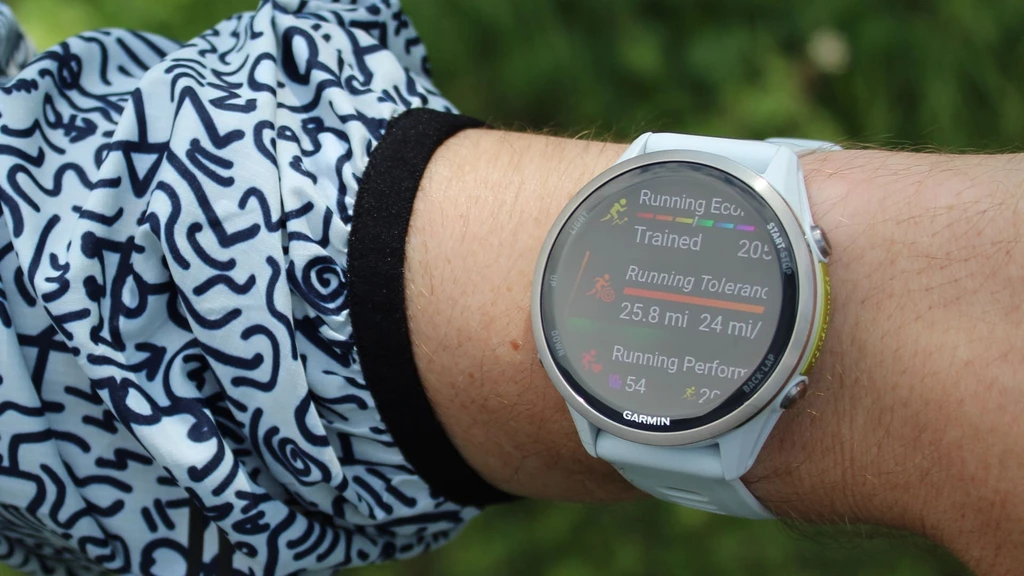
The metrics go well beyond basic pace and distance. Running economy, running tolerance, wrist-based running power, cadence, stride length, and ground contact time give experienced athletes more ways to interpret form and workload. Step speed loss requires the separate HRM 600 monitor, so that particular feature is not a complete out-of-the-box capability. Training readiness draws on sleep, recovery, training load, and HRV status.
The 970 also handles multisport events with automatic transitions between swim, bike, and run. Garmin Coach plans adapt to performance and recovery, and the built-in microphone and speaker enable calls when paired with a smartphone. The ECG app can record heart rhythm and check for signs of atrial fibrillation, but the supplied data limits it to people 22 and older and notes that availability varies by country.
This is more watch than a casual runner needs. The Forerunner 265 covers structured training with less complexity, and the 165 is easier to live with for everyday running. The 970 earns its place for athletes who will actually use maps, advanced dynamics, multisport recording, and training readiness. Skip it if you mainly need a clear pace screen and dependable GPS.
6. Garmin vívoactive 5: Best for All-Day Wellness

Pros
- AMOLED display with up to 11 days of smartwatch battery
- Body Battery, sleep coaching, and nap detection
- More than 30 indoor and GPS sports apps
- Music downloads for phone-free listening
- Wheelchair mode with push tracking
Cons
- Running tools are less specialized than the Forerunner range
- Always-on display reduces battery life to up to 5 days
- Supplied data does not specify GPS battery life
Best for: people who run regularly but want broader health, sleep, and fitness tracking.
The vívoactive 5 is the most balanced wellness watch in the Garmin lineup here. It can track a run, but its purpose is broader: sleep, naps, stress, recovery, strength work, cycling, swimming, golf, yoga, and daily movement all receive attention. Its bright AMOLED display makes everyday information pleasant to read, and the 42mm format keeps it from feeling oversized.
Garmin lists up to 11 days of battery life in smartwatch mode, or up to five days with the display always on. The supplied data does not give a GPS-mode figure, so runners planning long tracking sessions should not assume it will match the Forerunner watches. Music can be downloaded from Spotify, Amazon Music, or Deezer accounts, then played through wireless headphones without carrying a phone.
Body Battery uses sleep, naps, stress, and workouts to estimate when you are ready to push or should rest. Sleep score, sleep coaching, automatic nap detection, HRV status, morning reports, stress tracking, and recovery time make the vívoactive 5 particularly useful for runners whose training decisions depend on how they feel. Garmin notes that several of these metrics are close estimations of tracked data, not medical diagnoses.
The watch includes more than 30 indoor and GPS sports apps, plus preloaded workouts for cardio, yoga, strength, HIIT, and Pilates. Its wheelchair mode tracks pushes instead of steps and includes push and handcycle activities. That makes it more inclusive than a standard running-first watch, and the training library can support a mixed routine.
The Forerunner 165 is a better fit for runners who want daily workout suggestions and race-adaptive plans at the center of the experience. The vívoactive 5 is the better match for someone who wants running alongside sleep, music, recovery, and general fitness. It should be skipped by runners seeking detailed race strategy or advanced running dynamics.
7. Amazfit Bip 6: Best Large Display

Pros
- Large 1.97-inch AMOLED display
- Downloadable maps with turn-by-turn directions
- More than 140 workout modes
- Five-satellite-system support
- Up to 14 days of battery life
Cons
- Large screen may feel oversized on smaller wrists
- Supplied data does not specify GPS battery life
- Health readings are not a substitute for medical care
Best for: runners who want very readable data and a broad set of fitness modes.
The Bip 6 is built around visibility. Its 1.97-inch AMOLED display gives pace, workout controls, and notifications plenty of room, which is useful when glancing at a watch mid-run. The aluminum build is described as lightweight and workout-ready, and the 44mm size gives a clearer sense of its physical footprint than the smaller Garmin models.
Battery life reaches up to 14 days, which makes the Bip 6 practical for runners who dislike daily charging. GPS battery life is not specified in the supplied data, so runners should not compare that figure directly with the Forerunner 55 or COROS PACE 3. The watch supports five satellite systems, downloadable maps, and turn-by-turn directions, giving it useful route capability for a watch in this class.
The activity list is broad, with more than 140 workout modes including HYROX Race and strength training. Personalized AI coaching adds structure, while 50m water resistance makes it suitable for swim-related routines as well. Health tracking covers heart rate, sleep, blood oxygen, and stress, with the practical caveat that these readings are fitness information rather than a diagnosis.
Compared with the Garmin Forerunner 55, the Bip 6 gives you a much larger AMOLED screen and more navigation-oriented features. The Forerunner 165 offers a more developed Garmin training ecosystem, and the COROS PACE 3 remains the stronger endurance choice for long GPS sessions. The Bip 6 makes sense when readability and activity variety matter more than advanced running analysis.
The screen's advantage becomes a drawback on a small wrist, where the 44mm case can dominate. It is also not the clearest pick for runners who want Garmin-style race planning or COROS-style battery endurance. Choose it for easy-to-read training data, broad activity support, and a watch that can handle more than running.
8. Garmin Forerunner 165 Whitestone: Best Light Garmin Alternative

Pros
- Compact 43mm design
- AMOLED touchscreen and physical controls
- Adaptive daily suggested workouts
- Morning report and recovery information
- Incident detection and Garmin Pay
Cons
- GPS battery life is up to 19 hours
- Smartphone pairing is required for several connected tools
- It has the same limitations as the Black version
Best for: runners who want the Forerunner 165 experience in a lighter-looking finish.
The Forerunner 165 Whitestone is functionally the same running smartwatch as the Black version, so the buying decision is about finish rather than capability. Its 43mm case and lightweight design suit runners who want a compact watch, while the AMOLED touchscreen makes workout data much easier to pick out than on a basic running display.
It lasts up to 11 days in smartwatch mode and up to 19 hours with GPS active. That is enough for ordinary training and many races, but it trails the Forerunner 55's stated GPS endurance and falls well behind the PACE 3. Wrist-based heart rate and built-in GPS cover the essential running measurements, and more than 25 activity profiles extend its use to cycling, HIIT, and strength work.
The software is where the 165 earns its place. Daily suggested workouts adapt based on performance and recovery, and Garmin Coach plus race-adaptive training plans can guide preparation for an event. The morning report combines sleep, recovery, training outlook, weather, and HRV status. Training effect and recovery time help connect each workout to the next one instead of treating every run as an isolated activity.
Safety features include incident detection during select outdoor activities and Assistance, which sends live location information to emergency contacts when paired with a compatible smartphone and supported network connection. Smart notifications and Garmin Pay add everyday convenience. Those features are useful, but they should not be mistaken for independent cellular communication.
The Forerunner 165 Black is the straightforward choice if you prefer a darker finish, while the 265 is stronger for advanced training and multi-band positioning. This Whitestone version is best for someone who wants the same compact Garmin running experience with a lighter visual style. Its only meaningful weaknesses are shared with the Black model: limited GPS endurance relative to the COROS and reliance on a phone for connected safety tools.
9. Amazfit Active Max: Best for Maps and Endurance

Pros
- 3, 000-nit 1.5-inch AMOLED display
- Up to 25 days of battery life
- 4GB of storage for music and downloaded maps
- More than 170 workout modes
- Offline maps and turn-by-turn directions
Cons
- Large size may not suit smaller wrists
- Supplied data does not specify GPS battery life
- Some message replies require an Android phone
Best for: runners who want offline maps, a very bright screen, and long everyday endurance.
The Active Max is aimed at runners and outdoor users who want a large, highly visible screen. Its 1.5-inch AMOLED display is rated at 3, 000 nits, a brightness level intended to keep workout data readable in harsh sunlight. The large format will not suit everyone, but it is appealing for runners who want to check maps and metrics without squinting.
Battery life is listed at up to 25 days, although the supplied data does not separate everyday use from GPS tracking. That figure makes the watch attractive for continuous wear and recovery monitoring, while the built-in five-satellite positioning system is intended to support fast, accurate tracking. Free downloadable terrain and ski maps can work offline, which is more useful on remote routes than a watch that depends on a phone connection.
The Active Max stores music and maps in 4GB of onboard storage. Its 170-plus workout modes cover strength sessions, running, and many other activities, while Zepp Coach creates adaptive plans for 3K, 5K, 10K, half marathon, and full marathon goals. BioCharge energy monitoring uses workouts and stress levels to suggest when to push and when to recover.
The watch also has a speaker and microphone for Bluetooth calls. Zepp Flow can reply to instant messages hands-free, but the supplied feature notes require an Android phone for that function. The watch works with iOS and Android more broadly, yet connected features should be checked against the phone you use.
The Amazfit Bip 6 is a simpler alternative with a larger 1.97-inch display, while the Active Max offers more storage, route tools, and training modes. The Garmin Forerunner 970 remains the stronger choice for deep running dynamics and multisport metrics. Choose the Active Max when map access, screen brightness, and long daily battery endurance matter more than a tightly focused race-training ecosystem.
10. Garmin Forerunner 55 Aqua: Best Colorful Option

Pros
- Up to two weeks in smartwatch mode
- Up to 20 hours with GPS active
- Suggested workouts based on recovery
- PacePro guidance and race predictions
- Broad activity profile support
Cons
- Display technology is not specified
- Does not have the Forerunner 165's AMOLED screen
- App-based customization requires a compatible smartphone
Best for: runners who want the Forerunner 55 feature set in an Aqua finish.
The Forerunner 55 Aqua is the same focused running platform as the Black version, with the Aqua finish providing the only meaningful distinction in this dataset. It is a sensible choice for someone who wants a watch that looks less anonymous while keeping the interface centered on running. Wrist-based heart rate and GPS handle the core measurements without requiring a more elaborate smartwatch routine.
Garmin lists up to two weeks in smartwatch mode and up to 20 hours in GPS mode. PacePro provides GPS-based pace guidance for a selected course or distance, although the supplied information says it is not compatible with on-device courses. Race time predictions and finish-time estimates give newer runners a way to set expectations before an event.
Suggested workouts are based on training history, fitness level, and recovery time. That makes the watch more useful than a simple distance recorder, especially for a runner trying to alternate easier and harder days. Running, track running, virtual running, cycling, pool swimming, Pilates, HIIT, and breathwork are among the built-in activity profiles.
The watch also offers intensity minutes, fitness age, all-day respiration, free watch faces, data fields, apps, and widgets through Garmin's connected apps. Customization requires a compatible smartphone, and the heart-rate feature is explicitly not a medical device. These limitations matter if you need independent communication or clinical monitoring.
The Forerunner 165 Whitestone offers a brighter AMOLED display and more modern training reports, while the COROS PACE 3 is better for long GPS outings. The Aqua 55 remains appealing because it keeps the running experience simple and adds PacePro without the larger cases and deeper menus of the premium models. It is the right pick for a runner who wants practical guidance and a more distinctive color.

How to choose the best running watch
The right running watch depends on how much guidance, navigation, battery endurance, and everyday smartwatch functionality you will actually use.
GPS accuracy and route tools
GPS determines how well a watch records distance, pace, and route position. Multi-band or dual-frequency positioning is especially useful around tall buildings, dense tree cover, and complicated urban routes. The Garmin Forerunner 265, Forerunner 970, and COROS PACE 3 all have positioning features aimed at difficult environments, while the Amazfit models add downloadable maps and turn-by-turn guidance.
A basic watch can still be perfectly suitable for familiar roads. If you run trails, travel often, or race in unfamiliar places, look for maps, route planning, breadcrumb navigation, or dynamic rerouting rather than GPS alone.
GPS battery life
Battery figures vary widely between everyday smartwatch use and active GPS tracking. The COROS PACE 3 leads this group with up to 38 hours of continuous GPS tracking, while the Forerunner 970 reaches up to 26 hours and the Forerunner 55 models reach up to 20 hours.
Do not choose based only on the longest smartwatch figure. A runner training for long events should compare the GPS mode directly, since a watch that lasts weeks between casual charges may still need careful charging before a long run.
The best battery figure is the one that covers your longest planned workout with room to spare.
Training guidance and recovery
Suggested workouts can turn a watch from a recorder into a coach. Garmin's Forerunner 55, 165, and 265 models adapt workout recommendations using training history and recovery, while the 265 can incorporate a race and course. The Amazfit Active Max offers Zepp Coach plans for distances from 3K through full marathon.
Recovery information is useful when it changes your decision about today's workout. Body Battery on the vívoactive 5, training readiness on the Forerunner 265 and 970, and recovery time across several Garmin models all provide context, but these are estimates rather than medical measurements.
Display and controls
AMOLED screens are bright, colorful, and easy to read, which makes the Forerunner 165, 265, 970, vívoactive 5, Bip 6, and Active Max appealing for quick glances. The COROS PACE 3 uses a transflective 1.2-inch touchscreen designed for always-on visibility and restrained power use.
A large display is not automatically better. The Bip 6's 1.97-inch screen and the Active Max's 1.5-inch screen help with readability, but smaller wrists may be more comfortable with the 43mm Forerunner 165 or 42mm vívoactive 5. Physical buttons are also valuable when rain, sweat, or gloves make touch controls awkward.
Size and comfort
A watch worn for every run should not feel distracting. The COROS PACE 3 lists a 30g weight with its nylon band, while the Forerunner 165 uses a lightweight 43mm design. The Forerunner 265 is 46mm, the Forerunner 970 is 47mm, and the vívoactive 5 is 42mm.
Case size affects how much information fits on screen and how noticeable the watch feels during sleep. Choose a larger model for maps and dense data only if your wrist can comfortably support it.
Frequently asked questions
Do running watches work without a phone?
GPS running watches can record outdoor routes without carrying a phone. Some features still require a compatible smartphone, including notifications, connected safety messaging, app synchronization, and certain payment or voice functions. Check the individual watch when phone-free use is important.
Which watch has the longest GPS battery life?
The COROS PACE 3 has the longest stated GPS endurance in this group, at up to 38 hours of continuous GPS tracking. The Garmin Forerunner 970 follows with up to 26 hours, while the Forerunner 55 models list up to 20 hours.
Is AMOLED useful on a running watch?
AMOLED displays provide bright colors and strong readability for workout data. They can make maps, pace fields, and notifications easier to see, though an always-on setting can reduce battery life. The COROS PACE 3 uses a transflective display instead, prioritizing continuous visibility and endurance.
Can these watches create running training plans?
Several can. The Forerunner 55 offers suggested workouts, the Forerunner 165 adds Garmin Coach and race-adaptive plans, and the Forerunner 265 adapts suggestions using a race and course entered in Garmin Connect. The Amazfit Active Max offers Zepp Coach plans for several race distances.
Are wrist heart-rate readings medical measurements?
No. The supplied Garmin information identifies the Forerunner 55 as not being a medical device, and Garmin describes several health metrics as close estimations. The Amazfit health features should also be treated as fitness information, not a diagnosis or replacement for professional medical advice.
Which watch is best for trail running?
The answer depends on the route. The COROS PACE 3 offers dual-frequency GPS, route planning, and breadcrumb navigation, while the Garmin Forerunner 970 adds full-color maps, multi-band GPS, and dynamic round-trip routing. The Amazfit Active Max also supports downloadable terrain maps for offline use.
Can running watches play music without a phone?
The Garmin vívoactive 5 supports downloaded music from Spotify, Amazon Music, or Deezer accounts and can connect to wireless headphones. Other connected features vary by model, so confirm music support before choosing a watch specifically for phone-free listening.
The bottom line
The Best running watch for most people is the Garmin Forerunner 165 Black. Its 43mm case, AMOLED screen, adaptive workouts, recovery information, safety tools, and Garmin Pay cover the needs of a wide range of runners without the complexity of the Forerunner 970.
The COROS PACE 3 is the smarter choice for long GPS sessions, low weight, and route-focused training. Runners who need deeper metrics, maps, and multisport tools should step up to the Garmin Forerunner 970, while beginners who want a simpler experience can stay with either Forerunner 55 color option.
If you are undecided, choose the Forerunner 165 unless long GPS endurance or advanced running metrics is your first priority.
As an Amazon Associate we earn from qualifying purchases.