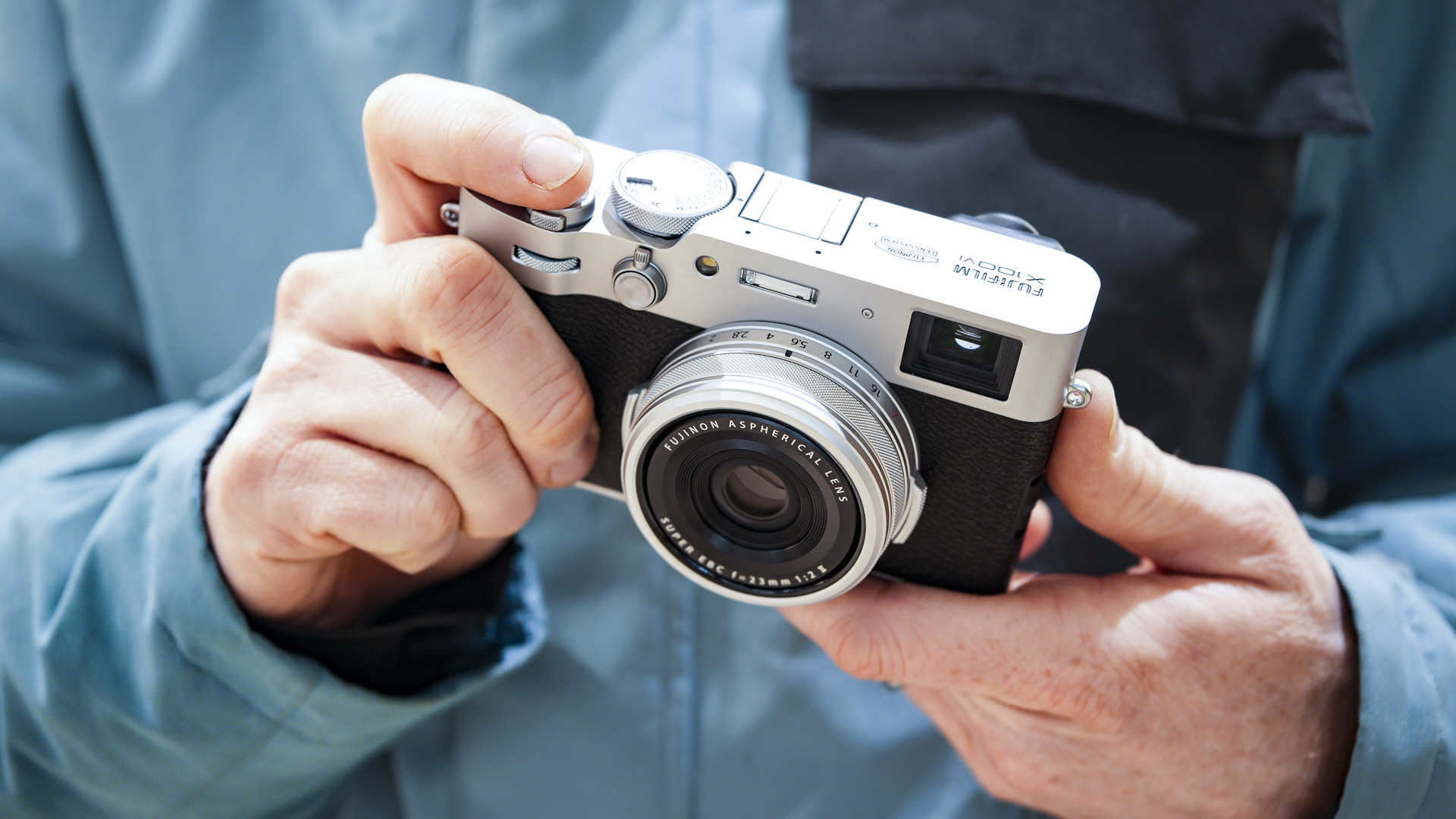

A small camera should make taking pictures easier, not turn every outing into a lesson in menus, lenses, and accessories. The right model slips into a pocket or day bag, focuses without fuss, and gives you a meaningful advantage over a phone in the situations that matter.
Our Best small camera picks range from straightforward Kodak point-and-shoots to rugged waterproof cameras, creator-focused models, a DSLR, and two inexpensive cameras designed for younger photographers. The KODAK PIXPRO FZ55 is the one we'd choose for most people, while the list also includes better options for vlogging, outdoor use, interchangeable-lens photography, and first cameras for children.
Best small camera comparison
| # | Product | Award | Sensor or video | Zoom or lens | Best for |
|---|---|---|---|---|---|
| 1 | KODAK PIXPRO FZ55 | Best overall | 16MP CMOS, 1080p | 5x optical, 28mm wide angle | Everyday photos and travel |
| 2 | KODAK PIXPRO FZ45 | Best for simple shooting | 16MP CMOS, 1080p | 4x optical, 27mm wide angle | Familiar point-and-shoot use |
| 3 | Duluvulu 4K | Best for beginner vlogging | 48MP stills, 4K video | 16x digital | Selfies and casual creators |
| 4 | AUREAPIX 8K | Best for creative features | 96MP stills, 8K video | 20x digital | Beginners who want many modes |
| 5 | KODAK PIXPRO C1 | Best for selfies | 13MP BSI CMOS, 1080p | 26mm fixed lens | Selfies and simple vlogs |
| 6 | KODAK PIXPRO WPZ2 | Best waterproof model | 16MP BSI CMOS, 1080p | 4x optical | Swimming and outdoor adventures |
| 7 | Canon EOS Rebel T7 | Best for photography control | 24.1MP APS-C, Full HD | 18 to 55mm lens | New photographers learning DSLR basics |
| 8 | CAMKORY FHD Kids Camera | Best first camera | 1080p video | 16x zoom | Young children |
| 9 | DJI Osmo Pocket 3 | Best for stabilized video | 1-inch CMOS, 4K at 120fps | Gimbal camera | Serious mobile video |
| 10 | Lecran FHD Kids Camera | Best feature-packed kids model | 44MP stills, 1080p | 16x digital | Kids who want creative modes |
1. KODAK PIXPRO FZ55: Best Overall

Pros
- 5x optical zoom is useful for travel and family scenes
- Rechargeable battery avoids carrying AA cells
- Compact body is easy to keep in a small bag
- 28mm wide-angle lens suits indoor and group photos
Cons
- Full HD video rather than 4K
- LCD is only 2.7 inches
- More limited than a camera with interchangeable lenses
Best for: people who want a straightforward compact camera for everyday photos and trips.
The KODAK PIXPRO FZ55 gets the basic compact-camera experience right. It is small enough to carry without planning around it, but it still gives you a real optical zoom and familiar physical-camera simplicity. For family gatherings, vacations, and quick snapshots, that combination is more useful than a long list of creative modes you may never open.
Its 16MP CMOS sensor is aimed at everyday still photography, while the 5x optical zoom brings distant subjects closer without relying on the softer enlargement of digital zoom. The 28mm wide-angle lens is a practical choice for interiors, group shots, and street scenes. It will not give you the background control of the Canon EOS Rebel T7, but it is much easier to carry and use.
The 2.7-inch LCD is not especially spacious, yet it keeps framing and playback clear enough for a simple point-and-shoot workflow. The FZ55 also records 1080p Full HD video, which is suitable for short travel clips and family moments. Its rechargeable lithium-ion battery is a meaningful advantage over the AA-powered FZ45 because it keeps the camera routine simpler when you are moving between locations.
The limitation is ambition. This is not the camera for someone who wants advanced manual control, high-end low-light work, or polished creator video. The DJI Osmo Pocket 3 is dramatically better for moving footage, and the Canon offers a much broader photographic path through its lens system. The FZ55 wins by being less demanding than both.
For readers comparing small cameras that fit easily into a travel day bag, this is the sensible starting point. Choose it when you want a pocketable camera that feels familiar, has useful optical reach, and does not make a casual photograph feel like a project.
2. KODAK PIXPRO FZ45: Best for Simple Shooting

Pros
- Simple controls suit casual photographers
- 4x optical zoom is more useful than phone cropping
- 27mm lens gives a slightly wider view
- Uses two AA alkaline batteries
- Lightweight body is easy to carry
Cons
- AA batteries add another item to pack
- Smaller zoom range than the FZ55
- No flip screen for self-facing video
Best for: anyone who wants a familiar compact camera with replaceable batteries.
The KODAK PIXPRO FZ45 is the uncomplicated alternative to the FZ55. It is the camera we'd hand to someone who wants a shutter button, a zoom control, and a screen without having to understand a creator mode or a complex autofocus system. That restraint is its main appeal.
The 16MP CMOS sensor handles the everyday assignment: people, places, pets, and quick holiday photos. Its 4x optical zoom is genuinely useful when you cannot move closer, and the 27mm wide-angle lens gives you a little more room for indoor scenes and group pictures than the FZ55's 28mm lens. The difference is small, but it is helpful when a room or viewpoint feels cramped.
A 2.7-inch LCD handles composition and playback, and the camera records 1080p Full HD video for short clips. The FZ45's most distinctive practical feature is its use of two AA alkaline batteries. That makes replacement easy in places where charging is inconvenient, although it also means the camera depends on carrying spare cells. The FZ55's rechargeable battery is neater for regular travel.
At 3.66 inches long, 2.37 inches wide, and 1.13 inches high, the FZ45 remains easy to stow. Its listed weight is 0.25625 pounds, so it should not weigh down a small bag. It is not as suited to selfies as the C1, and the Duluvulu 4K offers a flip screen and extra creator functions. The FZ45 is better when the priority is ordinary photography with minimal distraction.
This is a good choice for a relative who wants a dedicated camera instead of a phone, or for a traveler who prefers replaceable batteries. Skip it if you want a rechargeable setup or need more reach. For a clear explanation of when a dedicated camera still makes sense beside a phone, its basic design is exactly the point.
3. Duluvulu 4K: Best for Beginner Vlogging

Pros
- 4K video and 48MP still-image mode
- 3-inch screen flips 180 degrees
- Autofocus and webcam functionality are useful for beginners
- Includes two rechargeable batteries
- Anti-shake and creative modes encourage experimentation
Cons
- 16x zoom is digital rather than optical
- Specification-heavy design may feel less simple than a Kodak
- No optical zoom for distant subjects
Best for: beginners who want a small camera for selfies, casual videos, and online calls.
The Duluvulu 4K is built around the idea that a small camera should do more than take conventional snapshots. Its 3-inch IPS screen flips 180 degrees, so the person in front of the camera can see the composition while recording. That immediately makes it more practical for solo vlogging and self-recorded clips than the FZ45 or FZ55.
The camera offers 48MP still images and 4K video, alongside autofocus and 16x digital zoom. The image numbers sound ambitious, but the important distinction is that the zoom is digital. It can help frame a distant subject, but it does not provide the same optical detail as the FZ55's 5x zoom. For talking-to-camera clips, short social videos, and creative experiments, its feature set is more relevant than long-distance image quality.
Its modes include exposure compensation from -3.0 to +3.0, time-lapse, slow motion, continuous shooting, smile and face detection, a self-timer, beauty effects, filters, and a fill light. That is a lot for a beginner camera, but the features have a clear purpose: they give a new user things to try without adding lenses or other equipment. The camera can also act as a webcam when connected to a computer.
Two rechargeable batteries are included, which is useful during a day of recording. The Duluvulu is a better fit for a teenager making casual videos than the FZ55, while the AUREAPIX 8K offers a larger 3.5-inch flip screen and more modes. The Kodak cameras remain better for someone who simply wants dependable point-and-shoot stills.
The weakness is that its broad feature list does not change the limits of a small digital camera with digital zoom. Buyers seeking the cleanest moving footage should look at the DJI Osmo Pocket 3, whose 3-axis mechanical stabilization is in another class. Choose Duluvulu when a flip screen, webcam mode, two batteries, and beginner-friendly creative tools matter more than optical reach.
4. AUREAPIX 8K: Best for Creative Features

Pros
- 3.5-inch 180-degree flip LCD
- Wi-Fi transfer through the Viipulse app
- Autofocus, HDR, anti-shake, and slow motion
- Webcam functionality for streaming and calls
- Includes two batteries and 60 filters
Cons
- 20x zoom is digital
- Listed dimensions are larger than the other compact point-and-shoots
- Many features may overwhelm a first-time user
Best for: beginner creators who want Wi-Fi sharing and a broad collection of shooting modes.
The AUREAPIX 8K is the most feature-heavy traditional-looking camera in this roundup. Its appeal is not just the headline resolution. It is the way the camera combines a large flip screen, Wi-Fi transfer, webcam mode, autofocus, and a collection of effects for someone who wants to explore content creation without starting with a complicated interchangeable-lens system.
The camera is described as producing 96MP stills and 8K video, with a 20x digital zoom controlled by a W/T rocker. That zoom can help a beginner compose a distant subject, but it should not be confused with the optical zoom on the Kodak FZ55 or FZ45. Digital reach is most useful when convenience matters more than preserving fine detail.
A 3.5-inch 180-degree flip LCD is generous for this class and gives solo creators a better view when framing themselves. Built-in Wi-Fi can transfer content to a phone through the Viipulse app for sharing to services such as YouTube, TikTok, or Facebook. The camera also supports webcam use, HDR imaging, anti-shake, slow motion, continuous shooting, self-timer functions, and 60 filters.
There is a physical trade-off. The listed dimensions are 6.9 inches high, 4.53 inches long, and 6.9 inches wide, which do not sound especially pocket-friendly even though the product information describes it as ultra-compact. That makes the AUREAPIX less compelling for someone searching for the smallest possible everyday camera. The Duluvulu is a simpler creator option, while the DJI is far stronger for stabilized video.
The AUREAPIX suits a beginner who enjoys trying filters, transfer tools, and different recording modes. It is not the one we'd choose for a clean, quiet travel kit or serious still photography. If your priority is creative flexibility and a screen you can easily see while filming, its unusually broad feature set is the reason to choose it.
5. KODAK PIXPRO C1: Best for Selfies
Pros
- Bright f/2.0 fixed wide-angle lens
- 180-degree tilting screen
- USB-C charging
- Compact, lightweight body
- 1080p video for casual clips
Cons
- Fixed lens has no optical zoom
- 13MP sensor has less resolution than the FZ45 and FZ55
- Not designed for distant subjects
Best for: selfie photos, simple vlogs, and people who prefer a fixed wide-angle view.
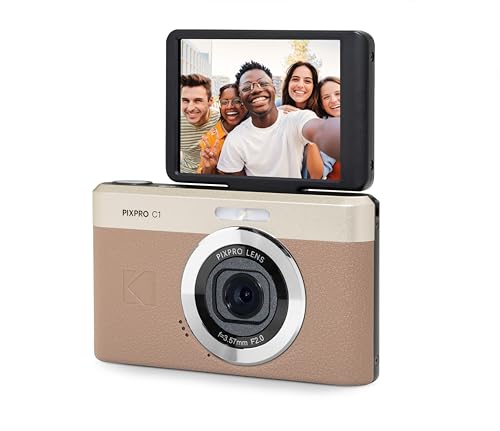
The KODAK PIXPRO C1 takes a different route from the zoom-equipped FZ models. Instead of trying to cover every framing situation, it uses a fixed wide-angle lens and a tilting screen. That makes it less versatile for travel scenes, but more immediately useful when the camera is pointed back at its owner.
Its 13MP BSI CMOS sensor pairs with a bright f/2.0 lens. The wide aperture can help the camera gather light in ordinary indoor scenes, while the 26mm focal length gives selfies and group shots breathing room. The camera also offers 4x digital zoom, but that is best treated as a framing convenience rather than a replacement for optical reach.
The 2.8-inch LCD tilts 180 degrees, making it easier to frame a selfie, vlog, or group shot from the front of the camera. It records 1080p Full HD video, so this is a casual content camera rather than a high-resolution video tool. USB-C charging is a welcome modern touch, especially for people who already carry a compatible charging cable.
At 4.05 inches wide, 2.36 inches high, and 0.79 inches deep, the C1 is shaped more like a slim carry-along camera than the larger creator models. Its listed weight is 0.253125 pounds. The FZ55 is the stronger all-purpose choice because its 5x optical zoom handles more situations, but the C1 is easier to recommend for self-facing use.
The fixed lens is also the reason to skip it if you photograph wildlife, sports, or distant landmarks. It cannot optically bring those subjects closer. Pick the C1 when the best shot is likely to be a selfie, a group portrait, or a quick vlog and when USB-C charging and a bright lens matter more than flexibility.
6. KODAK PIXPRO WPZ2: Best Waterproof Model

Pros
- Waterproof to 15 meters
- Shockproof from 2-meter drops
- Dustproof body for beaches and trails
- 4x optical zoom
- Built-in Wi-Fi and 1080p video
Cons
- Heavier than the FZ45 and FZ55
- Waterproof design is specialized rather than universal
- Uses microSD and microSDHC cards
Best for: swimmers, snorkelers, skiers, and travelers who need a camera for wet or dusty conditions.
The KODAK PIXPRO WPZ2 is the clear choice when the environment matters more than having the thinnest camera. It is waterproof to 15 meters, shockproof from drops up to 2 meters, and dustproof. Those protections let it go to places where an ordinary compact camera needs a case or should stay in the bag.
Its 16MP BSI CMOS sensor is paired with a 4x optical zoom. That gives the WPZ2 the same kind of useful optical framing advantage found in the FZ45, while the backside-illuminated sensor is intended to help in challenging outdoor light. It records 1080p HD video, including footage for water sports and outdoor activity.
Built-in Wi-Fi lets you transfer images to a phone or use the phone as a remote viewfinder. That can be useful for group photos when the camera is set up away from the action. The rechargeable lithium-ion battery is more convenient for extended outings than carrying AA cells, and microSD or microSDHC card support keeps storage physically small.
The WPZ2 is listed at 4.06 inches wide, 2.62 inches high, and 2.06 inches long, with a weight of 0.388125 pounds. It is still compact, but noticeably less featherweight than the FZ55. Its rugged construction is the reason to choose it, not a reason to expect the same slim feel as a standard point-and-shoot.
For readers considering camera features that matter on wet and active trips, the WPZ2 makes the most sense when water, dust, or drops are likely. Skip it for ordinary indoor snapshots if you have no need for protection. The FZ55 is more pleasant for general use, but it cannot follow you underwater.
7. Canon EOS Rebel T7: Best for Photography Control

Pros
- 24.1MP APS-C CMOS sensor
- Interchangeable EF and EF-S lens compatibility
- Optical viewfinder
- Built-in Wi-Fi and NFC
- 9-point autofocus with AI Servo AF
Cons
- Much larger and heavier than the compact cameras
- DSLR design is less immediate for casual snapshots
- Full HD video rather than 4K
Best for: beginners who want to learn photography with a real lens system and optical viewfinder.
The Canon EOS Rebel T7 only belongs in a small-camera roundup with an important qualification: it is small compared with many full-size camera kits, not small in the pocket-camera sense. It is the largest and heaviest product here, yet it offers the most conventional path into photography control.
Its 24.1MP CMOS sensor uses the APS-C format, which is substantially different from the small sensors in the compact point-and-shoot models. The included EF-S 18 to 55mm lens covers a useful range from wide scenes to short telephoto framing. More importantly, the camera can accept compatible Canon EF lenses, excluding EF-M lenses, so the system can grow as the photographer learns.
The optical viewfinder provides approximately 95 percent viewing coverage, and the 9-point autofocus system includes AI Servo AF. Those controls are useful for someone who wants to understand focus behavior, framing, and lens choice rather than leaving every decision to a compact camera's automatic modes. Built-in Wi-Fi and NFC make transferring images more convenient, while Full HD video and EOS Utility Webcam Beta Software add practical flexibility.
The body measures 5.1 inches wide, 4 inches high, and 3.1 inches deep, with a listed weight of 1.04 pounds before considering a larger lens. That is not a carry-in-your-pocket camera. The FZ55 is far easier to take everywhere, and the DJI Osmo Pocket 3 is a much better fit for stabilized moving video.
The T7 is the right answer for a beginner who wants photography to become a skill rather than just a way to record moments. It is the wrong answer for a child, a casual traveler, or anyone who specifically wants a camera that disappears into a pocket. Choose it only if the interchangeable-lens system and optical viewfinder justify carrying more.
8. CAMKORY FHD Kids Camera: Best First Camera

Pros
- Simple design aimed at kids and teens
- 1080p Full HD video
- 16x zoom function
- Includes a 32GB card
- Package includes batteries, bag, lanyard, adapter, and cable
Cons
- Product information provides few detailed camera specifications
- Digital zoom is less useful for preserving detail
- Less suitable for adults seeking manual control
Best for: a child who wants a simple camera with basic video and an included accessory bundle.
The CAMKORY FHD Kids Camera is built around a simple first-camera idea. It is intended for boys, girls, and teens who want to take pictures and videos independently, without the cost or complexity of an adult camera system. The pink finish reinforces that it is being positioned as a gift, but the more useful detail is the straightforward package.
The listed capabilities include 1080p video, 16x zoom, and a flash. The dataset does not provide a sensor resolution or screen specification, so it would be misleading to make stronger image-quality claims. The 16x zoom should be understood as a digital zoom function, which can enlarge a distant subject but will not behave like the optical zoom on the Kodak FZ55.
The package includes a 32GB card, lanyard, storage bag, batteries, adapter, cable, and an embellished box. That means a child can begin using the camera without assembling a separate set of basic accessories. The listed weight is about 0.35 pounds, and the product information describes the size as compact.
The compromise is control. This is not a camera for learning aperture, lenses, or autofocus behavior, and the sparse technical information makes it difficult to compare directly with the FZ45 or FZ55. The Lecran FHD Kids Camera offers a richer set of stated creative functions, including anti-shake, time-lapse, and webcam capability.
Choose CAMKORY when the goal is a first camera that is uncomplicated and ready to give. It works best for a child who wants to experiment with taking pictures, rather than a young photographer who is already asking for advanced controls.
9. DJI Osmo Pocket 3: Best for Stabilized Video

Pros
- 1-inch CMOS sensor
- 4K video at 120fps
- 3-axis mechanical stabilization
- Rotating 2-inch touchscreen
- ActiveTrack 6.0 subject tracking
- Supports DJI Mic 2 and Mic Mini transmitters
Cons
- Primarily a video camera rather than a traditional point-and-shoot
- Gimbal mechanism needs careful handling
- More features than a casual stills shooter may need
Best for: vloggers and travelers who want smooth moving footage in a genuinely small body.
The DJI Osmo Pocket 3 is the most capable video tool here, and it is also one of the easiest to carry. Its tall, narrow body measures about 5.5 inches long, 1.66 inches wide, and 1.32 inches high, with a listed weight of roughly 0.395 pounds. It is pocketable in a way the Canon EOS Rebel T7 is not, but its real advantage appears when the camera is moving.
A 1-inch CMOS sensor records 4K video at up to 120fps. That combination gives the Pocket 3 a stronger foundation for detailed video and slow-motion work than the 1080p Kodak models. The rotating 2-inch touchscreen supports both horizontal and vertical shooting, so the camera can adapt to conventional video, social clips, and self-facing recording without an awkward framing compromise.
The 3-axis mechanical stabilization is the feature that changes the experience most. It is designed to keep footage smooth while walking, dancing, hiking, or following pets. ActiveTrack 6.0 helps keep a subject centered, and the camera can focus quickly on moving or still subjects. Stereo recording, D-Log M, and 10-bit color depth add options for creators who want to shape their footage later rather than accepting a finished-looking image straight from the camera.
The Pocket 3 can connect directly to two DJI Mic 2 or Mic Mini transmitters, which is useful for interviews, vlogs, and livestreams. It includes a protective cover, wrist strap, and a handle with a 1/4-inch thread. Those details make it more ready for a creator workflow than the Duluvulu or AUREAPIX, though the setup is less instantly simple than a Kodak point-and-shoot.
The weakness is specialization. If you mainly want still photos and a traditional zoom, the FZ55 is easier to understand and carry around for casual shooting. The Pocket 3 is the one to choose when video is the priority, especially if smooth walking footage, tracking, rotating framing, and better audio options matter. For a broader look at how different compact designs handle travel shooting, this is the most video-first option in the group.
10. Lecran FHD Kids Camera: Best Feature-Packed Kids Model

Pros
- 44MP still-image mode and 1080p video
- Two rechargeable batteries
- Includes a 32GB SD card
- Anti-shake, time-lapse, slow motion, and webcam modes
- Two-year satisfaction warranty is stated
Cons
- 16x zoom is digital
- The feature list may be more than a very young child needs
- Product information does not state the screen size
Best for: kids and teens who want filters, video modes, and more ways to experiment.
The Lecran FHD Kids Camera is the more adventurous alternative to the CAMKORY. It is still designed for children, teens, students, and beginners, but its feature list gives a young photographer more to explore. The camera is described as ultra-compact and includes a lanyard, bag, Type-C cable, charger adapter, 32GB SD card, and two rechargeable batteries.
It records Full HD 1080p video and offers a stated 44MP still-image mode. It also includes anti-shake and a 16x digital zoom. As with the other inexpensive creator-style cameras here, the digital zoom is a convenience rather than an optical substitute. It can make a distant subject larger on screen, but the FZ55 remains the better choice when optical detail and predictable framing matter.
The creative tools are the main attraction. Lecran lists filters, timestamping, self-timer, time-lapse, slow motion, continuous shooting, motion detection, face detection, webcam capability, and automatic turn-off. That gives children plenty of ways to make the camera feel like a creative toy as well as a recording device. Two rechargeable batteries are more convenient for vacations and camping than relying on a single battery.
The camera's stated dimensions are limited to a weight of about 0.6 pounds, and no screen size is supplied in the product information. That makes it important not to assume the handling experience is identical to another kids camera. The CAMKORY is the simpler gift, while Lecran is the better fit for a child who will actually use filters, slow motion, or webcam mode.
This is not an adult camera and should not be chosen for serious still photography. It is a good first device for a child who wants more control than a basic shutter-and-video toy provides. Pick it when rechargeable power, included storage, and creative modes matter more than optical zoom or advanced image quality.
How to choose best small camera
The right small camera depends less on the biggest number in its title and more on how you plan to carry, frame, and share what you shoot.
Size and weight
A genuinely pocketable camera should be easy to take along without a dedicated camera bag. The KODAK PIXPRO FZ45, FZ55, and C1 are especially compact, while the Canon EOS Rebel T7 is portable only by DSLR standards. The DJI Osmo Pocket 3 has a narrow body that makes it unusually easy to carry despite its advanced video hardware.
Check the full body dimensions, not just a label such as compact or ultra-compact. A flip screen, lens housing, or gimbal can change how easily a camera fits into a pocket.
Optical and digital zoom
Optical zoom changes the lens's view and preserves more useful detail as you frame a distant subject. The FZ55's 5x optical zoom and the FZ45 and WPZ2's 4x optical zoom are meaningful advantages for travel and family photography.
Digital zoom enlarges part of the image after capture or during framing. It can be handy for casual use, but it should not be judged by the same standard as optical zoom. The 16x and 20x figures on the creator and kids cameras are convenience features, not evidence of long-lens performance.
A small camera is most useful when its zoom solves a real framing problem, not when its largest number wins the specification sheet.
Video and stabilization
For occasional clips, 1080p Full HD is enough, and it is available on the Kodak models, Canon, and kids cameras. Creators should look for a flip screen, webcam mode, and a way to transfer footage easily. The Duluvulu and AUREAPIX focus on those conveniences.
Stabilization matters when the camera moves. Digital anti-shake can help, but the DJI Osmo Pocket 3's 3-axis mechanical stabilization is a more fundamental solution for walking and action footage. Its 4K at 120fps recording also gives it a much higher video ceiling than the 1080p models.
Screen design
A conventional LCD is fine when the camera is held behind the photographer. A 180-degree flip or tilting screen is much more useful for selfies, group shots, and vlogs because it lets you see the composition from in front of the lens.
The C1 has a 2.8-inch screen that tilts 180 degrees, the Duluvulu has a 3-inch 180-degree flip screen, and the AUREAPIX offers a 3.5-inch 180-degree flip LCD. The DJI uses a rotating 2-inch touchscreen for horizontal and vertical video. Choose based on how often you will face the camera toward yourself.
Battery and storage
Battery type affects how easy the camera is to keep running. The FZ45 uses two AA alkaline batteries, while the FZ55, C1, WPZ2, and creator cameras use rechargeable batteries. The kids models in this list include two rechargeable batteries, which is helpful for long days.
Storage support also matters. The FZ45 and FZ55 support Class 10 SD, SDHC, and SDXC cards up to 512GB. The WPZ2 uses microSD and microSDHC cards. Several kids and creator products include a card, but confirm what the camera supports before buying extra storage.
Frequently asked questions
What is the best small camera for travel?
The KODAK PIXPRO FZ55 is the strongest general travel pick because it combines a compact body, 5x optical zoom, a 28mm wide-angle lens, and a rechargeable battery. Choose the WPZ2 instead when swimming, rain, dust, or drops are part of the trip.
Is a small camera better than a phone?
It can be better when you want optical zoom, a dedicated physical shutter, or a device that does not compete with your phone for battery and storage. The advantage depends on the model. The FZ55 adds useful optical reach, while the DJI Osmo Pocket 3 offers stabilization and creator controls that are not the same as a basic phone camera.
Which small camera is best for vlogging?
The DJI Osmo Pocket 3 is the strongest vlogging choice because it has 3-axis mechanical stabilization, a rotating screen, ActiveTrack 6.0, 4K at 120fps, and support for DJI wireless transmitters. The Duluvulu and AUREAPIX are simpler options for beginners who want a flip screen and webcam mode.
Do digital zoom numbers matter?
Digital zoom numbers should not be compared directly with optical zoom. Digital zoom enlarges the image and can reduce useful detail, while optical zoom changes the lens framing before the image is captured. For distant subjects, the FZ55's 5x optical zoom is more meaningful than a kids camera's 16x digital zoom.
Which camera is easiest for a child to use?
The CAMKORY FHD Kids Camera is the simplest first-camera option in this group, with 1080p video, a 16x zoom function, and a package that includes a card and basic accessories. The Lecran is better for an older child who wants filters, time-lapse, slow motion, webcam use, and other creative modes.
Is the Canon EOS Rebel T7 small enough for everyday carrying?
The Canon EOS Rebel T7 is compact compared with larger DSLR kits, but it is not pocket-sized. Its 5.1-inch width, 4-inch height, 3.1-inch depth, and 1.04-pound listed weight make it a better choice for someone who accepts a larger camera in exchange for an APS-C sensor, optical viewfinder, and interchangeable lenses.
Which small camera is best for underwater photography?
The KODAK PIXPRO WPZ2 is the clear choice because it is waterproof to 15 meters, shockproof from 2-meter drops, and dustproof. Its 4x optical zoom and 1080p video make it useful above and below the water, where a standard compact camera would need extra protection.

The bottom line
The KODAK PIXPRO FZ55 is our top recommendation for the Best small camera because it is compact, uncomplicated, and more versatile than the basic kids and fixed-lens models. Its 5x optical zoom, 28mm wide-angle lens, 16MP sensor, and rechargeable battery cover the everyday situations most people actually encounter.
Choose the DJI Osmo Pocket 3 instead when moving video is the priority. Its 1-inch sensor, 4K at 120fps recording, 3-axis mechanical stabilization, rotating screen, and subject tracking make it a much more serious creator tool. For children, the CAMKORY and Lecran offer simpler paths into photography, while the WPZ2 is the specialist pick for water and rough conditions.
If you are undecided, choose the FZ55 for photos, the Pocket 3 for video, and the WPZ2 when the camera has to survive the elements.
As an Amazon Associate we earn from qualifying purchases.