

Thin TV speakers make dialogue disappear under music, effects, and the low rumble of a film soundtrack. A good all-in-one bar solves that without forcing you to build a receiver system, and a built-in or included subwoofer gives movies the weight a TV cannot.
We compared eight genuine soundbar systems, from compact one-piece designs to surround packages with wireless bass and rear speakers. The Best soundbar with integrated subwoofer for most living rooms is the ULTIMEA Poseidon M60, while the Yamaha SR-B30A is the cleanest one-piece alternative.
Comparison table
| # | Product | Award | Channels | Bass design | Connections | Best for |
|---|---|---|---|---|---|---|
| 1 | ULTIMEA Poseidon M60 | Best overall | 5.1 | Wired subwoofer | HDMI eARC, Bluetooth 5.4 | Immersive movie sound |
| 2 | ULTIMEA Wireless Subwoofer Soundbar | Best wireless bass | 2.1 | Wireless subwoofer | Bluetooth 6.0, app control | Easy room placement |
| 3 | TCL S55H | Best for smart TV setups | 2.1 | Wireless subwoofer | HDMI eARC/ARC, optical, Bluetooth, AUX | Small and medium rooms |
| 4 | Saiyin 2.1 Soundbar | Best simple setup | 2.1 | Dedicated subwoofer | Optical, Bluetooth, AUX | Basic TV and PC audio |
| 5 | LG S40TR | Best surround package | 4.1 | Wireless subwoofer | TV and app control | Full-room surround |
| 6 | Yamaha SR-B30A | Best one-piece design | 2.1 | Built-in subwoofers | HDMI eARC/ARC, Bluetooth | Minimalist living rooms |
| 7 | Samsung HW-B400F | Best compact bar | 2.0 | Built-in woofer | Wireless TV connection | Smaller TVs and bedrooms |
| 8 | Saiyin Detachable Soundbar | Best flexible design | Not specified | Subwoofer included | HDMI-ARC, optical, AUX, Bluetooth 5.3 | Wide stereo separation |
1. ULTIMEA Poseidon M60: Best Overall

Pros
- Real 5.1-channel Dolby Atmos support
- Side-firing drivers widen the soundstage
- Strong wired wooden subwoofer
- Extensive app EQ and surround controls
Cons
- The subwoofer requires a cable
- More setup complexity than a one-piece bar
- No rear speakers included
Best for: movie fans who want convincing surround sound without placing rear speakers around the room.
The ULTIMEA Poseidon M60 is the most ambitious system here. It is not simply a TV speaker with extra bass. Five built-in speakers, including two side-firing drivers, create a broader front soundstage, while Dolby Atmos and 5.1-channel processing give films more height and movement. The result should feel much larger than the slim bar itself, particularly in front of a TV where a conventional stereo bar can sound narrow.
The dedicated wooden subwoofer is wired, which is the main practical compromise, but its 5.3-liter tuned cabinet and 18 mm high-excursion driver give the low end a more substantial foundation than the compact built-in woofer designs from Samsung and Yamaha. ULTIMEA lists up to 300W peak output, a 45 Hz to 18 kHz frequency response, and a maximum SPL of 99 dB. Those figures point to enough headroom for energetic action scenes, while the separate enclosure keeps bass from competing with voices in the bar.
HDMI eARC matters here because it can carry higher-bandwidth, lossless Dolby Atmos audio than standard ARC. The app is unusually configurable for this group, with a 10-band graphic EQ, 121 sound presets, and 13 surround-level adjustments. VoiceMX processing focuses on the 120 Hz to 6 kHz vocal region, which is useful when dialogue gets buried by soundtrack or effects. Bluetooth 5.4 handles wireless music playback.
Compared with the wireless ULTIMEA system below, the Poseidon M60 offers more channels and more surround control, but it gives up cable-free subwoofer placement. The TCL S55H is tidier and includes automatic room calibration, while the M60 has the stronger channel count and greater tuning range. Skip this one if you want a completely uncluttered setup or cannot route a cable to the subwoofer. For film-first buyers who want the fullest front-stage presentation, it is the clear lead pick.
2. ULTIMEA Wireless Subwoofer Soundbar: Best Wireless Bass

Pros
- Wireless subwoofer placement
- Useful app-based sound customization
- Clear dialogue processing
- Bluetooth 6.0 streaming
Cons
- Only a 2.1-channel layout
- No Dolby Atmos or HDMI eARC listed
- Less immersive than the Poseidon M60
Best for: viewers who want stronger bass while keeping the subwoofer free from audio cables.
The ULTIMEA Wireless Subwoofer Soundbar makes the most sense when placement is the problem. Its subwoofer connects to the bar without an audio cable, so it can sit beside a sofa, near a wall outlet, or in another position that gives the room better low-frequency coverage. That freedom is more useful than it sounds in small living rooms, where a wired bass module can leave the entire system constrained by one cable.
This is a 2.1-channel system, so it does not create the same front-to-back effect as the Poseidon M60. It is built around a soundbar and a dedicated subwoofer, with up to 240W peak output and a listed 45 Hz to 18 kHz frequency response. The subwoofer uses an 18 mm high-excursion driver and a 6.5-liter tuned cabinet, and ULTIMEA says its BassMX processing targets the 45 Hz to 150 Hz range. That combination should add impact to a soundtrack without asking the thin bar to reproduce every low note.
Dialogue gets its own attention through VoiceMX, which dynamically works across the stated 120 Hz to 6 kHz vocal range. The app is the standout control feature. A 10-band equalizer and 121 preset EQ matrices give this system far more flexibility than the three fixed modes on the Saiyin 2.1 Soundbar. Bluetooth 6.0 is also listed for phone, tablet, and laptop streaming, with an emphasis on pairing speed and connection stability.
The TCL S55H is a better fit if Dolby Atmos, DTS Virtual:X, HDMI eARC, or automatic room calibration matters more than app depth. The ULTIMEA is the better choice when bass placement and wireless convenience come first. Its weakness is the lack of a stated high-bandwidth TV connection and its conventional 2.1 presentation. Choose it for straightforward TV, music, and gaming audio in a room where cable-free bass placement will make installation easier.
3. TCL S55H: Best for Smart TV Setups

Pros
- Dolby Atmos and DTS Virtual:X
- Automatic room calibration
- HDMI eARC/ARC plus optical, Bluetooth, and AUX
- Low-profile bar and wireless subwoofer
Cons
- 2.1 channels cannot match a rear-speaker system
- Larger bass module needs floor space
- App setup is required for calibration
Best for: smart TV owners who want broad connectivity and easy room-specific tuning.
The TCL S55H is the balanced middle ground in this group. It gives you a wireless subwoofer, modern surround formats, and a slim bar that should sit neatly below most televisions. The bar measures 31.89 inches wide and 2.36 inches high, so it avoids the bulky look of some larger home theater packages. Its subwoofer is 7.68 inches wide, 12.60 inches high, and 7.68 inches deep, which is compact enough for many rooms but not something to hide on a narrow shelf.
Dolby Atmos and DTS Virtual:X handle the spatial side of the presentation. They cannot replace physical rear speakers, so the LG S40TR remains the stronger pick for sound coming from behind the listener. TCL counters with AI Sonic auto room calibration, which adjusts the audio to the room layout and listening position through the TCL app. That feature is particularly helpful when the sofa is off-center or the bar has to sit in an awkward media console.
HDMI eARC/ARC is the main connection, with optical, Bluetooth, and AUX available when a TV or projector lacks HDMI. The included remote provides direct control, and the package includes an HDMI cable, a wall-mount kit, and remote batteries. Those details reduce the number of small installation decisions that often make a soundbar feel more complicated than it should.
The TCL S55H has a more complete TV connection story than the second-place ULTIMEA and a cleaner calibration feature set than the Saiyin models. It does not have the M60’s five built-in speakers or the LG’s rear units, and its subwoofer still takes up meaningful floor space. Readers comparing TV compatibility can also see how different TV connection options affect soundbar setup. Pick the TCL when you want current surround processing and easy setup without stepping up to a full four-speaker package.
4. Saiyin 2.1 Soundbar: Best Simple Setup

Pros
- Dedicated subwoofer adds punch
- Optical and AUX cables are included
- Three straightforward sound modes
- Bluetooth and Fire TV remote compatibility
Cons
- No Dolby or DTS format support
- Remote is not compatible with universal remotes
- Limited tuning compared with app-controlled models
Best for: TV or PC owners who want a basic bar, separate bass module, and uncomplicated controls.
The Saiyin 2.1 Soundbar is refreshingly direct. The box includes the soundbar, subwoofer, remote, optical cable, AUX cable, mounting brackets, screws, and other basic setup pieces. Connect it by optical or 3.5 mm AUX, choose a mode, and the system is ready for TV or computer audio. Bluetooth adds a convenient way to stream from a phone or laptop.
Its dedicated subwoofer is the reason to choose it over a bare compact bar. Saiyin describes a large-cavity design intended to produce fuller bass, while the soundbar uses a 28-degree sound dispersion angle to spread audio across nearby seating positions. The dimensions listed for the soundbar are 17.55 inches long, 5.71 inches high, and 12.52 inches wide, although the unusually broad measurement suggests buyers should check the orientation and available space before mounting.
There are three equalizer modes for movies, music, and news. A three-color LED identifies optical, Bluetooth, and AUX modes, while a volume progress display shows the total or bass level. The controls are simple rather than deeply customizable, and that can be an advantage for a bedroom TV or desktop where a phone app would add unnecessary steps.
The major limitation is format support. Saiyin explicitly says the bar is not compatible with Dolby or DTS audio, and recommends PCM or stereo output from the TV and streaming device. That makes it a poor match for someone expecting Atmos effects from a new streaming box. It is less capable than the TCL S55H and less adjustable than both ULTIMEA models, but it is an honest pick for basic stereo and bass enhancement. For a computer setup, choosing the right speaker layout for desktop listening can help decide if this bar is a better fit than separate speakers.
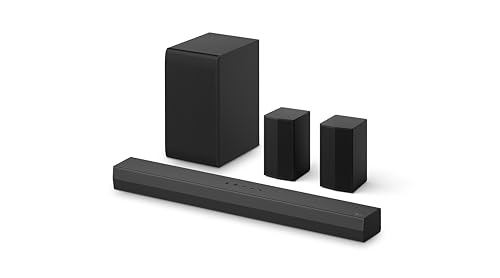
5. LG S40TR: Best Surround Package
Pros
- Wireless rear surround speakers included
- Separate wireless subwoofer
- Dolby Audio and DTS Digital compatibility
- Clear Voice Plus and AI Sound Pro features
Cons
- Requires space behind the seating position
- More components to position and power
- No Dolby Atmos listed
Best for: viewers who want genuine rear-channel presence without buying separate speakers.
The LG S40TR is the most convincing surround package here because it includes wireless rear speakers as well as a wireless subwoofer. That changes the experience more fundamentally than adding another virtual surround mode. Effects can be placed behind the listening position, and the four-channel layout has a clearer route to room-filling sound than the 2.1 bars from TCL and ULTIMEA.
LG lists Dolby Audio and DTS Digital compatibility, plus Clear Voice Plus for conversations. Its smart up-mixer can turn two-channel content into a wider multi-channel presentation, which is useful for ordinary broadcast TV and older shows that were not mixed for surround. AI Sound Pro adjusts the presentation for different types of content, while the LG Soundbar app provides a three-band equalizer for bass, treble, and mid-range control.
The wireless rear speakers avoid a special receiver, but wireless does not mean no installation work. Each rear speaker still needs a suitable position and a power connection, and the subwoofer needs its own place in the room. The bar itself measures 28.4 inches wide, 2.5 inches high, and 3.4 inches deep, making it relatively easy to fit below a TV. LG’s WOW Interface allows compatible LG TV and soundbar functions to be managed from one remote, and WOW Orchestra can combine audio from an LG TV and the bar.
The TCL S55H has Atmos and DTS Virtual:X, but it cannot put physical speakers behind you. The LG reverses that trade-off with real rear channels but no Atmos listing. It is also less suitable for a clean, cable-minimal room than Yamaha or Samsung. Choose the S40TR if surround placement matters more than the newest height format, especially for a sofa where rear speakers can be positioned properly.
6. Yamaha SR-B30A: Best One-Piece Design

Pros
- Built-in subwoofers keep the room uncluttered
- Dolby Atmos support
- Clear Voice dialogue enhancement
- Bluetooth multipoint
- Wall-mountable design
Cons
- No separate subwoofer for flexible bass placement
- Wider than several competing bars
- Fewer adjustment details are listed
Best for: listeners who want a single physical unit with built-in bass and a restrained design.
The Yamaha SR-B30A is the cleanest answer to the integrated-subwoofer brief. There is one soundbar, no bass box to place, and no rear speakers to power. Its two built-in subwoofers preserve the visual simplicity of a normal TV bar while adding the low-end weight missing from most television speakers.
Dolby Atmos creates a spatial presentation from the bar, while Yamaha’s Clear Voice mode brings dialogue forward when music or effects start to dominate. The available modes are Movie, Stereo, Standard, and Game, giving you sensible starting points without burying basic controls in a complicated menu. HDMI eARC/ARC supports uncompressed, high-bitrate audio from a compatible TV.
Bluetooth multipoint is a useful everyday feature. Two devices can remain connected, making it easier to switch between a television and a phone without repeatedly pairing. The bar measures 35.88 inches wide, 2.63 inches high, and 5.25 inches deep. It can sit on a console or mount to a wall using built-in keyholes, though its width deserves attention if the TV stand is narrow.
The Yamaha is a better one-piece choice than the Samsung HW-B400F because it adds Dolby Atmos and a larger, more capable presentation. The M60 and TCL S55H produce deeper bass through separate subwoofers, and the LG goes further with rear channels. The SR-B30A is for people who do not want those extra boxes. It is the right pick when a tidy room matters as much as stronger sound.
7. Samsung HW-B400F: Best Compact Bar

Pros
- Compact 25.23-inch width
- Built-in woofer avoids a separate bass box
- Voice Enhance Mode
- One remote control with compatible Samsung TVs
- Night mode reduces bass and volume impact
Cons
- 2.0-channel design
- No separate subwoofer
- No HDMI eARC or Atmos listed
Best for: bedrooms, small TVs, and listeners who want a noticeable step up from built-in TV speakers.
The Samsung HW-B400F is the smallest, simplest bar in this ranking. Its built-in woofer adds bass without requiring a separate cabinet, and the 25.23-inch width works well with smaller televisions or bedroom furniture. At 2.62 inches high and 4.21 inches deep, it should fit beneath many displays without dominating the setup.
This is a 2.0-channel design, so expectations need to stay realistic. Samsung lists Surround Sound Expansion to spread audio through the room, but there is no separate subwoofer and no Dolby Atmos listing. Its advantage is convenience, not cinematic placement. Voice Enhance Mode helps lift dialogue, and the built-in woofer gives TV programs more body than the television’s own speakers.
One Remote Control is particularly useful with compatible Samsung TVs, handling power, volume, and sound effects from the television remote. The bar can connect to the TV wirelessly, reducing cable clutter. A night mode lowers volume and minimizes bass, a thoughtful feature for apartments, bedrooms, or homes where late viewing should not shake the room.
The Yamaha SR-B30A is the stronger one-piece system for Atmos content and wider presentation, while the Samsung is easier to fit in a small space. The Saiyin Detachable Soundbar offers more unusual speaker separation, but its footprint is less conventional. Samsung’s weakness is obvious: it cannot produce the low-frequency scale or surround depth of the separate-subwoofer picks. Choose it when compact dimensions and simple Samsung TV control take priority.
8. Saiyin Detachable Soundbar: Best Flexible Design

Pros
- Detachable design can create two tower speakers
- Horn tweeter design projects sound farther
- Ten bass adjustment levels
- HDMI-ARC, optical, AUX, and Bluetooth 5.3
Cons
- Unusual footprint needs careful planning
- No Dolby or DTS support listed
- Bass level has no indicator
Best for: listeners who want to change between a conventional bar and separated stereo speakers.
The Saiyin Detachable Soundbar is the most unconventional product here. Its two-in-one design lets the bar remain assembled or transform into two tower speakers using the speaker base. That can create more channel separation and a wider stereo image than a single compact enclosure, provided the room has enough space for the separated arrangement.
The horn soundstage is intended to project audio farther, making this model worth considering in a larger room where a short bar can sound concentrated near the TV. Saiyin also lists two silk dome tweeters and two customized 53 by 83 mm square woofers. The product includes a subwoofer, but the supplied data does not specify its driver dimensions or enclosure volume, so the design should be judged by its flexibility rather than assumed bass performance.
Bass can be adjusted across ten levels, although there is no indicator showing the current bass setting. Three DSP modes cover movies, music, and news. Bluetooth 5.3 handles wireless streaming, and wired inputs include HDMI-ARC, optical, and AUX. Fire TV remote compatibility is listed, while other TV brands require an ARC connection for TV-remote control.
The Samsung HW-B400F is easier to place, and the TCL S55H offers more conventional room calibration and surround formats. Saiyin’s advantage is that it can adapt to a changing room layout, moving from a bar to separated speakers when stereo width becomes more important. Its missing Dolby and DTS support limits it for format-heavy home theater. Choose it for a flexible TV and music system, not for Atmos effects.

How to choose best soundbar with integrated subwoofer
The right system depends on whether you want a tidy one-piece bar, flexible bass placement, or actual speakers behind the seating position.
Subwoofer design
A built-in woofer keeps the room clean and makes installation easier, as seen on the Yamaha SR-B30A and Samsung HW-B400F. A separate subwoofer generally gives the designer more enclosure volume and lets the bar focus on dialogue and midrange detail. Wireless models such as the ULTIMEA Wireless Subwoofer Soundbar and TCL S55H also let you move bass away from the TV.
Surround channels
Channel count only tells part of the story. The Poseidon M60 uses five built-in speakers and side-firing drivers, while the LG S40TR adds physical wireless rear speakers. Virtual formats can widen the front presentation, but they cannot place sound behind the listener as consistently as properly positioned rear units.
Choose physical rear speakers for rear effects, and choose built-in surround processing when a cleaner room matters more.
TV connections
HDMI eARC is the most capable connection in this group because it supports higher-bandwidth audio from compatible TVs. HDMI ARC is still useful for unified volume control, while optical and AUX help older TVs and computers. Check the TV’s available output before choosing a bar, especially if Dolby Atmos or high-bitrate audio is important.
Dialogue processing
Clear speech is often more useful than extra bass. VoiceMX on the ULTIMEA systems, Clear Voice on the Yamaha, Clear Voice Plus on the LG, and Voice Enhance Mode on the Samsung all target dialogue in different ways. Look for a dedicated voice mode if the TV will be used for news, dramas, podcasts, or late-night viewing.
Room size and placement
A wide bar can spread sound across a larger screen, but it needs suitable furniture or a wall mount. Separate subwoofers and rear speakers need additional floor or shelf space and nearby power outlets. Compact models work well in bedrooms and small rooms, while the LG and Poseidon M60 make more sense when the listening area has room for a broader setup.

Frequently asked questions
What is an integrated subwoofer soundbar?
An integrated subwoofer soundbar places the low-frequency driver inside the main bar. Some buyers also use the term for a system that includes a dedicated subwoofer, even when that subwoofer is a separate wired or wireless enclosure. The Yamaha SR-B30A and Samsung HW-B400F are one-piece examples, while the ULTIMEA and TCL systems use separate bass modules.
Is a built-in subwoofer as powerful as a separate subwoofer?
A separate enclosure usually provides more room for the driver and cabinet, which can produce deeper and more forceful bass. Built-in subwoofers are easier to place and keep the room visually tidy. The right choice depends on whether low-frequency impact or simple installation is the bigger priority.
Do all of these soundbars support Dolby Atmos?
No. The Poseidon M60, TCL S55H, and Yamaha SR-B30A list Dolby Atmos support. The Saiyin 2.1 Soundbar explicitly does not support Dolby or DTS formats, while the other products list different audio features rather than Atmos.
Can a soundbar replace rear speakers?
Virtual surround processing can make the soundstage seem wider, but it does not fully replace physical rear speakers. The LG S40TR includes wireless rear speakers and is the strongest choice here for genuine surround placement. The Poseidon M60 creates a wide front presentation without rear units.
Is HDMI eARC necessary for a TV soundbar?
It is not necessary for basic TV audio, but it is useful when the TV and soundbar support higher-bandwidth formats such as lossless Dolby Atmos. HDMI ARC, optical, Bluetooth, and AUX can all work depending on the television and the content source. The TCL S55H and Poseidon M60 have the most explicit HDMI eARC support in this list.
Which model is easiest to use in a small room?
The Samsung HW-B400F is the simplest compact option because its built-in woofer eliminates a separate box. The Yamaha SR-B30A is also tidy but is wider and offers a more advanced audio presentation. If the room has space beside the TV, the TCL S55H adds wireless bass and room calibration.

The bottom line
The Best soundbar with integrated subwoofer for most buyers is the ULTIMEA Poseidon M60. Its 5.1-channel layout, Dolby Atmos support, side-firing drivers, wired wooden subwoofer, and unusually deep app controls give it the most complete movie presentation in this group.
Choose the Yamaha SR-B30A if you want a genuine one-piece design with built-in subwoofers, or the LG S40TR if physical rear speakers matter more than Atmos. The TCL S55H is the sensible smart-TV middle ground, while the Samsung HW-B400F is the easiest fit for a small room.
If you are undecided, choose the Poseidon M60 for cinematic sound and the Yamaha SR-B30A for a cleaner, simpler room.
As an Amazon Associate we earn from qualifying purchases.