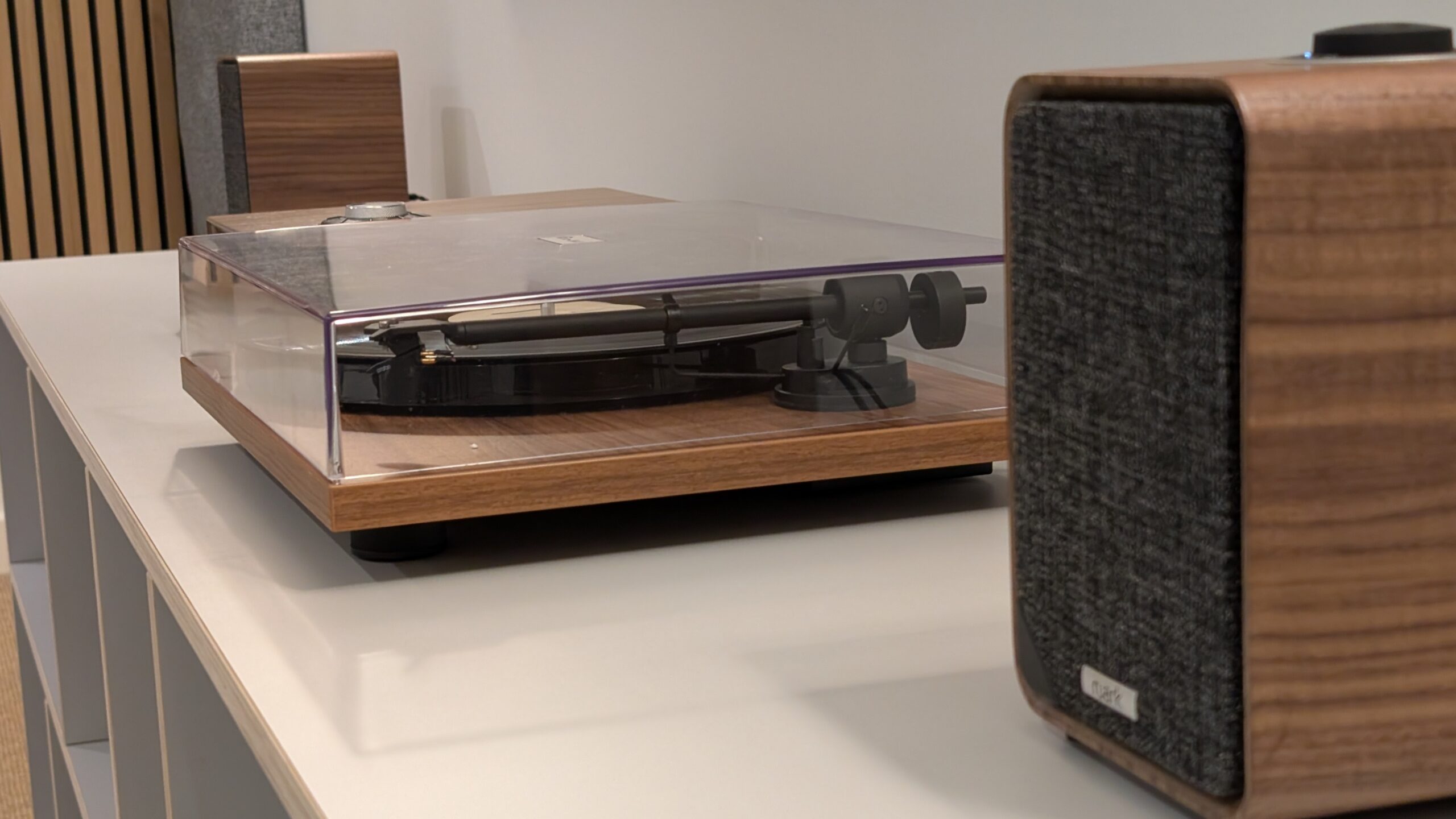

Your turntable needs a voice. Without decent speakers, that warm analog signal falls flat, compressed into tinny laptop drivers or buried inside a cheap all-in-one system. The best speakers for record player setups share one thing: they are powered. No separate amp, no receiver, no extra box. You plug the turntable's RCA cables directly into them, and the music comes alive.
That simplicity is deceptive. The range runs from small desktop pairs that fit next to a mid-century console to full bookshelf speakers that fill a living room. Some include Bluetooth for streaming the rest of your library. Others focus purely on wired fidelity. A few cost less than a single vinyl record, while others approach the price of a decent turntable itself.
We tested nine powered bookshelf speakers built for record players, comparing them on sound quality, connectivity, build, and ease of use. The Edifier R1280T emerged as our top pick, but the right choice depends on your room, your turntable, and whether you want to add a subwoofer later.
Comparison table
| # | Product | Award | Woofer | Inputs | Best for |
|---|---|---|---|---|---|
| 1 | Edifier R1280T | Best overall | 4 inch | 2x AUX (RCA/3.5mm) | Anyone who wants natural, balanced sound for vinyl |
| 2 | Saiyin 4-Inch Woofer | Best with subwoofer output | 4 inch | RCA, Optical, Coaxial, Bluetooth 5.3 | Building a system you can expand later |
| 3 | Edifier R980T | Best compact studio sound | 4 inch | 2x AUX (RCA/3.5mm) | A smaller, slightly warmer alternative to the R1280T |
| 4 | Saiyin 3.5-Inch Woofer | Best small-room value | 3.75 inch | RCA, Optical, Coaxial, Bluetooth 5.3 | Tight spaces and desktop listening |
| 5 | OHAYO 60W Speakers | Most versatile inputs | 3 inch + tweeter | Bluetooth 5.3, RCA, AUX, USB | Gaming and music on a compact budget |
| 6 | Electrohome Huntley EB10 | Best retro design | 3 inch | Bluetooth 5, RCA, AUX | A stylish partner for vintage turntables |
| 7 | RIOWOIS DS6701NP | Best budget all-rounder | 3 inch | Bluetooth 5.3, AUX, Optical, TV-ARC | A cheap, full-featured starter set |
| 8 | Elimavi 30W Speakers | Best for wall mounting | 4 inch | RCA, 3.5mm | Mounting speakers on shelves or brackets |
| 9 | RIOWOIS 25W Speakers | Smallest footprint | 3 inch | Bluetooth, AUX, Optical, TV-ARC | Ultra-compact setups with remote control |
1. Edifier R1280T: Best Overall

Pros
- Natural, balanced sound with no harshness
- Two AUX inputs let you switch between turntable and phone
- Remote control with bass and treble knobs on the side
- Solid MDF cabinet reduces resonance
Cons
- No Bluetooth
- No subwoofer output
Best for: anyone who wants a premium unlocked tool with a unique build.
The Edifier R1280T is the speaker that keeps popping up in vinyl forums for a reason. It sounds right. The 13mm silk dome tweeter and 4-inch full-range driver produce a sound that is detailed without being clinical, warm without being muddy. On acoustic records, the midrange feels present and natural. On classic rock, the cymbals have air, and the bass lines have enough thump to fill a 12-by-12-foot room.
The cabinet is made from MDF with a wood-effect vinyl finish that looks convincing from a few feet away. It is not solid wood, but it does the job of keeping resonance low. At 10.8 pounds for the pair, these are not the lightest speakers on this list, and that heft helps keep them planted. The side-panel controls include bass and treble adjustment knobs, a feature missing on many competitors. You can dial in a bit more low end if your turntable's cartridge is on the bright side, or cut the treble if the room is live.
Connectivity is straightforward: two AUX inputs, each accepting both 3.5mm and dual RCA. That means you can keep your turntable plugged into one and a phone or computer into the other, switching with the remote. There is no Bluetooth, so if wireless streaming is a deal breaker, look at the Saiyin options below. Also, there is no subwoofer output. If you eventually want to add a powered sub, you will need to split the signal elsewhere.
Compared to the Edifier R980T, the R1280T has more power (42 watts RMS vs. 24 watts) and slightly better extension. The difference is audible at higher volumes and in larger rooms. The R980T is a fine speaker, but the R1280T is the one we would keep.
2. Saiyin 4-Inch Woofer: Best with Subwoofer Output

Pros
- Subwoofer output for adding a powered sub
- Bluetooth 5.3 with aptX support
- Optical and coaxial inputs for TV and CD players
- Remote control included
Cons
- Slightly larger cabinet than the 3.5-inch version
- No treble or bass knobs on the speaker itself
Best for: building a system you can expand later.
The Saiyin 4-Inch Woofer model is the one to buy if you think you might want to add a subwoofer down the line. It has a SUB OUT jack on the back, a rare feature in this price range. That alone makes it more future-proof than most of its peers. The built-in amplifier drives the 4-inch woofer and 0.5-inch silk dome tweeter to a respectable volume, and the sound is clear with a reasonable low-end punch for its size.
Bluetooth 5.3 is onboard, and pairing is quick. The remote control lets you switch between Bluetooth, optical, coaxial, and RCA inputs, mute, and adjust volume. The buttons on top of the main speaker also work, which is convenient if you lose the remote. The cabinet measures about 6.7 by 9 by 11.8 inches, which is not tiny but still fits on most media consoles.
One quirk: if you plan to use the optical or coaxial inputs, make sure your source is set to PCM/stereo output. Dolby or DTS signals will cause crackling or no sound. This is common for budget powered speakers, but worth noting if you plan to connect a TV.
Compared to the smaller Saiyin 3.5-Inch Woofer, this model has more bass extension and can fill a medium-sized room. The 3.5-inch version is better suited for a desktop or very small space. The 4-inch is the one to get for a dedicated listening area.
3. Edifier R980T: Best Compact Studio Sound

Pros
- Front-firing bass reflex port works well against a wall
- Two AUX inputs for dual sources
- Solid wooden enclosure
Cons
- Only 24 watts RMS, less headroom than the R1280T
- No Bluetooth or subwoofer output
Best for: a smaller, slightly warmer alternative to the R1280T.
The Edifier R980T is the more affordable sibling in Edifier's bookshelf lineup, but it is no compromise. With a 4-inch woofer and a front-firing bass reflex port, it is designed to be placed closer to a wall than rear-ported speakers. That makes it a good fit for crowded shelves or desks where you cannot leave six inches of breathing room behind the cabinet.
The sound is slightly warmer and less analytical than the R1280T. The 24-watt amplifier is enough for near-field listening and small to medium rooms, but you will notice the limit if you try to fill a large living room at high volume. The treble is smooth, and the midrange is forward enough for vocals to sound present.
The cabinet is 100 percent wood, not MDF with vinyl. It feels denser and more premium. The included cables (RCA, 3.5mm, and speaker wire) cover everything you need for a basic turntable connection. You get two AUX inputs, so you can keep your phone or computer plugged in alongside the record player.
If you already own a turntable with a built-in phono preamp, the R980T is a simple, clean option. It lacks the wireless convenience of the Saiyin speakers, but its sound quality per dollar is excellent.
4. Saiyin 3.5-Inch Woofer: Best Small-Room Value

Pros
- Small footprint fits on crowded desks
- Bluetooth 5.3 with optical and coaxial inputs
- Remote control with mode switching
Cons
- Less bass than the 4-inch version
- No subwoofer output
Best for: tight spaces and desktop listening.
This is the smaller, cheaper version of the Saiyin 4-Inch Woofer, and for many record player owners, it is more than enough. The 3.75-inch woofer and 0.5-inch silk dome horn tweeter produce a sound that is clear and balanced, with enough low end for casual listening. It will not shake the walls, but on a desk or a small sideboard, it delivers a satisfying experience.
The dimensions are 5.3 by 6.3 by 8.6 inches for the main speaker, small enough to squeeze into spots where larger speakers cannot go. The inputs include RCA, 3.5mm, optical, and coaxial, plus Bluetooth 5.3. The remote works well and includes a mute button. The cabinet is MDF, and the build quality feels solid for the price.
The main trade-off is the lack of a subwoofer output. If you want to add a sub later, you need the 4-inch Saiyin or a splitter. Also, the bass is noticeably thinner than the 4-inch model, but in a small room or near-field setup, that is less of an issue.
5. OHAYO 60W Speakers: Most Versatile Inputs

Pros
- USB input for direct connection to a computer
- 30 watts per channel with carbon fiber drivers
- Rear bass port for deeper low end
Cons
- Design is more computer-speaker than bookshelf
- No optical input
Best for: gaming and music on a compact budget.
The OHAYO 60W speakers sit at the intersection of computer speakers and bookshelf speakers. They have a USB input alongside the usual RCA and 3.5mm AUX, which makes them a natural fit for a desk setup where both a turntable and a computer are in use. The carbon fiber silk dome tweeter (0.75-inch) and 3-inch full-range driver deliver clear highs and a punchy mid-bass. The rear bass port adds some low-end extension, though it is not as deep as dedicated subwoofer ports.
The volume knob is on the front panel, easy to reach during gaming or music listening. The MDF enclosure reduces resonance. At 60 watts total RMS, these are louder than most of the smaller options here. They fill a medium room without strain.
However, the design is more modern and less retro than the wood-finish speakers. If you want a classic look for your vinyl setup, the Electrohome or Edifier options may appeal more. Also, there is no optical input, so if you plan to connect a TV, you need an adapter.
6. Electrohome Huntley EB10: Best Retro Design

Pros
- Attractive teak wood cabinet with mid-century vibe
- Compact size fits small shelves
- Bluetooth 5 for wireless streaming
Cons
- 3-inch drivers limit bass response
- No subwoofer output
Best for: a stylish partner for vintage turntables.
The Electrohome Huntley EB10 is as much about looks as sound. The teak wood cabinet and retro grill make it a natural companion for a vintage-style turntable. It is one of the smaller speakers in this list, with a footprint that fits on narrow shelves. The 3-inch drivers produce a warm, natural sound that is pleasant for background listening and casual sessions.
Bluetooth 5 is built in, and the connections include RCA and AUX. The rear ported design helps a bit with bass, but the small woofer means the low end is modest. For jazz vocals, acoustic folk, or spoken word, the Huntley is delightful. For heavy bass music or rock, you will miss the thump of larger speakers.
Electrohome has a long history in audio, and the build quality feels solid. The handcrafted wood cabinets are resonance-free. If your turntable setup is as much about furniture as sound, the Huntley is a strong contender.
7. RIOWOIS DS6701NP: Best Budget All-Rounder

Pros
- Very low entry price for a full feature set
- Bluetooth 5.3 with AUX, Optical, TV-ARC
- Remote control with sound effects modes
Cons
- 3-inch woofer limits bass output
- Red color option may not suit all decor
Best for: a cheap, full-featured starter set.
The RIOWOIS DS6701NP is the budget champion of this roundup. It offers an incredible number of connections for its price: Bluetooth 5.3, AUX, optical, and TV-ARC. That means it can work with your turntable, TV, computer, and phone all at once. The remote lets you switch between modes and even cycle through three sound presets (music, movie, dialogue).
The sound is adequate for the size. The 3-inch woofer and 16mm silk dome tweeter produce a clear midrange and smooth highs. Bass is present but not deep. These speakers are best suited for small rooms or desks. The MDF cabinet with wood grain finish looks more expensive than it is.
One important caveat for turntable users: if your turntable only has a phono output (no built-in preamp), you will need a separate phono preamp. The DS6701NP expects a line-level signal via AUX or optical. Also, the optical input only works with PCM stereo; Dolby/DTS will cause crackling.
If you want to understand how to connect a turntable to any powered speaker, which turntable features matter most for sound quality is a good place to start.
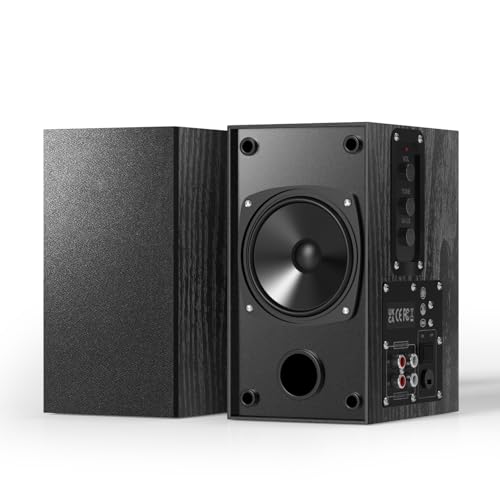
8. Elimavi 30W Speakers: Best for Wall Mounting
Pros
- Includes wall-mounting clips
- Bass and treble adjustment knobs on the front
- 4-inch dual subwoofers for fuller sound
Cons
- No Bluetooth or digital inputs
- Speaker wire connection between the two speakers
Best for: mounting speakers on shelves or brackets.
The Elimavi 30W speakers are designed for placement flexibility. They come with wall-mounting clips that let you attach them to brackets or hang them on screws. The speaker wire between the main and passive speaker is included, and the clips keep the wire tidy. This is a rare feature in this price range.
The sound is surprisingly robust for the size. The 4-inch woofers produce a full-range stereo effect, and the front-panel bass and treble knobs let you fine-tune. The 30-watt-per-channel amplifier has enough power for medium rooms. The black wood-grain finish is understated.
The biggest limitation is the lack of Bluetooth and digital inputs. You get RCA and 3.5mm only. That is fine for a dedicated turntable, but you cannot stream wirelessly. Also, the speakers connect to each other via speaker wire, which is less convenient than the standard captive cables on many competitors.
9. RIOWOIS 25W Speakers: Smallest Footprint

Pros
- Very small footprint (6.75 x 4.5 x 8.5 inches)
- Includes remote, optical cable, and foam plugs
- Bluetooth, AUX, Optical, TV-ARC
Cons
- 3-inch woofer limits bass and max volume
- Power adapter is external and bulky
Best for: ultra-compact setups with remote control.
The RIOWOIS 25W speakers are the most compact pair in this roundup, and they come with the most accessories: remote, optical cable, audio cable, foam plugs to reduce wind noise from the port, and a power adapter. The 3-inch woofer and 16mm silk dome tweeter deliver clear sound for their size. The foam plugs are a nice touch for desktop use where you want to reduce bass port noise.
Connectivity is excellent for such a small package: Bluetooth, AUX, optical, and TV-ARC. The remote works up to about 16 feet. The sound is clean at low to medium volumes, but distortion creeps in at higher levels. These are best for near-field listening, such as a desk or bedside table.
The power adapter is an external brick, which can be annoying to hide. The speakers themselves are light, at around 4 pounds total. If you need something tiny for a dorm room or a small apartment, this is the one. But for a dedicated living room vinyl setup, the larger options are better.
How to choose speakers for your record player
Choosing speakers for a turntable comes down to a few key factors that are different from typical computer or TV speakers. Here is what matters.
Active vs. passive
All the speakers on this list are active (powered), meaning the amplifier is built in. You connect them directly to your turntable without a separate receiver. This is the simplest route for most people. Passive speakers require an external amplifier or receiver, which adds cost and complexity. For a first vinyl setup, active speakers are the way to go.
Inputs and phono preamp
Most turntables output either a phono-level signal (very low, needs a preamp) or a line-level signal (if the turntable has a built-in preamp). Before buying speakers, check your turntable's output. If it only has phono output, you need either a phono preamp or speakers that include one (none of the speakers here have a phono stage). If your turntable has a line/aux output, you can connect directly via RCA.
Woofer size and room size
A 3-inch woofer works fine for a desk or small room. For a 12x15-foot living room, a 4-inch woofer is the minimum. If you want deep bass, look for a speaker with a subwoofer output so you can add a powered sub later.
"The size of the woofer is the biggest single predictor of how much bass you will get. A 4-inch driver can move about twice the air of a 3-inch driver."
Bluetooth and digital inputs
If you also want to stream music from your phone, Bluetooth is convenient. Some speakers (like the Saiyin and RIOWOIS) include optical and coaxial inputs for TV or CD players. If you only care about vinyl, a simple RCA pair like the Edifier R1280T may be all you need.
Build and placement
MDF cabinets with wood veneer look classic and reduce resonance. Front-ported speakers can sit closer to a wall, while rear-ported ones need breathing space. Consider whether you want to wall-mount, place on a shelf, or stand-mount.
Frequently asked questions
Can I connect my turntable directly to these speakers?
Yes, if your turntable has a built-in phono preamp and outputs line-level audio via RCA. If your turntable only has phono output, you need a separate phono preamp between the turntable and the speakers.
Do I need a receiver for powered speakers?
No. Powered speakers have an amplifier built in. You connect the audio source directly to them. Do not connect them to a receiver's speaker outputs, as that can damage the speakers.
Why do some speakers have optical and coaxial inputs?
These digital inputs allow you to connect a TV, CD player, or game console with a cleaner signal than analog. They are useful if you want the speakers to serve double duty for your TV and turntable.
What size speaker is best for a record player?
For a typical living room, 4-inch woofers provide a good balance of bass and clarity. For a desk or small bedroom, 3-inch woofers are adequate. Larger rooms may need 5-inch or bigger drivers, but those are less common in powered bookshelf speakers.
Can I add a subwoofer later?
Only if the speakers have a subwoofer output (SUB OUT). Among this list, the Saiyin 4-Inch Woofer has one. For others, you can use a Y-splitter on the source but with some signal loss.
The bottom line
The Edifier R1280T remains our top recommendation for a reason: it delivers balanced, natural sound that makes vinyl shine, with a build quality that outlasts cheaper alternatives. If you want the option to add a subwoofer later, the Saiyin 4-Inch Woofer is the smart choice. For the tightest budgets, the RIOWOIS DS6701NP offers surprising connectivity and a decent sound. And if your turntable setup is also a design statement, the Electrohome Huntley EB10 brings vintage charm without sacrificing much.
No single pair is perfect for every room and every record collection. The best speakers for record player setups will match your space, your turntable's output, and your listening habits. Start with the Edifier R1280T, and you will have a solid foundation for years of listening. If you want to explore how these compare to dedicated hi-fi options, the best home speakers for music guide covers larger systems for more serious listening rooms.
As an Amazon Associate we earn from qualifying purchases.