

A security camera is only useful when it covers the right area, stays connected, and gives you footage you can actually retrieve. A battery camera may be simple to mount, but it can miss activity when its battery is low. A plugged-in model avoids that problem, but limits placement.
We compared ten best wifi security cameras across outdoor, indoor, solar, cellular, pan-tilt, and multi-camera designs. The strongest all-around choice is the Blink Outdoor 4, while the other picks make more sense for solar coverage, local storage, indoor monitoring, or locations without Wi-Fi.
Comparison table
| # | Product | Award | Resolution | Power and connection | Best for |
|---|---|---|---|---|---|
| 1 | Blink Outdoor 4 | Best overall | 1080p HD | Battery, Wi-Fi | Simple multi-camera outdoor monitoring |
| 2 | SEHMUA 2K Solar Camera | Best solar two-pack | 2K | Solar, 2.4GHz Wi-Fi | Broad outdoor coverage |
| 3 | Vivideye 4MP Solar System | Best local-storage system | 4MP | Solar, dual-band Wi-Fi | Large properties avoiding subscriptions |
| 4 | Hiseeu Dual-Lens System | Best plugged-in outdoor system | Not specified | Plug-in, dual-band Wi-Fi | Fixed and moving views together |
| 5 | SEHMUA 4G LTE Solar Camera | Best for locations without Wi-Fi | 2K | Solar, 4G LTE | Barns, farms, and remote sites |
| 6 | Anona 4K Indoor Camera | Best indoor detail | 4K UHD | Plug-in, dual-band Wi-Fi 6 | Pets, babies, and room-wide viewing |
| 7 | realhide 2K Outdoor Camera | Best flexible storage | 2K UHD | Battery, dual-band Wi-Fi | Outdoor users wanting cloud or SD storage |
| 8 | HITELLARCAM 2K Camera | Best smart-alert features | 2K UHD | Battery, dual-band Wi-Fi | Spotlight, alerts, and siren deterrence |
| 9 | GMK 2K Four-Camera System | Best four-camera kit | 2K, 3MP | Battery or plug-in, 2.4GHz Wi-Fi | Covering several entry points |
| 10 | TP-Link Tapo C100 | Best indoor simplicity | 1080p | Plug-in, 2.4GHz Wi-Fi | Baby and pet monitoring |
1. Blink Outdoor 4: Best Overall
Pros
- Three cameras are included
- Up to two years of battery life
- 1080p live view with infrared night vision
- Enhanced motion detection and two-way audio
- Alexa support
Cons
- Sync Module Core does not include local storage
- Person detection requires a separate subscription plan
- No 2K or 4K video
Best for: households that want a straightforward multi-camera outdoor setup with very long battery life.
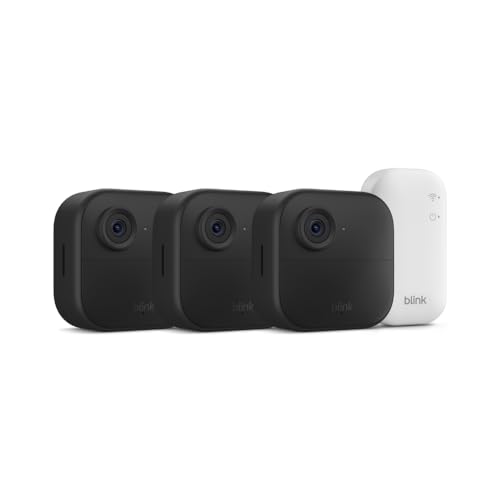
The Blink Outdoor 4 is the one we would recommend to most people who want several cameras without turning installation into a project. The three-camera kit includes a Sync Module Core, mounting kits, lithium AA batteries, a USB-C cable, and a power adapter. Each camera is compact, weighing 0.24 pounds and measuring 2.76 inches high by 2.76 inches wide, so it is easier to position discreetly than the larger solar and pan-tilt models here.
Its 1080p HD live view is not the sharpest in this group, but it is a sensible resolution for checking a porch, side gate, or driveway from a phone. Infrared night vision handles dark scenes, while two-way audio lets you speak to a visitor. Enhanced motion detection uses dual zones to send alerts faster, and the optional person detection feature adds computer vision when used with a Blink Subscription Plan. Alexa integration can bring up a multi-camera live view or arm and disarm the system by voice.
Battery life is the standout. Blink says the included Energizer lithium batteries can last up to two years, though frequent motion events, cold weather, and live viewing will affect that figure. That makes the Outdoor 4 much less demanding than the GMK 2K Four-Camera System or the battery-based realhide 2K Outdoor Camera, both of which quote shorter operating periods. The trade-off is storage. Sync Module Core does not provide local storage, so footage is tied to cloud options unless you add compatible equipment later.
The Blink Outdoor 4 also lacks the color night vision, pan and tilt, and higher resolution found in the SEHMUA 2K Solar Camera and Vivideye 4MP Solar System. It is not the right pick for reading fine details at the far end of a large property, and buyers who want recording without a cloud plan should look elsewhere. For simple outdoor coverage, though, its clean app experience, included three-camera setup, and unusually long stated battery life make it the easiest system to live with.
2. SEHMUA 2K Solar Camera: Best Solar Two-Pack

Pros
- Two cameras with solar panels
- 2K video and color night vision
- Pan and tilt control
- PIR motion sensing
- Local storage support up to 128GB
Cons
- Supports 2.4GHz Wi-Fi only
- Memory card is not included
- IP65 protection is below some outdoor picks here
Best for: monitoring two outdoor areas where solar charging and remote viewing matter more than dual-band Wi-Fi.
The SEHMUA 2K Solar Camera is a practical answer to the problem of charging cameras mounted above a porch or along a fence. The two-pack includes removable solar panels, and each camera can pan and tilt remotely. That movement matters when a single fixed lens would leave a large section of a yard outside the frame. The cameras can mount to a wall or ceiling, and the manufacturer describes installation as taking about five minutes.
Video is recorded at 2K, giving this model more detail than the Blink Outdoor 4. The white spotlight supports color night vision, while infrared LEDs provide another way to view dark areas. PIR motion sensing is intended to reduce irrelevant alerts compared with simpler motion triggers. Two-way audio lets you talk through the app, which is useful for visitors and deliveries, though it should not be confused with a professional alarm system.
The major networking limitation is its 2.4GHz-only connection. That band generally reaches farther through walls than 5GHz, but it can be more crowded in busy neighborhoods. The realhide 2K Outdoor Camera and HITELLARCAM 2K Camera support both 2.4GHz and 5GHz, making them more flexible when a router offers both bands. The SEHMUA model instead makes its strongest case through solar power and physical viewing range.
Storage is handled through a built-in memory card slot supporting cards up to 128GB, with optional cloud storage also mentioned in the product details. The card is not included, so setup requires an extra storage purchase if local recording is your priority. Its IP65 weather protection is suitable for many outdoor placements, but the Vivideye 4MP Solar System and Hiseeu Dual-Lens System specify IP66 protection. Choose this SEHMUA when two solar-powered pan-tilt cameras solve the placement problem better than a higher-resolution fixed system.
3. Vivideye 4MP Solar System: Best Local-Storage System

Pros
- 4MP video with color night vision
- Two solar-powered cameras
- 128GB built-in local storage
- Dual-band Wi-Fi support
- 360-degree pan, tilt, and digital zoom
Cons
- Requires a home hub
- Detection range is listed as 16 to 29 feet
- Large system components need careful placement
Best for: property owners who want solar cameras, broad coverage, and recordings kept on a local hub.
The Vivideye 4MP Solar System is the most complete outdoor package here for someone who wants to avoid a recurring storage plan. It includes two wire-free solar cameras and a four-channel home hub with built-in 128GB memory. The system says that recordings can loop for up to three months, although actual retention depends on how much motion the cameras capture. Keeping footage on the hub also means the cameras do not have to rely on a cloud account for every recording.
The 4MP image gives it a resolution advantage over the Blink Outdoor 4 and the TP-Link Tapo C100. Color night vision is rated for viewing up to 65 feet, and the cameras support remote pan, tilt, and digital zoom. That combination is helpful for a driveway or broad yard, where a fixed 1080p camera may leave too much dead space. AI human detection and PIR sensing can be adjusted, with a listed detection range of 16 to 29 feet.
This is also one of the more flexible networking choices. The system supports 2.4GHz and 5GHz Wi-Fi, and the hub can connect to a router through Ethernet or Wi-Fi. The cameras are paired with the base unit before setup, which should make the initial process less frustrating than pairing each camera separately. Alexa voice control is available for bringing up a live feed. That is a more capable arrangement than the 2.4GHz-only SEHMUA 2K Solar Camera.
The hub is both an advantage and a constraint. You need to find a suitable indoor location for it, and the system is less compact than a standalone camera. The product dimensions listed for the system are 16 inches high, 8 inches long, and 5 inches wide, so buyers should check their available shelf or cabinet space. It is also more equipment than someone needs for a single front door. For a property with several outdoor sightlines and a clear preference for local recording, the Vivideye system is the strongest fit.
4. Hiseeu Dual-Lens System: Best Plugged-In Outdoor System

Pros
- Fixed and PTZ views in each camera
- Supports 2.4GHz and 5GHz Wi-Fi
- Automatic motion tracking
- IP66 weather protection
- NVR and HDMI viewing
Cons
- Cameras must be plugged in
- Setup needs separate camera and NVR power
- Resolution is not specified in the supplied details
Best for: buyers who want continuous outdoor coverage and do not need battery or solar installation.
The Hiseeu Dual-Lens System is important because “wireless” does not mean wire-free here. The cameras use Wi-Fi for their connection, but each one still needs a DC 12V 1A power cable, while the NVR needs its own DC 12V 2A connection. That makes this a better choice for an exterior wall, eave, or other location with nearby power than for a remote fence post.
Each dual-lens camera combines a fixed camera with a PTZ camera. The fixed view keeps watching its assigned area while the motorized view can follow movement. Hiseeu also lists a 100-foot connection range, plus support for both 2.4GHz and 5GHz Wi-Fi. This arrangement offers a different kind of coverage from the SEHMUA 2K Solar Camera, which moves one lens around a scene but does not provide the same simultaneous fixed viewpoint.
Motion tracking uses a built-in PIR sensor and the EseeCloud app. The system can identify movement, follow a person with the PTZ lens, and retain the fixed camera's view. Color night vision, infrared night vision, and adaptive color night vision are available, with built-in LEDs for illumination and light alarms. IP66 weather protection gives the cameras a stronger stated outdoor rating than the IP65 GMK 2K Four-Camera System.
The supplied information does not specify a video resolution, so this is not the right pick for shoppers who want to compare 1080p, 2K, and 4K detail directly. It is also a more involved installation than the battery products. The benefit is continuous power and an NVR-based viewing setup that can be accessed through an HDMI-connected monitor. If you are wiring an outdoor system and value a fixed view alongside a tracking view, Hiseeu is the unusual option in this roundup.
5. SEHMUA 4G LTE Solar Camera: Best for Locations Without Wi-Fi

Pros
- Works without Wi-Fi or wired power
- Solar panel and built-in battery
- 2K color night vision
- 360-degree viewing with digital zoom
- Two-way talk and PIR alerts
Cons
- Cellular service requires an ongoing subscription after the trial
- Requires 4G LTE coverage
- Spotlight must be enabled manually in the app
Best for: remote properties with 4G coverage but no dependable Wi-Fi or electrical outlet.
The SEHMUA 4G LTE Solar Camera solves a problem that ordinary Wi-Fi cameras cannot. It does not connect to Wi-Fi, and it does not need a wired electrical connection. Instead, it uses cellular service through its built-in SIM card and a 6W solar panel. That makes it a natural fit for a barn, ranch, construction site, warehouse, vacation home, or RV location where a router is not available.
Its 2K video, 4X digital zoom, and 360-degree horizontal and vertical movement provide useful flexibility for open areas. Color night vision works with a spotlight, though the product notes that the spotlight must be switched on manually in the Ubox app. PIR detection can alert you when people or animals move through the scene, and sensitivity can be adjusted. Two-way talk is available for communicating with someone near the camera.
The included EIOTCLUB SIM supports AT&T, T-Mobile, and Verizon in the United States, with a seven-day unlimited trial stated in the listing. After that trial, cellular service requires a subscription. That ongoing connection requirement is the central distinction between this camera and the Vivideye 4MP Solar System, which uses Wi-Fi and local hub storage. It also means coverage should be confirmed before mounting the camera, since solar power cannot compensate for weak cellular reception.
The camera itself is substantial, with listed dimensions of 5.35 inches high, 7.68 inches long, and 6.57 inches wide, and a listed weight of 2.34 pounds. It needs a solid mounting point and sunlight suitable for the panel. This is not the camera to choose for a typical house with strong Wi-Fi nearby. For remote monitoring, however, its cellular connection and solar design are more useful than the extra network compatibility offered by ordinary outdoor Wi-Fi models.
6. Anona 4K Indoor Camera: Best Indoor Detail

Pros
- 4K UHD video and 8X zoom
- Two-camera pack
- 360-degree pan and 110-degree tilt
- Auto-tracking
- Person, pet, and baby-cry detection
Cons
- Indoor use only
- Requires a power connection
- microSD card is not included
Best for: families that want detailed indoor video and automatic tracking for pets, babies, or moving people.
The Anona 4K Indoor Camera is the sharpest indoor option in this group. It comes as a two-camera pack and records 4K UHD video, with 8X zoom for examining details farther across a room. That extra resolution has a practical benefit when you need to identify what a pet is carrying, check a sleeping area, or inspect a distant corner without moving the camera.
Its 360-degree pan and 110-degree tilt cover a wide field, and auto-tracking follows a moving object after detection. The camera can distinguish people and pets, while baby-cry detection adds a useful alert for nursery monitoring. These capabilities make it more versatile than the fixed-view TP-Link Tapo C100, although the Tapo is smaller and simpler for a single room.
Anona supports dual-band Wi-Fi and Wi-Fi 6, switching between 2.4GHz and 5GHz connections. That can help when a home network has congestion or when the camera is placed farther from the router. Storage can be handled through Anona Cloud, which uses AES-128 encryption according to the listing, or through a microSD card with support up to 512GB. The card is not included, so local recording needs a separate card.
This is a plug-in indoor camera, not a battery model for outdoor mounting. Its listed weight is 1.85 pounds, and the camera measures 4.77 inches high, 3.23 inches long, and 3.11 inches wide. Privacy mode is listed among the product features, which is reassuring for a camera used in living spaces, but buyers should still decide carefully where a motorized camera should point. Pick Anona for detail and tracking indoors, not for simple weatherproof perimeter monitoring.
7. realhide 2K Outdoor Camera: Best Flexible Storage

Pros
- 2K UHD video
- Color night vision with spotlight
- 2.4GHz and 5GHz Wi-Fi
- Free cloud and local SD storage options
- IP66 weather protection
Cons
- Stated battery life is up to six months
- Free plan records in SD quality
- Supplied details describe a single camera
Best for: outdoor users who want a choice between cloud recording and a local SD card.
The realhide 2K Outdoor Camera stands out for giving storage options room to breathe. The camera supports free rolling cloud storage and a local SD card up to 256GB. That means buyers can choose the convenience of remote cloud access or keep recordings on a card. The listing notes that the free plan provides SD-quality recording, while HD is available with paid plans, so the storage choice also affects how much detail you retain.
Video is captured in 2K UHD, and a built-in spotlight produces full-color night vision. For a front door or driveway, that can make clothing and objects easier to distinguish than infrared-only footage. The camera also has two-way audio and app control for live view, playback, and settings. Motion alerts are designed to notify the phone when activity is detected, with the listing describing person and activity identification.
Dual-band Wi-Fi is a meaningful advantage over the 2.4GHz-only SEHMUA 2K Solar Camera and GMK 2K Four-Camera System. The 5GHz option can provide a faster local connection when the camera is close enough to the router, while 2.4GHz remains useful for longer range. IP66 protection is specified for rain, snow, heat, humidity, and dust, giving it a stronger weather rating than several less rugged battery cameras here.
The battery is rated for up to six months, with actual life varying by detection activity. That is a reasonable fit for a low to moderate traffic area, but it is not the same as the Blink Outdoor 4's stated two-year maximum or a solar system designed for continuous charging. The product details list one camera, so buyers planning several viewpoints should account for that. Choose realhide when storage flexibility and dual-band Wi-Fi matter more than solar power or a multi-camera bundle.
8. HITELLARCAM 2K Camera: Best Smart-Alert Features

Pros
- 2K video with color night vision
- Dual-band Wi-Fi
- AI motion detection
- Spotlight and siren alarm
- Free cloud and SD storage support
Cons
- Battery life depends heavily on motion activity
- Free cloud plan uses SD quality
- microSD card is not included
Best for: homeowners who want a battery camera with active alerts, lighting, and a siren.
The HITELLARCAM 2K Camera puts more emphasis on notification and deterrence features than the quieter Blink Outdoor 4. Its 2K video is paired with full-color night vision, built-in LED lighting, and a siren alarm. Those tools can make the camera more noticeable when someone approaches, while also giving you a way to communicate through two-way audio.
The camera supports both 2.4GHz and 5GHz Wi-Fi, and the listing describes setup through a phone app. AI motion detection is intended to reduce irrelevant alerts, with a recommended detection distance of 5 to 8 meters. That range is useful context when choosing a mounting point. A camera placed too far from a walkway may not provide the alert behavior you expect, while one aimed at a busy road may still receive frequent triggers.
Storage is flexible. The listing includes free cloud storage and support for a local SD card up to 256GB. The free cloud plan records in SD quality, while HD is associated with paid plans. That is similar to the trade-off on the realhide 2K Outdoor Camera, though both products still offer a local route for buyers who prefer not to rely entirely on cloud recording.
The stated battery range is one to six months, and the listing explains that its test result involved 100 motion triggers per day for 60 days, with lower activity potentially extending operation toward six months. That is much more dependent on the location than Blink's stated maximum. The camera also lacks solar charging, pan and tilt, and the four-camera scale of the GMK system. It makes sense for one active entrance where a spotlight and siren are more useful than hands-off battery endurance.
9. GMK 2K Four-Camera System: Best Four-Camera Kit

Pros
- Four cameras in one system
- 2K, 3MP video
- Color and infrared night vision
- Battery or constant plug-in operation
- Privacy schedules and family sharing
Cons
- Supports 2.4GHz Wi-Fi only
- Battery life is listed as one to six months
- Cloud features have a seven-day trial
Best for: covering several outdoor entry points with one app and a mix of battery and plug-in operation.
The GMK 2K Four-Camera System is built around coverage rather than a single standout camera feature. Four cameras can be aimed at a front door, driveway, backyard, and side passage without asking one pan-tilt unit to patrol everything. The cameras record 2K, 3MP video, with color and infrared night vision. A 3.3mm lens is listed for a wide-angle view, which suits entry points and general property monitoring.
Installation is designed to be quick, and each camera can operate from its rechargeable battery or stay plugged in where constant power is available. The stated battery life is one to six months, with support for more than 3, 000 motion triggers on a charge. Charging is listed as taking six to eight hours. High-traffic areas will put more pressure on the battery, so the hybrid power option is especially useful for a porch or driveway that sees frequent activity.
The system uses PIR motion detection and AI cloud analysis, with configurable zones and instant phone alerts. It also includes two-way audio, flashing white lights, and a siren. Family sharing provides view-only access for invited users, while a privacy sleep mode can pause recording or follow a schedule. These controls make the GMK more adaptable for a busy household than the simpler Blink Outdoor 4, though Blink has the advantage in stated battery longevity.
GMK supports local memory card storage and an encrypted cloud service, but the listing mentions a seven-day trial for advanced AI and cloud functions. It also supports only 2.4GHz Wi-Fi, unlike the realhide 2K Outdoor Camera and HITELLARCAM 2K Camera. IP65 weather protection is specified, and the cameras can stand on a flat indoor surface as well as mount outdoors. Choose this system when four viewpoints matter most and you are comfortable managing battery schedules or using outlets at high-traffic locations.
10. TP-Link Tapo C100: Best Indoor Simplicity

Pros
- 1080p video
- Night vision up to 30 feet
- Motion, person, and baby-cry detection
- Two-way audio and built-in siren
- Alexa and Google Assistant support
Cons
- Indoor use only
- 2.4GHz Wi-Fi only
- No pan and tilt
Best for: a simple indoor camera for a baby, pet, or single room.
The TP-Link Tapo C100 is the least complicated camera here, and that is precisely why it earns a place in the roundup. It is a compact indoor unit for a nursery, office, hallway, or pet area. The 1080p video is clear enough for routine monitoring, while infrared night vision reaches up to 30 feet according to the listing. It does not try to be a solar outdoor system or a whole-property recorder.
Motion detection can send push notifications when activity, a person, or a baby's cry is detected. The camera's two-way audio can comfort a pet or let you speak to someone in another room, and the built-in siren adds a basic deterrent. Alexa and Google Assistant support allow the live feed to appear on a compatible screen. Those integrations make it more convenient for a smart-home user than an unbranded indoor camera with a less familiar ecosystem.
The main limitation is its network and viewing design. Tapo C100 connects through 2.4GHz Wi-Fi, and the supplied details do not mention pan, tilt, or automatic tracking. The Anona 4K Indoor Camera is a much better fit when you need to follow movement or inspect distant details, while the Tapo makes more sense when the camera can remain aimed at one crib, crate, or doorway.
It also needs to stay indoors and near an outlet. The camera measures 3.89 inches high, 2.66 inches long, and 2.15 inches wide, so it can fit on a shelf without taking much room. Storage is described as cloud and SD card storage, but the supplied details do not specify a maximum card capacity. For a single indoor room, its straightforward feature set is easier to manage than the more elaborate outdoor systems.
How to choose best wifi security cameras
The right camera depends on where it will be mounted, how it will be powered, and how you plan to retrieve recordings. These are the factors that separate the ten best wifi security cameras from one another.
Resolution and night vision
Resolution determines how much detail appears in live view and recordings. A 1080p camera such as the Blink Outdoor 4 or TP-Link Tapo C100 is suitable for broad indoor or entryway monitoring, while 2K and 4MP models can show more detail across a driveway or yard. The Anona 4K Indoor Camera goes further for indoor scenes where zooming into distant details matters.
Night vision is just as important as daytime resolution. Infrared produces a monochrome view, while a spotlight can enable color footage in darkness. Color night vision may help identify clothing or objects, but it can also make the camera more visible and may require more power.
Choose resolution for the distance you need to identify, not for the largest number on the product page.
Power method
Battery cameras are easiest to mount because they do not need an outlet, but battery life depends on motion frequency, live viewing, temperature, and recording behavior. Blink quotes up to two years, while the GMK and HITELLARCAM models list shorter ranges. Those figures are best treated as operating estimates rather than guarantees.
Solar cameras reduce ladder trips by replenishing their batteries during daylight. The SEHMUA 2K Solar Camera, Vivideye 4MP Solar System, and SEHMUA 4G LTE Solar Camera all use solar power, but each still needs a location with suitable sunlight. Plug-in systems such as Hiseeu are better for continuous operation when an outlet is available.
Wi-Fi and cellular connection
Check the camera's supported band before mounting it. Dual-band models support 2.4GHz and 5GHz, while the SEHMUA 2K Solar Camera, GMK system, and TP-Link Tapo C100 are limited to 2.4GHz. The 2.4GHz band usually travels farther through walls, but 5GHz can provide a faster connection near the router.
A cellular camera is a different category. The SEHMUA 4G LTE Solar Camera works without Wi-Fi, but it needs 4G LTE coverage and ongoing cellular service after its included trial. For a remote property, that trade-off may be necessary. For a house with a reliable router, a Wi-Fi camera is simpler.
Motion detection and camera movement
PIR sensors detect heat and movement, while AI features can attempt to distinguish people, pets, or other activity. Detection zones and adjustable sensitivity help reduce alerts caused by roads, trees, or passing animals. The Vivideye system, GMK system, and TP-Link Tapo C100 each offer different approaches to filtering activity.
Pan and tilt are useful when a camera must cover a wide area, but a moving lens can stop watching one part of the scene while following another. Dual-lens Hiseeu cameras keep a fixed view alongside a PTZ view. A fixed camera is often preferable for a narrow doorway where the framing is already correct.
Storage and access
Cloud storage is convenient because clips can be viewed away from home, but plan limits and recording quality vary. The realhide and HITELLARCAM cameras list free cloud storage with SD-quality limitations on their free plans. Blink's Sync Module Core does not include local storage, so buyers who want local recording need compatible additional equipment.
Local storage can reduce dependence on a cloud plan, but memory cards and hubs still need management. The Vivideye system includes 128GB in its home hub, while other cameras support cards that are not included. Check whether footage stays on the camera, on a hub, or in the cloud, and decide how important access would be if the camera were damaged or removed.
For a broader look at installation trade-offs, the difference between cordless placement and continuous power is worth considering before choosing an outdoor model. If your home network is the weak link, how a camera handles a crowded wireless connection should guide the decision. Buyers covering several entry points may also want to compare the practical limits of multi-camera coverage before buying a kit.

Frequently asked questions
Do wifi security cameras need to be plugged in?
Not always. Battery cameras such as Blink Outdoor 4 and solar models such as the Vivideye system can operate without a continuous electrical connection. The Hiseeu system uses Wi-Fi for data but still requires DC power for each camera and its NVR.
Which camera works without Wi-Fi?
The SEHMUA 4G LTE Solar Camera uses a cellular connection rather than Wi-Fi. It requires 4G LTE coverage and a supported cellular service plan after its included trial. The other cameras in this roundup require Wi-Fi.
Is 2K better than 1080p for a security camera?
2K can show more detail, especially when the camera covers a driveway or large yard. A well-placed 1080p camera can still be adequate for a porch, nursery, or small room. Night lighting, lens position, and connection reliability can matter as much as resolution.
Are solar security cameras reliable at night?
They can be, provided the panel receives enough daylight to replenish the battery. Battery capacity and motion activity still matter during long periods of cloud cover or frequent alerts. A solar camera should be fully charged and mounted where its panel is not shaded for much of the day.
Can these cameras store video without a subscription?
Some can. Vivideye includes 128GB local storage in its home hub, while realhide, HITELLARCAM, GMK, SEHMUA, and Anona list SD card storage options. Blink Outdoor 4 with the included Sync Module Core does not include local storage.
Do all of these cameras support 5GHz Wi-Fi?
No. SEHMUA 2K Solar Camera, GMK 2K Four-Camera System, and TP-Link Tapo C100 list 2.4GHz support only. Blink Outdoor 4, realhide, HITELLARCAM, Vivideye, Hiseeu, and Anona list dual-band support or 5GHz compatibility in their supplied details.
Can indoor cameras be used outdoors?
The TP-Link Tapo C100 and Anona 4K Indoor Camera are intended for indoor use and do not list outdoor weather protection. Outdoor cameras specify ratings such as IP65 or IP66 and are built for exposure to rain and dust. Mounting an indoor camera outside can damage it and void its intended use.
The bottom line
The Blink Outdoor 4 is the most balanced of the ten best wifi security cameras for a typical home. Its three-camera bundle, simple wireless setup, 1080p video, two-way audio, and stated battery life of up to two years make it the easiest recommendation for ordinary outdoor monitoring. Its lack of local storage in the included Sync Module Core is the weakness to accept.
For solar coverage and local recording, the Vivideye 4MP Solar System is the more capable alternative. It combines two solar cameras, 4MP video, 360-degree movement, dual-band Wi-Fi, and 128GB hub storage. Indoor shoppers should choose the Anona 4K Indoor Camera for detail and tracking, while remote-property owners should choose the SEHMUA 4G LTE Solar Camera when Wi-Fi is unavailable.
If you are undecided, choose the camera whose power and storage method you can maintain easily, then choose resolution and smart features around that constraint.
As an Amazon Associate we earn from qualifying purchases.