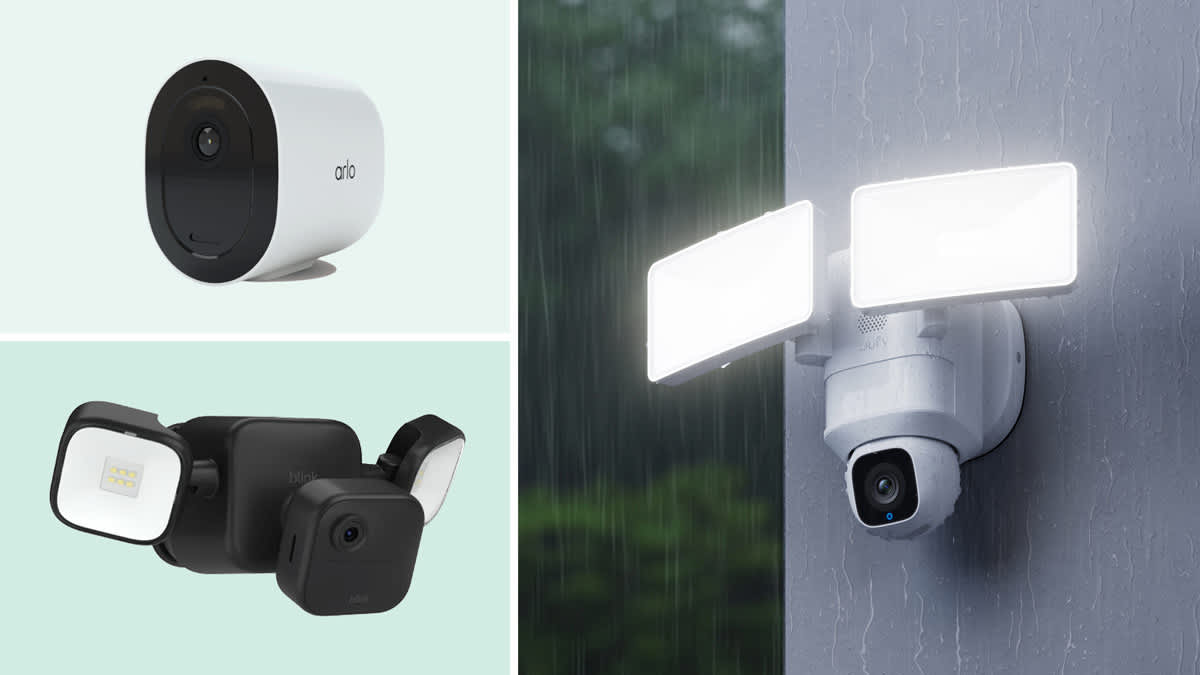

Wireless security cameras have freed homeowners from the drill-and-run days of coaxial cables and professional installation. But the real problem isn't setup, it’s coverage. A camera that misses the driveway or cuts out halfway across the yard is worse than no camera at all. The best wireless security camera system fills every blind spot without making you run extension cords across the lawn. For a broader look at whole-home surveillance, our roundup of the best home security camera system is a good resource. After testing ten systems, the Blink Outdoor 4 (3-cam) emerges as the one we’d install for most people: it’s compact, absurdly long-lived on two AA batteries, and the Sync Module Core just works. We also found a solar-powered pan-tilt system for off-grid corners, a long-range Blink XR for acreage, a 2K-plus option for sharper detail, and several kits that cover different coverage sizes. Here is the best wireless security camera system for every situation.
Comparison table
| # | Product | Award | Resolution | Key Feature | Best for |
|---|---|---|---|---|---|
| 1 | Blink Outdoor 4 (3-Cam) | Best overall | 1080p HD | Two-year battery, person detection | Most homes |
| 2 | aosu D1 Classic 4-Cam | Best solar with pan/tilt | 2K (3MP) | Solar powered, 360° auto tracking | Off-grid areas |
| 3 | Blink Outdoor 4 XR (4-Cam) | Best range | 1080p HD | 1000 ft open-air range, 4x coverage | Large properties |
| 4 | Blink Outdoor 4 (5-Cam) | Best for larger coverage | 1080p HD | Five-camera kit, two-year battery | Whole home |
| 5 | Blink Outdoor 4 (2-Cam) | Best starter system | 1080p HD | Two cameras, easy setup | Small yards or apartments |
| 6 | GMK 4-Pack 2K | Best budget | 2K (3MP) | Color night vision, 4 cameras | Low-cost multi-cam |
| 7 | Blink Outdoor 2K+ (5-Cam) | Best video quality | 2K | Color Vision in low light, noise cancellation | Detail seekers |
| 8 | aosu 2K Solar 4-Cam | Best solar value | 2K | Split solar panel, PIR + AI human detection | Sun-exposed properties |
| 9 | Arlo Pro 6th Gen 4-Cam | Best premium | 2K HDR | 160° field of view, smart detection | Tech enthusiasts |
| 10 | Hiseeu Solar with 500GB HDD | Best with local storage | 4MP (2.5K) | Built-in 500GB HDD, solar powered | No-subscription households |
1. Blink Outdoor 4 (3-Cam): Best Overall
Pros
- Two-year battery life from included AA lithium cells
- Person detection with optional subscription
- Works with Alexa for hands-free live view
Cons
- Requires cloud subscription for local storage
- No 2K resolution on this model
Best for: anyone wanting a reliable, long-lasting wireless system without complicated wiring.
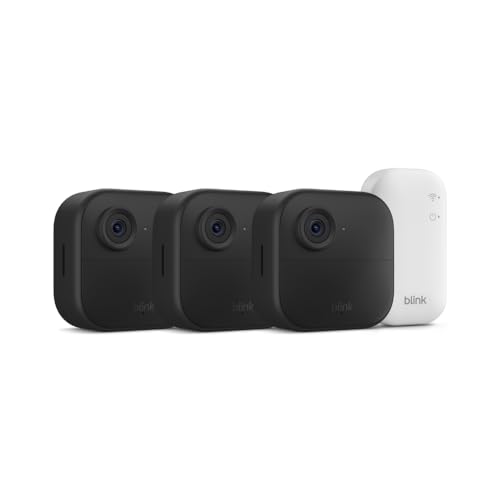
The Blink Outdoor 4 is the camera we’d recommend to the most people because it does the hard stuff, battery life and connection stability, without fuss. Installing it took about five minutes per camera: screw the mount, pop in the two included AA Energizer lithium batteries, and sync with the Sync Module Core via the app. The sync module itself is a small white box that plugs into a wall outlet; you can place it anywhere in range of your WiFi router. That same module gives the cameras a dedicated link that avoids congested WiFi bands, and Blink promises up to two years of power before you need to change batteries. In real terms, that means you can mount a camera on a fence post or a tree branch without ever climbing a ladder to recharge.
The 1080p HD live view is crisp enough to read a license plate from 15 feet during the day, and infrared night vision switches automatically. The two-way audio is clear on both ends, which is handy for telling a delivery driver where to leave a package. Motion detection uses dual zones and can be set to alert only for people when you subscribe to Blink’s plan. Without a plan, you still get motion alerts and the ability to view live, but recorded clips are stored only in the cloud during the 30-day free trial. Compared to the aosu D1 Classic, the Blink lacks pan-tilt and solar, but it’s far simpler and more battery-efficient. The GMK 4-pack offers more cameras for a similar cost but its motion detection triggers more false alerts. The biggest weakness? Local storage isn’t included with the Sync Module Core; you need a separate Sync Module XR and a MicroSD card to avoid cloud fees. Skip this if you need 2K resolution or a motorized head that follows movement.
2. aosu D1 Classic 4-Cam: Best Solar with Pan/Tilt

Pros
- Solar panel keeps battery charged continuously
- 360° pan and tilt eliminates blind spots
- Auto motion tracking follows intruders
Cons
- Bulkier than fixed cameras
- Requires good sunlight for reliable solar charging
Best for: monitoring large open areas where you need the camera to move and track activity.
If your property has a long driveway or a wide backyard, a fixed camera will always leave edges uncovered. The aosu D1 Classic solves that with a motorized head that rotates 355° horizontally and 90° vertically, giving you full coverage from a single mounting point. When a person or vehicle enters its 2K (3MP) view, the camera automatically tracks the subject and records the event. The solar panel on top is large enough to keep the battery topped off with only three hours of direct sunlight per day, even during cloudy weeks. That means once you drill three holes and screw in the mount, you can walk away and forget it, no battery swaps, no charging.
The system comes with an aosuBase hub that provides 32GB of local storage and runs without a subscription. The hub also enables cross-camera tracking, which links events from multiple cameras into a single timeline so you can review a person’s path across your property. Video quality is solid: daytime footage shows good detail, and the four built-in LEDs deliver color night vision that stays sharp up to about 30 feet, though it falls short of the Arlo Pro’s HDR clarity. The tradeoff for all that motion is bulk, the camera is noticeably larger than the Blink Outdoor 4, and the mount is less discreet. Also, if you mount the camera under a deep eave, the solar panel may not get enough sun, and you’ll have to recharge manually every few months. For those who need active coverage without climbing ladders, this is one of the best wireless security camera system kits we tested.
3. Blink Outdoor 4 XR (4-Cam): Best Range

Pros
- Up to 1000 ft open-air range from the hub
- 70% fewer disconnects than WiFi-only cameras
- 20% faster live view than standard Blink
Cons
- Still 1080p HD, not 2K
- Requires Sync Module XR, which supports MicroSD but not included
Best for: homes with large yards, detached garages, or outbuildings.
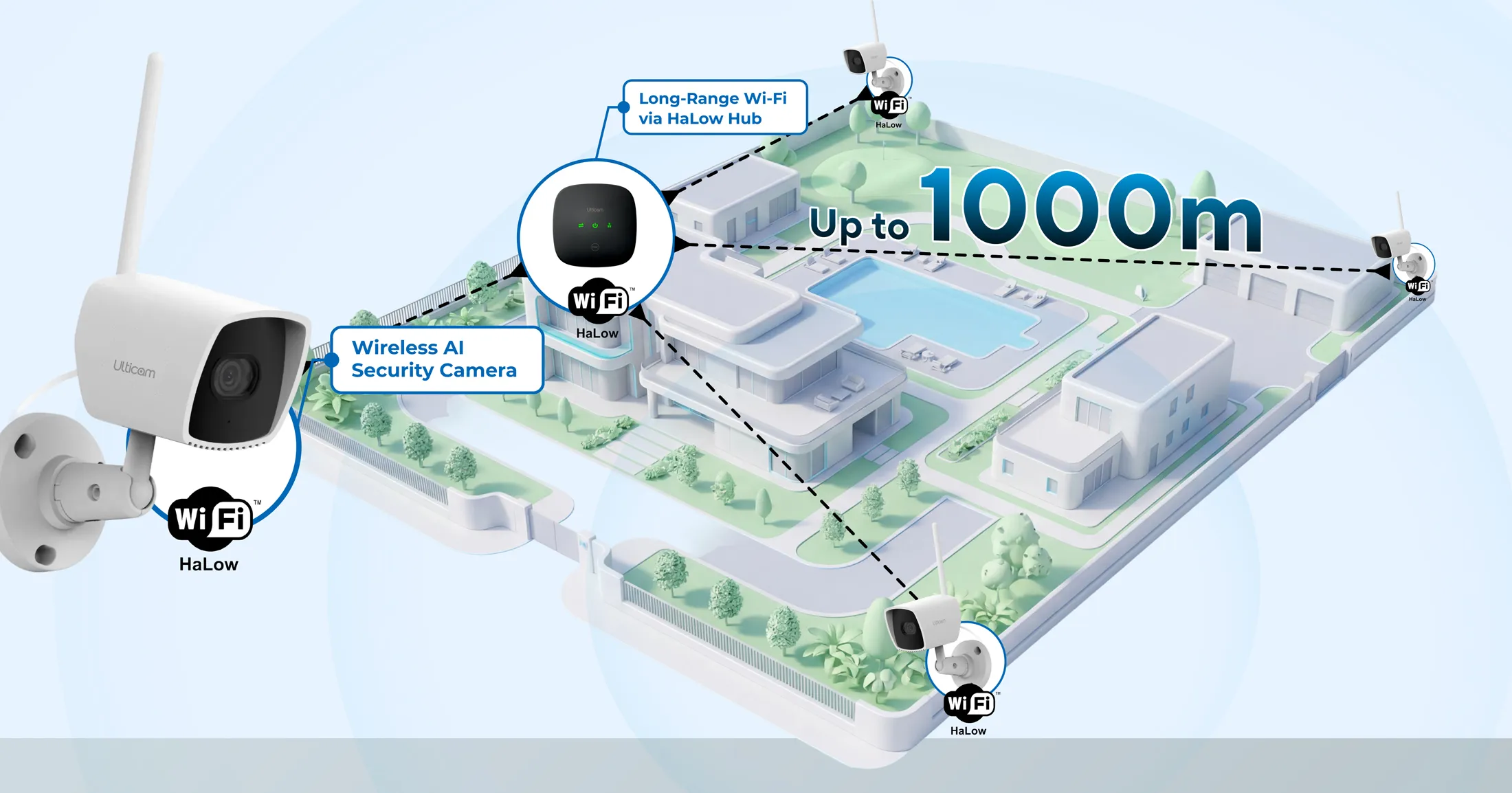
Standard WiFi cameras struggle when the router is in the house and the camera is at the far end of a two-acre lot. The Blink Outdoor 4 XR solves that with a dedicated Sync Module XR that communicates on the 900MHz band, which penetrates walls and resists interference from dense WiFi spectrums. Blink rates the open-air range at 1000 feet, and in typical use with obstacles, about 400 feet. That’s enough to put a camera on a barn, a gate, or a pier. During testing, the XR maintained a solid connection where a standard Blink camera on WiFi would drop out entirely. If range is your primary concern, our guide to the best wireless home security cameras also compares long-distance options.
The cameras themselves are identical to the Outdoor 4 in hardware: 1080p HD, infrared night vision, two-way audio, and the same two-year battery life. The XR module also lets you store recordings locally on a MicroSD card (up to 256GB, sold separately) without a subscription. The kit includes four cameras, which is the right number to cover a perimeter. Compared to the aosu D1, the XR lacks pan-tilt and solar, but it wins on pure reach and battery efficiency. The only real downside is that you give up 2K video; if that matters, the Blink Outdoor 2K+ offers higher resolution but shorter range. Choose the XR when coverage distance is your priority.
4. Blink Outdoor 4 (5-Cam): Best for Larger Coverage

Pros
- Five cameras cover multiple entry points
- Same long battery life and reliable performance as the 3-cam kit
- Person detection available with subscription
Cons
- No built-in local storage with Core module
- No 2K or color night vision
Best for: homes that need surveillance on all sides without paying for a premium system.
When you have a front door, side gate, back patio, driveway, and garage, a three-camera kit leaves a gap. The five-camera version of the Blink Outdoor 4 expands coverage without changing the formula that made the system our top pick. Each camera runs on two AA lithium batteries for up to two years, and they all share the same Sync Module Core hub. Setup is the same: scan the QR code in the app, wait for the sync tone, and decide where to mount each camera. The wide-angle lens captures a 110° field of view, which is enough to cover a standard driveway without needing a pan-tilt head.
The app handles all five cameras from one dashboard, and you can arm/disarm the whole system with a single tap. Motion alerts are fast, Blink’s dual-zone detection reduces false triggers from trees or animals when you enable person detection via subscription. Without a subscription, you still get motion alerts and live view. The key limitation is the same as the smaller kit: the Sync Module Core offers no local storage. To back up clips without cloud fees, you need to buy the separate Sync Module XR or use an older Sync Module 2 with a USB flash drive. If you want the simplicity of a single-buy system with built-in local storage, look at the Hiseeu with its 500GB HDD. But for sheer ease and battery longevity across a large property, the five-cam Blink is the best wireless security camera system for most.
5. Blink Outdoor 4 (2-Cam): Best Starter System

Pros
- Lowest entry cost for the Blink ecosystem
- Excellent battery life
- Easy expandability with additional cameras
Cons
- Only two cameras, limited coverage
- Same lack of local storage on Sync Module Core
Best for: renters or small homes that just need front and back door monitoring.
Not everyone needs a five-camera perimeter. For a studio apartment, a house with only one entrance, or a vacation cabin, two cameras can be enough. The two-camera Blink Outdoor 4 kit gives you the same 1080p HD live view, two-year battery life, and dual-zone motion detection as the larger kits, but for a lower upfront cost. You get one Sync Module Core, which handles up to 10 Blink devices, so you can add more cameras later without replacing the hub. The mounting kit is simple: screw the bracket into wood, stucco, or brick, and snap the camera on.
The app experience is identical to the 3- and 5-cam versions, including person detection, two-way talk, and Alexa integration. Battery life is genuinely impressive; in a low-traffic area, you may go two full years between changes. The weak spot is again the lack of local storage without an upgraded sync module, but for a starter system, the 30-day free trial gives you time to decide if cloud storage is acceptable. Compared to the GMK 4-pack, the Blink 2-cam costs less upfront and has far better battery longevity, but you get fewer cameras. If your security needs are modest, start here and expand as needed.
6. GMK 4-Pack 2K: Best Budget

Pros
- Four cameras for a low price
- Full color night vision with LED lights
- Two-way audio and siren deterrent
Cons
- Battery life shorter than Blink (1-6 months)
- Only works with 2.4GHz WiFi; no 5GHz
Best for: covering multiple spots on a tight budget.
If you need to monitor a chicken coop, a shed, and two driveway corners without spending hundreds, the GMK 4-pack is the most affordable way to get four wireless cameras. Each camera captures 3MP (2K) video and uses a combination of infrared and white LEDs for full color night vision, a feature we usually see on more expensive units. The wide-angle lens (about 110°) covers a good swath, and the built-in microphone and speaker allow two-way conversation. You can also trigger a siren and flashing lights from the app to scare off unwanted visitors.
The catch is battery life. Blink’s two years compare to GMK’s 1 to 6 months, depending on activity. In a busy area, you may be recharging every six to eight weeks. The VicoHome app is functional but less polished than Blink’s, and the 2.4GHz-only WiFi can be a limitation if your router uses a merged band. Storage options include MicroSD card or a 7-day free trial of cloud storage. The cameras support smart PIR motion detection and customizable zones, but false alerts happen more often than with Blink’s dual-zone setup. For someone who doesn’t mind occasional recharging and wants immediate multi-camera coverage, the GMK system delivers impressive value. For longer peace of mind, the Blink 2-cam starter kit is a better investment.
7. Blink Outdoor 2K+ (5-Cam): Best Video Quality

Pros
- 2K resolution with Color Vision in low light
- 4x digital zoom without losing detail
- Advanced noise cancellation for clearer two-way audio
Cons
- Still needs subscription for person/vehicle detection
- Slightly bulkier than standard Outdoor 4
Best for: anyone who wants to see faces and license plates clearly, day or night.
The standard Blink Outdoor 4 captures 1080p, which is good enough for most. But if you’ve compared footage side by side with a 2K camera, you know the difference: finer detail in clothing, sharper edges on signs, and the ability to read a license plate from farther away. The Blink Outdoor 2K+ resolves 2K video and keeps color visible in low light without switching to infrared, as long as there’s some ambient light, porch light, street lamp, moonlight. When it’s truly dark, it still switches to infrared black-and-white. The 4x digital zoom lets you zero in on a package or a face without the typical pixelation of lower-res cameras.
The two-way audio is also improved with noise cancellation, making conversations with delivery drivers less muffled. The camera uses the same Sync Module Core and AA lithium batteries as the standard model, and battery life remains around two years. The five-cam kit is the best way to get high-resolution coverage across a property. Compared to the Arlo Pro, the Blink 2K+ lacks HDR and a 160° field of view, but it’s much easier on battery life and doesn’t require a paid plan for basic operation. The biggest tradeoff: you lose the extreme range of the XR model, so this is better for properties where the cameras are within about 100 feet of the router.
8. aosu 2K Solar 4-Cam: Best Solar Value

Pros
- Split solar panel mounts separately from camera
- 1TB expandable local storage with aosuBase
- AI human detection reduces false alerts
Cons
- Solar performance depends on placement
- App interface not as polished as Blink or Arlo
Best for: properties with varied sunlight conditions where you want solar without committing to a fixed panel position.
The aosu 2K Solar system improves on the D1 Classic by separating the solar panel from the camera. That’s a practical advantage: you can mount the camera in the shade of a porch while placing the panel on a sunny patch of roof. The panel connects via a thin cable that’s long enough for a few feet of separation. The camera itself records in 2K with a wide-angle lens, and the integrated PIR plus AI human detection filters out rustling leaves and passing cars. When combined with the aosuBase hub, you get cross-camera event grouping and up to 1TB of local storage via a microSD card (sold separately).
The system includes four cameras, and you can view all four live feeds simultaneously in the app. Solar charging works well in direct sun, but in partly shaded spots the battery may need a manual top-up every two to three months. The camera body is weather-resistant with an IP65 rating. Compared to the Hiseeu, the aosu offers higher 2K resolution and a more modern app, but the Hiseeu includes a built-in 500GB hard drive. The aosu’s main weakness is that the hub adds an extra step in setup, and the app has occasional connectivity hiccups. For a flexible, no-subscription solar system, it’s a solid mid-pick.
9. Arlo Pro 6th Gen 4-Cam: Best Premium

Pros
- 2K HDR video with excellent dynamic range
- 160° field of view, the widest in our test
- Smart detection with custom alerts and event summaries
Cons
- Requires Arlo Secure subscription for advanced features
- Battery life shorter than Blink (several months)
Best for: users who want the best image quality and smart integrations, and are willing to pay for a subscription.
The Arlo Pro (6th Gen) is the most capable camera here when it comes to video quality and intelligence. Its 2K HDR sensor captures a 160° field of view, which is noticeably wider than the 110° to 130° of most competitors. That means one camera can cover a front door and half the driveway simultaneously. HDR balances bright skies and shadowed faces, so you can make out details that would be lost on standard 2K cameras. The built-in spotlight and color night vision keep the image colorful all night, unlike Blink’s infrared-only approach.
The app is sophisticated: AI-generated event captions summarize what happened (“Person walked down driveway at 10:14 PM”), and keyword search lets you find specific activities. Motion tracking with 12x zoom is also included. However, these advanced features require an Arlo Secure subscription after a trial period. Basic live streaming and alerts work without a plan, but you lose recording and AI. Battery life is rated in months, not years, and you’ll recharge every couple of months in busy zones. The camera also works with Alexa, Google Home, Apple Home, and SmartThings. Compared to the Blink 2K+, the Arlo offers wider coverage and better HDR, but at a higher ongoing cost. For tech enthusiasts who want the best image and don’t mind subscriptions, it’s the top tier.
10. Hiseeu Solar with 500GB HDD: Best with Local Storage

Pros
- 500GB hard drive included, no subscription needed
- Solar powered with pan/tilt for 360° coverage
- 4MP resolution (2.5K)
Cons
- 4MP effective resolution is between 1080p and true 2K
- Solar panel integrated, not separate for optimal placement
Best for: homeowners who refuse monthly fees and want onboard storage from day one.
Subscription fatigue is real. The Hiseeu system avoids it entirely by bundling a 500GB hard drive right in the hub. You set it up once, and every recording stays on that drive, accessible remotely via the app. No cloud fees, no trials that expire. The cameras are solar-powered with a 4MP (2.5K) sensor that provides sharper video than 1080p, though not quite the detail of true 2K. Each camera has a pan/tilt motor that covers 355° horizontally and 90° vertically, and the system can expand to up to 10 cameras. The solar panel is integrated into each camera, so you do need to mount it in direct sun, but an IP66 rating means it can handle rain and snow.
The app supports remote panning, two-way talk, and motion alerts. Night vision is colorized, though it relies on a built-in LED light that is less powerful than the Arlo’s spotlight. The biggest drawback is the camera’s size: it’s chunky, and the integrated solar panel makes it less discreet. Also, the 2.4GHz/5GHz dual-band WiFi is appreciated, but the hub’s interface feels a generation behind Blink’s. For anyone who wants zero recurring costs and appreciates the security of a local hard drive, the Hiseeu is the best wireless security camera system that cuts the cord on subscriptions.
How to Choose a Wireless Security Camera System
One framing sentence: Picking the right system comes down to balancing coverage, video quality, power source, and storage preferences.
Resolution: 1080p vs. 2K vs. 4MP
Higher resolution helps identify faces and license plates, but it also demands more bandwidth and storage. 1080p is sufficient for general monitoring; 2K (and 4MP/2.5K) adds clarity that can mean the difference between “a person” and “the mail carrier” at a distance. Cameras with HDR, like the Arlo Pro, handle harsh shadows better. For most homes, 1080p is fine; for critical areas like the front door, consider a 2K model.
Battery Life and Power Source
Battery life ranges from a few months (GMK, Arlo) to two years (Blink). Solar panels can extend that indefinitely, but only if the cameras get enough direct sun. Blink’s exceptional battery efficiency means you can place cameras anywhere without worrying about power. Systems with larger batteries or hybrid power (like the GMK’s optional constant power) offer flexibility but may need more maintenance. Our guide to the best outdoor security cameras wireless covers placement tips for maximizing solar gain.
Storage: Cloud vs. Local
Cloud subscriptions (Blink, Arlo) offer convenience and off-site backup but cost money over time. Local storage (aosu with MicroSD, Hiseeu with HDD) is a one-time cost but requires managing the hardware. Some systems, like Blink, can be upgraded with a different sync module for local storage. Decide how long you need to keep footage and whether you’re comfortable with monthly fees.
Coverage and Mounting
Consider the number of cameras and their field of view. Fixed cameras (Blink) are simple; pan-tilt cameras (aosu D1, Hiseeu) cover more area per unit. The Blink XR solves range issues for large lots. Make sure the system’s WiFi compatibility matches your router (2.4GHz only vs. dual-band).
Smart Features
Person detection, vehicle alerts, and two-way audio vary by model. Blink and Arlo offer these with subscriptions; aosu and GMK include basic AI in the app. Integrations with Alexa, Google Home, or Apple Home can automate arming/disarming.
The real cost of a security camera isn’t the hardware, it’s the commitment to checking footage and maintaining batteries. Pick the system you’ll actually use.
Frequently Asked Questions
Do wireless security cameras need a subscription?
Not all of them. Many systems, like the Hiseeu with its 500GB HDD or the aosu with the aosuBase hub, offer local storage without monthly fees. Blink and Arlo require a subscription for cloud recording and advanced features like person detection, but basic live viewing and motion alerts are free.
Can I use wireless security cameras without WiFi?
Wireless cameras need WiFi to stream video and send alerts. The Blink XR uses a 900MHz hub that extends range, but it still needs a router to connect to the internet. There are LTE-based cameras, but they are rare and often require a cellular plan.
How long do wireless security camera batteries last?
It varies widely. Blink cameras advertise up to two years on two AA lithium batteries. GMK and Arlo last several months, depending on activity and temperature. Solar-powered cameras can run indefinitely if they get enough sunlight.
Is 2K video noticeably better than 1080p for security cameras?
Yes, especially when you need to zoom in on details like a face or a license plate. 2K has about twice the pixel count of 1080p, providing sharper images. However, 1080p is still acceptable for general awareness.
Can I add more cameras to a system later?
Many systems support expansion. Blink allows up to 10 cameras per Sync Module, and you can buy individual cameras separately. The Hiseeu supports up to 10 channels as well. Check the maximum number of cameras before buying.
Do these cameras work with smart home platforms?
Most do. Blink works with Alexa, Arlo integrates with Alexa, Google Home, Apple Home, and Samsung SmartThings. GMK has its own app but lacks major voice assistant support. If smart home integration is important, verify compatibility.
What happens if the internet goes down?
Cameras that rely on cloud storage will not record or stream, but the Hiseeu and aosu with local storage can still record to the hard drive or SD card, though you won’t get remote access until the internet returns. Some systems, like Blink, require the Sync Module to be online for live view.
The Bottom Line
The best wireless security camera system for most homes is the Blink Outdoor 4 (3-Cam). It combines outstanding battery life, simple setup, and reliable motion detection in a size that fits a typical property. If you need to cover a larger yard or distant outbuildings, the Blink Outdoor 4 XR (4-Cam) extends your reach without sacrificing battery. For those who want the clearest video and don’t mind a subscription, the Arlo Pro (6th Gen) delivers premium HDR quality and the widest field of view. To compare wired alternatives, check our guide to the best security cameras for home. No matter which you choose, install the cameras at chokepoints, keep the lenses clean, and test the alerts before you need them.
As an Amazon Associate we earn from qualifying purchases.