

A trail camera has one job: stay outside, notice movement, and record the animal before it disappears. The trouble is that impressive resolution numbers do not tell you whether a camera works without cellular service, how far its night vision reaches, or whether you must pull an SD card every time you want to see a clip.
We compared ten cameras covering local WiFi hotspots, solar charging, no-glow infrared, traditional SD card recording, and cellular alerts. The Best wildlife camera for most people is the GardePro E5S, while the TACTACAM Reveal X 3.0 is the better fit for remote monitoring from a phone. The rest range from solar-powered backyard cameras to twin packs for covering more than one trail.
Comparison table
| # | Product | Award | Photo and video | Night vision | Best for |
|---|---|---|---|---|---|
| 1 | GardePro E5S | Best overall | 64MP, 1296P video | 100 feet, no-glow | Reliable local trail monitoring |
| 2 | TACTACAM Reveal X 3.0 | Best cellular camera | Not specified | Night vision | Remote alerts and property checks |
| 3 | MAXDONE Solar Pro | Best solar design | 64MP, 4K video | 65 feet, infrared | Long-term backyard monitoring |
| 4 | Meidase P70 | Best built-in screen | 64MP, 1296P video | 100 feet, no-glow | Reviewing footage in the field |
| 5 | GardePro A3S 2-Pack | Best low-light twin pack | 64MP, 1296P video with sound | 100 feet, no-glow | Two-angle wildlife coverage |
| 6 | GardePro E5S 2-Pack | Best twin pack for trails | 64MP, 1296P video | 100 feet, no-glow | Monitoring separate locations |
| 7 | SPYPOINT FLEX-M Twin Pack | Best multi-camera cellular setup | 28MP, 720P video with sound | Night vision | Phone-based scouting |
| 8 | DEATTI T4 | Best included accessories | 48MP, 4K video | 30 meters, no-glow | A ready-to-use local camera |
| 9 | Misstech Solar Cam | Best solar starter | 64MP, 4K video | Clear night vision | Yards, farms, and gardens |
| 10 | MAXDONE Solar Cam | Best solar local storage | 64MP, 4K video | 65 feet, low-glow infrared | Private local recording |
1. GardePro E5S: Best Overall

Pros
- Fast 0.1-second trigger
- Three PIR sensors
- 100-foot no-glow night vision
- IP66 weather resistance
- Supports an optional solar panel
Cons
- Requires eight AA batteries
- No wireless file transfer
- SD card is not included
Best for: someone who wants a dependable local trail camera without cellular service.
The GardePro E5S is the camera we would put on a regular deer trail first. It avoids the complications of cellular activation and does not pretend its short-range wireless connection can send alerts across the internet. Instead, it records to an SD card, stays quiet, and gives you the basic controls that matter when the camera is left alone.
Its 64MP still photos and 1296P video provide plenty of detail for identifying animals and studying movement. The 0.1-second trigger is backed by three PIR sensors, so motion coming from the sides has a better chance of being noticed before an animal exits the frame. That matters more than headline resolution when a deer is moving quickly through a narrow path.
At night, the 100-foot no-glow infrared system is the E5S's strongest advantage over simpler backyard cameras. The IP66 rating adds protection against rain and dust, while the 1/4-inch-20 mounting thread gives you a standard way to attach it to a tree, post, or fence. It runs on eight AA batteries and supports the GardePro SP350 solar panel, sold separately, for a more permanent installation.
The trade-off is the lack of convenient wireless access. You must retrieve the SD card, and batteries are not included. The MAXDONE Solar Pro is easier for nearby phone downloads, while the TACTACAM Reveal X 3.0 is the clear choice for remote alerts. Pick the E5S when dependable motion capture and simple local operation matter more than checking footage from a distance.
2. TACTACAM Reveal X 3.0: Best Cellular Camera

Pros
- Automatic AT&T and Verizon carrier selection
- Built-in GPS
- No SD card required
- Three-shot burst mode
- Remote alerts through the REVEAL app
Cons
- Cellular operation depends on signal
- Service is part of the operating setup
- Photo and video resolution is not specified
Best for: landowners and hunters who need wildlife images sent to a phone from remote ground.
The TACTACAM Reveal X 3.0 solves the problem that defeats every non-cellular camera in this roundup: you do not have to visit the tree to find out what happened. Its integrated SIM can connect through AT&T or Verizon, selecting the stronger carrier at the location rather than forcing you to choose one network in advance.
The camera sends images through the REVEAL app, and built-in storage means there is no SD card to format or remove. GPS tracking is also built in, which is useful when several cameras are spread over a large property. Setup is designed around a pre-installed antenna and pre-activated SIM, with the app guiding the activation process.
A sub-half-second trigger and three-shot burst mode help preserve a sequence instead of a single moment. The feature list also positions this model for monitoring gates, equipment, farms, and ranches, not just animal paths. Battery life is listed as up to six or more months, though actual results will depend on activity, signal conditions, and the chosen power setup.
This is a very different proposition from the GardePro E5S. The E5S has a specified 0.1-second trigger and 100-foot no-glow range, but it makes you collect the footage. The Reveal X 3.0 is the one to choose when an alert matters more than maximum stated image detail. Skip it if the camera site lacks dependable cellular coverage or if you do not want a connected camera system.
For readers comparing conventional trail cameras with dedicated wildlife photography equipment, the choice also depends on whether you need remote detection or a camera setup built for detailed wildlife photography. The Reveal X 3.0 is about awareness at a distance, not a substitute for a long lens and a photographer nearby.
3. MAXDONE Solar Pro: Best Solar Design

Pros
- Adjustable split solar panel
- 6000mAh rechargeable battery
- 4K video and 64MP photos
- Short-range WiFi and Bluetooth app access
- 0.1-second trigger
Cons
- WiFi does not support remote viewing
- Phone must be near the camera
- Night vision is rated to 65 feet
Best for: a fixed outdoor location where solar charging and nearby phone downloads are useful.
The MAXDONE Solar Pro is designed to reduce the maintenance that comes with a camera mounted high on a tree. Its split solar panel can be manually angled, making it easier to position the panel toward the sun when the camera itself needs to face a trail. A built-in 6000mAh rechargeable battery and Type-C charging provide alternatives when sunlight is limited.
The camera records 64MP photos and 4K video, with infrared night vision rated to 65 feet. A 0.1-second trigger and customizable detection zones help it react quickly without recording every swaying branch. Time-lapse, scheduled shooting, five-shot burst mode, audio recording with noise reduction, and timestamp controls give it more flexibility than a basic motion-only unit.
The important distinction is what MAXDONE calls WiFi. This camera creates its own short-range hotspot for setup and file downloads. It cannot join household WiFi, cannot provide remote internet viewing, and has a stated open-area range of 33 to 49 feet for the hotspot. That is still convenient when you are standing near the camera, but it is not cellular monitoring.
The included 32GB SD card makes the camera easier to deploy, and IP66 protection suits year-round outdoor use. The Misstech Solar Cam also combines solar power with local app playback, while the MAXDONE Solar Pro offers a more explicitly adjustable panel design. Choose this model for a sunny yard, farm, or nearby woodland position where you want fewer battery changes and do not mind walking to the camera.
4. Meidase P70: Best Built-In Screen

Pros
- 2.4-inch color display
- 64MP photos and 1296P video
- 100-foot no-glow infrared
- 0.1-second trigger
- H.264 video compression
Cons
- Eight AA batteries are sold separately
- Solar panel is optional
- No cellular or WiFi connection
Best for: checking footage at the camera without relying on a phone or computer.
The Meidase P70 makes field checks less awkward by putting a 2.4-inch color display on the camera. You can review clips at the tree, confirm the framing, and change settings without guessing what the lens is seeing. That is a practical advantage over cameras that require an SD card reader or a nearby phone connection.
Its 64MP still image mode and 1296P video are aimed at the same detail level as the GardePro E5S. The P70 uses an f/1.6 aperture lens, which is intended to help gather light at dawn, dusk, and night. H.264 compression produces MP4 or MOV files that should be easier to move and play than very large uncompressed clips.
For fast movement, the 0.1-second trigger uses side sensors, and the 940nm infrared LEDs provide no-glow night vision to a stated 100 feet. That gives it a stronger nighttime range on paper than the MAXDONE Solar Pro. The camera also supports an optional Meidase SP350 solar panel, with eight AA batteries serving as backup power.
The P70 is not a connected camera. There is no cellular alerting and no WiFi file transfer, so it is better for owners who are comfortable visiting the site. It is also larger and heavier than the GardePro E5S. Choose the Meidase P70 when the built-in screen is worth that extra bulk, particularly for first-time users who want immediate playback in the field.
5. GardePro A3S 2-Pack: Best Low-Light Twin Pack
Pros
- Two cameras for separate viewpoints
- Sony Starvis sensor
- 120-degree PIR detection angle
- 64MP photos and video with sound
- Supports cards up to 512GB
Cons
- Eight AA batteries per camera are not included
- No wireless transfer
- Solar panel is sold separately
Best for: covering two paths or getting both close and wide views of one area.
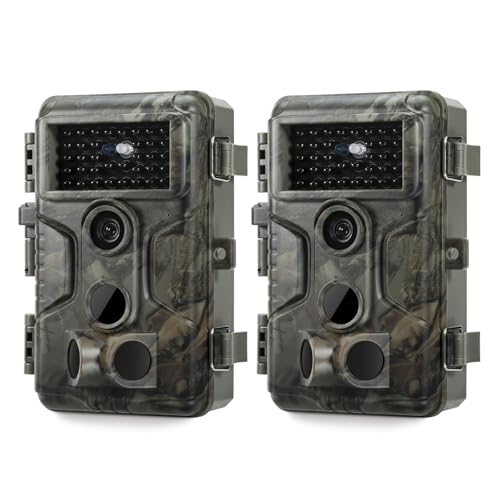
The GardePro A3S 2-Pack is useful when one camera cannot tell the whole story. Put one unit on the approach to a feeding area and another on the exit trail, or aim them across a clearing from different angles. That simple change can reveal direction of travel and reduce the blind spots that a single camera leaves behind.
The A3S uses a Sony Starvis sensor for low-light performance, with 64MP stills and 1296P video that includes sound. Its 0.1-second trigger, 120-degree PIR detection angle, and up to five-shot burst mode are well suited to animals crossing quickly through a frame. The 940nm no-glow infrared system reaches up to 100 feet.
Recording flexibility is a strength. Motion detection, time-lapse, and hybrid mode let you adapt the cameras to a narrow trail or a broad area. Support for SD cards up to 512GB, in-camera playback, and loop recording reduce the need to revisit the camera merely to manage storage. Each unit uses eight AA batteries and can work with the GardePro SP350 solar panel.
The GardePro E5S 2-Pack has the same broad resolution and night-vision claims, but the A3S adds the Starvis sensor, wider detection angle, and sound recording. The single GardePro E5S is simpler when you need only one position. Choose the A3S pair when low-light coverage and two viewpoints matter more than minimizing equipment.
6. GardePro E5S 2-Pack: Best Twin Pack for Trails

Pros
- Two matching cameras
- 0.1-second trigger
- Three PIR sensors
- 100-foot no-glow night vision
- Supports 512GB SD cards
Cons
- No SD cards included
- Eight AA batteries per camera are not included
- No wireless or cellular access
Best for: monitoring two separate trails with matching controls and recording modes.
The GardePro E5S 2-Pack takes the straightforward strengths of the single E5S and applies them to two locations. Matching cameras are easier to configure than two unrelated models, especially when both need the same trigger behavior, night settings, and time stamps. It is a sensible arrangement for a property with a main trail and a secondary route.
Each camera records 64MP photos and 1296P HD video. The three PIR sensors support a 0.1-second trigger, helping capture animals that enter from either side. At night, 940nm no-glow infrared reaches up to 100 feet, which keeps the cameras discreet while giving you useful coverage across a clearing.
The cameras support motion detection, time-lapse, and hybrid mode. Loop recording can keep the system working when the card fills, and support for SD cards up to 512GB gives you room for extended deployment. IP66 weather resistance and a 1/4-inch-20 mounting thread make the units adaptable to trees, posts, and fences.
The A3S 2-Pack is more interesting when low-light sensitivity, a 120-degree detection angle, and sound recording are priorities. The E5S pair is the cleaner choice for two ordinary trail positions because it concentrates on fast detection and consistent operation. It cannot send footage to a phone, and each camera needs its own eight AA batteries, so plan for physical visits.
7. SPYPOINT FLEX-M Twin Pack: Best Multi-Camera Cellular Setup

Pros
- Two cellular cameras
- Cross-carrier connectivity
- GPS and map features
- Remote setting and firmware control
- Photo, video, and time-lapse modes
Cons
- 28MP photos and 720P video are lower resolution here
- MicroSD card is not included
- Cellular features require network service
Best for: managing two remote cameras from the SPYPOINT app.
The SPYPOINT FLEX-M Twin Pack is about coverage and convenience rather than maximum image resolution. Two cellular cameras can watch separate access points, feeding images to a phone, tablet, or computer without a WiFi router at the property. For someone scouting a large area, that is more useful than collecting high-resolution files weeks later.
Cross-carrier connectivity reduces the risk of choosing the wrong network before installation. The SPYPOINT app handles activation, maps, weather information, remote settings, firmware updates, and a Buck Tracker AI feature for species filtering. GPS adds another layer of organization when the cameras move between properties or locations.
The FLEX-M records 28MP photos and 720P video with sound. Those figures are lower than the 64MP and 4K claims on several local cameras here, but cellular transmission benefits from manageable files. Photo, video, time-lapse, and time-lapse-plus modes cover both motion events and broad-area observation, while Constant Capture is designed to send and record at the same time.
The GardePro E5S pair is better if your priority is no-glow coverage and high stated resolution without a connected system. The SPYPOINT pair wins when not visiting the camera is the point. Be clear about the cellular requirement and the missing microSD card before choosing it, and use it where network connectivity is reliable.
8. DEATTI T4: Best Included Accessories

Pros
- 4K video and 48MP photos
- 0.1-second trigger
- 120-degree detection angle
- 2-inch color LCD
- Includes 32GB SD card and eight batteries
Cons
- WiFi is short-range only
- No remote viewing
- Night vision range is listed as 30 meters
Best for: a first setup that includes the basic recording and mounting accessories.
The DEATTI T4 is an easy camera to understand because its package covers many of the things needed for a first installation. It includes a 32GB SD card, eight batteries, a wall mount bracket, a USB cable, and a strap. Its 2-inch color LCD also lets you check the view and review files without carrying a separate screen.
The camera records 4K video and 48MP photos. A 0.1-second trigger and 120-degree detection angle are intended to catch fast movement across a broad area. At night, 36 940nm infrared lights provide no-glow recording, with a claimed night vision distance of 30 meters.
Its WiFi is local rather than internet-based. The camera creates a hotspot, and the TrialCam Go app can download files when your phone is within roughly 5 to 8 meters. That is convenient for a camera mounted near a garden or accessible trail, but it is not a way to check a remote property from home.
The MAXDONE Solar Pro offers solar charging and a larger stated 64MP photo mode, while the DEATTI T4 is more ready to use because batteries and a card are included. IP66 protection, password protection, time intervals, delayed capture, and PIR sensitivity controls round out the feature set. Pick the T4 when included setup items and a local screen matter more than cellular alerts or solar power.
9. Misstech Solar Cam: Best Solar Starter

Pros
- Built-in solar panel and rechargeable battery
- 4K video and 64MP photos
- 0.1-second activation
- Built-in screen and phone app playback
- Includes 8GB card
Cons
- App connection is local
- Storage support tops out at 128GB
- No cellular viewing
Best for: simple solar monitoring around a yard, farm, or garden.
The Misstech Solar Cam is aimed at people who want to mount a camera and avoid regular battery changes. Its built-in rechargeable battery works with the solar panel for continued outdoor use, while the compact body is easier to place around a garden or farm than a larger surveillance unit.
It records 4K video and 64MP photos through an f/1.6 wide-aperture lens. The feature list specifically calls out dawn, dusk, and nighttime activity, and a 0.1-second activation with five-frame sequence mode gives fast animals more than one chance to appear clearly. The camera also records moon phase, temperature, and time on footage.
Playback is available on the built-in screen or through the Trailcam Go app. The app connection is local, with a stated range of 30 to 50 meters in open areas, so you can download files without removing the camera from its mount. An included 8GB card supports loop recording for up to 30 days according to the listing, with expansion up to 128GB.
The MAXDONE Solar Pro has a 6000mAh battery and a more adjustable split-panel design, while the Misstech offers useful environmental timestamps and location saving through MapPin. Neither provides cellular remote viewing. Choose Misstech for a small solar installation where local playback and low maintenance are the main goals.
10. MAXDONE Solar Cam: Best Solar Local Storage

Pros
- 6000mAh rechargeable battery
- 4K video and 64MP photos
- 0.1-second trigger
- Includes 32GB card
- Supports storage up to 256GB
Cons
- WiFi hotspot is not household WiFi
- No cellular or remote viewing
- Night vision is rated to 65 feet
Best for: private local recording with solar power and occasional nearby downloads.
The MAXDONE Solar Cam is a close relative of the MAXDONE Solar Pro, with the same basic idea: use solar charging and a rechargeable battery to reduce maintenance, then connect locally when you need the files. It is a good fit for a yard, ranch, or nearby woodland where privacy and local storage matter.
The built-in 6000mAh battery works with solar charging, while Type-C charging provides another way to replenish it. The camera records 64MP stills and 4K video, and its 0.1-second trigger, 100-degree detection angle, and five-shot burst mode are suited to moving animals. Night vision reaches a stated 65 feet through low-glow infrared.
The included 32GB TF card can be expanded to 256GB. Time-lapse, operation hours, audio recording, programmable detection zones, loop recording, timestamps, and password protection make it more configurable than a bare motion sensor camera. IP66 construction is intended for rain, snow, heat, and dusty outdoor environments.
The local WiFi hotspot has a range of up to 55 feet, but the camera does not connect to household WiFi and does not support cellular networks. The MAXDONE Solar Pro has the more flexible split-panel placement, while the Misstech Solar Cam offers a built-in screen and environmental markers. Pick this MAXDONE model when local storage capacity and a 6000mAh battery are the features you care about most.

How to choose the best wildlife camera
The right camera depends less on the largest headline number than on where it will be mounted, how often you can visit, and how quickly an animal crosses the frame.
Connectivity
Cellular cameras such as the TACTACAM Reveal X 3.0 and SPYPOINT FLEX-M can send images to an app from remote locations. They need usable network coverage and a cellular service setup. Local WiFi cameras only create a nearby hotspot, so they help with downloads at the site but cannot provide alerts while you are away.
Trigger speed and detection angle
A 0.1-second trigger is useful when deer, foxes, or birds move quickly through the detection area. A wider detection angle can improve coverage across a clearing, while multiple PIR sensors can help detect motion approaching from the sides. The GardePro E5S uses three PIR sensors, and the A3S and DEATTI T4 list 120-degree detection angles.
Night vision
No-glow 940nm infrared helps keep the camera discreet around wildlife. Check both the infrared type and the claimed distance. The GardePro and Meidase models list 100-foot night vision, while the MAXDONE models list 65 feet. Actual framing, vegetation, and the animal's distance still affect how useful the footage is.
A fast trigger is wasted if the camera is aimed too high, too low, or across the wrong part of the trail.
Power
Solar cameras can reduce visits for battery changes, but they still need sensible placement where the panel receives light. Standard cameras use replaceable AA batteries, and some support optional solar panels. Consider whether the camera will sit in shade, how much motion it will record, and whether you can safely reach it for maintenance.
Storage and playback
SD card cameras keep recording locally and generally require a physical visit. Look for loop recording, in-camera playback, and adequate card capacity. Some models, including the MAXDONE Solar Pro and DEATTI T4, include cards, while the GardePro models require you to supply one. A built-in screen or local app can make field checks easier.
Frequently asked questions
Do wildlife cameras need WiFi?
No. Many trail cameras record directly to an SD card and work without WiFi. Local WiFi models create their own nearby hotspot, while cellular cameras use mobile networks rather than a home router.
Can these cameras send photos to a phone?
The TACTACAM Reveal X 3.0 and SPYPOINT FLEX-M are designed for remote app delivery through cellular connections. MAXDONE, DEATTI, and Misstech use short-range local connections for nearby downloads, not remote viewing. The GardePro and Meidase cameras rely on local storage and physical retrieval.
Is 4K necessary for wildlife monitoring?
Not always. A fast trigger, suitable framing, and effective night vision can matter more than the video resolution. The 1296P GardePro E5S can be a better trail choice than a 4K camera if its faster detection and 100-foot no-glow range fit the location.
What does no-glow night vision mean?
No-glow systems use infrared illumination intended to be invisible to animals and people. They help the camera record at night without a noticeable red light. The GardePro, Meidase, and DEATTI models list 940nm infrared systems.
Are solar trail cameras maintenance-free?
No camera is completely maintenance-free. Solar models reduce battery changes, but the panel needs a suitable position and may need cleaning. Shade, weather, recording activity, and battery condition can all affect how long the system operates.
How should a trail camera be positioned?
Aim it across the direction of travel rather than directly along the trail, since a side-on crossing gives the trigger more time to detect movement. Keep nearby grass and branches out of the detection area where possible. Check the frame using the camera's screen or local app before leaving.
Should I choose one camera or a twin pack?
A single camera is enough for one clear trail position. A twin pack makes more sense when you want separate viewpoints, two trails, or coverage of both sides of a clearing. Cellular twin packs are especially useful when visiting both locations would be inconvenient.
The bottom line
The Best wildlife camera for most people is the GardePro E5S. Its 0.1-second trigger, three PIR sensors, 100-foot no-glow night vision, IP66 construction, and straightforward SD card operation cover the core needs without adding cellular complexity.
Choose the TACTACAM Reveal X 3.0 when remote alerts and GPS matter more than stated resolution, or the MAXDONE Solar Pro when the camera will stay in a sunny location and nearby phone downloads are enough. The GardePro A3S 2-Pack and E5S 2-Pack are the practical choices for covering two trails.
If you are undecided, choose the GardePro E5S for a single trail and the TACTACAM Reveal X 3.0 for a remote property you cannot visit often.
As an Amazon Associate we earn from qualifying purchases.