

A dash cam can record an incident clearly and still be frustrating to use if retrieving the clip means removing a memory card or untangling cables. The best wireless dash cam options use Wi-Fi for phone access, while the camera itself still needs vehicle power during recording.
This list covers everything from compact front-only cameras to four-channel systems that watch the cabin and both sides of the vehicle. The ROVE R2-4K Dual Dash Cam is our top pick, with the REDTIGER models close behind and several wider-coverage alternatives for rideshare drivers and parked-car surveillance.
Comparison table
| # | Product | Award | Front video | Coverage | Wi-Fi | Best for |
|---|---|---|---|---|---|---|
| 1 | ROVE R2-4K Dual Dash Cam | Best overall | 4K at 30fps | Front and rear | 5GHz and 2.4GHz, up to 20MB/s | Most drivers |
| 2 | REDTIGER F7N Touch | Best for easy control | 4K | Front and rear | 5.8GHz, up to 20MB/s | Touch and voice control |
| 3 | REDTIGER F7NP | Best night recording | 4K | Front and rear | 5.8GHz, up to 20MB/s | Low-light driving |
| 4 | TERUNSOUl 3-Channel Dash Cam | Best for rideshare | 4K | Front, rear, and cabin | 5.8GHz and 2.4GHz, up to 20MB/s | Cabin monitoring |
| 5 | galphi Mini Dash Cam | Best compact option | 4K | Front only | 5GHz, up to 8MB/s | Discreet installation |
| 6 | ZMOPO 4-Channel Dash Cam | Best side coverage | 1080p on all channels | Front, rear, left, and right | 5GHz | Full vehicle coverage |
| 7 | IIWEY N6 4-Channel Dash Cam | Best parking surveillance | Ultra Full HD | Front, rear, and both sides | 5.8GHz and 2.4GHz, up to 20MB/s | Long parked periods |
| 8 | Neideso N300 4-Channel Dash Cam | Best voice control | Up to 4K | Front, rear, and interior | 5GHz, up to 10MB/s | Hands-free operation |
| 9 | Veement V300 Dash Cam | Best front-only camera | 1296p | Front only | Wi-Fi app | Simple front recording |
| 10 | REDTIGER F17 3-Channel Dash Cam | Best three-camera night view | 4K with inside camera off | Front, rear, and cabin | 5GHz and 2.4GHz | Flexible three-channel use |
1. ROVE R2-4K Dual Dash Cam: Best Overall
Pros
- 4K front and 1080p rear recording
- STARVIS 2 sensor with wide apertures
- Fast 5GHz phone transfers
- GPS data and three parking modes
- Supercapacitor and thermal protection
Cons
- Parking mode requires a separate hardwire kit
- The rear camera records at a lower resolution than the front
- The 3-inch screen takes more space than a screen-free design
Best for: drivers who want sharp front footage, rear coverage, GPS, and a polished phone workflow.
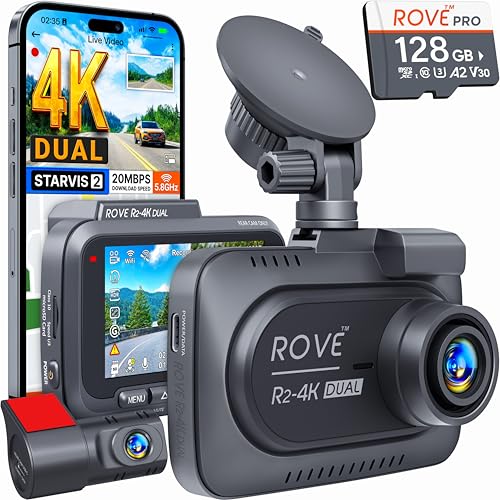
The ROVE R2-4K Dual Dash Cam feels like the most complete two-camera system here. It gives you a proper 3-inch IPS screen for setup and playback, but the built-in Wi-Fi means you do not have to use that screen every time you need a clip. The front camera records at 3840 by 2160 at 30fps, while the rear camera records 1920 by 1080 at 30fps. That split makes sense: the front view gets the extra detail needed for signs and plates, and the rear camera fills in the context behind the car.
The Sony IMX675 STARVIS 2 sensor is the important part of the front camera. Its F1.5 aperture lets in more light, while the rear lens uses an F1.8 aperture. In practice, those details matter most after sunset, when a narrow exposure window can turn dark road footage into a noisy blur. The 150-degree front angle and 140-degree rear angle also give this setup broad coverage without moving into the distortion-heavy territory of some extreme wide-angle cameras.
Wireless access is handled well. The dual-band Wi-Fi supports 5GHz and 2.4GHz connections, with downloads listed at up to 20MB/s through the ROVE app. GPS adds route, speed, and compass information to the recording, and the free GPS Player can show that data on a computer. Loop recording, a G-sensor, and emergency video locking cover the everyday basics. The included 128GB card lets the system start recording immediately, and support for cards up to 1TB gives frequent drivers room to keep more footage.
Parking protection is more flexible than on many of the alternatives. The ROVE offers 1fps time-lapse, motion detection, and collision detection modes, though all require a separate hardwire kit. Its supercapacitor and built-in thermal protection are sensible choices for a device that spends long periods behind a windshield. The weakness is that the rear video is only 1080p, and the screen-free galphi is less visually intrusive. Still, the ROVE is the one we'd keep for a normal car because it balances image quality, installation, phone access, and useful evidence features better than the rest.
2. REDTIGER F7N Touch: Best for Easy Control

Pros
- 4K front and 1080p rear video
- Touchscreen and voice commands
- HDR, WDR, and STARVIS 2 sensor
- GPS and fast 5.8GHz Wi-Fi
- Loop recording with impact locking
Cons
- Parking modes require a hardwire kit
- The touchscreen adds a visible dashboard display
- The model name is easy to confuse with other REDTIGER cameras
Best for: drivers who want to change settings or protect clips without reaching for a phone.
The REDTIGER F7N Touch stands apart from the ROVE by putting control directly on the camera. Its touchscreen can lock an emergency clip, activate Wi-Fi, and capture a scene, while physical buttons remain available for drivers who prefer tactile controls. Voice commands add another hands-free option. This is useful when you need to save a moment quickly and do not want to open the phone app while pulled over.
The recording setup is familiar but capable. The front camera records in 4K with a 170-degree view, and the rear camera records in 1080p through a 140-degree lens. WDR and HDR work to balance bright headlights, shadowed streets, and uneven exposure. The STARVIS 2 sensor supports the front camera's low-light work, so this is a strong match for drivers who regularly travel at night or through changing light.
The F7N Touch connects through 5.8GHz Wi-Fi and claims download speeds up to 20MB/s. The REDTIGER Cam app handles preview, downloads, playback, and settings, while built-in GPS records location, speed, and route information. Loop recording clears older unlocked files when the card fills, and the G-sensor protects footage associated with a sudden impact. An included 128GB card gives the dual-channel system a useful starting point for storage.
Its biggest limitation is not image quality but installation scope. The camera is wired in the car, and its 24-hour collision and time-lapse parking modes need a separate hardwire kit. The REDTIGER F7NP offers a similar recording arrangement with a simpler control experience, while the ROVE gives more parking-mode choices and a more established all-round feature set. Pick the F7N Touch if the touchscreen and voice commands will actually get used. Skip it if you want the smallest, least noticeable camera on the windshield.
3. REDTIGER F7NP: Best Night Recording

Pros
- 4K front and 1080p rear recording
- STARVIS 2 sensor and F1.5 aperture
- WDR and HDR for difficult lighting
- GPS and 5.8GHz Wi-Fi
- Supercapacitor for heat resistance
Cons
- Separate hardwire kit needed for parking mode
- No stated touchscreen or voice control
- Rear footage remains 1080p
Best for: drivers who put low-light clarity ahead of on-camera controls.
The REDTIGER F7NP is the less flashy sibling to the F7N Touch, and that is a good thing for drivers who want to set a camera up once and leave it alone. Its front camera combines 4K recording with a STARVIS 2 sensor, an F1.5 aperture, and a six-layer optical lens. Those features do not guarantee perfect night footage, but they give the camera more useful light and contrast to work with than a basic front-facing recorder.
The dual-camera arrangement records 4K at the front and 1080p at the rear. Both lenses use wide fields of view, with 170 degrees up front and 140 degrees behind the vehicle. WDR and HDR help manage the difficult mix of headlights, dark pavement, and reflective signs that can make nighttime footage hard to interpret. For ordinary driving, the front camera is the clear priority, and this model puts its hardware there.
Its 5.8GHz Wi-Fi connects to the REDTIGER Cam app for live preview, playback, settings, and downloads of up to 20MB/s. GPS records the route, speed, and location, which can make a clip more useful when you need to establish where and when an incident happened. The included memory card supports loop recording, and the G-sensor locks footage after a collision so it is not immediately swept away by the next recording cycle.
The F7NP uses a supercapacitor rather than a lithium battery. That matters for a device exposed to heat inside a parked vehicle, though the manufacturer still advises avoiding prolonged extreme temperatures. It also needs a separate hardwire kit for time-lapse or impact-triggered parking coverage. The ROVE is more versatile and the F7N Touch is easier to operate from the driver's seat, but the F7NP is the focused choice for someone who wants a straightforward dual camera with strong low-light credentials.
4. TERUNSOUl 3-Channel Dash Cam: Best for Rideshare

Pros
- Front, rear, and cabin recording
- 4K front video with 1080p secondary cameras
- 170-degree front and 165-degree rear and cabin views
- GPS and dual-band Wi-Fi
- Included 3.16-inch IPS screen
Cons
- Larger and heavier than the front-only options
- Parking mode needs a separate hardwire kit
- Cabin coverage is not a substitute for a dedicated security camera
Best for: rideshare and family drivers who need the interior recorded alongside the road.
The TERUNSOUl 3-Channel Dash Cam is the first meaningful change in coverage from the dual-channel cameras above. It records the front, rear, and cabin simultaneously, so it can document what happened inside the vehicle as well as around it. That makes the layout especially relevant to rideshare drivers, taxi operators, and families who want a record of the passenger area.
The front channel records in 4K, while the rear and cabin channels record in 1080p. A 170-degree front view and 165-degree views for the rear and cabin create broad coverage across all three perspectives. The cabin lens is also useful for interactions that a front-and-rear system simply cannot see. Starlight night vision, a five-layer lens, an F1.6 aperture, and HDR are listed for low-light recording, though the additional channels naturally make this a busier system than a dual camera.
A 3.16-inch IPS screen makes initial alignment easier, and the built-in GPS records route, speed, location, compass, and timestamp information in the files. Dual-band 5.8GHz and 2.4GHz Wi-Fi connects to the TERUNSOUl app, with downloads listed at up to 20MB/s. The included 128GB card, loop recording, and collision locking cover the essential storage workflow.
The trade-off is physical presence. This camera weighs more than the compact front-only models and has more wiring to route cleanly. A separate hardwire kit is needed for parking mode, too. The REDTIGER F17 3-Channel Dash Cam offers a more flexible resolution setup, but this TERUNSOUl model is the clearer pick when cabin recording is the primary reason to move beyond a two-camera system. Drivers who only need road evidence should choose the ROVE instead.
5. galphi Mini Dash Cam: Best Compact Option

Pros
- 4K front recording
- Small, screen-free design
- 5GHz Wi-Fi and app access
- F1.6 aperture and WDR
- Supports cards up to 256GB
Cons
- No rear or cabin camera
- Wi-Fi downloads are listed at up to 8MB/s
- Parking mode needs a separate Type-C hardwire kit
Best for: drivers who want a discreet front camera without a screen taking up windshield space.
The galphi Mini Dash Cam takes the opposite approach from the touchscreen and multi-camera models. It has no screen, which keeps the camera less distracting and makes the small body easier to position behind a mirror. The front-only design is also easier to install because there is no rear camera cable to hide. For a driver who wants recording to happen quietly in the background, that simplicity is the attraction.
It records in 4K through a 160-degree lens, with an F1.6 aperture and WDR for low-light scenes and uneven exposure. That combination should help preserve road detail when headlights and dark surroundings appear together. The camera does not offer rear, cabin, or side views, however. A clear front image cannot replace the broader evidence provided by the ROVE or any of the four-channel cameras.
The 5GHz Wi-Fi connection works with the companion app for playback and clip downloads, with a stated transfer speed of up to 8MB/s. That is slower than the 20MB/s claims on several REDTIGER models, but it still avoids removing the card for routine sharing. A 32GB card is included, and the camera supports cards up to 256GB. Loop recording replaces older files, while the G-sensor locks footage after a sudden collision.
Parking mode records in time-lapse, but it requires a separate Type-C hardwire kit. There is also no built-in display for checking the framing, so the app becomes more important during setup. The Veement V300 is even simpler in its front-only role, but the galphi gives you 4K recording and a more compact screen-free format. It is the right fit for a small windshield footprint, not for anyone who needs evidence from behind or inside the vehicle.
6. ZMOPO 4-Channel Dash Cam: Best Side Coverage

Pros
- Four simultaneous 1080p channels
- Front, rear, left, and right views
- Eight infrared lights and WDR
- 5GHz Wi-Fi app access
- Time-lapse recording saves card space
Cons
- GPS requires a separately purchased logger
- Parking mode needs an optional hardwire kit
- All channels are 1080p
Best for: drivers who care more about side coverage than maximum front-camera resolution.
The ZMOPO 4-Channel Dash Cam solves a blind-spot problem that front-and-rear systems leave open. Four Full HD cameras record the front, rear, left, and right sides at the same time. That arrangement is useful in crowded parking areas, dense city traffic, and situations where an impact comes from an adjacent lane rather than directly ahead or behind.
Every channel records at 1080p, and the front cameras can be adjusted for a better view. Eight infrared lights support the night-vision system, while WDR works to balance bright and dark parts of the image. This is not the model to choose when you need the smallest possible plate detail from a distant car. It is the one to choose when knowing what happened on both sides of your vehicle matters more than a 4K front view.
The camera supports time-lapse recording that compresses 60 minutes into one minute, which reduces the amount of storage used during extended monitoring. Loop recording removes the oldest unlocked clips when the card fills, and incident lock protects footage after an event. The 5GHz Wi-Fi connection lets you use the mobile app to access recordings without taking the card out.
There are two important qualifications. GPS is optional and requires a separate logger, despite GPS appearing in the longer product title, and parking mode requires an optional ACC hardwire kit. The IIWEY N6 has a similar four-channel concept with built-in GPS and faster stated Wi-Fi, while the ZMOPO is more appealing if side-facing coverage is the deciding feature. Skip it if front image detail or built-in route data is more important than a complete view around the vehicle.
7. IIWEY N6 4-Channel Dash Cam: Best Parking Surveillance

Pros
- Four-channel front, rear, and side recording
- 170-degree front and rear views
- 150-degree side views
- Eight infrared lights
- GPS and Wi-Fi 6 support
Cons
- Hardwire kit required for parking surveillance
- Four-channel footage is described as Ultra Full HD rather than 4K
- More complex installation than a dual camera
Best for: owners who need broad parked-car monitoring and are prepared for a hardwired installation.
The IIWEY N6 is built around coverage rather than a single highly detailed forward image. It records the front, rear, and both sides simultaneously, using 170-degree front and rear views and 150-degree side views. Adjustable side cameras help reduce blind spots, and the system includes eight infrared lights for interior and side visibility after dark.
Its parking feature is the most ambitious in this group. With the required hardwire kit, the N6 can use time-lapse recording at 1, 3, or 5fps for up to about 48 hours, according to the listed specifications. Impact detection can capture and lock a 10-second clip after a bump or tampering event. That is a practical division of labor: time-lapse watches continuously while using less storage, while impact recording preserves a specific event.
The N6 includes GPS, and its 5.8GHz Wi-Fi 6 connection is listed at up to 20MB/s, with 2.4GHz support as well. The app can preview and download clips, show routes on a map, and display speed information. Loop recording manages the included 128GB card, supports cards up to 256GB, and uses the G-sensor to protect important clips from being overwritten.
The main compromise is that this is not a plug-in-and-forget wireless camera. The manufacturer explicitly says it has no built-in battery and needs a vehicle power connection while operating. The four-camera wiring also takes more patience than the REDTIGER F7NP installation. Choose the IIWEY if parked-car coverage and side views justify that work. For ordinary commuting, the ROVE gives sharper priority to the forward view and requires less hardware to place around the vehicle.
8. Neideso N300 4-Channel Dash Cam: Best Voice Control

Pros
- Four-channel coverage with adjustable cameras
- Up to 4K front recording
- GPS and 5GHz Wi-Fi
- Eight infrared lights
- English voice commands
Cons
- Wi-Fi downloads are listed at up to 10MB/s
- Parking mode requires a separate hardwire kit
- Not a wireless power system
Best for: drivers who want voice commands and adjustable multi-camera coverage.
The Neideso N300 offers four-channel recording with more flexibility than its title suggests. It can be configured in three modes: 4K plus 1080p, 4K plus two 1080p channels, or 2K plus three 1080p channels. That lets the driver decide whether forward detail or broader simultaneous coverage matters more. The front and rear cameras can also be rotated and adjusted for a better installation angle.
The extra cameras cover the cabin and surrounding areas, while eight infrared LEDs and Night Vision 3.0 support low-light recording. WDR helps reduce the effect of bright headlights and sudden changes in exposure. The N300 is therefore more suited to rideshare or family use than the galphi or Veement, both of which only watch the road ahead.
Built-in GPS records location, speed, route, and time. The 5GHz Wi-Fi connection works with the app for previewing, saving, and sharing clips, with transfer speeds listed at up to 10MB/s. Loop recording uses three-minute segments and overwrites the oldest footage when the card is full. A G-sensor locks event clips, while the app can receive over-the-air firmware updates.
Voice control is the unusual feature here. English commands can start or stop video, take a photo, switch audio or Wi-Fi, and turn the screen on or off. That can be useful when you need to save a moment without pressing a button, though it is not a substitute for safe driving or pulling over to review footage. Parking mode needs a separate hardwire kit, and the camera still requires a power cable in use. The ZMOPO 4-Channel Dash Cam has a simpler four-view concept, while the N300 is the better choice for someone who wants resolution modes and hands-free controls.
9. Veement V300 Dash Cam: Best Front-Only Camera

Pros
- 1296p front recording
- 170-degree viewing angle
- F1.7 aperture and six-layer lens
- Compact design without a lithium battery
- Wi-Fi app for preview and downloads
Cons
- No rear, cabin, or side cameras
- Memory card is not included
- Parking mode requires continuous power
Best for: drivers who need a small front recorder and straightforward app access.
The Veement V300 is a basic front-facing camera with a sensible focus. It records at 2304 by 1296, which gives more vertical and horizontal detail than standard 1080p without the storage demands of 4K. The 170-degree lens covers multiple lanes, and the F1.7 aperture plus six-layer glass lens are intended to keep the image usable in low light.
There is no rear camera, cabin camera, or side view, so the V300 is only a fit for drivers who accept front coverage as sufficient. Its small design should be easy to position without dominating the windshield. It also avoids a traditional lithium battery and instead uses an RTC circuit with continuous USB-C power, a design intended to improve heat safety inside a vehicle.
Wi-Fi connects the camera to the VeeCar app for live preview, playback, downloads, editing, and sharing. The connection is local rather than an internet connection, so this is not a remotely accessible security camera. The camera supports cards up to 256GB, loop recording, and 24-hour parking mode, although the product information says a memory card must be purchased separately and the camera needs continuous power.
That last point makes the V300 less ready to use than the galphi, which includes a 32GB card and records in 4K. The Veement's advantage is a simple, compact design with a moderate recording resolution that should be easier on storage. It is a practical pick for a driver who only wants forward evidence and does not need GPS, rear footage, or a multi-camera installation.
10. REDTIGER F17 3-Channel Dash Cam: Best Three-Camera Night View

Pros
- Front, rear, and cabin recording
- STARVIS 2 IMX675 front sensor
- HDR and WDR for difficult lighting
- GPS and dual-band Wi-Fi
- Supercapacitor design
Cons
- 4K front recording requires the inside camera to be turned off
- Parking modes need an extra hardwire kit
- Three-camera wiring is more involved than a dual setup
Best for: drivers who want a cabin camera but still want the option of maximum front resolution.
The REDTIGER F17 is a flexible three-channel camera rather than a fixed-resolution system. With all three cameras active, it records the front, rear, and cabin views, using 1080p for the secondary cameras. The listed viewing angles are 150 degrees in front, 160 degrees inside, and 155 degrees behind. That arrangement makes sense for family trips and rideshare work where the interior matters as much as the road.
The front camera uses the STARVIS 2 IMX675 sensor, with HDR and WDR to improve contrast in dim streets and uneven light. The important caveat is the recording mode: 4K front and 1080p rear recording are available when the inside camera is turned off. With all three channels recording, the camera supports 2.5K dual-channel recording as described in the product information. Buyers should choose the mode before installation based on whether cabin coverage or forward detail is the priority.
The F17 has 5GHz and 2.4GHz Wi-Fi, and the REDTIGER app can access footage and GPS route data from a phone. The system supports simultaneous replay of the three channels, which is useful when an event needs context from the road and cabin at the same time. A 64GB card is included, and the supercapacitor is designed for more reliable operation in changing temperatures than a conventional battery.
Parking monitoring uses time-lapse and collision detection, but it requires an additional hardwire kit. The F17 is also more involved to install than the dual-camera REDTIGER F7NP, and its 4K mode comes with a clear coverage compromise. Choose it when the ability to switch between maximum front detail and three-camera recording is genuinely useful. If you always want the cabin recorded, the TERUNSOUl provides a more direct three-channel setup.
How to choose best wireless dash cam
A wireless dash cam still needs a power cable while recording. The wireless part normally refers to local Wi-Fi access from a phone, so judge the camera by its coverage, image hardware, storage, and installation requirements first.
Camera coverage
Front-only cameras are the simplest to install, but they cannot show what happened behind or inside the car. Dual systems add rear context, while three-channel cameras add a cabin view for rideshare and family use. Four-channel models from ZMOPO, IIWEY, and Neideso go further with side coverage, though they add more cables and more files to manage.
Wide viewing angles help capture adjacent lanes and intersections, but a larger angle can introduce more edge distortion. A 150 to 170-degree front lens is common in this group. The right choice depends on whether you need a clear view of distant road details or a broad record around the vehicle.
Video resolution and sensors
4K front recording preserves more detail than 1080p or 1296p, especially when a sign or plate is not close to the camera. It also creates larger files, and some three-channel systems reduce front resolution when all cameras operate together. Check the recording mode rather than assuming every listed channel runs at the highest resolution at once.
Sensor design and lens aperture matter after dark. STARVIS 2 sensors, F1.5 to F1.7 apertures, HDR, WDR, and infrared lights appear across these picks. They help manage dim scenes and harsh headlights, but no dash cam can make an obscured plate readable in every nighttime situation.
Wi-Fi and phone access
Wi-Fi lets you preview, download, and share clips without removing the memory card. The products here use 5GHz, 5.8GHz, 2.4GHz, or a combination. The stated transfer rates range from up to 8MB/s on the galphi to up to 20MB/s on several REDTIGER and ROVE models.
The connection is usually local, not a cellular or cloud connection. That means your phone needs to connect directly to the camera, and the camera cannot normally be viewed from another location. Drivers who want remote monitoring should not confuse Wi-Fi clip access with an always-connected security system.
GPS and parking mode
GPS can embed route, speed, location, and time data into recordings. It is built into the ROVE, REDTIGER, IIWEY, Neideso, and TERUNSOUl models, while the ZMOPO requires a separately purchased GPS logger. The Veement and galphi listings do not specify built-in GPS.
Parking mode is another feature that nearly always requires a hardwire kit. Time-lapse recording saves storage by capturing fewer frames, while impact detection wakes or records after a collision. Before choosing a model for parked-car protection, confirm the required kit and installation method.
A camera with four views is only useful if you can route all four cables cleanly and still retrieve the clips you need.
Storage and heat protection
4K and multi-channel recording fill a card quickly, so included capacity and maximum supported capacity matter. Several models include 128GB cards, the galphi includes 32GB, the F17 includes 64GB, and the Veement does not include a card. Loop recording overwrites older unlocked footage, while a G-sensor protects clips associated with sudden impacts.
Dash cams live in difficult temperatures. Supercapacitors, thermal protection, and designs without traditional lithium batteries appear in several products here. They do not remove the need for careful installation or sensible heat precautions, but they are useful traits for a device that remains in a parked car.
For a broader look at choosing a camera for everyday driving, the coverage details that matter in a daily car are a useful place to continue. If installation is your main concern, what changes when a dash cam uses a power cable can prevent a misleading expectation about the word wireless.
Frequently asked questions
Are wireless dash cams truly wireless?
Usually, no. In this category, wireless generally means the camera has Wi-Fi for local phone access, while it still needs a power cable during operation. The Veement and IIWEY listings explicitly describe the need for continuous vehicle power.
Can I download dash cam videos to my phone?
Yes. The ROVE, REDTIGER, TERUNSOUl, galphi, ZMOPO, IIWEY, Neideso, and Veement models list Wi-Fi app access for previewing or downloading footage. Transfer speeds vary, and the Wi-Fi connection is local rather than an internet connection.
Do these dash cams record while the car is parked?
Several support parking modes, including time-lapse, motion detection, or collision detection. Most require a separate hardwire kit to keep the camera powered after the ignition is off. Check the individual model's installation requirements before relying on parked-car monitoring.
Is 4K necessary for a dash cam?
4K can preserve more forward detail than 1080p or 1296p, particularly when a subject is farther away. It also uses more storage, and some three-channel cameras only provide 4K when the cabin camera is disabled. Choose based on the recording mode you will actually use.
Which dash cam is best for rideshare drivers?
The TERUNSOUl 3-Channel Dash Cam, REDTIGER F17, and Neideso N300 all include cabin recording. The TERUNSOUl records the front in 4K and adds rear and cabin channels, while the F17 lets you choose between three-channel coverage and a higher-resolution front mode.
Does a dash cam need GPS?
No, but GPS can add route, speed, location, and time information to footage. That data may provide useful context after an incident. The ZMOPO can add GPS with a separate logger, while several other models include it directly.
How much storage does a multi-camera dash cam need?
Multi-camera systems create more footage than front-only models, and 4K footage uses more space than 1080p. An included 128GB card gives several of these cameras a practical starting point, while the galphi starts with 32GB and the F17 with 64GB. Loop recording will overwrite older unlocked clips when storage fills.

The bottom line
The ROVE R2-4K Dual Dash Cam is the strongest all-round answer for the Best wireless dash cam search. Its 4K STARVIS 2 front camera, rear coverage, GPS, fast Wi-Fi, included card, and flexible parking modes cover the needs of most drivers without the installation complexity of a four-channel system.
Choose the REDTIGER F7NP when low-light recording is your main concern, or the TERUNSOUl 3-Channel Dash Cam when you need the cabin recorded for rideshare or family use. The IIWEY N6 and ZMOPO 4-Channel Dash Cam make more sense for drivers who specifically need side coverage and accept a more involved installation.
If you are undecided, get the ROVE for normal front-and-rear protection, and move to a three or four-channel model only when the extra views solve a problem you actually have.
As an Amazon Associate we earn from qualifying purchases.