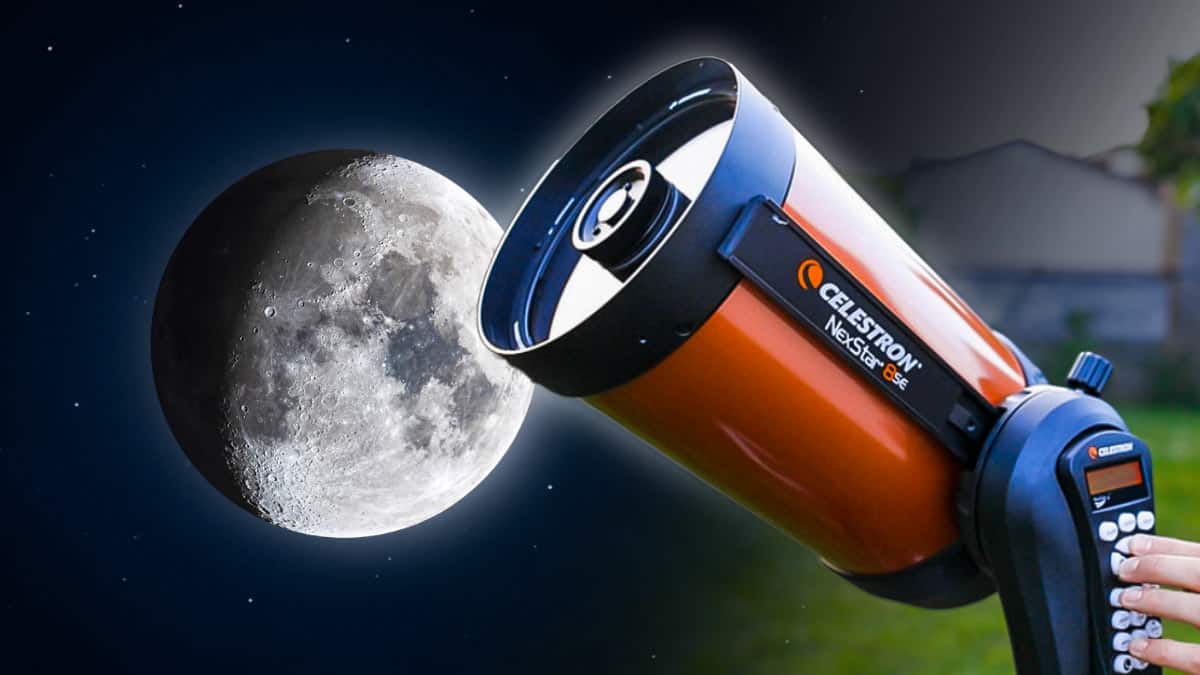

So you want to buy a telescope. The night sky looks the same through every one, right? Not even close. A poor scope turns the Moon into a blurry smear and makes Saturn look like a wobbly star. A good one puts you ringside at Jupiter, resolves the Orion Nebula into a glowing cloud, and keeps you coming back for more. The "best telescopes and astronomy equipment" list below separates the spendy headaches from the keepers, covering refractors for beginners, a smartphone-guided Newtonian for serious sky hunters, and the two essential guidebooks that belong on every observer's shelf.
Our top pick is the Celestron StarSense Explorer DX 130AZ. It uses your phone's camera to map the sky and steer you to objects you'd never find on your own. For the money, it's the biggest jump in capability over anything else here. Read on for the other nine, from compact travel scopes to the books that will teach you how to use them.
Comparison Table
| # | Product | Award | Aperture | Focal Length | Mount Type | Best for |
|---|---|---|---|---|---|---|
| 1 | Celestron StarSense Explorer DX 130AZ | Best overall | 130mm (reflector) | 650mm | Manual altazimuth | Smartphone-guided deep-sky observing |
| 2 | MEEZAA 90mm Refractor Telescope | Best large-aperture refractor | 90mm | 800mm | Altazimuth | Lunar and planetary detail |
| 3 | Dianfan 90mm Refractor Telescope | Best value 90mm | 90mm | 800mm | Altazimuth | Versatile entry-level astronomy |
| 4 | Celticbird 80mm 900mm Refractor Telescope | Best long-focal-length refractor | 80mm | 900mm | Altazimuth | Planetary and lunar zoom |
| 5 | Celticbird 80mm Travel Refractor Telescope | Best portable package | 80mm | 600mm | Altazimuth | Families and travel stargazing |
| 6 | EACONN 80mm Refractor Telescope | Best adjustable mount | 80mm | 600mm | Altazimuth with scale gimbal | Beginners wanting fine control |
| 7 | A-Maker 70mm Beginner Refractor Telescope | Best first scope for kids | 70mm | 400mm | Altazimuth | Young astronomers age 8+ |
| 8 | Jvcla 70mm Refractor Telescope | Best budget starter kit | 70mm | 300mm | Altazimuth | Absolute beginners on a tight budget |
| 9 | Turn Left at Orion | Best guidebook | N/A | N/A | N/A | Learning to find hundreds of deep-sky objects |
| 10 | The 100 Best Astrophotography Targets | Best for photo planning | N/A | N/A | N/A | Systematic astrophotography scheduling |
1. Celestron StarSense Explorer DX 130AZ: Best overall

Pros
- Smartphone app replaces the finder scope and guides you to any target
- 130mm parabolic mirror gathers enough light for bright deep-sky views
- Slow-motion controls make fine adjustments easy
- Stable mount handles the tube well
- 2-year US warranty from Celestron
Cons
- Requires a compatible smartphone (iOS/Android) to function
- Manual alignment takes a few minutes each session
Best for: anyone who wants to skip the frustration of star-hopping and get straight to observing planets, nebulae, and galaxies.
The Celestron StarSense Explorer DX 130AZ is the only scope here that uses your phone's camera to tell you exactly where to point. You dock the phone into the included mount, launch the app, and it analyzes the star patterns overhead to determine the telescope's orientation. Then it draws on-screen arrows that guide you to whatever you want to see. When the bullseye turns green, the target is in the eyepiece. It's that simple. The experience is light-years ahead of hunting for a faint fuzz with a standard finder, and it makes the 130mm aperture -- a 5-inch Newtonian reflector with high-reflectivity coatings -- actually usable on deep-sky objects like the Orion Nebula, Andromeda Galaxy, and globular clusters. On Jupiter and Saturn, the views are crisp enough to see bands and ring divisions under steady skies.
The manual altazimuth mount includes dual-axis slow-motion cables that let you track objects smoothly once you find them, which is important at higher magnifications. The tripod is sturdy and the whole setup weighs 18 pounds, making it portable without being flimsy. The app generates a nightly list of the best targets for your location and time, so you never have to wonder what to look at. That said, the StarSense system is useless without a phone, and the initial alignment requires you to hold the phone steady for a few seconds while the app matches the sky. If you forget to charge your phone, you are stuck with a manual scope and no finder. But for the observer who wants to spend time looking, not hunting, this is the most capable instrument in the lineup.
Compared to the 90mm refractors below, the Celestron gathers significantly more light -- about double the area of a 90mm objective -- which means brighter images of faint nebulae and galaxies. The trade-off is that a Newtonian needs occasional collimation (mirror alignment) and the tube is shorter but bulkier. If you are serious about moving beyond the Moon and planets, this is the telescope to buy. For a deeper look at what other professional-grade gear exists, check out our guide to the best professional telescopes for astronomy.
2. MEEZAA 90mm Refractor Telescope: Best large-aperture refractor

Pros
- 90mm aperture captures plenty of light for detailed lunar and planetary views
- Fully multi-coated optics improve contrast and color
- 3x Barlow lens plus two eyepieces gives 32x to 240x magnification range
- Stainless steel tripod is more stable than many budget aluminum legs
- Quick 10-minute assembly
Cons
- The white tube is prone to showing scratches
- The 3x Barlow pushes magnification past useful limits in poor seeing
Best for: the observer who wants a no-fuss refractor with enough aperture to show lunar craters, Jupiter's cloud bands, and Saturn's rings in satisfying detail.
The MEEZAA 90mm is a classic refractor design with a long 800mm focal length (f/8.88). That focal ratio is a sweet spot for refractors: it keeps chromatic aberration well under control, so you don't see purple fringing around bright objects, and it gives you ample magnification for planetary work. With the included 10mm eyepiece and 3x Barlow, you can push to 240x, which is enough to see the Cassini Division in Saturn's rings on a steady night. The fully multi-coated objective lenses deliver a noticeably brighter, more contrasty image than the cheaper single-coated 70mm scopes on this list.
The kit includes a 25mm eyepiece for low-power wide-field views, a 10mm for higher power, a 3x Barlow, a 90-degree star diagonal, and a 5x24 finder scope. The stainless steel tripod adjusts from 28 to 46 inches and feels sturdier than the aluminum tripods common at this price. Assembly is straightforward, with a paper manual that actually helps. The carry bag is large enough to hold everything, though you'll want to pad the tube separately.
Where the MEEZAA falls short is portability: the tube is 32 inches long, and the tripod is heavier than the aluminum alternatives. It's not a scope you want to hike with. Also, the 3x Barlow combined with the 10mm eyepiece gives 240x, but in typical backyard seeing conditions that will often be too much magnification, producing a soft image. Stick to 160x or below for reliable results. If you want a refractor that walks the line between light gathering and image quality without the complexity of a reflector, this is your best option among the 90mm scopes here.
3. Dianfan 90mm Refractor Telescope: Best value 90mm

Pros
- Same 90mm aperture and 800mm focal length as the MEEZAA
- Fully coated objective for bright images
- 45-degree erect-image diagonal useful for daytime terrestrial viewing
- Lightweight design at about 10 pounds total
- Includes a dedicated bag for storage
Cons
- The 45-degree diagonal reduces light slightly compared to a 90-degree star diagonal
- Tripod wobbles a bit at full extension
Best for: the budget-conscious beginner who wants a 90mm refractor for both astronomy and land observation.
The Dianfan 90mm shares the same core optical specs as the MEEZAA -- 90mm aperture, 800mm focal length, fully coated optics -- but it comes with a 45-degree erect-image diagonal instead of the standard 90-degree star diagonal. That means the image is upright and correct left-to-right, which is a big plus if you plan to use the scope for birdwatching, wildlife observation, or scanning distant landscapes during the day. For astronomy, it works fine, but it introduces a slight light loss and the image is mirrored compared to a pure star diagonal. You can always swap it later.
The kit includes two eyepieces (25mm and 10mm) and a 3x Barlow lens, giving magnifications from 32x to 240x. The Barlow's performance is similar to the MEEZAA's: useful in the 25mm for 96x, less useful in the 10mm for 240x. The stainless steel tripod is adjustable and stable enough for casual viewing, though the legs can flex if you bump them at full height. Assembly takes about 15 minutes and requires no tools.
The Dianfan undercuts the MEEZAA on some accessories -- it lacks the adjustable finder scope and the carry bag is simpler -- but optically it is a near match. If you want a 90mm refractor and plan to use it for daytime spotting as well as night-sky observing, the erect-image diagonal makes this a more versatile choice. For pure astronomy, the MEEZAA's standard star diagonal and slightly better build quality give it an edge.
4. Celticbird 80mm 900mm Refractor Telescope: Best long-focal-length refractor

Pros
- 900mm focal length gives excellent magnification for planets
- Wide-angle 20mm and 10mm eyepieces included for 45x and 90x views
- Aluminum tripod with adjustable height from 20 to 45 inches
- Phone adapter works well for smartphone astrophotography
- 3-year satisfaction service
Cons
- Tube is long and a bit front-heavy on the mount
- 5x24 finder scope is small and dim for faint objects
Best for: planetary observers who want a long-focal-length refractor that delivers high magnification without needing a Barlow lens.
The Celticbird 80mm 900mm refractor is optimized for high-magnification work. With an f/11.25 focal ratio, chromatic aberration is nearly absent, and the image at 90x (using the 10mm eyepiece) is clean and sharp. You can add a Barlow to push higher, but even at 90x the Moon shows fine detail and Jupiter's bands are distinct. The longer focal length also means a narrower field of view, so locating objects requires a bit more patience, but the smooth AZ mount and slow-motion controls (not included, but standard on the mount) help once you are on target.
The kit includes two wide-angle eyepieces (20mm and 10mm), a 1.5x erecting eyepiece (less useful for astronomy), a moon filter, and a phone adapter. The phone adapter is decent quality and lets you take serviceable shots of the Moon through the eyepiece. The aluminum tripod is lighter than steel but still stable enough for the 80mm tube. One downside: the mount's altitude adjustment can slip slightly if the tube is not perfectly balanced.
Compared to the Celticbird 80mm 600mm travel scope (our next pick), this one sacrifices portability for magnification potential. The 900mm focal length gives you 1.5x more magnification with the same eyepiece, which makes it better for planets but worse for wide-field sweeping. If you know you want to zoom in on Jupiter or the Moon, get this one. If you want a do-it-all scope for a family camping trip, the shorter version is more practical.
5. Celticbird 80mm Travel Refractor Telescope: Best portable package

Pros
- Comes with a padded backpack that fits everything
- 80mm aperture gathers enough light for good lunar and planetary views
- Easy tool-free assembly in minutes
- Moon filter included to tame bright lunar glare
- 3-year satisfaction service
Cons
- 600mm focal length limits high-magnification potential
- Tripod is lightweight and can be shaky in wind
Best for: families and travelers who need a complete, grab-and-go telescope kit that won't stay in the closet.
The Celticbird 80mm travel scope is the quintessential starter package: an 80mm f/7.5 refractor, two eyepieces (20mm and 9mm), a 5x24 finder, a moon filter, a phone adapter, and a backpack that holds it all. The 600mm focal length gives a nice balance between magnification (30x with the 20mm, 66x with the 9mm) and field of view, making it suitable for both lunar close-ups and sweeping the Milky Way star fields. The fully multi-coated optics are a cut above the cheapest single-coated scopes, producing contrasty images.
Assembly is genuinely tool-free: the tripod legs lock with flip-levers, the tube mounts via a dovetail, and the finder slides into its bracket. You can be set up in under five minutes. The backpack has dedicated pockets for the tube, tripod, and accessories, which makes it easy to carry to a dark-sky site or keep organized at home. The phone adapter is the two-piece type that fits both common eyepiece diameters, and it works well enough for snapshot-style lunar photos.
The main compromise is the mount: the aluminum tripod is light but not especially rigid. At high power, a breeze or a heavy footstep can shake the view for a few seconds. Also, the 9mm eyepiece gives 66x, which is moderate; you'll want a Barlow for planetary detail. But for the observer who values portability and ease of use over peak magnification, this is the most complete travel setup here. If you ever want to step up to a more serious scope, the skills you learn with this one will transfer directly.
6. EACONN 80mm Refractor Telescope: Best adjustable mount

Pros
- Rough adjustment and positioning gimbal with scale makes aiming precise
- 80mm fully coated green optics for bright images
- Phone adapter with dual positions for 20mm and 9mm eyepieces
- Comes with a backpack for portability
- Detailed video instructions included
Cons
- Scale markings are printed, not engraved, and may wear off
- Gimbal adjustment can be stiff at first
Best for: beginners who want more control over where the telescope points than a standard pan-handle mount offers.
The EACONN 80mm stands out because of its mount: a "rough adjustment and positioning gimbal" with an altitude-azimuth scale. Instead of a simple friction mount, this one has a geared knob that lets you fine-tune the altitude, and the scale helps you roughly aim at known coordinates. It's a step up from the free-moving altazimuth mounts on most budget scopes, and it makes tracking objects a little easier once you understand how to use it.
Optically, it's a standard 80mm f/7.5 refractor with fully coated green optics. The images are bright and contrasty for the price. The kit includes two eyepieces (K20mm and K9mm), a 5x24 finder scope, and a phone adapter that has two dedicated slots for each eyepiece diameter -- a thoughtful design that ensures the phone camera is centered over the eyepiece. The 45-degree erect-image diagonal makes it usable for daytime birdwatching, though for astronomy a 90-degree diagonal would be better.
The backpack is functional and holds everything, though the tube is a bit long (about 24 inches) and protrudes from the top. The tripod is aluminum and adjustable, but the legs are not the most rigid. Still, for the beginner who wants a mount that offers more control than a simple swivel, the EACONN's gimbal is a genuine differentiator. It won't replace a GoTo mount, but it will help you learn celestial coordinates faster.
7. A-Maker 70mm Beginner Refractor Telescope: Best first scope for kids

Pros
- 70mm aperture is a good size for young eyes
- No-tool setup that truly requires no tools
- 16x to 120x magnification range with included Barlow
- Carrying case protects the scope during storage
- Lightweight at about 5.3 pounds
Cons
- 400mm focal length means limited magnification for planetary detail
- Tripod is short (not specified, but typical for this size) and may be low for adults
Best for: a child's first serious telescope that they can set up themselves and use to see the Moon's craters and a few bright planets.
The A-Maker 70mm is designed from the ground up for kids and absolute beginners. The tube is short (400mm focal length, f/5.7), the mount is simple, and assembly requires exactly zero tools -- not even a screwdriver. The kit includes a 20mm eyepiece (20x), a 10mm eyepiece (40x), a 3x Barlow lens, a 5x24 finder scope, and a smartphone adapter. With the Barlow, you can reach 60x with the 20mm and 120x with the 10mm, though the latter is pushing the limits of the small aperture and short focal length.
The fully coated optical glass lens gives decent image quality for the class. The Moon looks crisp at 40x, and you can make out Jupiter's four Galilean moons and maybe a hint of cloud bands in good seeing. Saturn will appear as a small oval with visible rings. The finder scope has crosshairs to help locate objects, and the included smartphone adapter works well enough for basic lunar photography.
The carrying case is a hard-shell case with foam inserts, which is a step above the soft bags that come with other scopes. The tripod is aluminum and adjustable, but it's on the shorter side -- an adult may have to stoop to look through the eyepiece. However, for a 10-year-old, it's just right. If your child is showing an interest in astronomy, this is a safe, frustration-free entry point that won't overwhelm them with complexity. When they want to see more, our guide to the best telescopes for planetary observation will point them toward the next step.
8. Jvcla 70mm Refractor Telescope: Best budget starter kit

Pros
- Very low entry price for a fully functional telescope
- 15x to 150x magnification with 1.5x erecting eyepiece and 3x Barlow
- Fully multi-coated optics for a scope at this price
- Erecting eyepiece makes daytime use practical
- Comes in a gift box, ready to give
Cons
- 70mm aperture at f/4.3 means a fast focal ratio, which can cause chromatic aberration
- Tripod is basic and may need a counterweight to stay stable at high angles
Best for: the curious person who isn't sure if astronomy is for them and wants the lowest possible cost of entry.
The Jvcla 70mm is the most affordable option on this list, but it's not a toy. The 70mm aperture and fully multi-coated optics deliver a bright image for the money, and the 300mm focal length gives a wide field of view that's great for sweeping the Moon and star clusters. The kit includes a 20mm eyepiece (15x), a 6mm eyepiece (50x), a 1.5x erecting eyepiece, and a 3x Barlow lens, along with a phone adapter and a wireless remote for hands-free shooting. The erecting eyepiece makes the image upright, so you can use the scope for birdwatching or landscape viewing during the day.
The short focal ratio (f/4.3) means the scope is compact (the tube is only about 12 inches long) and portable, but it also means more chromatic aberration -- a purple fringe around bright objects. The included 1.5x erecting eyepiece helps a bit, but you'll still see it on the Moon. The finder scope is a 5x24 with crosshairs, and it's adequate for getting on target. The tripod is basic but the phone adapter and remote are a nice touch for capturing your first lunar shots.
The biggest limitation is the mount: it's a simple pan-and-tilt head on aluminum legs that can be shaky. You'll want to set it up on a sturdy table rather than use the tripod at full height. For someone who just wants to take a look at the Moon and a few planets to see what the fuss is about, the Jvcla delivers a surprisingly good view of the Moon's craters. If you find yourself wanting more, you haven't wasted much money, and you can move up to one of the 80mm or 90mm scopes above.
9. Turn Left at Orion: Best guidebook

Pros
- Spiral-bound for use at the telescope in the dark
- Hundreds of finder charts for objects visible in small telescopes
- Organized by season and object type
- Written in a clear, encouraging style
- Covers everything from the Moon to distant galaxies
Cons
- Requires some basic knowledge of celestial coordinates
- Not a comprehensive atlas for large telescopes
Best for: any telescope owner who wants to get the most out of their instrument by learning how to find deep-sky objects.
A telescope without a guide is like a car without a map. Turn Left at Orion is the most respected beginner's guide to the night sky, and it belongs in every observer's kit. Now in its fifth edition from Cambridge University Press, this spiral-bound book contains detailed charts for hundreds of objects -- galaxies, nebulae, star clusters, double stars, and planets -- all visible with a 60mm to 130mm telescope. The charts are drawn from the perspective of the eyepiece, so what you see in the book matches what you see in the scope. Each object includes a description, a finder map, and a realistic sketch.
The book is organized by season, which means you can flip to the winter section in January or the summer section in July and know exactly what to look for. The instructions for each object are step-by-step: "Start at the star Betelgeuse, move two fields east, and look for a faint oval glow." That systematic approach teaches you to star-hop, a skill that will serve you even if you later buy a GoTo telescope. The writing is conversational and encouraging, full of tips about eyepiece selection, observing conditions, and what to expect.
The biggest challenge is that it's a physical book, and using it in the dark requires a red light and some page-flipping. But the spiral binding lies flat, and the large format (10.2 x 12.2 inches) makes the charts easy to read. If you own any of the telescopes in this roundup, buy this book. It will double your enjoyment of the night sky.
10. The 100 Best Astrophotography Targets: Best for photo planning

Pros
- Monthly guide with exactly 100 prime astrophotography targets
- Includes CCD imaging tips and camera settings
- Covers the whole sky over a calendar year
- Written by an experienced amateur astrophotographer
- Part of the respected Patrick Moore Practical Astronomy Series
Cons
- Focused on CCD imaging; less relevant for DSLR or mirrorless users
- Some technical details are dated (published 2009)
Best for: the astrophotographer who wants a curated list of targets to shoot each month, saving time on planning.
The 100 Best Astrophotography Targets is a specialized resource for those who want to move beyond visual observation and start capturing images. The book is organized by month, with each entry listing a target's coordinates, magnitude, size, and recommended equipment, as well as notes on composition and exposure. It covers nebulae, galaxies, star clusters, and planets, and each entry includes a finder chart and a sample image.
The book is written for CCD camera users, which is a more technical approach than most beginners will use, but the target selection and timing advice are universal. For each month, you get a list of "best" objects that are well placed in the sky at that time of year. That alone saves hours of browsing star charts and deciding what to photograph. The technical details about filter selection and exposure times are useful for anyone using a cooled camera, though DSLR users will need to adapt some recommendations.
The main downside is the publication date: 2009. Some reference material is outdated, and the book doesn't cover modern CMOS cameras or software. But the celestial mechanics haven't changed, and the target list is still valid. If you are serious about astrophotography and own one of the scopes above with a tracking mount, this book will help you plan a year's worth of imaging sessions. For more general advice on choosing equipment, you might also want to read about what to look for in a telescope for viewing the sun (always use a proper solar filter).
How to choose a telescope and astronomy equipment
Choosing a telescope starts with being honest about how you will use it. A 90mm refractor is wonderful for lunar and planetary detail, but if you want to photograph faint galaxies, you need a larger aperture and a tracking mount. A 70mm scope is fine for a beginner child, but an adult will outgrow it quickly. Here are the factors that matter most.
Aperture
The diameter of the primary lens or mirror is the single most important spec. A larger aperture gathers more light, which means brighter images of faint objects and better resolution. For visual observing, 70mm to 80mm is a good starting point. 90mm to 130mm gives you significantly more capability. Beyond that, you are in serious amateur territory. The Celestron StarSense's 130mm mirror collects about twice the light of a 90mm refractor, making it much better for deep-sky observing.
Focal length and f-ratio
The focal length determines the magnification potential and field of view. A longer focal length (800mm or 900mm) is better for high-power views of planets. A shorter focal length (400mm or 600mm) gives a wider field for sweeping the Milky Way. The f-ratio (focal length divided by aperture) tells you how "fast" the telescope is: a low f-number (f/4.3) is good for wide-field astrophotography but can show chromatic aberration in refractors. A high f-number (f/8 to f/11) usually means a sharper, more color-correct image.
Mount type
The mount is as important as the optics. Altazimuth mounts are simple and intuitive: you move the scope up/down and left/right. They are fine for visual use but do not track the rotation of the sky without manual adjustment. Equatorial mounts are tilted to align with Earth's axis, allowing one-knob tracking, but they are more complex to set up. GoTo mounts have motors and a computer that automatically finds objects. For beginners, a good manual altazimuth mount with slow-motion controls (like the Celestron StarSense) is ideal. A flimsy mount ruins even the best optics.
Portability
If you have to carry your scope to a dark site, weight and size matter. A 70mm short-tube refractor fits in a backpack. A 90mm with a steel tripod weighs 10 pounds and takes up a car's back seat. The Celestron StarSense is 18 pounds and requires a bit more space. Think about where you will store it and how far you will travel.
Accessories
A finder scope is essential for locating objects. A phone adapter lets you take basic photos. Eyepieces with different focal lengths give you a range of magnifications. A Barlow lens doubles or triples the magnification of any eyepiece. Moon filters reduce glare. Some kits include all of these; others are bare. The Celticbird travel scope is an example of a kit that includes everything you need out of the box.
"The best telescope is the one you actually use. A scope that is too big or too complicated to set up will spend its life in a closet."
Books and guides
No telescope is complete without a guidebook. Turn Left at Orion teaches you how to find hundreds of objects with any small telescope. The 100 Best Astrophotography Targets helps you plan imaging sessions. Both are cheap relative to the cost of a telescope and will dramatically improve your experience.
Frequently asked questions
What can I see with a 70mm telescope?
A 70mm refractor shows the Moon's craters in crisp detail, Jupiter's four bright moons and its cloud bands (on a good night), Saturn's rings as a small oval, and dozens of the brightest deep-sky objects like the Orion Nebula and the Pleiades star cluster. It will not show details of galaxies beyond a faint smudge.
Is a 90mm telescope a big upgrade over 80mm?
Yes. The 90mm aperture collects 27 percent more light than an 80mm, which translates to brighter images and slightly better resolution. The difference is noticeable on faint objects and at high magnifications. For lunar and planetary observation, the 90mm is a solid sweet spot for a portable refractor.
What is the difference between a refractor and a reflector?
A refractor uses a glass lens at the front to focus light. It is maintenance-free, gives high-contrast images, and is good for planets. A reflector uses a mirror at the back of the tube. Reflectors are cheaper per inch of aperture and are better for deep-sky, but they need occasional collimation (mirror alignment) and the tube is open to dust. The Celestron StarSense is a reflector; the others here are refractors.
Do I need a smartphone adapter for astrophotography?
No, but it helps. A smartphone adapter holds your phone's camera over the eyepiece, letting you take simple photos of the Moon, planets, and bright star clusters. It won't work for faint galaxies without a tracking mount, but it's a fun and easy way to share your views. Most of the scopes here include one.
What is a Barlow lens and do I need one?
A Barlow lens increases the effective focal length of your telescope, typically by 2x or 3x. It lets you achieve higher magnifications with your existing eyepieces. A 3x Barlow with a 20mm eyepiece gives the same magnification as a 6.7mm eyepiece. They are useful but can degrade image quality if the optics are cheap. Use them on your longest eyepiece for the best results.
How do I choose a telescope for a child?
Look for a refractor with a 70mm aperture, a simple altazimuth mount, and tool-free assembly. The A-Maker 70mm is a great example. Avoid tiny "toy" telescopes with plastic optics; they frustrate more than they inspire. A solid telescope and a good guidebook like Turn Left at Orion will give a child years of enjoyment.
What is the best telescope for viewing planets?
For planets, you want a long focal length to achieve high magnification, and a clean optical path to keep images sharp. A refractor with a 90mm aperture and 800mm focal length (like the MEEZAA) or an 80mm with 900mm focal length (like the Celticbird 900mm) are excellent choices. A Newtonian reflector like the Celestron StarSense also works well.
Can I use these telescopes for birdwatching?
Yes, if the scope has an erect-image diagonal (most of these do, either included or as an option). A 45-degree or 90-degree erect-image diagonal makes the image upright and correct left-to-right. The EACONN and Dianfan scopes come with such diagonals. For birding, a shorter focal length gives a wider field of view, which is more useful.
How important is the finder scope?
Very. A finder scope is a low-power, wide-field scope attached to the main tube. You use it to locate objects before switching to the main eyepiece. A 5x24 finder (magnifies 5x with a 24mm objective) is standard. Without one, you'll struggle to aim at anything fainter than the Moon.
What does "fully multi-coated" mean on a telescope lens?
It means every lens surface has multiple anti-reflective coatings. This reduces light loss and glare, and increases contrast. Fully multi-coated optics are noticeably better than single-coated or uncoated lenses. All the telescopes in this roundup use fully multi-coated or multi-coated optics.
The bottom line
The best telescopes and astronomy equipment for 2026 cover a wide range: from a 70mm starter scope that costs less than a video game to a 5-inch smartphone-guided Newtonian that will keep you busy for years. If you buy one thing, make it the Celestron StarSense Explorer DX 130AZ. It is the only scope here that uses your phone to make finding objects trivially easy, and the 130mm aperture shows you the universe in a way that smaller scopes cannot match. For the money, it is the single best investment in an astronomy hobby you can make.
If the Celestron is out of reach or you want a simpler, more portable setup, the MEEZAA 90mm Refractor is a close second. It delivers crisp planetary views, comes with all the accessories you need, and is a delight to use. The Celticbird 80mm Travel Scope is the best choice for families who want to take the telescope camping. And whatever scope you choose, buy Turn Left at Orion alongside it. That combination of hardware and knowledge will give you many clear nights of discovery.
The universe is out there, every clear night. With the right gear, it becomes your backyard.
As an Amazon Associate we earn from qualifying purchases.