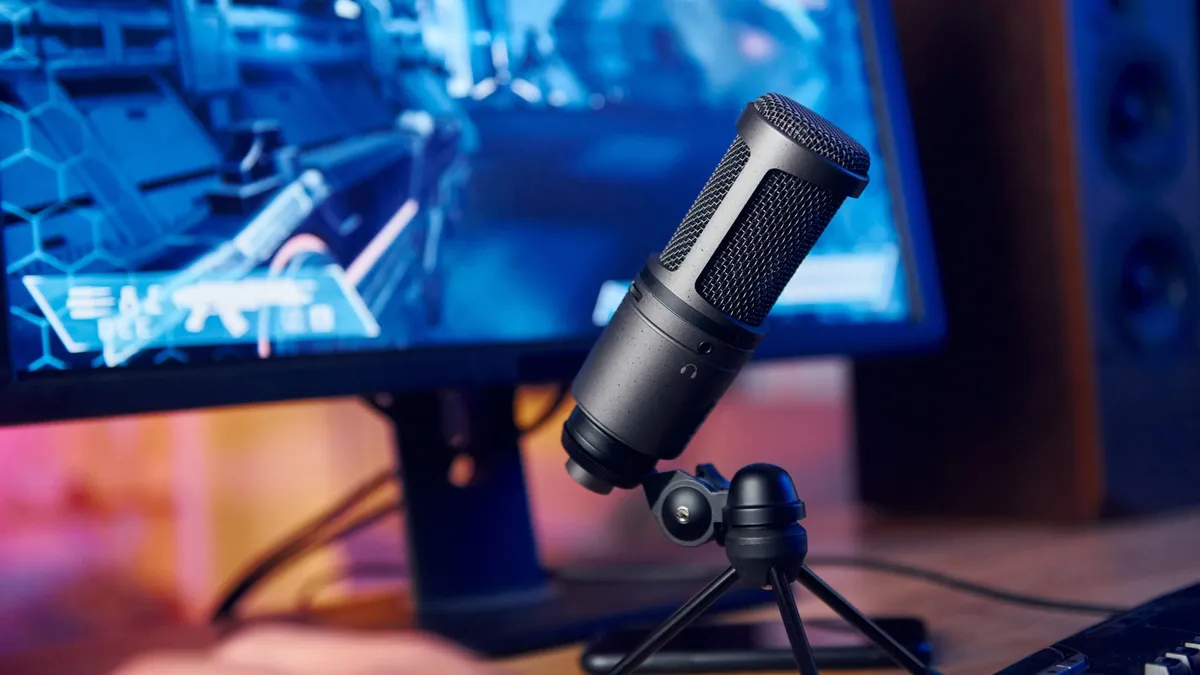

A bad gaming microphone makes every call harder. Teammates ask you to repeat yourself, keyboard noise fills the channel, and the mic arm or desktop stand keeps getting in the way of your screen. The right model should make your voice clear without turning mute control, monitoring, and setup into another game to manage.
The Best microphone for gaming depends on your room, connection, and plans for streaming. Dynamic models such as the FIFINE AM8 are more forgiving around background noise, while condenser models such as the Blue Yeti can offer a more open sound and extra pickup patterns. XLR models also leave room for a future audio interface.
Our top pick is the FIFINE AM8, with the Shure MV6 as the premium choice and the FIFINE AM8T Kit as the strongest all-in-one option. The ten picks below cover compact desktop microphones, boom arm kits, USB simplicity, and XLR upgrade paths.
Comparison table
| # | Product | Award | Connection | Pickup pattern | Key controls | Best for |
|---|---|---|---|---|---|---|
| 1 | FIFINE AM8 | Best overall | USB, XLR | Cardioid dynamic | Mute, gain, headphone volume | Gamers who may add an interface |
| 2 | FIFINE AM8T Kit | Best complete kit | USB, XLR | Cardioid dynamic | Mute, gain, headphone volume, RGB | New streamers needing a boom arm |
| 3 | MAONO DGM20S | Best for easy noise control | USB | Cardioid condenser | Mute, gain, monitoring, noise reduction | PC and console chat |
| 4 | FIFINE A6T | Best condenser kit | USB | Cardioid condenser | Mute, volume, RGB | Streaming with a warm vocal sound |
| 5 | FIFINE K688CT | Best for vocal recording | USB, XLR | Cardioid dynamic | Mute, gain, headphone volume | Gaming and podcast work |
| 6 | TONOR TC310+ | Best simple boom arm kit | USB | Not specified | Mute, gain, RGB brightness | Straightforward desktop setups |
| 7 | Blue Yeti | Best pickup-pattern flexibility | USB | Cardioid, omni, bidirectional, stereo | Mute, gain, pattern, headphone volume | Games, podcasts, and group recording |
| 8 | COCONISE ME6-C | Best compact desktop option | USB | Cardioid condenser | Mute, volume, monitoring, RGB | Casual gaming and voice chat |
| 9 | Shure MV6 | Best automatic processing | USB-C | Cardioid dynamic | Mute, monitoring, auto level | Streamers who want polished sound |
| 10 | FIFINE AM8PROT | Best RGB upgrade kit | USB, XLR | Cardioid dynamic | Mute, mix, gain, headphone volume, RGB | Full streaming setups |
1. FIFINE AM8: Best Overall

Pros
- USB setup is quick and uncomplicated
- XLR connection leaves room for a future interface
- Tap mute, gain, and headphone controls are easy to reach
- Cardioid dynamic design helps reject off-axis noise
- RGB has three modes and more than 10 colors
Cons
- XLR cable is not included
- RGB and onboard controls work only over USB
- The microphone is heavier than a basic desktop model
Best for: gamers who want clean voice chat now and an upgrade path later.
The FIFINE AM8 is the microphone we would put on the largest range of gaming desks. It keeps the important controls on the body, works immediately over USB, and does not force you to replace the microphone if you later move to an audio interface. That combination matters more than decorative lighting or a long list of recording modes.
Its 50Hz to 16kHz frequency response is aimed at balanced voice capture rather than exaggerated bass or treble. The cardioid dynamic capsule focuses on sound from the front and rejects unwanted off-axis noise, which is useful when a PC fan, second monitor, or nearby keyboard is part of the room. FIFINE recommends keeping the end-addressing microphone 2 to 6 inches from your mouth, so positioning is part of getting the best result.
USB mode gives you tap-to-mute with an LED reminder, a headphone jack for live monitoring, a monitor volume control, and a gain knob. The RGB ring offers three modes and more than 10 light colors, with memory so it can return to the selected setting after power-up. Over XLR, the AM8 can connect to an interface or mixer, but its RGB and function key are inactive, and the separate XLR cable is not supplied.
Compared with the FIFINE AM8T Kit, the AM8 is the better choice when you already have a stand or boom arm. The AM8T is more convenient as a complete package, while the Shure MV6 adds automatic processing for people who want more hands-off sound. The AM8's weakness is that it expects you to manage distance and level yourself, and its 1.32-pound body needs a reasonably stable support.
Choose the AM8 if your priority is a focused gaming voice, practical controls, and a genuine USB to XLR path. Skip it if you want software-assisted leveling or a full arm kit in the same box.
2. FIFINE AM8T Kit: Best Complete Kit

Pros
- Includes a metal boom arm and desk clamp
- USB and XLR connectivity
- Tap mute, gain, and headphone monitoring
- RGB controls are built into the microphone
- Clamp fits desks up to 2 inches thick
Cons
- XLR cable is not included
- USB is required for RGB and onboard controls
- The arm requires careful positioning on a crowded desk
Best for: first-time streamers who need the microphone and support hardware together.
The FIFINE AM8T Kit takes the core idea of the AM8 and solves the common first-day problem: finding something to hold it. The included boom arm gets the microphone off the desk and closer to your mouth, leaving more room for a keyboard, mouse, and gamepad. It is a particularly sensible starting point for a new streaming station.
This is a cardioid dynamic microphone with a stated sensitivity of -50dB. The pattern is designed to favor your voice in front of the capsule and avoid some sound from behind it. That does not make room noise disappear, but it gives the AM8T a more forgiving starting point than a highly sensitive condenser in a lively room.
USB connection is plug and play for a PC, with no additional drivers required. The body includes a mute button, gain knob, headphone jack, and headphone volume control, while the RGB lighting can be changed or switched off by tapping its button. The included USB to USB-C cable is 8.2 feet long. XLR connection is available for a mixer or sound card, but the XLR cable must be supplied separately.
The metal arm has elastic springs, adjustable positioning, and a clamp with an anti-scratch pad for desks less than 2 inches thick. Compared with the FIFINE A6T, the AM8T uses a dynamic design that should suit noisier gaming rooms better, while the A6T offers a more explicitly warm condenser presentation. The FIFINE AM8 is the cleaner standalone pick, but the AM8T wins when the arm is part of the decision.
The compromise is desk fit. The clamp has a stated thickness limit, and the 2.76-pound kit is not something to mount casually on a flimsy surface. Pick the AM8T when you want a ready-to-position setup and an eventual XLR route without assembling a separate microphone system.
3. MAONO DGM20S: Best for Easy Noise Control

Pros
- One-click noise reduction
- USB works with PC, Mac, PS4, and PS5
- Zero-latency headphone monitoring
- Includes arm, shock mount, pop filter, and cables
- RGB can be customized or turned off
Cons
- Not compatible with Xbox
- Noise adjustment software is Windows only
- No XLR connection
Best for: gamers who want simple USB control and a little help taming room distractions.
The MAONO DGM20S is built around convenience. It is a USB condenser microphone with its own arm, shock mount, and removable pop filter, so the setup is aimed at a player who wants to get into Discord or streaming without learning an audio interface. Its strongest feature is not the RGB. It is the one-click noise reduction control.
The cardioid pickup pattern focuses on the voice in front of the microphone, while the noise reduction mode is intended to reduce background distractions. MAONO also provides noise cancellation software for more precise adjustment on Windows. That software limitation matters, but the physical microphone still works with PC, Mac, laptop, PS4, and PS5 through USB. Xbox is specifically excluded.
A tap on the mute control silences the microphone, and the gain knob lets you set voice level without leaving the game. The 3.5mm headphone jack provides zero-latency monitoring, which helps you catch a low or overly loud signal before teammates do. The supplied shock mount and pop filter address two different problems: vibration from the desk and bursts of air on certain consonants.
The boom arm saves surface space and lets you pull the microphone toward your mouth, but its stated dimensions are broad enough that a small desk needs planning. Compared with the TONOR TC310+, the DGM20S has more explicit audio-focused controls and a shock mount. The FIFINE AM8 remains the stronger long-term choice because it offers XLR, but the DGM20S is easier for a USB-only console and PC setup.
This microphone is not the pick for an Xbox owner or someone who expects studio expansion. It suits a gamer who wants mute, monitoring, gain, and noise reduction close at hand, especially when Windows software is part of the setup.
If team communication is your main concern, our guide to choosing a microphone that keeps game chat intelligible covers the same room-noise problem from another angle.
4. FIFINE A6T: Best Condenser Kit

Pros
- Warm, energetic vocal presentation
- USB plug and play for PC, Mac, PS4, and PS5
- Touch mute and large volume knob
- Includes boom arm, shock mount, and pop filter
- Two-tone automatic gradient RGB
Cons
- USB only
- Condenser design may reveal more room noise
- Boom arm clamp is limited to desks up to 2 inches thick
Best for: streamers who want a warm vocal sound and a complete USB kit.
The FIFINE A6T has a more presentation-focused character than the dynamic microphones above it. Its upgraded condenser capsule is described as producing energetic and warm vocals, which can give game commentary and streams a fuller sense of presence. It is still a plug-and-play USB microphone, so the appeal is immediacy rather than studio complexity.
Its cardioid pattern emphasizes the front of the microphone and reduces pickup from the rear. That is helpful for voice chat, but a condenser capsule can still make a room's sound more apparent than a dynamic design. Place it close to your mouth, use the supplied pop filter, and keep the keyboard from sitting directly in its forward pickup area.
The top touch button provides quick mute without a mechanical click, and the large control at the bottom handles volume. The 8.2-foot USB-C to USB-A/C cable gives flexibility when the computer sits behind or below the desk. A shock mount helps isolate vibration, while the detachable pop filter reduces plosive noise without blocking the game screen.
The supplied arm rotates nearly 180 degrees up and down, and its C-clamp fits a desk up to 2 inches thick. Compared with the MAONO DGM20S, the A6T offers a warmer stated vocal character and a long cable, while the DGM20S adds one-click noise reduction and Windows software support. The FIFINE AM8T Kit is more adaptable because it also supports XLR.
The A6T's weakness is the lack of an upgrade connection. It is also not the first choice for a loud room with fans, hard floors, or a clicky keyboard close to the microphone. For a controlled desk and a streamer who wants a polished condenser kit with RGB, it remains an appealing fit.
5. FIFINE K688CT: Best for Vocal Recording

Pros
- USB and XLR connections
- Cardioid dynamic design
- Stated 130dB SPL handling
- Tap mute, gain, and headphone monitoring
- Heavy-duty arm, shock mount, and windscreen included
Cons
- Onboard controls are inactive over XLR
- C-clamp fits desks under 2 inches thick
- Nearly 2.9 pounds requires solid support
Best for: gamers who also record vocals, podcasts, or voiceovers.
The FIFINE K688CT is the serious recording pick in this group. Its dynamic capsule is paired with both USB and XLR, and the kit includes the support hardware needed to keep the microphone stable near your mouth. The emphasis is on natural sound reproduction, so it makes sense for a gamer who expects the microphone to do more than carry team chat.
FIFINE lists a 130dB SPL specification, indicating the microphone is designed to handle loud sound levels without immediately becoming the limiting part of the chain. Its cardioid pattern keeps the focus toward the speaker and helps reduce ambient noise. The recommended recording distance is 2 to 6 inches, a familiar close-mic position that can also improve voice separation during a game.
In USB mode, the K688CT has tap-to-mute, a gain knob, a headphone monitoring jack, and a volume control. The included windscreen helps with breath and plosive sounds, while the shock mount and boom arm reduce the effect of desk bumps and collisions. All of those microphone controls stop working when the connection changes to XLR, so an interface or mixer must take over.
Its 2.89-pound weight is significant, but that mass matches the heavy-duty support approach. The C-clamp is intended for desks under 2 inches thick. Compared with the FIFINE AM8, the K688CT is the more recording-oriented kit and includes a more substantial arm setup. The Shure MV6 offers more automatic processing, but it does not provide the K688CT's XLR route.
The K688CT is not ideal for someone who wants a light desktop microphone or refuses to manage a close speaking distance. It is the better fit for a creator who wants one dynamic microphone for gaming, vocal recording, and future interface-based work.
For creators who record more than game chat, the practical trade-offs in a vocal recording microphone are worth considering before choosing between dynamic and condenser designs.
6. TONOR TC310+: Best Simple Boom Arm Kit

Pros
- Complete microphone and arm package
- Tap mute and rotating gain control
- Four RGB modes
- Brightness can be adjusted
- Clamp fits desks up to 2.36 inches thick
Cons
- USB only
- Pickup pattern is not specified
- Fewer audio features than the MAONO DGM20S
Best for: players who want a clean boom arm setup with minimal controls to learn.
The TONOR TC310+ keeps its brief simple. It is a USB condenser microphone with a metal boom arm, a sturdy clamp, RGB lighting, mute, and gain control. There is no XLR connection or expanded software feature set to distract from the basic job of getting a clear voice into a PC setup.
The gain control is built into the top of the microphone, so level adjustments can be made without reaching behind the body. A tap mutes the microphone for an immediate response during a stream or a match. TONOR recommends a USB 2.0 or USB 3.0 port and says the Type-C connector should be fully inserted, a small setup detail that can prevent intermittent connection problems.
RGB gives you four modes: six static colors, a single-color gradient, breathing, and a mixed-color gradient. Long tapping the RGB control adjusts brightness, which is useful when the microphone sits in the edge of a monitor's light. The arm has multiple adjustable joints, and the clamp fits most desks up to 2.36 inches thick.
The published features do not specify a pickup pattern, so we would be more cautious about assuming how it behaves in a noisy room. The MAONO DGM20S is a stronger choice when noise reduction and zero-latency monitoring matter. The COCONISE ME6-C is more compact on a desktop, while the TC310+ clears space by placing the microphone on an arm.
This is a deliberately straightforward product. Skip it if you need XLR, headphone monitoring, or detailed pickup-pattern information. Choose it if tap mute, gain, arm positioning, and adjustable lighting cover what your gaming station needs.
7. Blue Yeti: Best Pickup-Pattern Flexibility

Pros
- Four selectable pickup patterns
- Three-capsule array
- Blue VO!CE software effects
- Onboard gain, mute, pattern, and headphone controls
- Desktop stand can connect to a boom arm
Cons
- Heavy 3.51-pound body
- USB only
- Extra patterns can complicate a simple gaming setup
Best for: gamers who also record podcasts, instruments, or more than one speaker.
The Blue Yeti remains the most flexible microphone here when gaming is only one part of the plan. Its three-capsule array and four pickup patterns let it change roles instead of locking the user into a single front-facing voice position. For a solo player, cardioid is the obvious starting point. For other recording situations, omni, bidirectional, and stereo add options the rest of this list largely does not offer.
The pickup patterns have practical consequences. Cardioid favors one speaker in front, omni captures sound around the microphone, bidirectional is suited to two opposite speakers, and stereo is intended for a broader left and right image. They are useful capabilities, but they also reward deliberate placement. A player who simply wants voice chat may never use three of the four modes.
Onboard controls include headphone volume, pattern selection, instant mute, and microphone gain. The desktop stand allows the microphone to pivot in relation to the sound source, and the headphone output supports no-latency monitoring. Blue VO!CE software adds broadcast-style effects, modulation, and HD audio samples for supported computer workflows.
At 3.51 pounds, the Yeti is one of the heaviest microphones in the group. Its included stand is convenient, though a boom arm can make a gaming desk easier to organize. Compared with the FIFINE AM8, the Yeti has more recording patterns but no XLR upgrade path. The Shure MV6 is more focused on automatic voice processing, while the Yeti is the more versatile tool for varied recording.
The Yeti is a poor match for someone who wants the smallest, simplest gaming microphone. It is a strong match for a creator who records guests, instruments, podcasts, and solo gameplay from the same desk.
A headset can still be useful for monitoring, and the choice depends on how much isolation you need while gaming and recording, especially when the microphone is sensitive to room sound.
8. COCONISE ME6-C: Best Compact Desktop Option

Pros
- Weighted carbon steel base
- Touch mute with visual RGB confirmation
- 3.5mm headphone monitoring
- Detachable metal pop filter
- Compatible with PS4, PS4 Pro, PS5, PC, and laptop
Cons
- USB only
- No XLR connection
- No boom arm included
Best for: casual gamers who prefer a stable desktop microphone over an arm.
The COCONISE ME6-C takes a different approach from most of the kits here. Rather than supplying a boom arm, it uses a weighted carbon steel base intended to stay put during energetic gaming. That makes it a reasonable fit for a player who does not want an arm crossing the desk or taking up clamp space.
Its 25mm condenser diaphragm and cardioid pattern are listed as the main voice-capture features. The cardioid design focuses on the front of the microphone and reduces side pickup. COCONISE also lists a sampling rate of up to 192kHz, though the more useful gaming question is still placement: keep the microphone aimed at your voice and avoid putting a loud keyboard directly in front of it.
A one-button touch sensor mutes the microphone, and the RGB lights switch off to confirm the muted state. The bottom rotary control handles volume, while the 3.5mm headphone jack supports real-time monitoring. The detachable metal anti-splash screen helps reduce plosives, and the shock mount's rubber elastic band is intended to reduce vibration from keyboard and mouse activity.
The included detachable USB cable is 180cm long and supports PC, laptop, PS4, PS4 Pro, and PS5. Compared with the TONOR TC310+, the ME6-C is better for a fixed desktop position, while the TONOR offers arm adjustment and brightness control. The MAONO DGM20S is the more complete audio-control choice because it adds noise reduction and a boom arm.
There is no XLR connection and no stated software noise control, so this is not a future studio centerpiece. It makes sense for a console or PC gamer who wants quick mute, headphone monitoring, RGB, and a base that does not need desk-clamp installation.
9. Shure MV6: Best Automatic Processing

Pros
- Voice Isolation Technology
- Auto Level Mode
- Real-Time Denoiser
- Digital Popper Stopper
- USB-C, monitoring, and tap mute
Cons
- USB only
- No included boom arm is listed
- Heavy 3.75-pound body
Best for: streamers who want software and onboard processing to handle more of the audio work.
The Shure MV6 is the least manual microphone in this roundup. It uses a dynamic cardioid design, but its headline feature is the processing around it. Voice Isolation Technology, Auto Level Mode, a Real-Time Denoiser, and Digital Popper Stopper are designed to keep the voice focused and polished while the user concentrates on the game or stream.
That processing changes the buying decision. The MV6 is aimed at reducing keyboard clicks, fan noise, room echo, and other background distractions. It does not remove the need to speak toward the capsule, but it can reduce the amount of level and cleanup work between the microphone and the finished stream. For a creator who does not want to tune every parameter manually, that is the central appeal.
USB-C provides the desktop connection for PC and Mac. The 3.5mm headphone output supports zero-latency monitoring, and the tap-to-mute button provides quick control in a live chat. The MOTIV Mix desktop application can customize the monitor mix and microphone audio settings, adding a software layer beyond the physical controls.
The MV6 weighs 3.75 pounds, so a suitable stand or arm matters. It is also USB only, unlike the FIFINE K688CT and FIFINE AM8PROT, which can move to XLR hardware. The FIFINE AM8 is easier to recommend for someone who wants a straightforward dynamic microphone with a future interface route, while the MV6 is better for automatic leveling and denoising.
Do not choose the MV6 if XLR expansion or an included arm is essential. Choose it if the goal is a focused voice with less manual adjustment, and if the heavier body will have a secure home on the desk.
10. FIFINE AM8PROT: Best RGB Upgrade Kit

Pros
- USB and XLR connections
- Stated 48kHz, 24-bit USB audio
- Mix control for voice and computer audio
- 240 or more RGB combinations
- Boom arm extends to 30 inches
Cons
- RGB and multifunction controls work only over USB
- XLR cable is not listed among the included accessories
- More controls require more setup attention
Best for: streamers who want a dynamic XLR path with extensive USB lighting and monitoring controls.
The FIFINE AM8PROT is the most elaborate streaming kit in the FIFINE group. It combines a dynamic cardioid microphone with USB and XLR, a boom arm, a windscreen, and a control layout aimed at live gameplay. Its reason to exist is not just voice capture. It is the ability to manage commentary, game audio, monitoring, and lighting from the same setup.
FIFINE lists 48kHz and 24-bit USB audio, a 115dB SPL specification, and a 75dB signal-to-noise ratio. The cardioid pattern is intended to reject low-level interference from multiple devices, while the windscreen helps disperse breath and plosive sounds. Those specifications matter most when the microphone is placed close to the speaker and the rest of the signal chain is set sensibly.
USB mode includes tap mute with a visible LED panel, a mix control for balancing microphone and PC audio, and a three-in-one knob for gain and headphone volume. The monitoring arrangement is useful for a Let's Play setup where commentary and game audio need to be judged together. Over XLR, the microphone can connect to an interface, but the USB-specific controls and RGB system are no longer active.
The lighting system offers more than 240 RGB combinations, including beat modes for the microphone and arm. The thickened arm extends to 30 inches, has multiple angle joints, and is intended to save desk space. Compared with the FIFINE AM8T Kit, the AM8PROT has more elaborate monitoring and RGB features. The FIFINE K688CT is the quieter, more recording-oriented alternative, while the Shure MV6 has stronger automatic processing.
The AM8PROT is not the pick for someone who wants a microphone with no settings to consider. It is also important to confirm that the XLR connection plan includes the necessary cable and interface hardware. Pick it for a serious gaming desk where USB convenience, XLR flexibility, game audio mixing, and lighting all matter.

How to choose best microphone for gaming
The right gaming microphone is determined by the room, the connection you need, and how much control you want during a match or stream.
Dynamic and condenser capsules
Dynamic microphones such as the FIFINE AM8, FIFINE K688CT, Shure MV6, and FIFINE AM8PROT are generally the safer starting point for rooms with fans, keyboards, or other nearby noise. Their cardioid patterns focus on the speaker in front. Condenser models such as the MAONO DGM20S, FIFINE A6T, Blue Yeti, TONOR TC310+, and COCONISE ME6-C can produce an open, sensitive voice, but placement and room sound deserve more attention.
USB and XLR connections
USB is the simplest route to a PC, Mac, or supported console. It keeps the microphone's controls close and avoids an extra audio interface. XLR is useful when you plan to add an interface or mixer later, but some models disable their onboard mute, gain, monitoring, and RGB features when used that way.
Pickup pattern
A cardioid pattern is usually the most practical choice for solo game chat because it favors sound from the front. The Blue Yeti's omni, bidirectional, and stereo modes make it more flexible for guests or instruments, but those modes are unnecessary for many single-player setups. The TONOR TC310+ does not specify its pickup pattern, so do not assume it offers the same placement behavior as the cardioid models.
A microphone near your mouth with the correct pickup direction usually beats a more complicated microphone placed across the desk.
Monitoring and mute controls
A headphone jack with zero-latency monitoring lets you hear what the computer is receiving without a distracting delay. Tap mute is just as useful in practice because it handles coughs, doorbells, and private conversations quickly. Gain knobs are helpful when they are easy to reach, but automatic processing such as the Shure MV6's Auto Level Mode can reduce the need for constant adjustment.
Arm, stand, and desk fit
A boom arm moves the microphone closer to your mouth and clears space for your mouse and keyboard. Check the clamp limit before buying: the AM8T and A6T specify desks up to 2 inches, the MAONO DGM20S includes a clamp and arm, and the TONOR TC310+ lists a limit of 2.36 inches. A desktop stand is simpler, while a heavier microphone such as the Blue Yeti or Shure MV6 needs stable support.

Frequently asked questions
Is a dynamic or condenser microphone better for gaming?
A dynamic microphone is often easier to manage in a noisy gaming room because it focuses on close speech and is less prone to making the whole room prominent. A condenser microphone can sound more open and detailed, but it benefits from careful placement and a quieter environment. Both types can work well when aimed and positioned correctly.
Do I need an XLR microphone for gaming?
No. USB is enough for voice chat, streaming, and recording on a compatible computer or console. XLR becomes useful when you want an audio interface, mixer, or more control over the recording chain.
Does a boom arm improve microphone sound?
A boom arm does not change the capsule's sound by itself. It can improve the result by letting you place the microphone 2 to 6 inches from your mouth and by keeping it away from desk vibration. It also clears space around the keyboard and monitor.
Can these microphones work with PS5?
The FIFINE AM8, MAONO DGM20S, FIFINE A6T, and COCONISE ME6-C list PS4 or PS5 compatibility. The FIFINE AM8PROT lists PS4 compatibility and USB-C laptop support. Compatibility can depend on the available USB port and connection mode, so check the product's listed platform support before setup.
Does RGB lighting affect microphone performance?
RGB lighting is primarily an appearance feature. On products such as the FIFINE AM8, the lighting is available over USB and does not change the microphone's pickup pattern. The COCONISE ME6-C also uses its lights to indicate mute status, which gives the lighting a practical confirmation role.
What does zero-latency monitoring mean?
Zero-latency monitoring sends the microphone signal to your headphones without a noticeable processing delay. It helps you hear your voice as you speak and catch a muted, distorted, or incorrectly adjusted signal before it reaches teammates or viewers.
Can one microphone handle gaming and podcasting?
Yes. USB and XLR models such as the FIFINE AM8, FIFINE AM8T Kit, FIFINE K688CT, and FIFINE AM8PROT can cover gaming and podcast use. The Blue Yeti is particularly flexible for multiple speakers because it provides four pickup patterns, while a cardioid dynamic model is usually better for a single speaker in a noisy room.

The bottom line
The FIFINE AM8 is our top recommendation for the Best microphone for gaming because it balances focused cardioid dynamic pickup, convenient USB controls, and an XLR upgrade path. Choose the FIFINE AM8T Kit instead when you need the boom arm and clamp included, or the Shure MV6 when automatic leveling and denoising matter more than XLR flexibility.
The MAONO DGM20S is a strong USB option for PC and PlayStation users who want noise reduction, monitoring, and a complete arm kit. Creators who also record vocals should look at the FIFINE K688CT, while the Blue Yeti remains the most adaptable choice for several recording patterns.
If you are undecided, choose a cardioid dynamic USB microphone with a reachable mute button and place it close to your mouth.
As an Amazon Associate we earn from qualifying purchases.