
An in-wall speaker has to solve two problems at once: sound convincing from inside a cavity, then disappear into the room when the installation is finished. The wrong model can leave you with thin dialogue, harsh treble, or a cutout that is difficult to hide.
Our Best best in wall speakers include large two-way speakers, purpose-built center channels, horn-loaded Klipsch designs, and a matched Yamaha pair. The right choice depends on whether you are building a theater, adding whole-room music, or trying to keep a center channel out of sight.
Micca M-8S is the best pick for most installations, with a large woofer, useful aiming control, and unusually clear published specifications. The other six cover more specialized needs, from high-output theater channels to compact center-channel placement.
Comparison table
| # | Product | Award | Driver layout | Mounting depth | Best for |
|---|---|---|---|---|---|
| 1 | Micca M-8S | Best overall | 8-inch woofer, 1-inch tweeter | 3.4 inches | Music and front-channel audio |
| 2 | Klipsch R-5502-W II | Best for high-output theater | Dual 5.25-inch woofers, 1-inch compression driver | 3.5 inches | Left, center, or right channels |
| 3 | Polk Audio 255c-RT | Best center channel | Dual 5.25-inch midwoofers, 1-inch tweeter | Not specified | Hidden center-channel installation |
| 4 | Micca M-CS | Best flexible center channel | Dual 5.25-inch woofers, 1-inch tweeter | 3.1 inches | Center, front, or surround channels |
| 5 | Yamaha NS-IW470 | Best three-way pair | 6.5-inch woofer, 2-inch midrange, 1-inch tweeter | Not specified | Matched stereo or surround pairs |
| 6 | Polk Audio 265-RT | Best for room-filling bass | Dual 6.5-inch midwoofers, 1-inch tweeter | Not specified | Larger home theater rooms |
| 7 | Klipsch R-5800-W II | Best large-format Klipsch | 8-inch woofer, 1-inch compression driver | Not specified | High-output front or surround channels |
1. Micca M-8S: Best Overall

Pros
- Large 8-inch woofer supports robust bass
- Pivoting tweeter helps aim the soundstage
- 100-watt handling and 90dB sensitivity
- Built-in mounting tabs simplify installation
Cons
- Sold as a single speaker
- Larger cutout than the smaller center-channel models
- Three and a half inches of mounting depth needs planning
Best for: listeners who want one adaptable in-wall design for music, TV, or a front-channel theater system.
The Micca M-8S is the speaker here that makes the fewest compromises for general use. Its 8-inch poly woofer gives it a stronger foundation than the dual 5.25-inch layouts in the Klipsch R-5502-W II and Micca M-CS, while the pivoting 1-inch silk dome tweeter provides some control over where high frequencies land. That matters when the listening position is not directly in front of the wall.
Micca publishes unusually useful installation and performance information for this model. The frequency response is listed as 40Hz to 20kHz, with 8-ohm impedance, 90dB sensitivity, and 100 watts of power handling for each speaker. The lower stated bass reach does not replace a subwoofer in a serious theater, but it gives music and television sound more weight before the subwoofer takes over.
The speaker measures 10 inches wide and 14.1 inches high externally. The wall cutout is 8.7 by 12.7 inches, and the mounting depth is 3.4 inches. That is not a shallow speaker, so check for wiring, plumbing, and stud placement before cutting. Built-in mounting tabs grab drywall or wood panels without additional brackets or boxes, which makes the installation less fussy than a design that requires separate hardware.
Its 12dB crossover network is intended to keep the transition between woofer and tweeter coherent, and the rimmed grille can be painted to match the wall. The M-8S is not the most theater-specific option here. The Polk Audio 255c-RT is better suited to a dedicated center-channel position, and the Klipsch R-5800-W II should play louder with its horn-loaded design. The Micca wins by being easier to recommend across more rooms and systems.
Skip it if your wall cannot accommodate the cutout or if you need a speaker sold as a stereo pair. For a living room, bedroom, or front-channel setup where clean installation and full-range sound matter, the Micca M-8S is the one we'd keep.
2. Klipsch R-5502-W II: Best for High-Output Theater

Pros
- Dual 5.25-inch Cerametallic cone woofers
- Horn-loaded compression driver controls distortion
- Pivoting 90 by 90 degree Tractrix Horn
- Can be installed horizontally or vertically
Cons
- Sold as a single speaker
- Horn presentation may be too forceful for some rooms
- No frequency response or power rating is provided here
Best for: a home theater builder who wants one in-wall model that can serve as a left, center, or right channel.
The Klipsch R-5502-W II is built around output and directivity rather than broad, relaxed background listening. Its dual 5.25-inch Cerametallic cone woofers are paired with a 1-inch titanium diaphragm compression driver and a pivoting 90 by 90 degree Tractrix Horn. That arrangement gives the speaker a very different identity from the softer presentation suggested by the Micca M-8S.
The horn is the important feature. It concentrates the treble into a controlled pattern, which can help dialog and effects remain intelligible when the room is reflective or the speaker has to sit off to one side. The compression driver is also designed to produce acoustic output with reduced distortion, though the supplied data does not include a frequency-response range, sensitivity figure, or power-handling rating.
Installation is more flexible than its theater-oriented design suggests. The R-5502-W II can be mounted horizontally or vertically and can serve as a left, center, or right channel. Its listed external dimensions are 17.8 inches high, 8 inches wide, and 3.5 inches deep. Measure carefully before choosing a position, especially if you are replacing an existing speaker with a different opening.
Compared with the Polk Audio 255c-RT, the Klipsch is the more forceful choice for action-heavy material and larger listening spaces. The Polk is shaped more explicitly around center-channel duties and has a silk dome tweeter, while the Klipsch brings the immediacy of a horn. The Micca M-CS is easier to use in a mixed front and surround layout, but it does not offer the same horn-loaded approach.
The weakness is tonal character. A horn can sound vivid and exciting, but listeners who prefer a restrained top end may find it less forgiving with bright recordings or reflective walls. Choose the R-5502-W II when cinema impact and placement flexibility matter more than a laid-back presentation.
3. Polk Audio 255c-RT: Best Center Channel

Pros
- Designed specifically for center-channel use
- Dual 5.25-inch midwoofers support clear dialogue
- Swivel-mounted 1-inch silk dome tweeter
- Rotating cam system supports secure mounting
Cons
- Less flexible than a conventional left or right speaker
- Sold as a single speaker
- Installation opening is broad and horizontally oriented
Best for: home theater owners who want the center channel hidden behind a paintable grille.
The Polk Audio 255c-RT understands the job of a center channel better than most general-purpose in-wall models. It uses two 5.25-inch midwoofer drivers and a 1-inch swivel-mount silk dome tweeter in a horizontal cabinet intended to sit behind a display. That layout is a natural fit for dialogue, where consistency across the front of the room matters more than a single speaker's ability to cover every role.
Polk includes several room and installation features aimed at custom theater work. The Distance Toggle is intended to help with reflective surfaces, while Power Port technology is designed to support deeper bass. The speaker is also described for use in 3.1, 5.1, 6.1, and 7.1 systems, so it can fit into a range of surround layouts.
The external dimensions are approximately 14.8 inches wide, 9.3 inches high, and 9.8 inches deep according to the listed product measurements. Those figures make it important to distinguish the speaker's broad front profile from its mounting depth, since the supplied information does not give a separate cutout or mounting-depth specification. Polk's precision flange, fit templates, and rotating cam system are intended to help produce a secure, vibration-free installation.
The wafer-thin sheer grille can be painted to blend into the wall. That is a meaningful advantage for a room where a conventional center speaker would block part of a cabinet or sit below the screen. Polk's approach is more installation-focused than the Micca M-8S, and the horizontal design is much better suited to a center position than the Yamaha NS-IW470 pair.
It is not the right pick if you need one speaker for stereo music or vertical surround placement. The Micca M-CS is more versatile because it can be installed horizontally or vertically, while the Polk 255c-RT is more committed to the center role. For a hidden dialogue speaker under or beside a display, that specialization is exactly why it ranks so highly.
If the front three channels are the foundation of your system, the speaker layout that keeps movie dialogue anchored is worth considering before you cut the wall.
4. Micca M-CS: Best Flexible Center Channel

Pros
- Dual 5.25-inch woofers in a center-friendly layout
- Pivoting 1-inch silk dome tweeter
- Works horizontally or vertically
- 120-watt handling and 90dB sensitivity
Cons
- Lower stated bass reach than the M-8S
- Sold as a single speaker
- Wide cutout requires careful stud planning
Best for: a center-channel buyer who may later repurpose the speaker for front or surround duty.
The Micca M-CS is a practical answer to an awkward installation question: what happens if the speaker's role changes later? It uses dual high-excursion 5.25-inch poly woofers and a pivoting 1-inch silk dome tweeter, then allows horizontal installation as a center channel or vertical installation as a front or surround speaker.
Its published response is 60Hz to 20kHz, with 8-ohm impedance, 90dB sensitivity, and 120 watts of power handling for each speaker. The 60Hz lower limit suggests a sensible crossover to a subwoofer for theater use, but it should still provide a solid vocal range and useful midbass. The higher power-handling figure gives it headroom for a front-channel amplifier without making the speaker dependent on a particularly powerful receiver.
The M-CS measures 15.4 inches wide and 8.3 inches high, with a 13.8 by 6.7 inch cutout and 3.1 inches of mounting depth. That is a broad opening, but the cabinet is slightly shallower than the M-8S. Built-in mounting tabs hold onto drywall or wood panels, and the paintable rimmed grille keeps the finished installation visually quiet.
For a purpose-built center channel, the Polk Audio 255c-RT has a more specialized installation package and features intended for reflective rooms. The Micca M-CS is the better choice when flexibility matters, and it is easier to repurpose than the Polk. It also offers more placement options than the Klipsch R-5502-W II, whose horn-loaded character is more theater-forward.
The limitation is bass extension. The M-8S is the stronger pick for full-range music because its 8-inch woofer reaches lower on paper, while the M-CS makes more sense in a system with a subwoofer and a defined center-channel role. Choose it when you want a discreet speaker that can adapt as your room or system changes.
For dialogue-focused systems, it also helps to understand how a dedicated center speaker handles voices across the room before selecting a horizontal model.
5. Yamaha NS-IW470: Best Three-Way Pair

Pros
- Three-way design separates woofer, midrange, and treble
- Includes a matched pair
- Swivel adjustment for the tweeter and midrange
- Paintable grille and protective cover included
Cons
- Older design with fewer published installation measurements
- Square format may not suit every wall
- No frequency-response range is provided here
Best for: a stereo installation or surround system that needs a matched pair with adjustable upper drivers.
The Yamaha NS-IW470 takes a more traditional three-way approach than the other speakers in this group. It combines a 6.5-inch coated paper cone woofer, a 2-inch paper cone midrange, and a 1-inch silk soft dome tweeter. Having a dedicated midrange gives Yamaha more separation between bass, vocal frequencies, and treble than the two-way designs from Micca and Polk.
The tweeter and midrange can swivel to aim high-frequency sound toward the main listening area. That is useful in an in-wall installation because the wall location is fixed, but the listener may not be directly centered on it. A high-quality crossover network is also included to manage the transition between the three drivers. Yamaha lists 120 watts of maximum input capability, though it does not provide a frequency-response range in the supplied information.
This model is sold as a pair, which makes it a natural fit for left and right stereo channels or matching surround positions. The listed dimensions are 11.9 inches long, 8.9 inches wide, and 3.8 inches high, with a listed weight of 8.9 pounds. The product information identifies a 6-inch three-way square in-ceiling format, while the title and feature set describe custom-install in-wall use, so installers should confirm the intended cutout dimensions before starting work.
The included paintable grille and protective cover are useful during a renovation. Yamaha also emphasizes installation with a few basic tools, but this product does not provide the same detailed cutout and mounting-depth information as the Micca models. That makes planning more important, especially when retrofitting an existing wall.
The NS-IW470 is less suited to a single center-channel position than the Micca M-CS or Polk Audio 255c-RT. It is the more appealing option for someone who wants a pair with a dedicated midrange and adjustable upper drivers. If you are comparing it with conventional stereo speaker placement for a balanced room, leave enough time to position both speakers symmetrically.
6. Polk Audio 265-RT: Best for Room-Filling Bass

Pros
- Dual 6.5-inch midwoofers
- Swivel-mounted 1-inch silk dome tweeter
- Designed for left, right, or surround use
- Paintable grille and rotating cam mounting system
Cons
- Large wall opening
- Sold as a single speaker
- Installation dimensions are not fully specified here
Best for: a larger theater room that needs substantial in-wall front or surround channels.
The Polk Audio 265-RT is the big, broad-shouldered option in Polk's Vanishing Series lineup. It uses two 6.5-inch midwoofers and a 1-inch swivel-mount silk dome tweeter, giving it more driver area than the 255c-RT center channel. Polk positions it for left, right, or rear surround use in 3.1, 5.1, 6.1, and 7.1 systems.
The larger midwoofers should help the 265-RT move more air than the dual 5.25-inch designs in this roundup, particularly through the lower midrange. Polk also includes Dynamic Balance, Distance Toggle, and Power Port technology in its feature set. These are intended to support clarity, manage reflective surfaces, and reinforce bass performance, although the supplied data does not include a frequency-response range or power rating.
Installation needs more advance planning than the compact-looking grille suggests. The listed dimensions are 23 inches long, 10.8 inches wide, and 12.8 inches high, with a listed weight of about 8.2 pounds. Because the product information does not separate the cabinet's mounting depth from its other dimensions, check the installation template and wall cavity carefully before choosing a location.
Like the 255c-RT, the 265-RT is designed to disappear behind a wafer-thin grille that can be painted. Its precision flange and patented rotating cam system are intended to create a secure, vibration-free fit. The result should suit a clean theater wall, but the large opening leaves less room for improvisation if a stud or obstruction is in the way.
The Klipsch R-5800-W II is the more compelling alternative when maximum output and horn-loaded treble are the priority. The Polk 265-RT offers a smoother silk dome approach and broader placement flexibility, while the Yamaha NS-IW470 gives you a matched pair and a dedicated midrange. Choose the Polk when you want the physical scale of larger drivers without moving to a horn-based presentation.
This is not the speaker to choose for a narrow wall cavity or a small room where a large front baffle would be difficult to place. It makes more sense as part of a planned theater installation with a subwoofer and enough wall space for its cutout.
7. Klipsch R-5800-W II: Best Large-Format Klipsch

Pros
- 8-inch Cerametallic cone woofer
- Horn-loaded titanium compression driver
- Pivoting 90 by 60 degree Tractrix Horn
- Treble and midbass attenuation switches
Cons
- Sold as a single speaker
- Large cabinet needs a substantial wall cavity
- Horn sound may not suit every room
Best for: high-output front or surround channels where treble adjustment and large-driver impact matter.
The Klipsch R-5800-W II is the most assertive speaker in this lineup. Its 8-inch Cerametallic cone woofer is paired with a 1-inch titanium dome compression driver and a pivoting 90 by 60 degree Tractrix Horn. That combination is aimed at high acoustic output and reduced distortion, making it a natural fit for a theater where effects need to stay clear at elevated listening levels.
The pivoting horn gives you some control over where the upper frequencies point. Klipsch also includes treble and midbass attenuation switches, which are valuable when the speaker's fixed wall position creates a tonal imbalance. Those controls cannot correct every room problem, but they give the installer more flexibility than a speaker with no voicing adjustments.
The listed external measurements are 14.8 inches high, 9.3 inches wide, and 3.8 inches deep, with a weight of 7.9 pounds. The product data does not provide a separate cutout size or frequency-response range, so the supplied installation template should be treated as essential. The 8-inch woofer also makes cavity clearance and stud placement worth checking before you commit.
Compared with the Klipsch R-5502-W II, this model replaces the dual 5.25-inch woofer arrangement with one larger 8-inch woofer. That gives it a different balance: the R-5502-W II is easier to place as a horizontally oriented center or front speaker, while the R-5800-W II is the more imposing choice for large-format front or surround output. The Polk Audio 265-RT is the calmer alternative, with dual 6.5-inch midwoofers and a silk dome tweeter.
The main weakness is the same feature that makes it exciting. Horn-loaded treble can expose bright recordings and reflective rooms, even with the attenuation switches available. Skip it if you want a soft, relaxed sound or if your wall cannot accommodate a large woofer. For a cinema system that needs scale and directness, this is the Klipsch to choose.
How to choose best in wall speakers
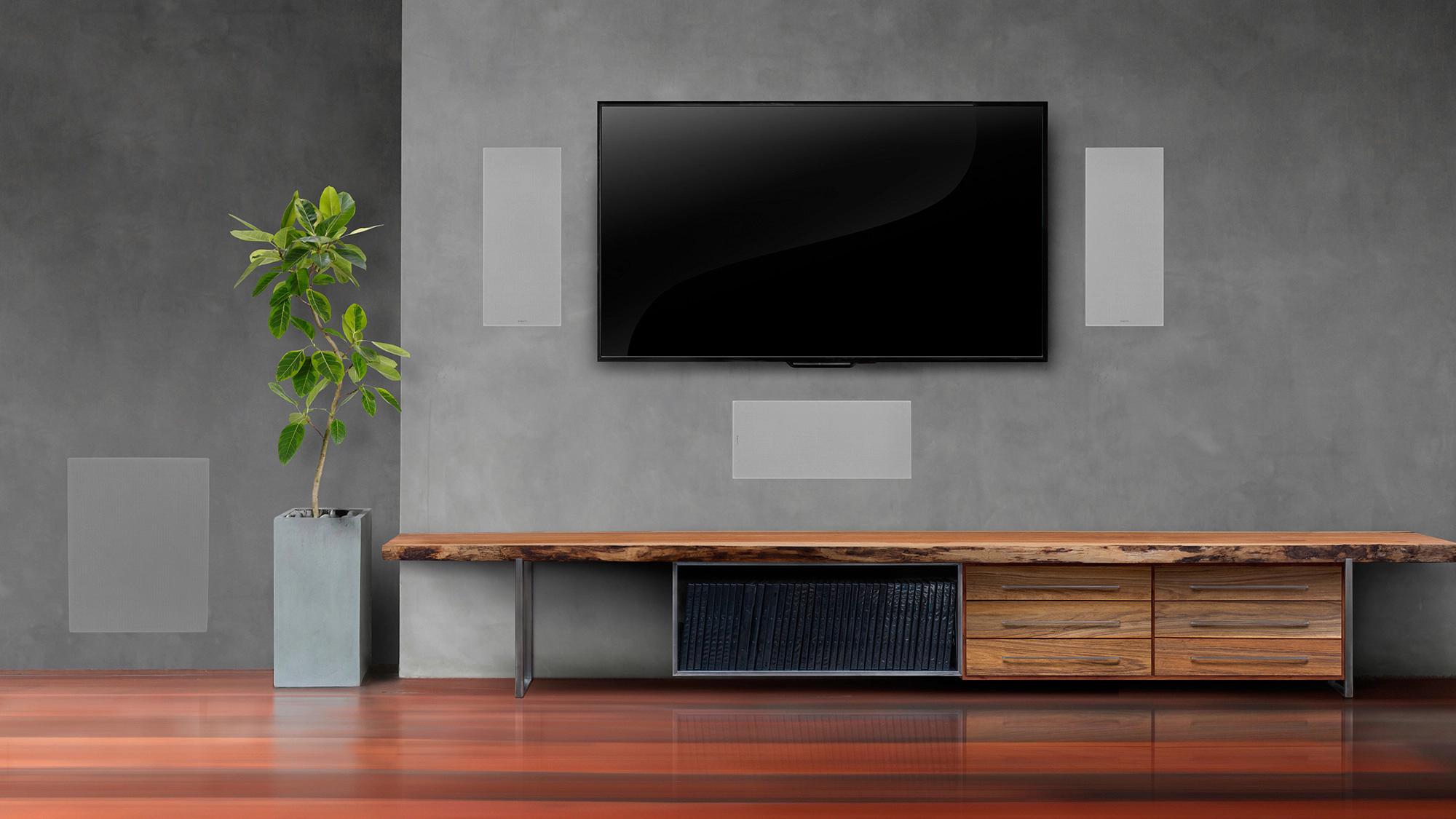
Start with the wall itself, then match the speaker's driver layout and role to the system around it. The strongest design on paper is still the wrong purchase if its opening conflicts with a stud or its voicing does not suit the room.
Speaker role
Center channels, front left and right speakers, surrounds, and stereo music speakers do not have identical jobs. The Polk Audio 255c-RT is shaped around horizontal center-channel placement, while the Micca M-CS can work horizontally or vertically. A general-purpose model such as the Micca M-8S gives you more freedom when the final system layout is not settled.
Driver layout
Two-way speakers divide the work between a woofer and tweeter. Three-way designs such as the Yamaha NS-IW470 add a dedicated midrange, while the Klipsch models use a compression driver and horn for controlled, high-output treble. Larger woofers can support more lower-midrange authority, but a subwoofer remains important for deep theater bass.
Match the speaker's role and wall opening first. Driver count comes second.
Sensitivity and power handling
Sensitivity indicates how efficiently a speaker turns amplifier power into acoustic output, while power handling describes how much input the speaker is designed to accept. Micca lists 90dB sensitivity for both the M-8S and M-CS, with 100 watts and 120 watts of handling respectively. The Yamaha lists 120 watts maximum input capability. Do not compare those figures blindly, because manufacturers may use different measurement methods.
Aimable drivers
A pivoting tweeter or horn lets you direct upper frequencies toward the main seats instead of firing straight out from a fixed wall position. The Micca M-8S and M-CS use pivoting silk dome tweeters, Yamaha lets you aim both its tweeter and midrange, and the Klipsch models use pivoting Tractrix Horns. This feature matters most when the speaker cannot be centered on the listening area.
Cutout and mounting depth
The external dimensions do not always tell you how much wall space the installation needs. The M-8S requires an 8.7 by 12.7 inch cutout and 3.4 inches of depth, while the M-CS needs a 13.8 by 6.7 inch opening and 3.1 inches of depth. Locate studs, wiring, plumbing, and insulation first, then confirm the manufacturer's template before cutting.
Grille and installation hardware
Paintable grilles help a finished speaker blend into the wall, but the mounting system determines how securely it stays in place. Built-in tabs on the Micca models simplify basic installations. Polk's rotating cam system and precision flange focus on a tight, vibration-resistant fit. A protective cover, included with the Yamaha NS-IW470, is useful while walls are being painted or finished.
Frequently asked questions
Are in-wall speakers suitable for a home theater?
Yes. Several models here are specifically intended for left, center, right, or surround use in multichannel systems. The Polk Audio 255c-RT is dedicated to center-channel duties, while the Klipsch R-5502-W II and Micca M-CS can take on more than one theater role.
Do in-wall speakers need a subwoofer?
They do not always need one, but a subwoofer is helpful for movie effects and the lowest bass. The Micca M-8S has a listed response down to 40Hz, while the M-CS is listed from 60Hz to 20kHz. Those figures suggest the larger model reaches lower, but neither removes the need for a subwoofer in a full theater system.
Can these speakers be painted?
The Micca models have paintable grilles, and the Yamaha NS-IW470 includes a paintable grille. Polk describes its Vanishing Series grille as paintable as well. Remove or protect the grille during painting and follow the relevant installation instructions so the finish does not block the grille openings.
Can one speaker be used as a center channel?
Yes, if the model is designed or approved for that position. The Klipsch R-5502-W II can be used as a left, center, or right channel, and the Micca M-CS can be installed horizontally as a center channel. The Polk 255c-RT is the most purpose-built center option in this group.
What is the difference between a two-way and three-way in-wall speaker?
A two-way design uses a woofer and tweeter, while a three-way design adds a separate midrange driver. The Yamaha NS-IW470 is a three-way model with a 6.5-inch woofer, 2-inch midrange, and 1-inch tweeter. More drivers do not automatically mean better sound, but separating the ranges can help a speaker handle voices and treble more distinctly.
Are horn-loaded in-wall speakers too bright?
Not necessarily, but horns can sound more direct and prominent than silk dome tweeters. The Klipsch R-5502-W II and R-5800-W II use pivoting Tractrix Horns, and the R-5800-W II includes treble and midbass attenuation switches. Room reflections, listening angle, and system voicing all affect whether that presentation feels lively or overly forward.
The bottom line
The Best best in wall speakers choice for most rooms is the Micca M-8S. Its 8-inch woofer, pivoting tweeter, clear installation measurements, and useful sensitivity and power figures make it the most adaptable model here. Choose the Polk Audio 255c-RT instead when the real goal is a hidden horizontal center channel with a dedicated theater installation.
The Klipsch R-5502-W II is the better fit for controlled, high-output theater sound, while the Micca M-CS is a smart option when a center speaker may later move into a front or surround position. The Yamaha NS-IW470 remains the most straightforward matched pair, and the Polk Audio 265-RT and Klipsch R-5800-W II suit larger rooms that can accommodate their bigger designs.
If you are undecided, choose the Micca M-8S for general use, or choose the Polk Audio 255c-RT when dialogue is the system's priority.
As an Amazon Associate we earn from qualifying purchases.