

A tired factory speaker can make every track sound thin, especially when road noise masks vocals and the bass loses its shape. The challenge is finding a 6x9 that fits the opening, works with the available power, and improves clarity without creating a harsh top end.
We compared nine coaxial and full-range models, paying close attention to sensitivity, power handling, driver layout, frequency response, and installation details. The Best 6x9 speakers range includes easy factory replacements, amplifier-ready options, and rugged pairs for a more substantial upgrade.
The Pioneer TS-A6971F is our top pick, with the KICKER DSC6930 close behind for buyers who want a clearly specified 4-ohm pair and a strong three-way design.
Comparison table
| # | Product | Award | Design | Power handling | Sensitivity | Best for |
|---|---|---|---|---|---|---|
| 1 | Pioneer TS-A6971F | Best overall | 4-way coaxial | 600 watts max, 100 watts continuous | 92 dB | Broad, lively factory upgrades |
| 2 | KICKER DSC6930 | Best for balanced sound | 3-way coaxial | 360 watts peak | 92 dB | A 4-ohm speaker pair |
| 3 | Pioneer TS-F6935R | Best for amplifier systems | 3-way coaxial | 230 watts max, 30 watts nominal | 87 dB | Custom amplified installations |
| 4 | Pioneer TS-A6961F | Best straightforward upgrade | 4-way coaxial | 450 watts max, 90 watts continuous | 92 dB | Direct factory replacements |
| 5 | Pioneer TS-A6991F | Best for extra driver separation | 5-way coaxial | 700 watts max, 120 watts continuous | 92 dB | High-output coaxial systems |
| 6 | Skar Audio RPX69 | Best soft-dome design | 3-way coaxial | 270 watts per pair | 92 dB | Smooth treble and durable surrounds |
| 7 | Rockford Fosgate R169X3 | Best factory replacement pair | 3-way full range | 65 watts RMS, 130 watts max | Not listed | Hardware included installations |
| 8 | Pioneer TS-G6930F | Best simple three-way | 3-way coaxial | 400 watts max, 45 watts continuous | 90 dB | Basic factory-system upgrades |
| 9 | BOSS CH6930B | Best for included warranty | 3-way coaxial | 400 watts per pair | 92 dB | Buyers wanting a complete pair |
1. Pioneer TS-A6971F: Best Overall

Pros
- Four-way driver layout
- 92 dB sensitivity suits modest factory power
- Wide 29 Hz to 33 kHz response
- Multi-fit installation adapters included
Cons
- The listing identifies one item
- Max power is more useful with an appropriate amplifier
- Larger driver layout may need careful fitment
Best for: someone replacing factory speakers while wanting a broad, energetic presentation.
The Pioneer TS-A6971F is the speaker we would start with for a general car-audio upgrade. It has enough design ambition to make the change obvious, but its 92 dB sensitivity means it does not demand a powerful amplifier just to become audible. That combination makes it a sensible match for many factory head units.
Its four-way coaxial layout separates frequency duties among multiple drivers rather than asking one cone to handle everything. Pioneer lists a 600-watt maximum rating and 100 watts of continuous power handling. The continuous figure is the more useful one when planning an amplifier, while the maximum figure indicates the headroom claimed by the design. Its 29 Hz to 33 kHz frequency response is unusually broad on paper for this class.
The adapters are a practical advantage. The speakers are supplied with 6 by 9 multi-fit installation adapters, which can make a replacement less dependent on the exact factory mounting pattern. That does not eliminate the need to verify the vehicle opening, wiring, and grille clearance, but it gives this model more installation flexibility than the Pioneer TS-G6930F.
The weakness is the product information's one-item count, so buyers should confirm the package contents before ordering for a two-speaker replacement. It also has more driver hardware than a simple three-way, which is not automatically better if the crossover integration is poor. Still, for a lively, high-sensitivity upgrade with useful fitment help, the Pioneer TS-A6971F is the strongest all-rounder here.
2. KICKER DSC6930: Best for Balanced Sound

Pros
- Three-way driver arrangement
- Clearly specified 4-ohm impedance
- 92 dB sensitivity
- Sold as a pair
Cons
- Frequency response stops at 20 kHz
- Peak power rating gives less planning guidance than an RMS figure
- Fitment dimensions should be checked carefully
Best for: a listener who wants a clearly specified 4-ohm pair for a conventional car-audio system.
The KICKER DSC6930 is the cleanest choice for shoppers who want the basic electrical information spelled out. It is a 6 by 9-inch, three-way speaker pair with a 4-ohm impedance and 92 dB sensitivity. Those details matter because the impedance is a straightforward match for many car amplifiers and head units, while the sensitivity helps the speakers play loudly without requiring extreme output.
KICKER lists 360 watts of peak power handling and a 30 Hz to 20 kHz frequency response. The lower limit suggests useful mid-bass potential, although the enclosure and vehicle door or rear deck will influence how much low-end weight reaches the cabin. The three-way layout assigns separate duties to the woofer, midrange, and tweeter, a sensible arrangement for keeping vocals and cymbals from being buried by the larger cone.
Compared with the Pioneer TS-A6971F, the DSC6930 uses fewer ways and has a narrower stated top-end response. That is not a clear disadvantage for ordinary music playback. The KICKER's advantage is its unambiguous pair packaging and 4-ohm specification. The Pioneer offers more ambitious driver separation and a wider published response, but the KICKER is easier to evaluate as a direct system component.
There is no continuous power figure in the supplied information, so amplifier matching should be conservative rather than based on the 360-watt peak number alone. Buyers should also measure the mounting area instead of assuming every 6x9 opening is identical. For a conventional replacement pair with predictable electrical characteristics, the KICKER DSC6930 is an easy recommendation.
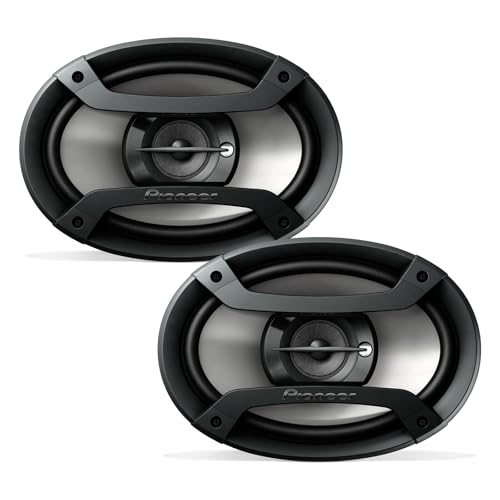
3. Pioneer TS-F6935R: Best for Amplifier Systems
Pros
- Three-way woofer, midrange, and tweeter design
- 4-ohm impedance
- 230 watts maximum and 30 watts nominal handling
- Standard 6 by 9-inch sizing
Cons
- 87 dB sensitivity is lower than most picks here
- External amplifier required according to the listing
- Professional installation is recommended
Best for: a custom system with an external amplifier and someone prepared to check the installation details.
The Pioneer TS-F6935R stands apart because its listing directly calls it a passive design that requires an external amplifier. That makes it less attractive as a casual factory swap, but more relevant to a buyer already building a system around a separate amp. It is also listed as a pair, which simplifies planning for a rear-deck or side-panel replacement.
The speaker uses a three-way arrangement with a woofer, midrange driver, and tweeter. Pioneer gives it a 230-watt maximum rating, 30 watts nominal handling, and 4-ohm impedance. The nominal figure is the one to keep in mind when choosing amplifier output. Its 87 dB sensitivity is lower than the 92 dB figures shared by the Pioneer TS-A6971F and KICKER DSC6930, so it needs more amplifier output to reach the same volume.
The 30 Hz to 20 kHz frequency response covers the conventional audible range. In a properly matched system, that is more relevant than a very high upper number. The standard 6 by 9 sizing should make it familiar to installers, but Pioneer recommends professional installation unless the buyer already has car-audio experience. The stated dimensions are approximately 9.3 inches wide, 6.4 inches high, and 2.75 inches deep.
This is not the pick for someone connecting replacement speakers to an underpowered factory radio and hoping for effortless volume. The Pioneer TS-A6971F is a better fit for that job because of its higher sensitivity. Choose the TS-F6935R when the amplifier, wiring, and fitment are already part of the plan, and when a conventional three-way pair is the goal.
4. Pioneer TS-A6961F: Best Straightforward Upgrade

Pros
- Four-way coaxial design
- 92 dB sensitivity
- 29 Hz to 28 kHz response
- Multi-fit adapters included
Cons
- The listing identifies one item
- Lower maximum handling than the TS-A6971F
- Vehicle fitment still needs verification
Best for: a factory replacement where simple installation and lively output matter more than maximum system power.
The Pioneer TS-A6961F is the quieter sibling to the TS-A6971F in this group, but it retains the features that make that model appealing. It is a four-way coaxial speaker with 92 dB sensitivity, so it should be comfortable on the limited output of many factory radios. Its sound target is clearly an upgrade from a basic single-driver replacement, with separate drivers intended to divide low, mid, and high frequencies.
Pioneer lists 450 watts maximum power handling and 90 watts continuous handling. The continuous figure gives this model enough room for a moderate amplifier, while the 92 dB sensitivity keeps it usable without one. Its stated response runs from 29 Hz to 28 kHz. The lower limit may help provide a fuller sense of kick and bass, although the vehicle's mounting location and acoustic treatment remain just as important.
The supplied 6 by 9 multi-fit installation adapters are useful when a factory opening does not line up perfectly with a standard speaker frame. The listed dimensions are 9.375 inches wide, 6.375 inches high, and 4.375 inches long. Those measurements make a pre-installation clearance check essential, especially around the basket and rear of the magnet.
Compared with the TS-A6971F, the TS-A6961F gives up some maximum and continuous handling and narrows the published top end. The difference is unlikely to matter in a basic factory system, where sensitivity and fitment are more important. The main caution is the one-item count in the product information, so confirm whether the package meets the number of speakers needed. This is the sensible Pioneer four-way for a less ambitious replacement.
5. Pioneer TS-A6991F: Best for Extra Driver Separation

Pros
- Five-way coaxial design
- 700 watts maximum and 120 watts continuous handling
- 92 dB sensitivity
- 29 Hz to 33 kHz response
Cons
- The listing identifies one item
- More drivers do not guarantee better integration
- Fitment details should be checked before installation
Best for: a high-output coaxial setup where the buyer specifically wants a five-way design.
The Pioneer TS-A6991F is the most elaborate coaxial design in the roundup. Its five-way layout is intended to split the frequency range across separate drivers, and the result should appeal to listeners who prefer a detailed, forward presentation from a single speaker location. It shares the 92 dB sensitivity of the other A-Series models, which helps it work with ordinary head-unit power.
Its headline specifications are 700 watts maximum power handling and 120 watts continuous handling. The continuous number is substantial for a 6x9 coaxial and makes the TS-A6991F the more appropriate Pioneer option for a system with a stronger amplifier. The published 29 Hz to 33 kHz response also matches the TS-A6971F, while the extra driver is the key design distinction.
The speaker measures 9.375 inches wide and 6.375 inches high in the supplied product information. No adapter is specifically listed in the feature text, unlike the TS-A6971F and TS-A6961F. That makes careful measurement more important. A five-way speaker also adds complexity, and a larger driver count should not be treated as proof of smoother sound without considering the crossover and the rest of the system.
The TS-A6971F is the safer all-purpose recommendation because it offers a similar sensitivity and response with a simpler four-way design. The TS-A6991F makes more sense when the amplifier has enough headroom and the buyer wants the most feature-heavy Pioneer coaxial in this selection. As with the other A-Series listings, confirm the one-item package before ordering.
6. Skar Audio RPX69: Best Soft-Dome Design

Pros
- Microfiber paper cone
- Butyl rubber surround
- 20 mm soft-dome silk tweeter
- 44 mm midrange driver
Cons
- Power rating is given per pair
- Response begins at 32 Hz
- Physical dimensions are larger than some listings
Best for: a buyer who prefers a three-way speaker with a soft-dome silk tweeter and rubber surround.
The Skar Audio RPX69 takes a more specific approach than the Pioneer models. Instead of adding a fourth or fifth way, it focuses on the materials and the individual midrange and tweeter. The microfiber paper cone is paired with a butyl rubber surround, while a 20 mm soft-dome silk tweeter and 44 mm midrange handle the upper portions of the music.
Skar lists 270 watts peak power handling per pair, or 135 watts each, along with 92 dB sensitivity. The 32 Hz to 24, 000 Hz response is narrower than the broad figures claimed by several Pioneer speakers, but it remains well suited to normal music playback. The soft-dome tweeter may be attractive to listeners who want a less aggressively specified high-frequency section than a hard piezo design.
The supplied product dimensions are 15 inches long, 10.5 inches wide, and 4.5 inches high, with a listed weight of 6.9 pounds. Those measurements deserve extra attention because catalog dimensions can be taken from the packaging or a different orientation. Verify the vehicle's mounting opening and depth before treating this as a simple swap.
Compared with the KICKER DSC6930, the RPX69 offers more detail about cone, surround, and tweeter construction, while KICKER provides clearer impedance information. The Pioneer TS-G6930F is lighter on paper and simpler in its feature set. The Skar is the more interesting pick for someone choosing around driver materials and a soft-dome tweeter, not merely the number of ways.
7. Rockford Fosgate R169X3: Best Factory Replacement Pair

Pros
- Sold as a pair
- 65 watts RMS and 130 watts maximum handling
- Mounting hardware and grilles included
- High-pass crossovers included
Cons
- Lower power handling than the leading picks
- 2.85-inch mounting depth must be checked
- No sensitivity figure listed
Best for: a factory replacement where included mounting hardware, grilles, and crossovers simplify the job.
The Rockford Fosgate R169X3 is refreshingly practical. It is a three-way full-range pair intended for factory replacements, and the box includes high-pass crossovers, mounting hardware, and grilles. That package is more useful to an installer than a large maximum-power number with no supporting details.
The speakers are rated at 65 watts RMS and 130 watts maximum. The RMS rating gives a much clearer picture of continuous use than the peak figure. They use polypropylene cones, a silk-dome pole-mounted Piezo tweeter, and a midrange driver. The 4-ohm specification makes the pair a conventional match for many car-audio systems.
Fitment is unusually well documented. Rockford lists a mounting diameter of 5.93 by 8.59 inches and a mounting depth of 2.85 inches. Those numbers should be compared with the vehicle's actual opening, particularly if the speaker sits behind a window mechanism or shallow rear deck. The listed dimensions are approximately 9 inches long, 6 inches wide, and 2.9 inches high.
The R169X3 cannot compete with the Pioneer TS-A6991F on amplifier headroom, and it does not provide a sensitivity figure for easy comparison with the KICKER or Skar. Its strength is a complete, clearly described replacement package. For a system that will remain close to factory power, the Rockford Fosgate R169X3 is the more grounded choice.
8. Pioneer TS-G6930F: Best Simple Three-Way

Pros
- Three-way coaxial design
- 400 watts maximum handling
- 32 Hz to 32 kHz response
- Designed as a factory replacement
Cons
- 45 watts continuous handling
- 90 dB sensitivity is below several alternatives
- Installation is required
Best for: a basic factory-speaker replacement with a conventional three-way layout.
The Pioneer TS-G6930F is the uncomplicated model in this group. It uses a three-way coaxial design, fits the familiar 6 by 9 format, and is described as compatible with a range of car-audio systems. That makes it a reasonable starting point for an older factory setup that needs a direct replacement without a complicated system redesign.
Pioneer lists 400 watts maximum power handling and 45 watts continuous handling. The continuous rating is modest, so this is not the speaker to choose for a high-output amplifier. Its 90 dB sensitivity is still usable with factory power, though the KICKER DSC6930, Skar Audio RPX69, and A-Series Pioneers have a stated 92 dB figure.
The 32 Hz to 32 kHz response covers a broad range on paper. The 3-way arrangement uses separate drivers for different frequency ranges, which should help keep vocals and treble distinct from the woofer. The listed dimensions are about 9.33 inches long, 7.24 inches wide, and 2.83 inches high, so the exact orientation and mounting opening need to be checked.
The Pioneer TS-A6961F is the better choice when four-way separation and multi-fit adapters matter. The TS-G6930F remains appealing for its simpler three-way design and factory-replacement role. It is a sensible pick for a modest system, but buyers planning an amplifier should look toward the TS-F6935R or one of the higher continuous-power A-Series models.
9. BOSS CH6930B: Best for Included Warranty

Pros
- Sold as a pair
- 92 dB sensitivity
- Rubber surround and poly injection cone
- Three-year platinum online dealer warranty
Cons
- 50 Hz low-frequency limit is higher than most picks
- 3.2-inch mounting depth needs checking
- Professional installation is encouraged
Best for: a buyer who wants a complete three-way pair and a stated long warranty period.
The BOSS CH6930B is a clearly defined pair with a conventional three-way driver layout. It combines a poly injection cone with a rubber surround, a 0.75-inch Piezo tweeter, and a 2-inch polyimide cone midrange. That gives it a straightforward hardware story for a factory system upgrade.
BOSS lists 4-ohm impedance, 92 dB sensitivity, and a 50 Hz to 20 kHz frequency response. The 50 Hz lower limit is the most restricted in this group, so listeners looking for pronounced mid-bass should consider the Pioneer TS-A6971F, KICKER DSC6930, or Skar Audio RPX69 instead. The 92 dB sensitivity should still help the CH6930B play efficiently from ordinary head-unit power.
Fitment information is useful here. The mounting depth is 3.2 inches, with a mounting hole of 8.9 by 6 inches. The pair weighs 6.2 pounds, and the listed dimensions are 4.3 by 10.2 by 7.4 inches. As always, the hole and depth figures matter more than the nominal 6x9 label when working inside a door or rear deck.
The BOSS CH6930B does not have the broad low-frequency claim of the Pioneer TS-G6930F, and the Rockford Fosgate R169X3 supplies more installation hardware in its stated package. BOSS counters with a three-year platinum online dealer warranty when purchased through Amazon.com, according to the listing. Choose it when warranty coverage and a complete pair are central to the decision.

How to choose best 6x9 speakers
The right replacement depends on the vehicle opening, the power available from the radio or amplifier, and the kind of tonal balance you want from the rear or door locations.
Fitment and mounting depth
A 6x9 label does not guarantee a universal fit. Check the mounting hole, basket shape, depth, grille clearance, and nearby window or trim hardware before ordering. The Rockford Fosgate R169X3 lists a 2.85-inch mounting depth, while the BOSS CH6930B lists 3.2 inches, a difference that can decide whether the speaker clears the vehicle.
Adapters can help with bolt patterns, but they cannot solve every clearance problem. The Pioneer TS-A6971F and TS-A6961F specifically include multi-fit installation adapters.
Sensitivity
Sensitivity indicates how much output a speaker can produce from a given amount of power. A higher figure generally suits a factory head unit better. The Pioneer TS-A6971F, KICKER DSC6930, Skar Audio RPX69, and BOSS CH6930B list 92 dB sensitivity, while the Pioneer TS-F6935R lists 87 dB.
A lower-sensitivity speaker is not automatically inferior. It simply makes amplifier matching more important. The TS-F6935R is explicitly described as requiring an external amplifier, so it belongs in a planned system rather than a casual radio-only replacement.
Continuous power handling
Maximum power numbers are easy to overread. Continuous or RMS handling is more useful for estimating what a speaker can accept during sustained listening. The Pioneer TS-A6991F lists 120 watts continuous, the TS-A6971F lists 100 watts, and the Rockford Fosgate R169X3 lists 65 watts RMS.
Match the continuous rating to the amplifier's real output rather than its biggest advertised peak number. A factory radio usually does not need a speaker designed for extreme amplifier output, while an aftermarket amplifier benefits from a more carefully matched model.
Choose the speaker that matches your amplifier and mounting depth first. Driver count comes after those two checks.
Driver layout
Three-way designs separate woofer, midrange, and tweeter duties. Four-way and five-way models divide that range further, but more drivers do not guarantee a smoother or more natural sound. The Pioneer TS-A6991F has the most elaborate layout here, while the KICKER DSC6930 and Rockford Fosgate R169X3 take a simpler three-way approach.
Driver materials also affect the design. The Skar Audio RPX69 uses a microfiber paper cone, butyl rubber surround, and silk tweeter. The BOSS CH6930B uses a poly injection cone, rubber surround, and Piezo tweeter. Those details can help narrow the choice when two models have similar electrical specifications.
Frequency response
Frequency response describes the range a speaker is designed to reproduce, but it does not predict the exact bass or treble you will hear in a car. The Pioneer TS-A6971F and TS-A6991F list 29 Hz to 33 kHz, while the BOSS CH6930B lists 50 Hz to 20 kHz.
The vehicle enclosure, placement, crossover, and sound deadening all influence the result. Treat the response figure as a useful comparison point, not a promise of deep subwoofer bass from a 6x9 speaker.
For broader listening outside the car, the difference between vehicle speakers and how home speakers handle room placement and bass becomes important. A separate system also makes it easier to choose the speaker size that suits a smaller listening space. If you want a system with its own amplification, consider how built-in amplification changes speaker setup.

Frequently asked questions
Will every 6x9 speaker fit my car?
No. The opening, mounting holes, basket shape, depth, and grille clearance vary by vehicle. Measure the factory speaker and surrounding space before ordering, even when the replacement uses the same nominal size.
Do I need an amplifier for these speakers?
Not always. The higher-sensitivity models can be suitable for factory head units, but the Pioneer TS-F6935R listing specifically says an external amplifier is required. Check the speaker's continuous power handling and your system's actual output before choosing.
Is a four-way speaker better than a three-way model?
Not by definition. A four-way design divides frequency duties among more drivers, but crossover integration and installation still determine the result. A well-matched three-way such as the KICKER DSC6930 can be a better fit for a particular system than a more complex design.
What does 4-ohm impedance mean?
Impedance describes the electrical load presented to the amplifier. The KICKER DSC6930, Pioneer TS-F6935R, Rockford Fosgate R169X3, and BOSS CH6930B list 4-ohm operation, which is common for car speakers. The amplifier should be designed to operate safely at that load.
Are peak watts or continuous watts more important?
Continuous or RMS handling is the more useful figure for sustained listening and amplifier matching. Peak ratings describe short-term maximum handling and should not be used alone to choose an amplifier.
Can a 6x9 speaker provide subwoofer bass?
It can provide useful mid-bass, but it is not a substitute for a dedicated subwoofer. The Pioneer A-Series models list low response figures beginning at 29 Hz, while the BOSS CH6930B lists 50 Hz. Actual bass depends heavily on the vehicle's mounting location and enclosure.

The bottom line
The Best 6x9 speakers pick is the Pioneer TS-A6971F because its four-way design, 92 dB sensitivity, 100 watts continuous handling, broad stated response, and included adapters cover the widest range of factory and upgraded systems. Its one-item package information is the main detail to verify before ordering.
The KICKER DSC6930 is the better alternative for a clearly specified 4-ohm pair, while the Pioneer TS-F6935R is the specialist choice for a system that already has an external amplifier. The Rockford Fosgate R169X3 is also compelling when included grilles, mounting hardware, and crossovers simplify installation.
If you are undecided, measure the mounting depth first, then choose the speaker whose sensitivity and continuous power rating match your car's amplifier.
As an Amazon Associate we earn from qualifying purchases.