
A good speaker system should make you forget about the equipment and pay attention to the recording. The problem is that bookshelf speakers, powered desktop models, and one-box wireless designs can look similar in a product listing while behaving very differently in a room. Our Best audiophile speakers picks separate those categories clearly.
The Klipsch RP-600M is our top choice for most traditional stereo systems, while Edifier's S3000MKII is the more complete powered option. The rest of the field covers compact desktop listening, home theater, old-school hi-fi, and convenient Bluetooth playback.
Comparison table
| # | Product | Award | Driver / power | Connectivity | Best for |
|---|---|---|---|---|---|
| 1 | Klipsch RP-600M | Best overall | 6.5-inch woofer, 1-inch tweeter | Binding posts | Traditional stereo systems |
| 2 | Edifier S3000MKII | Best powered system | 6.5-inch woofer, planar magnetic tweeter, 256W RMS | USB-B, XLR, RCA, optical, coaxial, Bluetooth | Flexible high-resolution listening |
| 3 | Marshall Acton III | Best single-speaker system | Stereo home speaker | Bluetooth 5.2, 3.5mm input | Simple room-filling playback |
| 4 | Edifier R1280T | Best simple powered pair | 4-inch driver, 13mm tweeter, 42W RMS | Dual AUX | Small stereo setups |
| 5 | Edifier M60 | Best desktop design | 3-inch mid-low driver, 1-inch tweeter, 66W RMS | USB-C, AUX, Bluetooth 5.3 | Compact computer desks |
| 6 | Edifier S1000MKII | Best active bookshelf pair | 5.5-inch woofer, 1-inch tweeter, 120W RMS | Optical, Bluetooth 5.0, aptX HD | TV and general home audio |
| 7 | Polk Audio ES20 | Best home theater pair | 6.5-inch woofer, 1-inch tweeter | Speaker terminals | Music and surround systems |
| 8 | Klipsch R-51M | Best compact Klipsch pair | Dual 5.25-inch woofers, 1-inch tweeters | Speaker terminals | Lively smaller-room audio |
| 9 | Wharfedale Linton | Best classic hi-fi package | Bookshelf speaker pair with stands | Speaker connection required | Full-size listening rooms |
| 10 | Sony SS-CS5M2 | Best three-way compact pair | 5.12-inch woofer, tweeter, super tweeter | Speaker connection required | Detailed small-room systems |
1. Klipsch RP-600M: Best Overall

Pros
- Large 6.5-inch cerametallic woofers
- Titanium tweeter with a hybrid Tractrix Horn
- Rear-firing Tractrix bass port
- Dual binding posts support bi-wiring or bi-amping
Cons
- Passive design needs a separate amplifier or receiver
- Rear port needs sensible placement
- Larger than the compact models here
Best for: listeners building a revealing, energetic traditional stereo system.
The Klipsch RP-600M is the pair we'd start with when someone asks for a serious stereo speaker without wanting a tower. Its presentation is immediate and lively. Vocals stand forward, percussion has convincing snap, and the 6.5-inch spun-copper cerametallic woofer gives music a physical sense of scale that smaller bookshelf designs struggle to match.
The 1-inch titanium LTS vented tweeter works with Klipsch's hybrid Tractrix Horn. That horn-loaded approach is central to the speaker's character, giving treble a focused, projected quality rather than a distant one. It suits rock, jazz, live recordings, and movie dialogue particularly well. Listeners who prefer a softer, more relaxed top end may find it too assertive in a reflective room.
This is a passive pair, so the amplifier matters. The dual binding posts allow bi-wiring or bi-amping, although a conventional connection is all many systems need. A rear-firing Tractrix port helps the woofer reach lower, fuller bass, but it also means the RP-600M should not be pressed hard against a wall. Give it some breathing room and use sturdy stands rather than a crowded shelf.
Compared with the smaller Klipsch R-51M, the RP-600M has more authority and a more ambitious driver arrangement. Polk Audio ES20 sounds broader and more theater-oriented, while the RP-600M is the sharper pick for a dedicated two-channel system. Its real weakness is its strong treble personality and the need for separate amplification. Skip it if you want a neutral, understated presentation or an all-in-one wireless setup.
For listeners trying to build around a turntable or integrated amplifier, the speaker placement choices that shape stereo imaging are just as important as the speaker itself. The RP-600M rewards that attention. It is the Best audiophile speakers pick for listeners who want scale, energy, and a distinctly live presentation.
2. Edifier S3000MKII: Best Powered System

Pros
- 256W RMS powered stereo system
- Planar magnetic tweeters and 6.5-inch aluminum woofers
- USB-B, XLR, RCA, optical, and coaxial inputs
- aptX HD Bluetooth and wireless speaker link
- Four EQ presets plus app and remote control
Cons
- Large cabinets need substantial shelf or stand space
- Feature set can feel excessive for a simple stereo
- Powered design limits amplifier upgrades
Best for: listeners who want high output and broad source compatibility without adding a receiver.
The Edifier S3000MKII is less a conventional bookshelf pair than a complete stereo hub. It has the authority to fill a larger room, accepts nearly every source most people will use, and avoids the usual amplifier-matching exercise. The 256W RMS system is the headline, but the more useful trait is how many jobs these speakers can handle without extra boxes.
Each speaker combines a 6.5-inch aluminum woofer with a planar magnetic tweeter. Edifier lists a 38Hz to 40kHz frequency range, which points to a system designed for both substantial low end and extended high-frequency detail. Four EQ presets, named Classic, Monitor, Dynamic, and Vocal, make the character easier to tailor. Dynamic is the natural choice for energetic playback, while Monitor should appeal to listeners who want a more restrained balance.
The inputs are unusually comprehensive. USB-B handles a computer, optical and coaxial inputs suit a TV or digital source, RCA works with conventional line-level equipment, and XLR gives studio gear a direct route. Bluetooth 5.0 with aptX HD covers wireless listening, while the proprietary 5.8GHz and 5.2GHz link connects the two speakers wirelessly. Digital inputs support 24-bit/192kHz audio according to the product information.
That flexibility puts the S3000MKII ahead of the Edifier S1000MKII for connectivity and output. The S1000MKII is easier to justify in a moderate room, and the passive Klipsch RP-600M remains the more upgradeable choice for a receiver-based system. The S3000MKII's weakness is its physical scale. The cabinets are about 17.9 inches high and 14.6 inches wide, so a shallow shelf is not an option.
The included remote, speaker controls, cables, and EDIFIER ConneX app make setup approachable, but serious listeners should still spend time positioning the pair. Those deciding between powered and passive layouts may also want to consider what changes when an amplifier is built into the speaker. Choose the S3000MKII when you want one polished system to serve music, movies, a computer, and a turntable.
3. Marshall Acton III: Best Single-Speaker System

Pros
- One-box stereo playback
- Bluetooth 5.2 and 3.5mm input
- Bass and treble controls
- Compact 6.28-pound cabinet
- Wide, room-filling presentation
Cons
- Not a true stereo pair
- Plug-in powered design limits placement
- Less suitable for careful two-channel imaging
Best for: listeners who want easy, attractive room-filling sound from one cabinet.
The Marshall Acton III is the outlier here, and that is exactly why it deserves a place. It is a single plug-in home speaker, not a pair of passive cabinets or a desktop monitor system. Put it on a sideboard, connect a phone over Bluetooth, and the listening experience is ready with very little ceremony.
Marshall describes the Acton III as having a wider soundstage than its predecessor and room-filling signature sound. The compact cabinet measures 10.24 inches wide, 6.69 inches high, and 5.91 inches deep, with a listed weight of 6.28 pounds. Those dimensions make it far easier to place than the Edifier S3000MKII or Wharfedale Linton.
Bluetooth 5.2 handles wireless playback, and the 3.5mm input gives older wired sources a straightforward connection. Bass and treble controls let you compensate for a bright room, a thin recording, or a placement close to a wall. It is a useful level of adjustment, though it does not offer the input range or EQ presets of the S3000MKII.
The Acton III beats every passive option here for simplicity. It cannot match the pinpoint left-right image of the Klipsch RP-600M, because it is not a separated stereo pair, and the Edifier M60 is a better fit for a close desktop position. Its weakness is therefore fundamental rather than hidden: a single cabinet cannot recreate the same wide, precise stereo stage as two properly spaced speakers.
The PVC-free build uses 70% recycled plastic and vegan materials, which adds a practical sustainability detail without changing the core listening experience. If you want a speaker for a living room, kitchen, or office where simple control matters more than component swapping, this is the pick. For a broader look at room playback, the connection options that matter in a home listening setup can help clarify whether one-box convenience is enough.
4. Edifier R1280T: Best Simple Powered Pair

Pros
- 42W RMS powered stereo pair
- Two AUX inputs
- 13mm silk dome tweeter
- Side-mounted bass and treble controls
- Remote included
Cons
- No Bluetooth input
- No optical or USB connection
- Smaller 4-inch driver limits room-filling scale
Best for: listeners who need an uncomplicated wired stereo pair for a desk or small room.
The Edifier R1280T succeeds by refusing to make a small stereo setup complicated. It is a powered pair with a conventional wooden-look MDF enclosure, a remote, and two AUX inputs. Connect a computer and another analog source, then switch between them without unplugging cables.
Its 13mm silk dome tweeter and 4-inch full-range unit are modestly sized, but that combination makes sense for near-field listening. At a desk, the speakers can provide a centered vocal image and a more natural spread than a single computer speaker. The 42W RMS system has enough headroom for everyday listening in a small room, though it is not intended to compete with the larger woofers in the RP-600M or ES20.
Bass and treble knobs sit on the side of the powered speaker. That is a useful practical touch because placement and room boundaries can change the balance of a small speaker quickly. The included remote handles volume from across the room. Two AUX inputs accept a 3.5mm headphone output or dual RCA source, so a basic computer and analog audio setup is easy.
Compared with the Edifier M60, the R1280T has fewer modern connections and a less compact design. The M60 adds USB-C, Bluetooth 5.3, LDAC, DSP, and angled stands. The R1280T remains easier to understand and operate, while the Marshall Acton III is simpler still but gives up separated stereo cabinets. Do not choose the R1280T if wireless streaming or a digital TV connection is central to your setup.
The wood-effect vinyl finish gives it a familiar hi-fi appearance, though this is not a speaker for listeners chasing the largest image or deepest bass. It is a sensible starting point for a desk, bedroom, or small living room where the source is primarily analog. The R1280T is one of the Best audiophile speakers options for keeping the system straightforward.
5. Edifier M60: Best Desktop Design
Pros
- 66W RMS output
- USB-C, AUX, and Bluetooth 5.3
- LDAC wireless support
- DSP and two-way active crossover
- Angled aluminum stands included
Cons
- Designed more for desktop listening than large rooms
- Touch controls may not suit everyone
- Compact drivers cannot match larger bookshelf speakers for scale
Best for: computer listeners who want a compact, capable stereo pair with modern inputs.
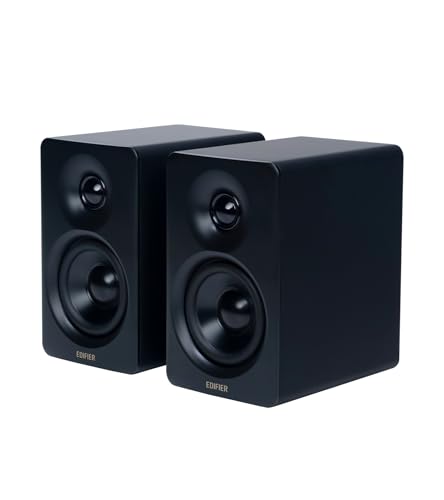
The Edifier M60 makes a convincing case that a desktop system does not need to look or sound like an afterthought. Each speaker measures about 3.94 inches wide, 5.79 inches high, and 6.61 inches deep. That compact footprint leaves space for a monitor, keyboard, and other desk equipment without forcing the speakers to the far edges.
Inside, a 3-inch long-throw aluminum mid-low driver works with a 1-inch silk dome tweeter. The pair is rated at 66W RMS, with 18W assigned to each mid-low driver and 15W to each tweeter. Full digital processing, a two-way active crossover, dynamic range control, and a built-in Class-D amplifier are intended to keep the compact system controlled at close range.
Connectivity is a major advantage over the R1280T. USB-C gives a direct wired route from a computer, AUX handles analog equipment, and Bluetooth 5.3 supports wireless playback. LDAC can carry up to 24-bit/96kHz audio from compatible Android devices, according to the product details. The EDIFIER ConneX app adds control, while a touch-sensitive panel lights as your hand approaches.
The included aluminum stands angle the speakers upward by 15 degrees. That is a small but meaningful design decision on a desk, where drivers often fire below ear level. The M60 creates a more deliberate listening position than the Marshall Acton III, and it takes up less space than the Edifier S1000MKII. The trade-off is bass scale. A 3-inch driver cannot produce the same physical weight as the larger Klipsch or Polk pairs.
The M60 is not the right pick for a large seating area or a system built around a conventional receiver. It is a strong fit for a computer desk, especially when USB-C and wireless convenience matter as much as sound. If your desk is especially tight, how much room speakers need around a computer is worth deciding before choosing a larger pair.
6. Edifier S1000MKII: Best Active Bookshelf Pair

Pros
- Built-in 60W-per-speaker Class-D amplification
- 5.5-inch aluminum alloy midrange bass driver
- Titanium dome tweeter
- Optical input and aptX HD Bluetooth
- 45Hz to 40kHz listed frequency response
Cons
- Large and heavy cabinets
- Less extensive input selection than the S3000MKII
- Powered design does not support amplifier upgrades
Best for: listeners who want substantial active bookshelf speakers for music, television, and everyday home audio.
The Edifier S1000MKII sits between a conventional hi-fi pair and a modern powered system. It has enough cabinet and driver size to sound at home in a living room, but its built-in amplification keeps the system to two speakers and a source. That makes it a particularly sensible match for a TV, CD player, laptop, or phone.
Each speaker uses a 5.5-inch aluminum alloy midrange bass driver and a 1-inch advanced titanium dome tweeter. Edifier lists a 45Hz to 40kHz frequency response. The built-in Class-D amplifier supplies 60W to each speaker, so no external receiver is necessary. The result is a system with more physical presence than the smaller R1280T and M60.
Optical input is useful for a television or digital player, while Bluetooth 5.0 with Qualcomm aptX HD handles compatible wireless sources. The product information also describes the S1000MKII as suitable for phones, tablets, laptops, TVs, Blu-ray players, CD players, and DVD players. It is not as connection-rich as the S3000MKII, which adds USB-B, XLR, coaxial, and broader EQ control, but most ordinary home setups will find the S1000MKII well equipped.
The cabinets are large, measuring 16 inches high and 14.5 inches deep, and the pair is listed at more than 36 pounds. That bulk can help create a grounded presentation, but it rules out a flimsy shelf. Compared with the passive Polk Audio ES20, the S1000MKII is easier to install because amplification is built in. Compared with the S3000MKII, it gives up output and connectivity.
Its weakness is the lack of a straightforward upgrade path. If you already own a receiver and expect to change amplification later, the RP-600M is the more flexible long-term platform. For everyone else, the S1000MKII is a well-balanced active pair for a modest home system, particularly when optical input and Bluetooth matter.
7. Polk Audio ES20: Best Home Theater Pair

Pros
- 6.5-inch woofer and 1-inch Terylene tweeter
- Power Port bass design
- 4 and 8 Ohm compatibility
- Suitable for stereo or surround placement
- Designed to blend with other Signature Elite speakers
Cons
- Requires an amplifier or AV receiver
- Larger cabinets need proper stands
- No built-in wireless or digital inputs
Best for: listeners combining music playback with a flexible home theater system.
The Polk Audio ES20 is the pick for someone whose listening includes movies and games as often as albums. It is a passive bookshelf pair with a 6.5-inch woofer and 1-inch Terylene tweeter, but Polk has also designed it to work as part of a larger Signature Elite surround system. That gives it a broader role than a strictly two-channel speaker.
Polk's Power Port technology is intended to increase bass output while reducing turbulence and distortion. In practice, the design should appeal to listeners who want a fuller lower register from a bookshelf cabinet without immediately adding a subwoofer. The ES20 is also described as compatible with both 4 and 8 Ohm amplifier loads, which gives an AV receiver more flexibility when building a system.
Placement is unusually versatile. Polk lists the ES20 for front, side, rear, or elevation surround use, with screw inserts and keyhole slots for directional wall mounting. A stand remains the better route for a serious stereo image, but those mounting options are useful when the speaker's job changes from music pair to surround channel.
Against the Klipsch RP-600M, the ES20 is less incisive and less horn-driven, but it presents a more obvious path to a matched center and tower setup. The Sony SS-CS5M2 is also a useful compact three-way alternative, while the Edifier active models are easier if you do not own amplification. The ES20's weakness is its passive nature and fairly substantial cabinet, so it is not a plug-and-play computer speaker.
The ES20 makes the most sense when a receiver already sits at the center of the room. It can handle stereo duties now and join a larger Polk system later. Readers assembling a cinema setup should also think about how the front speakers and center channel need to work together before choosing a pair.
8. Klipsch R-51M: Best Compact Klipsch Pair

Pros
- 1-inch aluminum LTS tweeters
- 90 by 90 Tractrix Horns
- Dual 5.25-inch spun-copper IMG woofers
- Rear-firing bass port
- Smaller cabinet than the RP-600M
Cons
- Passive design needs separate amplification
- Less low-end authority than the RP-600M
- Rear port limits wall-hugging placement
Best for: listeners who want Klipsch's energetic presentation in a smaller bookshelf cabinet.
The Klipsch R-51M takes the familiar Klipsch formula and makes it easier to fit into a smaller room. Its dual 5.25-inch spun-copper IMG woofers are smaller than the RP-600M's 6.5-inch units, but the speaker keeps the brand's horn-loaded approach with a 1-inch aluminum LTS tweeter and 90 by 90 Tractrix Horn.
That combination produces the R-51M's main appeal: lively sound with a strong sense of attack. It works well when music needs immediacy, and the horn helps voices and instruments retain presence at moderate listening levels. The smaller cabinet is listed at 13.3 by 7 by 8.5 inches in the product features, making it more manageable on a compact stand or shelf than the RP-600M.
A rear-firing port supports bass from the woofer, but placement still matters. The speaker should not be pushed flush against a wall, especially if the room already emphasizes low frequencies. These are passive speakers, so a receiver or amplifier is required. That extra component is part of the system plan, not a minor detail for someone coming from powered desktop speakers.
The R-51M is a clear step down from the RP-600M in scale and refinement, but it is also easier to place. The Sony SS-CS5M2 offers a three-way design and a different approach to treble, while the Edifier R1280T is much simpler because it includes amplification. The R-51M's weakness is its narrower comfort zone: listeners sensitive to forward treble may prefer the Polk or Wharfedale.
Choose it for a small stereo system where energy matters more than the last word in neutrality. It is especially appealing to Klipsch fans who cannot accommodate the larger RP-600M. A capable amplifier and careful toe-in will help the R-51M sound focused rather than aggressive.
9. Wharfedale Linton: Best Classic Hi-Fi Package

Pros
- Includes a pair of Linton bookshelf speakers
- Includes matching speaker stands
- Classic full-size hi-fi presentation
- Substantial 159.1-pound listed package weight
Cons
- Requires a separate amplifier or receiver
- Very heavy and difficult to move
- Needs more room than conventional bookshelf speakers
Best for: listeners creating a dedicated, furniture-like stereo listening space.
The Wharfedale Linton is the most imposing package in this group. The listing includes a pair of Linton 85th Anniversary bookshelf speakers and a pair of bookshelf stands, so the system arrives with the support furniture that a large traditional speaker needs. This is not a compact desktop purchase or a speaker to hide behind a television.
The available product information is sparse on driver and connectivity specifications, so there is no responsible reason to attach invented technical claims to it. What is clear is the intended format: a substantial passive stereo package with dedicated stands and a listed package weight of 159.1 pounds. That mass signals a setup designed to stay in one place and become part of the room.
The included stands are important. A large bookshelf speaker placed on a low cabinet can lose the intended listening height and stereo geometry. With the Linton package, the positioning problem is addressed from the start, although the owner still needs an amplifier, speaker cable, and enough room to place the pair with space around it.
Compared with the Klipsch RP-600M, the Linton is a more furniture-like commitment and less obviously suited to a compact room. The Edifier S3000MKII offers far more source flexibility without an external amplifier, while the Linton is the more traditional route for someone who enjoys building around separate components. Its weakness is the sheer burden of the package. Moving it, placing it, or fitting it into a small apartment will take planning.
Choose the Linton when the speaker system is the room's main listening feature rather than an accessory to a desk or TV. It makes the most sense for a dedicated stereo setup, a substantial amplifier, and a listener who values the rituals of conventional hi-fi.
10. Sony SS-CS5M2: Best Three-Way Compact Pair

Pros
- Three-way, three-driver design
- 5.12-inch woofer
- Dedicated tweeter and wide-dispersion super tweeter
- Bass-reflex enclosure
- Listed 53Hz to 50kHz frequency response
Cons
- Passive design needs separate amplification
- No built-in wireless or digital inputs
- Best suited to a compact stereo rather than a large room
Best for: listeners who want a compact three-way speaker pair for a traditional receiver system.
The Sony SS-CS5M2 takes a different route from the two-way designs that dominate this list. It uses three drivers in each cabinet: a 5.12-inch woofer, a high-precision tweeter, and a wide-dispersion super tweeter. That arrangement is intended to divide the frequency range across more specialized drivers while keeping the enclosure compact.
Sony lists a 53Hz to 50, 000Hz frequency response and describes the speakers as Hi-Res Audio compatible. The bass-reflex enclosure is intended to support lower frequencies without introducing unwanted distortion, while the super tweeter is designed to broaden the soundstage. Those specifications matter most to listeners who want a detailed, spacious presentation from a traditional receiver-based system.
The SS-CS5M2 is sold as a passive pair, so it needs an amplifier or AV receiver. Sony specifically identifies its CS speakers as a match for Sony AV receivers, but the basic connection is not limited to that brand. This makes it more flexible than an active speaker in one sense, since the electronics can be changed later, but less convenient than the Edifier powered models.
It is smaller and less assertive than the Klipsch RP-600M, while its three-way design gives it a different pitch from the two-way Klipsch R-51M. The Polk Audio ES20 is the stronger choice for a broader home theater plan, and the Edifier M60 is far easier for a computer desk. The Sony's weakness is that its high-resolution emphasis still depends on an amplifier and sensible placement.
For a small room, compact stereo rack, or Sony-centered system, the SS-CS5M2 is an interesting option. It is not the most flexible speaker here, but it gives listeners a genuine three-way design without moving to the size of the Wharfedale Linton.

How to choose best audiophile speakers
The right speaker depends less on a single headline specification than on how the drivers, amplifier, inputs, and cabinet fit your room and sources.
Passive or powered design
Passive speakers such as the Klipsch RP-600M, Polk Audio ES20, and Sony SS-CS5M2 need an amplifier or AV receiver. That adds another component, but it also lets you change amplification later and build a system around a turntable, CD player, or home theater receiver.
Powered speakers put the amplifier inside the cabinet. The Edifier S3000MKII, S1000MKII, R1280T, and M60 are easier to set up because the electronics are already matched. The trade-off is less upgrade flexibility, so choose passive if component swapping is part of the hobby.
Driver size and layout
Larger woofers generally have an easier time producing room-filling bass and dynamic impact. The 6.5-inch drivers in the RP-600M, S3000MKII, and ES20 are better suited to a living room than the 3-inch drivers in the M60.
A three-way design, such as the Sony SS-CS5M2, uses separate drivers for more of the frequency range. That can improve separation, but driver count alone does not guarantee a better speaker. Cabinet design, crossover work, and placement remain crucial.
Room size and placement
Compact models work well near a desk or in a small room, while large speakers need more physical space and listening distance. Rear ports on the Klipsch models need room behind the cabinet, and the Wharfedale Linton needs enough floor area for both speakers and its included stands.
A speaker that fits the room properly will usually sound better than a larger model forced into the wrong position.
Keep the tweeters close to ear height and place the pair symmetrically around the listening position. Stands are preferable for serious stereo listening, while angled stands make the Edifier M60 particularly practical on a desk.
Inputs and wireless formats
A powered speaker can simplify a mixed-source system. The S3000MKII is the most versatile here, with USB-B, XLR, RCA, optical, coaxial, and Bluetooth. The M60 focuses on desktop use with USB-C, AUX, and Bluetooth 5.3 with LDAC.
Optical input is useful for a TV, while aptX HD and LDAC can improve wireless playback with compatible devices. If you already own an amplifier and physical sources, passive speakers may be the cleaner choice.
Sound character
Horn-loaded Klipsch models tend toward an energetic, forward presentation. Polk emphasizes broad home theater compatibility and bass support, while Wharfedale's Linton package suits a traditional, dedicated listening room. Edifier's powered models offer more control through built-in amplification and, in the S3000MKII, selectable EQ modes.
There is no universal ideal balance. Bright, reflective rooms may favor a smoother speaker, while a heavily furnished room can accommodate a more lively design. If tonal accuracy is your main concern, how listeners judge detail without chasing exaggerated treble is a useful distinction.
Frequently asked questions
Do audiophile speakers need an amplifier?
Passive speakers need an external amplifier or receiver. Powered models such as the Edifier S3000MKII and M60 include amplification, so they can connect directly to compatible sources.
Are bookshelf speakers suitable for a living room?
Yes, provided the room is not too large and the speakers are placed correctly. Larger bookshelf models such as the Klipsch RP-600M and Polk Audio ES20 can produce more scale than compact desktop speakers.
Can these speakers connect to a turntable?
A turntable with the appropriate output can connect to powered speakers with a suitable analog input, such as the RCA input on the Edifier S3000MKII. Passive speakers need a receiver or amplifier, and a turntable may also require a phono preamp.
Is Bluetooth good enough for audiophile listening?
Bluetooth can be very convenient, particularly when the speaker supports a higher-quality codec such as aptX HD or LDAC. A wired digital or analog connection remains preferable when the source and system support it.
Should speakers be placed on stands?
Stands can improve tweeter height, stability, and stereo positioning. The Wharfedale Linton package includes stands, while the Edifier M60 includes angled desktop stands designed to direct sound toward the listener.
Do I need a subwoofer with bookshelf speakers?
Not always. Larger models with 6.5-inch woofers can provide satisfying bass for music in many rooms, while a subwoofer becomes more useful when you want deeper low-frequency effects for movies or a larger listening space.
The bottom line
The Best audiophile speakers pick for most traditional stereo systems is the Klipsch RP-600M. Its horn-loaded tweeter, large woofer, rear port, and bi-wire-ready binding posts make it a serious passive pair with strong musical energy. Choose the Edifier S3000MKII instead if you want a complete powered system with extensive inputs, wireless connectivity, high output, and built-in EQ control.
For a desk, the Edifier M60 is the most thoughtful compact option, while the Polk Audio ES20 is the better fit for a receiver-based music and home theater system. The Wharfedale Linton is the specialist choice for a large, dedicated listening room.
If you are undecided, choose the RP-600M for a traditional system and the S3000MKII for an all-in-one setup.
As an Amazon Associate we earn from qualifying purchases.