
A first drone should make the learning curve feel manageable, not turn every takeoff into a rescue mission. The difference between a toy quadcopter and a beginner-friendly camera drone usually comes down to altitude hold, GPS return-to-home, controller design, and how much help the flight software provides.
The Best beginner drones range from simple foldable flyers with phone-based video to sophisticated GPS models with mechanical gimbals, obstacle sensing, and dedicated screens. We have ranked these nine picks by how well their controls, safety features, camera systems, and included accessories serve a new pilot.
Potensic ATOM SE is our top pick, while the list also includes the DJI Mini 5 Pro for serious camera work, the Ruko F11PRO 2 for smooth stabilized footage, and several uncomplicated models for learning the basics.
Comparison table
| # | Product | Award | Camera | Flight and safety | Best for |
|---|---|---|---|---|---|
| 1 | Potensic ATOM SE | Best overall | 4K EIS, 12MP photos | GPS, return-to-home, 62 minutes with two batteries | New pilots who want room to grow |
| 2 | DJI Mini 5 Pro | Best camera | 1-inch CMOS, 4K/60fps HDR | Omnidirectional sensing, ActiveTrack 360° | Beginners focused on video |
| 3 | Ruko F11PRO 2 | Best stabilized footage | 6K photos, 4K/30fps | GPS return-to-home, Beginner Mode | Smooth outdoor filming |
| 4 | TRINTON TECH K600GPS | Best built-in screen | UHD camera, 90-degree adjustment | GPS, Circle Fly, Follow Me | Pilots who do not want a phone |
| 5 | karuisrc GPS Screen Drone | Best tracking modes | EIS camera | GPS, Follow Me, Orbit, return | Casual tracking shots |
| 6 | RELIDOL PK01 | Best screen-equipped starter | 1080P, 80-degree adjustment | Brushless motors, emergency stop | First flights without a phone |
| 7 | lanvansrc F417PRO | Best compact brushless model | 1080P, 90-degree adjustment | Altitude hold, three speeds | Beginners wanting direct control |
| 8 | Loiley 2K Mini | Best simple mini drone | 2K, 90-degree adjustment | Optical flow, altitude hold | Indoor practice and short trips |
| 9 | Hiturbo 1080P Mini | Best for playful flying | 1080P adjustable camera | Altitude hold, headless mode | Flips, gestures, and family fun |
1. Potensic ATOM SE: Best Overall

Pros
- GPS flight with automatic return-to-home
- 4K video and 12MP photos
- Two batteries provide up to 62 minutes of flight
- Foldable, under-249g design
- Beginner, Normal, and Sport flight modes
Cons
- The camera uses electronic rather than mechanical stabilization
- A microSD card is not included
- Phone compatibility and firmware updates require some setup
Best for: a new pilot who wants a capable GPS drone without immediately outgrowing it.
The Potensic ATOM SE is the most balanced first drone here. It feels like a proper outdoor aircraft rather than a flying toy, yet its Beginner Mode removes much of the intimidation that comes with a GPS drone. The foldable body slips into a jacket pocket, and its weight is under 249g, which makes carrying it less of a commitment. That weight does not prevent Potensic from fitting brushless motors, and the company rates them for level 5 wind resistance.
Its camera is a meaningful step above the basic 1080P units lower in this roundup. The 1/3-inch Sony CMOS sensor captures 12MP stills and 4K video at 30fps. Electronic image stabilization, called ShakeVanish here, helps smooth small vibrations, while the camera can angle from 20 degrees above horizontal to 90 degrees downward. That range is useful for learning how camera angle changes a shot. It is not the same as the mechanical gimbal on the Ruko F11PRO 2, but the ATOM SE is easier to carry and less demanding for a first-time owner.
Battery support is one of its strongest practical features. Two 2500mAh intelligent batteries are rated for up to 31 minutes each, or 62 minutes in total. Actual flight time depends on conditions and flight style, but having a second battery means a learner can practice takeoffs, turns, and returns without ending the session after one pack. The three flight modes give the pilot a sensible progression from assisted control to Sport Mode, where the drone can reach 16m/s.
GPS safety makes the ATOM SE a better outdoor teacher than the Loiley 2K Mini, Hiturbo 1080P Mini, or RELIDOL PK01. It can return to the takeoff point after signal loss or low power, and Follow Me, Waypoint Flight, and Circle Flight introduce automated shots once basic control feels comfortable. The stated 4km transmission distance is more than most beginners will need, but it gives the live view more breathing room in open areas.
The weakness is that electronic stabilization cannot fully match a three-axis mechanical gimbal. The setup also involves the Potensic app, a compatible phone, firmware support, and a microSD card for camera-related updates. That is a reasonable trade for this combination of portability, flight time, and control. For pilots who want one drone to teach the basics and remain useful after those basics are mastered, the ATOM SE is the one we would keep.
2. DJI Mini 5 Pro: Best Camera

Pros
- 1-inch CMOS sensor
- 4K/60fps HDR video
- Omnidirectional obstacle sensing with forward-facing LiDAR
- True vertical filming and 225-degree gimbal rotation
- DJI RC 2 controller and three batteries included
Cons
- Advanced features can be more than a first-time pilot needs
- The DJI Fly app must be downloaded outside Google Play
- Weight information is listed as approximately 249.9g plus or minus 4g
Best for: a beginner who wants to learn on a serious aerial camera rather than replace the drone soon.
The DJI Mini 5 Pro is the most advanced aircraft in this group, and it is also the easiest to recommend to someone who cares about image quality from the first flight. Its palm-sized foldable design is approachable, while the DJI RC 2 controller avoids the need to hold a phone for the live view. The included Fly More Combo adds three batteries, spare propellers, a charging hub, and ND filters, so the package is ready for longer filming sessions.
The 1-inch CMOS sensor is the headline feature. It gives the camera a larger imaging surface than the small sensors used by the Loiley 2K Mini, Hiturbo 1080P Mini, and RELIDOL PK01. The drone records 4K/60fps HDR video, which gives moving footage more temporal detail and supports smoother camera movement. It also provides 42GB of internal storage, a useful detail when a new pilot forgets to insert a card before heading outside.
This is not just a sharper camera. The gimbal supports true vertical filming and 225 degrees of roll rotation, allowing the pilot to change the composition for social video or unusual viewpoints. ActiveTrack 360° can keep a subject in focus while offering customizable tracking modes. Forward-facing LiDAR and vision sensors provide omnidirectional obstacle sensing, including support for safer night flight. Beginners should still fly conservatively, but these systems give the Mini 5 Pro more awareness than any other drone here.
The ATOM SE is a simpler teacher and may feel less overwhelming on a first afternoon. The DJI wins once the pilot starts caring about tracking, vertical video, HDR, and low-light awareness. It also offers up to 36 minutes from its Intelligent Flight Battery, with fast charging for three batteries in about 115 minutes. That is less total listed flight time than the Potensic package, but the DJI batteries and camera system are built around a more ambitious workflow.
The major catch is complexity. A beginner has more menus, flight options, and safety settings to understand, and the DJI Fly app is not available through Google Play because of platform compatibility issues. The listed weight is approximately 249.9g with a stated variation, so local rules deserve attention rather than assumptions. If the priority is simply learning to hover, this is more drone than necessary. If the priority is learning on a camera that can support polished work later, it is the strongest option.
Readers choosing a drone mainly for stills should also consider how a beginner camera handles changing light before deciding whether an aerial camera should be their first serious imaging tool.
3. Ruko F11PRO 2: Best Stabilized Footage

Pros
- Three-axis mechanical gimbal
- 4K video at 30fps and 6K photos
- Beginner Mode and one-key takeoff and landing
- GPS return-to-home for low battery or lost signal
- Two batteries rated for 70 minutes total
Cons
- Larger and heavier than the under-249g models
- The camera package is more involved than a toy-style drone
- The remote has separate charging and data port considerations
Best for: beginners who care more about smooth outdoor footage than the smallest folded size.
The Ruko F11PRO 2 is the obvious choice when shaky video is the problem you most want to avoid. Its three-axis mechanical gimbal physically steadies the camera, rather than asking software to correct every movement after capture. That gives it a different character from the Potensic ATOM SE. Potensic is lighter and more compact, while Ruko is built around steadier footage from a larger outdoor drone.
The camera records 4K video at 30fps and captures 6K photos. Those figures matter most when the pilot plans to crop stills or produce footage for a larger display. The gimbal is the more important specification in everyday use, since it helps keep horizons and slow pans composed while the aircraft moves. Ruko also includes a reminder to remove the gimbal cover before powering on, a small setup detail that new pilots should take seriously.
Beginner Mode and one-key takeoff and landing reduce the pressure of the first few launches. Once the pilot is comfortable, GPS Follow, Waypoint Flight, Cruise Control, and Orbit Mode provide a clear path toward automated shots. GPS return-to-home can activate when the battery is low or the signal is lost, and it can also be triggered by a button. That safety net makes the F11PRO 2 more suitable for open outdoor flying than the Hiturbo or Loiley.
Two intelligent batteries are rated for a combined 70 minutes of flight. That is a substantial amount of practice and filming time, although no drone reaches its headline figure in every wind or flight mode. The stated 10, 000-foot transmission range is far beyond what a responsible beginner should treat as a target, but it suggests the digital link is intended for broad outdoor spaces rather than living-room practice.
Ruko gives up the portability that makes the DJI Mini 5 Pro and Potensic ATOM SE so easy to pack. It also lacks the DJI's obstacle-sensing system and sophisticated ActiveTrack 360° feature. The remote has a charging-only Type-C port on the side and a separate data connection at the top, which is an easy thing to overlook. Choose the F11PRO 2 if stabilized footage is central to the purchase. Skip it if a small, light aircraft is more important than gimbal performance.
For people comparing drones primarily as video tools, the kind of footage you want to bring home is a more useful starting point than resolution alone.
4. TRINTON TECH K600GPS: Best Built-in Screen
Pros
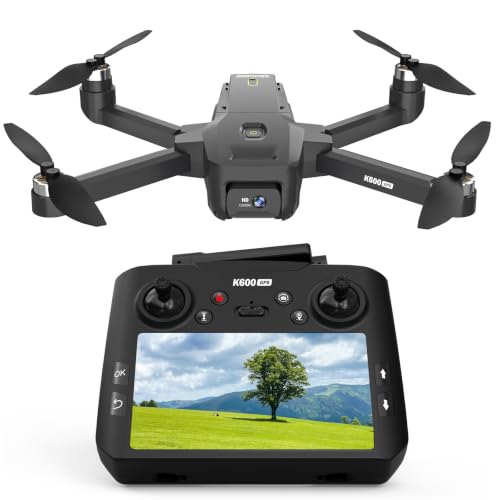
- 4.5-inch HD display built into the controller
- GPS positioning and return-to-home
- Follow Me and Circle Fly modes
- Foldable under-250g design
- 90-degree adjustable camera
Cons
- The screen is non-touch
- The camera claims are less specific than those of the DJI, Ruko, and Potensic
- GPS functions work best outdoors
Best for: beginners who want a live view without mounting or connecting a phone.
The TRINTON TECH K600GPS solves one of the most annoying parts of entry-level drone ownership: preparing a phone for every flight. Its controller has a built-in 4.5-inch non-touch HD display, so the pilot can see the live feed and flight information directly in the handset. That is a much cleaner experience than the Loiley, Hiturbo, or RELIDOL, all of which rely more heavily on a phone for camera viewing or extra functions.
The screen also supports storage to a 32GB SD card. The controller is not touch-operated, so flight inputs still come from the physical sticks and buttons. That is a good arrangement for a beginner who wants a clear image but does not want to steer through a phone screen. The camera has a 90-degree adjustable lens and is described as UHD, although the supplied data does not provide the same detailed capture figures as the 4K/30fps systems on the Potensic and Ruko.
GPS is the reason this model sits above the simple mini drones. The aircraft can fly up to a stated 3280 feet, and automatic return-to-home can be triggered by a button or low battery. Circle Fly and Follow Me add guided movement, while Indoor Mode offers a separate option for enclosed flying. New pilots should remember that GPS positioning is an outdoor advantage, not a substitute for an open, obstacle-free practice area.
The foldable construction and under-250g design make it travel-friendly. One-key takeoff and landing, altitude hold, headless mode, and three speed settings create a gentle set of controls for first sessions. The drone also supports 3D flips, which are entertaining once basic orientation is under control. Type-C charging for the modular battery is convenient, though the camera system still needs an SD card if the pilot wants to save footage.
The K600GPS is less camera-focused than the ATOM SE and less mechanically stable than the Ruko F11PRO 2. Its main advantage is the controller, and buyers should choose it for that directness rather than for professional image quality. The screen is non-touch, and some of the listing language is broad about video capability. For a learner who wants a self-contained flight setup with GPS assistance, it is a sensible middle ground.
5. karuisrc GPS Screen Drone: Best Tracking Modes

Pros
- 4.5-inch LCD screen on the controller
- GPS positioning and automatic return
- Follow Me, Waypoint, and Orbit modes
- Brushless motors
- Under-249g design
Cons
- Listed control distance is 400m
- The camera specifications are not very detailed
- Automated modes still need a clear, safe flight area
Best for: a beginner who wants to experiment with subject tracking and orbit shots.
The karuisrc GPS Screen Drone targets the beginner who is less interested in stunts and more interested in making the drone move around a person or landmark. Its 4.5-inch HD screen sits on the controller, keeping the live view available without a phone. That makes it similar in handling philosophy to the TRINTON TECH K600GPS, but the karuisrc puts more emphasis on Follow Me, Waypoint Navigation, and Orbit Mode.
GPS positioning supports automatic return and helps the drone hold its place outdoors. That is important when a first-time pilot wants to concentrate on framing rather than constantly correcting drift. The drone uses brushless motors, which are generally suited to a more capable outdoor platform than the small brushed-style flyers in this list. Its under-249g design also keeps it compact for travel.
The camera uses electronic image stabilization, and the supplied information describes its footage as suitable for aerial photography and content creation. It does not provide a concrete video frame rate or still-image resolution, so it should not be compared directly with the Potensic ATOM SE's 4K/30fps and 12MP figures. The 4.5-inch screen is useful for composing a shot, but the limited camera detail makes this a feature-led choice rather than a resolution-led one.
The stated mapping capability is 250m, with a 400m control distance. Those figures are more relevant to the way the drone is positioned in open space than to a beginner's first few flights. Follow Me and Orbit are attractive because they can create movement that is difficult to fly manually, but they require a clear area and a pilot ready to intervene. Automated flight should be treated as assistance, not permission to look away from the aircraft.
Compared with the TRINTON TECH K600GPS, the karuisrc has a stronger identity around tracking modes. Compared with the Potensic ATOM SE, it offers less camera detail and a shorter stated control distance, but its screen and guided flight options may suit a casual outdoor storyteller better. Its weakness is the thinness of the published camera information. Choose it if Follow Me and Orbit are the features you will actually use.
6. RELIDOL PK01: Best Screen-Equipped Starter

Pros
- Controller includes a live-view screen
- Brushless motors
- 1080P camera with 80-degree adjustment
- Two batteries provide about 25 minutes of flight
- Emergency stop and propeller guards
Cons
- An SD card is required to save photos and video
- GPS positioning is not listed
- Some features require the phone app
Best for: a first-time pilot who wants physical controls and a screen without moving to a GPS aircraft.
The RELIDOL PK01 is a straightforward bridge between toy drones and more advanced GPS models. Its controller has a built-in screen, so the pilot can see live HD footage and flight information without using a phone. That alone makes it less fussy than many entry-level flyers. The screen is not a replacement for GPS safety, but it gives a learner a direct way to frame the camera while learning the sticks.
The 1080P camera has an 80-degree adjustable lens, and the drone can also be controlled through the phone app. Gesture control can trigger photos and video, while the app adds waypoint flight, Circle Fly, rotation flight, and gravity sensing. Voice commands are available for tasks such as takeoff. Those extras are best treated as experiments after the pilot understands basic orientation, since managing an app and an aircraft at the same time can add confusion.
Brushless motors give the PK01 a sturdier foundation than the simplest mini drones. Two batteries are rated for approximately 25 minutes of combined flight, and the controller has its own built-in battery. Propeller guards, a child lock, low-power alarm, and emergency stop make the package feel deliberately designed around new pilots. The supplied guidance recommends beginning in a windless indoor area, below 6 meters and within 30 meters, which is a sensible way to keep early practice controlled.
The RELIDOL is more immediate than the Hiturbo 1080P Mini because its screen reduces dependence on a phone. The Hiturbo offers more playful controls, including gestures and voice control, but its camera view requires the app. RELIDOL also has brushless motors, though the Potensic ATOM SE remains the better outdoor choice because it adds GPS, return-to-home, longer listed flight time, and a more capable camera.
The central limitation is the absence of listed GPS positioning. A beginner must rely on direct control rather than automatic return, so open space and short flights matter. Saving images and videos also requires an SD card, which is not included. Pick the PK01 for screen-first simplicity and protected practice. Skip it if the main goal is long-range outdoor filming or automated recovery.
7. lanvansrc F417PRO: Best Compact Brushless Model

Pros
- LCD screen on the controller
- No phone needed for live viewing
- Brushless motor rated at 10000RPM
- 1080P adjustable camera
- Under-249g design and Type-C charging
Cons
- Camera quality is below the GPS camera drones
- No GPS return-to-home is listed
- The compact body is still vulnerable to wind
Best for: a beginner who wants direct, phone-free control in a small package.
The lanvansrc F417PRO focuses on removing setup friction. Its remote controller has an LCD screen, so the pilot can fly without connecting a phone. Type-C charging and support for up to 32GB of storage keep the routine familiar, and the under-249g design makes the drone easy to carry. It is a practical fit for a backyard session or a family trip where nobody wants to hand over a phone for the live view.
The adjustable 1080P camera can tilt through a 90-degree range. That is enough to teach the basic relationship between camera angle and the ground, though the supplied details do not identify electronic or mechanical stabilization. The listing also describes a night vision camera for low-light viewing, but beginners should not treat that as permission to fly at night without checking local rules and maintaining a safe, visible flight environment.
A brushless motor rated at 10000RPM gives the F417PRO a more substantial flight system than the Loiley and Hiturbo. One-key start, altitude hold, three speed settings, headless mode, and 3D flips cover the familiar beginner controls. The screen keeps those controls separate from the phone, which can make the first flights feel less distracting. It is still a manually flown drone, however, and the data does not list GPS or return-to-home.
That distinction matters beside the RELIDOL PK01. Both use a screen-equipped controller and offer 1080P cameras, but the F417PRO emphasizes a compact brushless design, while the RELIDOL lists propeller guards, an emergency stop, and app-based extra modes. The Potensic ATOM SE is a major step up for outdoor confidence because GPS can help with position and recovery. The F417PRO is better suited to someone who wants to learn hand-on control without immediately adding navigation systems.
Its weakness is the same quality that makes it portable. A lightweight aircraft can be easier to carry, but it is less reassuring when wind picks up. The camera is useful for casual aerial views rather than serious video work, and there is no listed automatic return. Choose the F417PRO for short, direct flights with a screen. Beginners planning to explore wide open areas should move up to a GPS model.
8. Loiley 2K Mini: Best Simple Mini Drone

Pros
- 2K camera with 90-degree adjustment
- Optical flow positioning and altitude hold
- Two batteries rated for about 26 minutes
- Folded size of 5 by 3 by 2 inches
- Propeller guards and spare blades included
Cons
- No GPS return-to-home is listed
- Phone connection is needed for the live camera view
- Not intended for demanding outdoor filming
Best for: someone learning basic drone control in calm conditions.
The Loiley 2K Mini is the least intimidating aircraft in the lineup. Folded dimensions are listed as 5 by 3 by 2 inches, and the lightweight body can disappear into a backpack. It is the sort of drone that makes sense for learning what the sticks do, practicing one-key takeoff and landing, and getting used to altitude without beginning with a more complex GPS platform.
Its 2K camera is a step above the 1080P systems on the Hiturbo, RELIDOL, and F417PRO. The lens adjusts through 90 degrees, and a connected smartphone provides the real-time view. The camera is suitable for casual photos and clips, but the supplied information does not list a frame rate, stabilization system, or storage arrangement. That makes it difficult to position as a serious aerial camera, even though the resolution is useful for basic experimentation.
Optical flow positioning works with altitude hold to keep the drone more settled than a completely unassisted toy flyer. Headless mode and gravity sensing simplify orientation, while speed adjustment lets a new pilot begin slowly. Two rechargeable batteries are rated for approximately 26 minutes of combined flight, with built-in overvoltage protection and a low-battery warning from the remote. Propeller guards and spare blades are welcome when early flights include a few inevitable bumps.
The Loiley is simpler than the TRINTON TECH K600GPS, karuisrc, and Potensic ATOM SE because it does not list GPS, return-to-home, Follow Me, or Waypoint Flight. It is also less screen-independent than the RELIDOL and F417PRO, since the camera view comes through a phone. Its strength is not advanced automation. It is the lower mental load of a compact aircraft with enough assistance to make controlled practice possible.
The real limitation is outdoor confidence. A small, light drone can be affected by wind, and optical flow positioning is not a substitute for GPS when the aircraft is farther away. Start in a calm, open area and keep the first sessions short. The Loiley is the right pick for basic learning, indoor practice where appropriate, and casual family use. Pilots who already know they want autonomous flight or stabilized landscape footage should skip it.
9. Hiturbo 1080P Mini: Best for Playful Flying

Pros
- 1080P camera with manual angle adjustment
- Two batteries rated for about 24 minutes total
- Voice control and gesture selfies
- Altitude hold, headless mode, and 3D flips
- Foldable body
Cons
- Camera capture requires the Hiturbo FPV app
- No GPS return-to-home is listed
- Each battery is rated for about 12 minutes
Best for: beginners who care more about fun controls than advanced navigation.
The Hiturbo 1080P Mini treats flying as a playful activity first and a camera task second. It folds down to a compact 5.5 by 3.3 by 2-inch form, and its controls include voice commands, gesture selfies, one-key takeoff and landing, and 3D flips. That feature mix is more likely to entertain a family than a barebones aircraft with only basic directional control.
The camera is 1080P and can be adjusted manually to look forward or downward. To view or capture photos and video, the pilot must connect through Wi-Fi and the Hiturbo FPV app. The app also provides trajectory flight and other controls under its control switch. This arrangement gives the Hiturbo more flexibility than its physical remote suggests, but it also adds a setup step that the RELIDOL PK01 and F417PRO avoid with their built-in screens.
Two rechargeable batteries provide approximately 24 minutes of flying, with each rated for about 12 minutes. Faster speeds and repeated flips reduce that time, so the second battery matters if the purpose is active practice rather than a quick hover. Altitude hold and headless mode make the aircraft easier to understand, while the instructions recommend calibrating the gyroscope after powering on and after a crash. That calibration is quick, but it is part of the ownership routine.
The Hiturbo is a more playful alternative to the Loiley 2K Mini. Loiley has a higher listed camera resolution and optical flow positioning, while Hiturbo offers more attention-grabbing controls. Neither lists GPS or automatic return-to-home, and neither should be the first choice for distant outdoor flights. The Potensic ATOM SE is much better once position holding, recovery, and longer sessions become priorities.
The camera and app are the Hiturbo's main constraints. The 1080P image is suited to casual clips, not carefully stabilized landscape footage, and voice control or trajectory flight cannot replace a pilot watching the aircraft. New users should follow the supplied guidance to begin in a calm area and complete calibration before takeoff. Choose the Hiturbo for flips, gestures, and family fun, not for a long-term aerial photography platform.
How to choose best beginner drones
The right first drone depends on how much assistance you want during flight and how seriously you take the camera. These are the traits that separate a forgiving trainer from a model that will keep serving you as your skills improve.
Flight assistance
Altitude hold keeps the drone from constantly rising or sinking while the pilot concentrates on horizontal movement. Optical flow can improve indoor or low-altitude stability, as on the Loiley, while GPS gives more dependable outdoor positioning on the Potensic, Ruko, TRINTON TECH, and karuisrc models.
Beginner Mode and adjustable speed settings are useful when the controls feel sensitive. Headless mode can simplify orientation, but learning the drone's actual front and rear is a better long-term skill. Look for one-key takeoff and landing when you want a calmer first launch.
A beginner drone should make recovery easier, not encourage you to fly farther than you can safely see.
GPS and return-to-home
GPS allows a drone to hold position outdoors and can support return-to-home after signal loss or low battery. Potensic ATOM SE, Ruko F11PRO 2, TRINTON TECH K600GPS, and karuisrc provide this kind of assistance. The DJI Mini 5 Pro adds a more advanced sensing system and return-to-home support.
The Loiley, Hiturbo, RELIDOL, and F417PRO do not list GPS return-to-home. That does not make them unusable, but it means the pilot must maintain closer control and choose a more forgiving practice area. A GPS system is especially useful when the aircraft is flown outdoors around changing wind conditions.
Camera stabilization and resolution
Resolution affects how much detail the camera can capture, but it is not the only camera consideration. The Potensic ATOM SE combines 4K/30fps capture with electronic stabilization, while the Ruko F11PRO 2 uses a three-axis mechanical gimbal for smoother footage. The DJI Mini 5 Pro goes further with a 1-inch CMOS sensor, 4K/60fps HDR, and a flexible gimbal.
The smaller drones provide 1080P or 2K cameras with adjustable angles. Those cameras can be useful for learning framing and recording casual clips, but the supplied details do not promise the same stabilization or editing flexibility. If aerial video is the reason for buying, consider which camera features matter for outdoor footage before choosing by resolution alone.
Controller display
A built-in screen changes how quickly a drone can be ready to fly. RELIDOL, F417PRO, TRINTON TECH, karuisrc, and DJI provide a controller display, while the Loiley, Hiturbo, Potensic, and Ruko use a phone-based view or phone connection as part of the camera workflow.
A physical screen is useful when the phone is needed for navigation, when battery life is limited, or when a child and adult are sharing the controls. A phone-based system can be perfectly workable, but it adds app permissions, Wi-Fi pairing, cable placement, and compatibility checks.
Battery and portability
Two batteries make a bigger difference than a headline flight-time claim. Potensic lists up to 62 minutes across two batteries, Ruko lists 70 minutes, and the smaller Loiley, Hiturbo, and RELIDOL models list approximately 26, 24, and 25 minutes respectively. Conditions, wind, speed, and camera use affect actual results.
Foldable, under-249g designs are easier to carry and often less stressful for short practice sessions. The DJI Mini 5 Pro is listed at approximately 249.9g with a stated variation, so local regulations should be checked. Portability is useful, but it should not outweigh the safety features and control system you will rely on outdoors.
Frequently asked questions
Are GPS drones easier for beginners?
GPS drones usually make outdoor learning easier because they can hold position and support return-to-home. They still require careful setup and active supervision, but the pilot has more assistance than with a small drone that depends only on manual control. Potensic ATOM SE is a strong example of a GPS model with Beginner Mode.
Is a built-in controller screen better than using a phone?
A built-in screen is simpler when you want to fly without installing an app or using your phone for the live view. It also leaves your phone available for calls, navigation, or recording notes. Phone-based controllers can offer more app features, so the better arrangement depends on whether convenience or software control matters more to you.
What is the easiest drone to fly in this roundup?
The Loiley 2K Mini is among the simplest because it combines one-key takeoff and landing, altitude hold, headless mode, and optical flow positioning. The Hiturbo 1080P Mini is also approachable, with a similar set of assisted controls. Neither has the GPS recovery features of the Potensic ATOM SE.
Do beginner drones need a camera?
No. A camera is useful for learning framing and seeing a live view, but it is not necessary to learn hovering, turning, or landing. In this roundup, the camera is included on every model, though the quality and viewing method vary considerably.
Is a three-axis gimbal important for a beginner?
A three-axis gimbal is important when smooth video is a major reason for buying the drone. It physically stabilizes the camera and helps reduce shakes during movement. It is less important if the drone will mainly be used for short practice flights, flips, and casual clips.
Can these drones be flown indoors?
Small models such as the Loiley, Hiturbo, RELIDOL, and F417PRO are more suitable for controlled indoor practice than larger GPS aircraft, but an indoor flight still needs clear space. The TRINTON TECH K600GPS specifically lists an Indoor Mode. Remove fragile objects, keep people and pets away from the flight path, and start at low altitude.
Should a first-time pilot choose the DJI Mini 5 Pro?
Choose it if you want to learn on a powerful camera platform with obstacle sensing, tracking, and advanced video features. It is more complex than the Loiley or Hiturbo, but the extra capability can prevent an early upgrade. If you only want to learn basic flight, the Potensic ATOM SE is a less complicated starting point.
The bottom line
The Best beginner drones are not all trying to do the same job. The Potensic ATOM SE is the strongest all-round recommendation because GPS, return-to-home, Beginner Mode, 4K EIS video, a foldable under-249g body, and two batteries give a new pilot useful assistance without boxing them into toy-level flying.
For the best camera, choose the DJI Mini 5 Pro. Its 1-inch CMOS sensor, 4K/60fps HDR video, flexible gimbal, obstacle sensing, and ActiveTrack 360° system make it the model most likely to remain satisfying after the first few flights. The Ruko F11PRO 2 is the better alternative when a three-axis mechanical gimbal and extended listed flight time matter more than compact portability.
If you are undecided, choose the Potensic ATOM SE for the clearest path from first hover to confident outdoor filming.
As an Amazon Associate we earn from qualifying purchases.