

A dead zone in the bedroom, a video call that freezes in the kitchen, or a streaming box that keeps dropping off the network usually points to a coverage problem, not a lack of bandwidth. The right router or mesh system can make the whole house feel like one network instead of a collection of weak signals.
We compared ten home networking products, from WiFi 7 mesh systems to a simple plug-in extender. The Best home wifi pick for most larger homes is the TP-Link Deco X55, while the list also includes strong choices for multi-gig connections, smaller homes, older devices, and single-room coverage.
Our top pick is the TP-Link Deco X55, with options ranging from a basic router to a high-capacity tri-band mesh system.
Comparison table
| # | Product | Award | WiFi and coverage | Wired connectivity | Best for |
|---|---|---|---|---|---|
| 1 | TP-Link Deco X55 | Best overall | WiFi 6, up to 6, 500 sq. ft. | Three Gigabit ports per unit | Large homes needing dependable mesh coverage |
| 2 | TP-Link Archer BE400 | Best single router | WiFi 7, up to 2, 400 sq. ft. | Two 2.5Gbps ports, three Gigabit ports | WiFi 7 devices and multi-gig internet |
| 3 | TP-Link Deco S4 | Best simple mesh | WiFi 5, up to 5, 500 sq. ft. | Two Gigabit ports per unit | Straightforward whole-home coverage |
| 4 | Amazon eero 6 | Best for easy setup | WiFi 6, up to 4, 500 sq. ft. | Not specified | App-led setup and Alexa homes |
| 5 | TP-Link Deco 7 | Best WiFi 7 mesh | WiFi 7, up to 6, 600 sq. ft. | 2.5Gbps Ethernet | Large homes with newer devices |
| 6 | NETGEAR Orbi 370 | Best compact WiFi 7 mesh | WiFi 7, up to 6, 000 sq. ft. | Not specified | Compact units and steady roaming |
| 7 | TP-Link RE315 | Best extender | WiFi 5, up to 1, 500 sq. ft. | One Ethernet port | Fixing one stubborn dead zone |
| 8 | TP-Link Deco 7 Pro | Best for power users | Tri-band WiFi 7, up to 7, 600 sq. ft. | Four 2.5Gbps ports per unit | Very fast networks with many devices |
| 9 | Google Nest Wifi Pro | Best for Google homes | WiFi 6E, up to 6, 600 sq. ft. | Not specified | Google smart-home households |
| 10 | TP-Link Archer AX21 | Best basic router | WiFi 6, 1.8Gbps total bandwidth | Not specified | Apartments and modest homes |
1. TP-Link Deco X55: Best Overall

Pros
- Covers up to 6, 500 square feet
- WiFi 6 capacity for up to 150 devices
- Three Gigabit Ethernet ports on every unit
- Supports wired Ethernet backhaul
- Useful security and parental-control features
Cons
- WiFi 6 rather than WiFi 7
- Requires a separate modem for most providers
- Three units can be more hardware than a small home needs
Best for: large homes that need stable roaming, broad coverage, and plenty of wired connections.
The TP-Link Deco X55 is the set we would choose first for a typical large home. Its three matching units create a single network, so phones and laptops can move between rooms without the awkward network switching associated with traditional extenders. The Deco app handles setup and lets you manage the network when you are away.
The important figure here is the claimed 6, 500 square feet of coverage. That does not guarantee the same performance through dense walls or across multiple floors, but it gives the X55 plenty of room to spread nodes sensibly instead of placing them right beside the dead zone. WiFi 6 supports up to 150 connected devices, which gives a busy household more breathing room for cameras, televisions, consoles, and smart-home products.
Each unit has three Gigabit Ethernet ports. That is unusually useful in a mesh kit because a satellite can serve wired devices without needing a separate switch. Ethernet backhaul is supported too, letting you connect the units by cable and reserve wireless capacity for client devices. HomeShield adds basic network security, quality-of-service controls, and parental controls, while the system also supports VPN clients and servers.
The TP-Link Deco 7 reaches newer WiFi 7 speeds, and the Deco 7 Pro is the more serious option for multi-gig wired networks. The X55 remains easier to recommend when broad coverage and sensible connectivity matter more than having the newest wireless standard. Its weakness is that a WiFi 6 system cannot take full advantage of the latest WiFi 7 clients, and Gigabit Ethernet limits wired throughput. Readers working with a very fast internet connection should consider how many wired ports a home network really needs before choosing.
The X55 is right for families, remote workers, and anyone replacing a router plus a troublesome extender setup. It is the balanced choice because it solves coverage first without leaving you short of ports.
2. TP-Link Archer BE400: Best Single Router

Pros
- WiFi 7 with Multi-Link Operation
- Up to 6.5Gbps combined wireless bandwidth
- Two 2.5Gbps Ethernet ports
- Supports up to 90 devices
- EasyMesh expansion support
Cons
- Covers less area than the leading mesh systems
- Dual-band design has no dedicated third band
- A separate modem is required for most internet providers
Best for: households that want a modern single router for newer WiFi 7 devices.
The TP-Link Archer BE400 makes sense when the router can sit near the middle of the home and you want WiFi 7 without moving to a multi-unit system. It has a tall, narrow body that takes less shelf depth than the wide antennas of the Archer AX21, and the Tether app or web interface keeps setup familiar.
Its six-stream, dual-band design combines up to 5, 764Mbps on 5GHz with up to 688Mbps on 2.4GHz. Those are theoretical link rates, not guaranteed internet speeds, but the extra capacity helps newer laptops and phones handle demanding transfers while older smart-home devices stay on 2.4GHz. Multi-Link Operation can move traffic across bands for better throughput, lower latency, and improved reliability on compatible clients.
The wired side is stronger than the usual home router. There is one 2.5Gbps WAN/LAN port, one 2.5Gbps LAN port, and three Gigabit LAN ports. That gives this model a practical route into a multi-gig setup, especially if the modem and client hardware support those speeds. Beamforming and six antennas are intended to strengthen connections across its claimed 2, 400 square feet.
The Archer BE400 is a better single-router choice than the TP-Link Archer AX21 for WiFi 7 phones and laptops, while the Deco X55 is the better answer for a sprawling floor plan. Its main weakness is coverage. A router with excellent throughput still cannot bend radio signals around every wall, and dual-band mesh expansion through EasyMesh is not as straightforward as starting with a matched three-pack.
Buy it for a central router position, a reasonably open layout, and newer devices that can use WiFi 7 features. Skip it if the far end of the house already has a dead zone.
3. TP-Link Deco S4: Best Simple Mesh

Pros
- Three units cover up to 5, 500 square feet
- Single network name across the home
- Supports up to 100 devices
- Wired Ethernet backhaul
- Alexa support for guest WiFi controls
Cons
- Uses older WiFi 5 technology
- Two Gigabit ports per unit
- Less wireless headroom than the WiFi 6 and WiFi 7 picks
Best for: homes that need broad, uncomplicated coverage more than cutting-edge wireless performance.
The TP-Link Deco S4 is an uncomplicated mesh kit that still gets the central job right: it puts a matching access point closer to the rooms where the main router struggles. The three units share one network name and password, and devices can move between them without the separate-network hassle of a basic extender.
It uses three-stream AC1900 WiFi 5 with a claimed capacity for up to 100 devices. That is enough for ordinary streaming, browsing, smart speakers, and video calls, but it gives the S4 less room for simultaneous heavy transfers than the WiFi 6 Deco X55. Its coverage claim reaches 5, 500 square feet, making placement more important than the headline number. Keep the middle unit where it can still receive a healthy signal from the main unit.
Every S4 has two Gigabit Ethernet ports, and the system supports wired backhaul. That is valuable in homes with Ethernet already installed because a cable between nodes avoids using wireless capacity for the link between rooms. The Deco app guides setup, while Alexa can turn guest WiFi on or off by voice.
The S4 is easier to place than a single powerful router, but its older WiFi 5 standard makes it less suitable for a crowded modern home than the eero 6 or X55. It also has fewer ports per unit than the X55. For readers comparing older and newer systems, the difference between a single router and several connected access points is the key decision, not the model number.
Choose the Deco S4 for a straightforward network in a medium or large home with ordinary client devices. Skip it if you are building around newer WiFi 7 hardware or regularly move large files over WiFi.
4. Amazon eero 6: Best for Easy Setup

Pros
- Simple app-guided installation
- WiFi 6 supports 75 or more devices
- Covers up to 4, 500 square feet
- Automatic updates
- Built-in Zigbee smart-home hub
Cons
- Intended for internet plans up to 500Mbps
- The product description does not specify port details
- Less configurable than enthusiast-focused routers
Best for: households that want a mesh network managed primarily from a phone.
The Amazon eero 6 is built around reducing the number of decisions during setup. The app walks through the installation, network management is available from anywhere, and automatic updates handle much of the maintenance. For a household that does not want to tune channels or dig through router menus, that is the main attraction.
The three-pack combines one router with two extenders and covers up to 4, 500 square feet. Eero specifies support for internet plans up to 500Mbps and more than 75 connected devices. Those limits make the intended use clear: it is aimed at a connected family home with streaming, video calls, smart speakers, and ordinary browsing, rather than a multi-gig workstation or home server.
WiFi 6 brings better handling of many simultaneous clients than older WiFi generations. The system can also act as a Zigbee smart-home hub, which is useful if Alexa is already central to the household. Cross-compatible eero hardware provides a path to expansion, although adding nodes does not fix poor placement. The system needs a modem for most internet service arrangements.
The eero 6 is simpler to live with than the TP-Link Deco S4 and more modern than that WiFi 5 system. The Deco X55 gives a larger claimed coverage area and more explicit wired connectivity, while eero's advantage is the polished, low-friction management experience. Its weakness is the stated 500Mbps plan limit and a comparatively restrained feature set for advanced users.
Choose eero 6 when ease matters more than deep control. It is a particularly sensible fit for a home already using Alexa devices and for anyone who wants the app to explain what needs attention.
5. TP-Link Deco 7: Best WiFi 7 Mesh

Pros
- WiFi 7 with four streams
- Covers up to 6, 600 square feet
- Supports more than 150 devices
- 2.5Gbps Ethernet
- Wired and wireless backhaul support
Cons
- Dual-band design lacks a dedicated third band
- WiFi 7 benefits depend on compatible clients
- Requires a separate modem
Best for: larger homes ready to move from WiFi 6 to WiFi 7 mesh.
The TP-Link Deco 7 is the natural step up from the X55 for buyers who want a current wireless standard across a whole home. Its three-unit system creates one Deco network, and the app handles setup, firmware updates, and management without requiring a networking background.
The four-stream BE5000 design combines up to 4, 324Mbps on 5GHz and 688Mbps on 2.4GHz. Those figures are most relevant to local wireless traffic and compatible devices, not a promise that an internet plan will run at those rates. The system is rated for more than 150 devices and up to 6, 600 square feet, which gives it strong capacity for a busy home with several active rooms.
A 2.5Gbps Ethernet connection helps prevent the wired side from becoming the immediate bottleneck. The Deco 7 can use wired and wireless backhaul at the same time, balancing traffic between nodes. That matters when satellites are separated by thick walls, or when a home has Ethernet available in more than one room. HomeShield supplies basic security and parental-control functions, and VPN client and server support adds flexibility.
The Deco 7 has a larger coverage claim and newer wireless features than the Deco S4, while the Deco 7 Pro adds a third band and much faster wired connections. The Archer BE400 can be faster in one central location, but it does not offer the same three-node coverage. This model's weakness is the dual-band layout, since a mesh system with no dedicated third band has less separate radio capacity for node-to-node traffic.
It is the right upgrade for a large home with WiFi 7 phones, laptops, or streaming hardware. If most devices are older and the main concern is dead zones rather than local network speed, the Deco X55 is the more balanced pick.
6. NETGEAR Orbi 370: Best Compact WiFi 7 Mesh

Pros
- WiFi 7 for current and future devices
- Covers up to 6, 000 square feet
- Enhanced backhaul for steadier roaming
- Supports up to 70 devices
- Compact units with app-guided setup
Cons
- Device capacity is lower than the Deco X55 and Deco 7
- Wired port details are not specified
- Security service starts with a 30-day trial
Best for: households that want compact mesh units and simple WiFi 7 management.
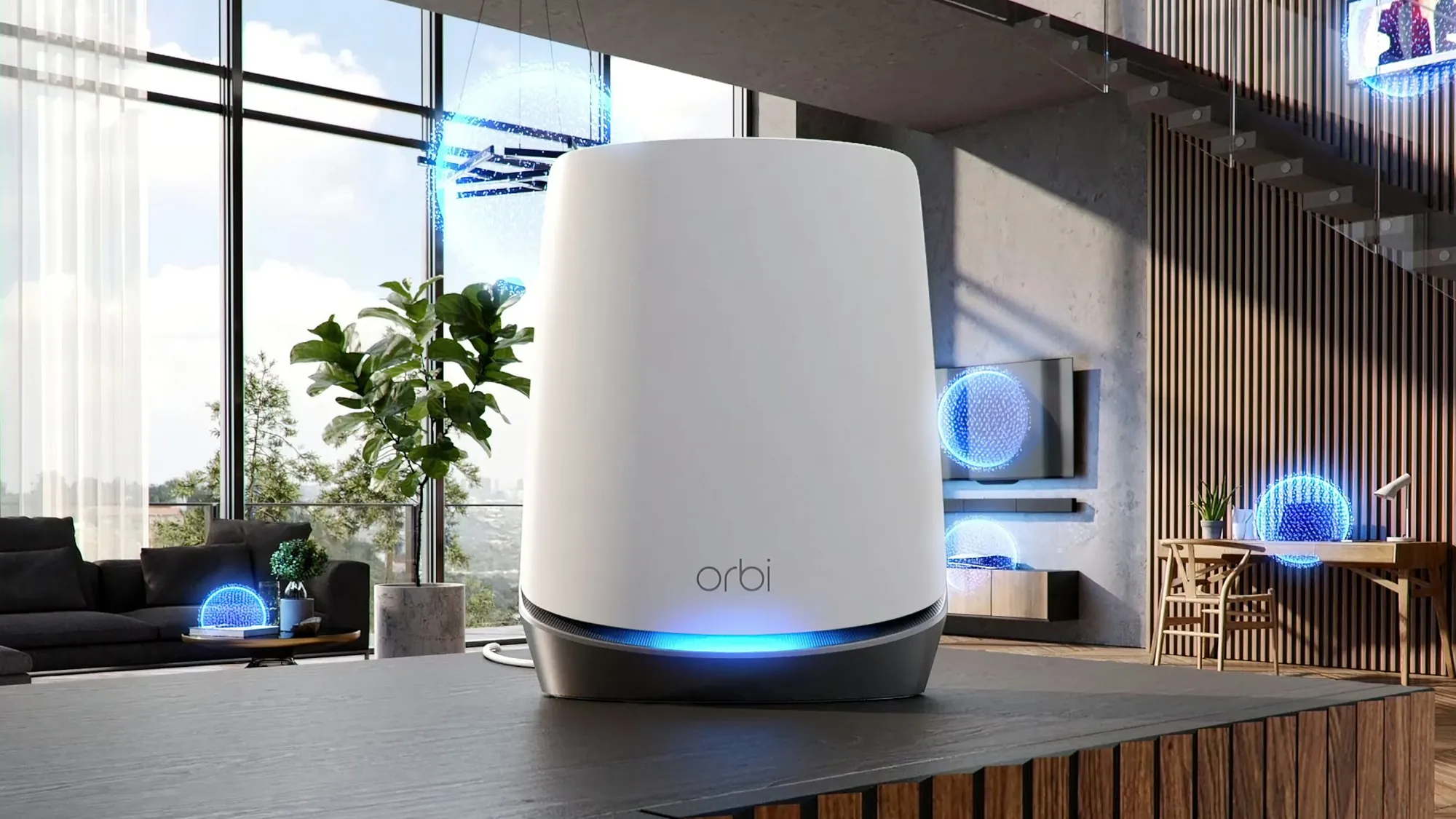
The NETGEAR Orbi 370 takes a clean, compact approach to WiFi 7 mesh. The three-pack is designed to cover up to 6, 000 square feet, and the units are meant to sit neatly on shelves rather than dominate the room. The Orbi app guides setup and provides remote management.
It uses dual-band BE5000 WiFi 7 and is rated for up to 70 devices. That is enough for many households, but it gives the Orbi 370 a narrower capacity brief than the Deco X55's 150-device claim or the Deco 7's support for more than 150 devices. Enhanced backhaul is the more important detail for many homes because it is intended to keep video calls, browsing, and streaming stable as devices move between nodes.
NETGEAR says the system works with cable and fiber providers and can replace an existing router. A satellite can be added to extend coverage by around 2, 000 square feet. The included NETGEAR Armor security feature starts with a 30-day trial, so buyers should pay attention to what protection remains available after that period rather than assuming every security feature is permanent.
The Orbi 370 is a tidier alternative to the larger-looking TP-Link systems, and its WiFi 7 standard puts it ahead of the eero 6 for newer clients. The Deco 7 offers a higher stated device capacity and more detailed wired-backhaul options. Orbi's weakness is the limited capacity claim and unspecified port layout, which makes it harder to recommend for a home built around wired workstations or storage.
Choose it when compact hardware, roaming stability, and a guided app are the priorities. It is less compelling for a very dense smart home or a network where wired connectivity matters as much as wireless coverage.
7. TP-Link RE315: Best Extender

Pros
- Extends coverage by up to 1, 500 square feet
- Dual-band AC1200 wireless
- Supports up to 32 devices
- One Ethernet port for a wired device
- EasyMesh compatibility
Cons
- Extenders improve coverage, not the underlying internet speed
- Not compatible with Deco mesh systems
- One Ethernet port limits wired expansion
Best for: fixing one isolated weak-signal area without replacing the existing router.
The TP-Link RE315 is the outlier in this group because it is an extender rather than a complete router or mesh kit. That is exactly why it can be the right answer for a home where the main network works well everywhere except one bedroom, garage, or upstairs corner.
Its AC1200 dual-band connection combines up to 867Mbps on 5GHz and 300Mbps on 2.4GHz, with coverage listed at up to 1, 500 square feet and support for up to 32 devices. The two adjustable external antennas help with placement, and the intelligent signal indicator in the Tether app can show whether the extender is too far from the existing router.
The single Ethernet port allows a television, game console, or desktop computer to use a wired connection near the extender. EasyMesh compatibility can provide a more unified experience when paired with a compatible router, but this model is not compatible with TP-Link Deco mesh systems. That distinction is important. A Deco owner cannot simply add the RE315 as another Deco node.
The RE315 does not create extra internet bandwidth. It repeats the existing connection, and throughput can fall when the extender has to receive and retransmit traffic wirelessly. A properly placed mesh node is usually the cleaner solution for several dead zones, while this unit is easier to justify for one troublesome room. Readers choosing between the two should consider where an extender can actually improve a weak signal before buying.
Choose the RE315 when the current router is otherwise satisfactory and the problem is local. Skip it for a large multi-floor home, a crowded network, or a Deco system that needs compatible satellites.
8. TP-Link Deco 7 Pro: Best for Power Users
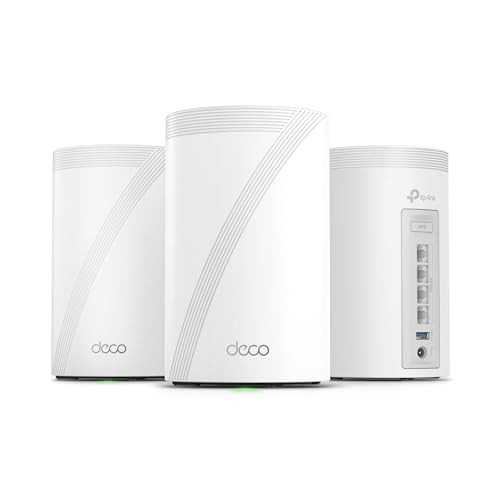
Pros
- Tri-band WiFi 7 with six streams
- Covers up to 7, 600 square feet
- Supports more than 200 devices
- Four 2.5Gbps ports per unit
- 10Gbps WAN/LAN support and USB 3.0
Cons
- More capability than most homes need
- Larger and heavier units than simpler systems
- Requires a separate modem for most providers
Best for: demanding homes with many devices, fast local transfers, and multi-gig networking.
The TP-Link Deco 7 Pro is the system to buy when the network itself is a serious part of the home. It is not merely a coverage kit. It is built around tri-band WiFi 7, multi-gig wired connections, and enough capacity for a large number of simultaneous clients.
The six-stream BE10000 layout provides up to 5, 188Mbps on 6GHz, 4, 324Mbps on 5GHz, and 574Mbps on 2.4GHz. The third band gives the system more room to separate client traffic and mesh backhaul than the dual-band Deco 7. TP-Link rates the three-pack for up to 7, 600 square feet and more than 200 devices, although wall materials and node placement still determine real coverage.
Wired connectivity is the standout feature. Each unit has four 2.5Gbps WAN/LAN ports, and the system includes a USB 3.0 port. TP-Link also describes a future-ready 10G WAN/LAN connection and simultaneous wired and wireless backhaul. That makes the Pro a better fit than the Deco X55 or Deco 7 for a home with multi-gig internet, wired desktops, network storage, or several high-bandwidth access points.
The Deco 7 Pro has a stronger hardware brief than every other mesh system here, but that does not automatically make it the right purchase. The Deco 7 is simpler and less demanding, while the Orbi 370 is more compact. The Pro's weakness is its excess: if the home has ordinary internet service and mostly phones, televisions, and smart speakers, much of its capacity will sit unused. The larger units also need more deliberate shelf placement.
Buy it for a large, device-heavy home where wired infrastructure and local network performance matter. It is the enthusiast pick, not the default pick.
9. Google Nest Wifi Pro: Best for Google Homes

Pros
- Three-band WiFi 6E
- Claimed coverage up to 6, 600 square feet
- Automatic performance adjustments
- Self-diagnosis for some network issues
- Strong Google Home management features
Cons
- Not compatible with earlier Google Wifi or Nest Wifi generations
- WiFi 6E rather than WiFi 7
- Wired port details are not specified
Best for: households already using Google Home and wanting a managed three-band mesh system.
The Google Nest Wifi Pro is the most natural fit for a Google-centered smart home. Its three-router pack uses one network across the house, and Google says the system can adjust network performance and activity automatically. That hands-off approach is useful for households that would rather see a clear diagnosis than manage a long list of wireless settings.
WiFi 6E adds a third 6GHz band alongside 2.4GHz and 5GHz. The 6GHz band can provide a cleaner path for compatible newer devices, while older products continue using the other bands. Google claims up to 6, 600 square feet of coverage with three units and says the system can prioritize video calls and help maintain a consistent connection near the edge of coverage.
The management features are unusually approachable. Nest Wifi Pro can show connected devices, pause unknown devices, create a separate guest network, monitor itself, and fix some common issues automatically. Secure booting and software updates add protection against unauthorized router software. The main compatibility catch is significant: it cannot join earlier Google Wifi or Nest Wifi generations.
The Nest Wifi Pro offers a more polished smart-home experience than the TP-Link systems, but the Deco 7 and Deco 7 Pro are stronger choices for WiFi 7 hardware and multi-gig networking. Google also does not specify the wired port details in the provided product information, which makes it less attractive for a wired-first home. Its weakness is that the Google ecosystem matters here, and owners of older Google mesh gear cannot mix generations.
Choose it when Google Home is already the household's control center. For a mixed-brand home focused on raw network flexibility, the Deco X55 or Deco 7 is easier to recommend.
10. TP-Link Archer AX21: Best Basic Router

Pros
- WiFi 6 with OFDMA
- Up to 1.8Gbps combined wireless bandwidth
- Four high-gain antennas
- Beamforming and front-end module
- OpenVPN and PPTP VPN server support
Cons
- Single-router coverage cannot match a mesh system
- No 6GHz band
- Requires a separate modem
Best for: apartments and smaller homes that need a conventional WiFi 6 router.
The TP-Link Archer AX21 is a conventional router for a conventional layout. It is a better fit for an apartment or modest home than for a long house with multiple floors, where a mesh system can put wireless coverage closer to the devices that need it.
Its dual-band WiFi 6 hardware is rated at up to 1, 200Mbps on 5GHz and 574Mbps on 2.4GHz, for 1.8Gbps of combined bandwidth. OFDMA helps the router communicate with more devices at once, while four high-gain antennas, beamforming, and a front-end module are intended to focus signal toward distant clients. As with every router in this list, walls, distance, and the client device influence the result.
The AX21 also supports OpenVPN and PPTP VPN servers, which gives it a useful feature for remote access. It works with major internet providers, but most setups still require a separate modem. The router does not support the 6GHz band, so it cannot provide the newer spectrum available from the Google Nest Wifi Pro or the WiFi 7 models.
The Archer AX21 is more capable than a basic older router and less complicated than any multi-unit system here. The Archer BE400 is the better single-router choice for WiFi 7 clients and multi-gig wired connections, while the Deco X55 is better when coverage is the problem. The AX21's weakness is simple: one box cannot always cover a difficult floor plan, no matter how good its antennas are.
Choose it for a smaller space with a central router position and ordinary WiFi 6 devices. If the far rooms already have weak coverage, start with mesh instead.

How to choose best home wifi
The right system depends on the shape of the home, the number of connected devices, and whether your network needs to support current WiFi 7 hardware or simply eliminate dead zones.
Coverage and layout
Coverage claims are useful for comparing systems, but they are not guarantees through concrete, brick, floors, or foil-backed insulation. A three-unit mesh system such as the Deco X55, Deco 7, or Deco 7 Pro can place access points around the home, while a single router such as the Archer AX21 works best when it can sit near the center.
A good mesh node needs to receive a strong signal from the previous node. Placing a satellite inside the dead zone usually produces a larger dead zone with a new name. Start with a central location, then move nodes toward the weak room while keeping them within reliable wireless range.
WiFi generation
WiFi 5 remains adequate for ordinary browsing and streaming, but WiFi 6 handles busy networks more efficiently. WiFi 6E adds the 6GHz band, and WiFi 7 introduces features such as Multi-Link Operation and 4K-QAM for compatible devices.
The benefit of WiFi 7 is greatest when the home has newer phones, laptops, access points, or local transfers that can use it. Older devices still connect, but they do not gain every feature. The WiFi 6 Deco X55 is often a better-balanced choice than paying for capability that no client can use.
A newer WiFi label cannot repair a badly placed node or a signal blocked by several dense walls.
Backhaul
Backhaul is the connection between mesh units. Wireless backhaul is easier to install, but it shares radio capacity with phones, televisions, and computers. Ethernet backhaul uses existing cable to create a more stable link and can make a large difference in a home with wired rooms.
The Deco X55 supports wired Ethernet backhaul, as do the Deco S4, Deco 7, and Deco 7 Pro. The Deco 7 and Deco 7 Pro also combine wired and wireless backhaul. Look for this feature if the home already has Ethernet outlets or if the nodes will be separated by difficult construction.
Device capacity
A home with a few phones and televisions has different needs from one with cameras, smart bulbs, speakers, tablets, consoles, and work computers. The eero 6 is specified for more than 75 devices, the Archer BE400 for up to 90, and the Deco X55 for up to 150. The Deco 7 Pro is rated for more than 200.
These numbers describe capacity rather than guaranteed speed. A system with more streams and a third band generally has more room for simultaneous activity, but placement and interference still matter. Count devices that are connected even when they are not actively streaming.
Wired ports
Ports matter for desktop computers, televisions, game consoles, network storage, and wired mesh backhaul. The Deco X55 provides three Gigabit ports per unit, while the Deco S4 provides two. The Archer BE400 adds two 2.5Gbps ports and three Gigabit ports, and the Deco 7 Pro has four 2.5Gbps ports per unit.
A Gigabit port is sufficient for many home connections. A 2.5Gbps or faster port becomes more useful with multi-gig internet, fast local storage, or several wired devices transferring data at once.
Frequently asked questions
Is a mesh system better than a single router?
A mesh system is usually better for a large, long, or multi-floor home because it places multiple access points around the building. A single router is simpler and can be faster near the router when the home is compact. The deciding factor is usually layout rather than the number printed on the box.
Do WiFi extenders increase internet speed?
No. An extender improves the reach of an existing network, but it does not increase the speed supplied by the internet connection. Wireless repeating can also reduce throughput, so an extender is best for a single weak area rather than a home with widespread coverage problems.
Can the TP-Link RE315 work with a Deco system?
The product information says the RE315 is not compatible with mesh WiFi systems such as Deco. It can work with compatible EasyMesh routers, but Deco uses its own mesh family. A Deco owner should add a compatible Deco unit instead.
Do WiFi 7 routers work with older devices?
Yes. WiFi 7 routers support older WiFi generations, so existing phones, televisions, and smart-home devices can still connect. They will use the capabilities of their own WiFi hardware, which means an older device will not gain every WiFi 7 feature.
Do mesh systems require a modem?
Most of the routers and mesh systems here require a separate modem for typical internet service. The modem connects the home to the provider, while the router or mesh system distributes that connection locally. Check the requirements of the provider before replacing existing equipment.
Is wired backhaul worth using?
Wired backhaul is useful when Ethernet can connect the mesh units. It prevents the node-to-node connection from competing with wireless client traffic and can improve stability through difficult layouts. Wireless backhaul is more convenient, but placement becomes especially important.
Which system is best for many smart-home devices?
Look for a system with strong device capacity and effective management tools. The Deco X55, Deco 7, Deco 7 Pro, and eero 6 all list support for substantial numbers of connected devices. The best choice depends on whether you also need WiFi 7, a third band, or Alexa and Google Home integration.
The bottom line
The Best home wifi choice for most large households is the TP-Link Deco X55. It combines broad claimed coverage, WiFi 6 capacity, three Ethernet ports per unit, wired backhaul, and useful management features without forcing every buyer into the complexity of a high-end network.
For newer devices and larger wireless demands, the TP-Link Deco 7 is the better WiFi 7 mesh option, while the TP-Link Deco 7 Pro is the pick for multi-gig wired networks and more than 200 connected devices. Smaller homes should look at the TP-Link Archer AX21, and a single troublesome room may only need the TP-Link RE315.
If you are undecided, choose the Deco X55 unless your home specifically needs WiFi 7 or a wired network faster than Gigabit Ethernet.
As an Amazon Associate we earn from qualifying purchases.