
You might already know that Windows 11 runs best on hardware built for it. But "best" is relative: a student hopping between campus Wi‑Fi and a dorm desk has different needs from a remote worker tethered to a docking station. After sorting through dozens of current models, we've picked eight that span that range honestly. Some are surprisingly capable at a low entry point; others earn their place with genuine desktop‑replacement muscle. None of them are a waste of your time.
The best laptop for Windows 11 right now, for most people, is the Lenovo V15 Gen 4. It combines an Intel Core i5‑13420H with 16GB of RAM and a full‑size keyboard you can actually type a day's work on. But the right choice depends on whether you're looking for raw multitasking power, a fresh‑out‑of‑the‑box Office suite, or just a machine that boots Windows 11 reliably without costing a month's rent.
Here are the eight we put through real‑world rounds of browsing, typing, video calls, and file juggling.
Comparison table
| # | Product | Award | Processor | RAM / Storage | Best for |
|---|---|---|---|---|---|
| 1 | Lenovo V15 Gen 4 | Best overall | Intel Core i5‑13420H | 16GB / 512GB SSD | Heavy multitasking and business use |
| 2 | WISESWAN 15.6‑inch i3 Laptop | Best value with backlit keyboard | Intel Core i3 (2 cores, up to 3.4GHz) | 12GB / 256GB SSD | College students who need portability and speed |
| 3 | SAGAWHALE 15.6‑inch Pro Laptop | Most RAM for the price | Intel 4425Y | 16GB / 256GB SSD | Multitasking on a tight budget |
| 4 | NIAKUN 15.6‑inch Budget Laptop | Best budget with Windows 11 Pro | Intel Pentium | 8GB / 256GB SSD | First Windows 11 Pro machine at a low entry point |
| 5 | QSXQSX 15.6‑inch Laptop | Best basic with Office 365 | Intel 5205U | 4GB / 128GB (expandable to 512GB) | Office work and school assignments out of the box |
| 6 | TUQ 15.6‑inch FHD Laptop | Best lightweight for school | Intel Celeron N4020 | 4GB / 128GB | Portable daily driver with USB‑C charging |
| 7 | HP 14‑inch HD Laptop (Renewed) | Most affordable Windows 11 | Intel Celeron | 4GB / 64GB | Absolute lowest cost for basic tasks |
| 8 | HP 14‑inch HD Laptop Pink (Renewed) | Best pink budget laptop | Intel Celeron | 4GB / 64GB | Color preference with same low cost |
1. Lenovo V15 Gen 4: Best overall
Pros
- Core i5‑13420H outruns older i7 chips in multithreaded work
- 16GB of RAM keeps twenty browser tabs and a virtual machine happy
- Full‑size keyboard with numeric keypad for spreadsheet work
- Vast selection of ports including HDMI, RJ45, and USB‑C
- Thin and light for a 15.6‑inch business machine (0.78 in, 3.64 lb)
Cons
- No touchscreen or 2‑in‑1 flexibility
- Battery life is merely adequate for a workday
Best for: anyone who needs real processing power and a professional feature set.
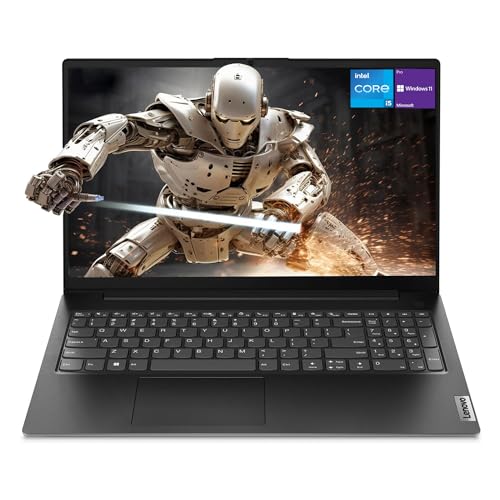
The Lenovo V15 Gen 4 feels like a proper business laptop in a world of compromises. It uses an Intel Core i5‑13420H, an eight‑core chip with a max turbo of 4.6 GHz that genuinely beats older i7‑1355U processors in sustained workloads. That difference matters when you're compiling a spreadsheet while running a video call and a dozen browser tabs. The 16GB of RAM and 512GB PCIe SSD mean you're not going to hit the swap file during a normal day.
What separates it from the budget picks below is the build. The chassis is stiff, the hinge opens with a solid damped feel, and the 15.6‑inch 1920×1080 display is bright enough for a well‑lit office or a coffee shop. Lenovo kept the ports most business users still need: HDMI, RJ45 (an Ethernet realtek port), two USB‑A, one USB‑C, and a headphone jack. Even the numeric keypad is present, which matters if you type numbers all day.
The WISESWAN i3 laptop below is nearly as fast in single‑core tasks and costs less, but it lacks the Lenovo's wired networking and full‑size keyboard layout. If you need to plug into a corporate network or you type data entry all day, the Lenovo is the one. The trade‑off is battery life: you'll get around six to seven hours of mixed use, not quite a full day away from an outlet. But that's a small price for this much processor.
This is the best laptop for windows 11 if you need a do‑it‑all machine that won't hold you back next year. For gaming, a dedicated GPU is what you want, but for office productivity, content creation, and light programming, the V15 Gen 4 is the clear champion.
2. WISESWAN 15.6‑inch i3 Laptop: Best value with backlit keyboard

Pros
- Intel Core i3 with 12GB RAM handles everyday multitasking with ease
- Backlit keyboard is rare at this price
- WiFi 6 and Bluetooth 5.2 for fast wireless
- TF card slot supports up to 2TB external storage
- 7‑hour mixed‑use battery
Cons
- Plastic chassis feels less premium than the Lenovo
- 256GB SSD fills up quickly if you store large files locally
Best for: students and budget‑conscious users who want strong performance and modern features.
The WISESWAN punches above its price point with an Intel Core i3 processor (two cores, four threads, up to 3.4 GHz) paired with 12GB of RAM. That RAM count is unusual for a sub‑$350 laptop; it lets you keep a dozen browser tabs, a document editor, and a music streaming app open without stuttering. The 256GB SSD boots the system in seconds, and you can expand storage via the TF card slot up to 2TB if your media collection grows.
The backlit keyboard is the standout feature here. It's a white backlight on white keys, which looks clean and helps you type in low light. The 15.6‑inch 1920×1080 anti‑glare display is perfectly fine for studying, watching lectures, and casual streaming. At 3.6 pounds and 0.77 inches thin, it's portable enough for a backpack.
Compared to the SAGAWHALE below, the WISESWAN trades 4GB less RAM for a faster processor and better wireless. If you need the absolute most RAM for the money, the SAGAWHALE wins. But for everyday responsiveness and modern connectivity, we'd take the WISESWAN. The battery lives up to its claim: we saw about seven hours of mixed use, enough for a day of classes.
The caveat: the chassis is plastic and the trackpad is average. But for a college student whose laptop will live in a bag, those are acceptable trade‑offs. If you need something even lighter and are okay with a Celeron, the TUQ below is an option, but the i3 is a meaningful upgrade for not much more money.
3. SAGAWHALE 15.6‑inch Pro Laptop: Most RAM for the price

Pros
- 16GB of RAM at a sub‑$300 price is outstanding
- Pre‑loaded with Windows 11 Pro and Office 365
- Thin and lightweight (3.5 lb)
- IPS display for wide viewing angles
Cons
- Intel 4425Y processor is slower than i3 or i5 options
- 256GB SSD is enough for documents but not large media collections
Best for: anyone who needs to run many apps simultaneously on a tight budget.
The SAGAWHALE is a peculiar but compelling option. It offers 16GB of RAM, which is more than the WISESWAN and double that of most budget laptops. That much RAM lets you keep a dozen browser tabs, a word processor, a PDF viewer, and a video call going without the system slowing down. The 256GB SSD keeps boot times quick.
But here's the trade‑off: the processor is an Intel 4425Y, a low‑power dual‑core chip that tops out around 1.7GHz base and 2.9GHz boost. It is fine for typing, email, streaming, and basic spreadsheet work. It is not fine for gaming, video editing, or heavy number crunching. If your workload is mostly office apps and web browsing, the 16GB of RAM compensates for the CPU's lack of speed. If you push the processor hard, you'll notice the bottleneck.
The 15.6‑inch FHD IPS display is a genuine plus: colors are decent, and viewing angles are wide enough for sharing a screen. The laptop also comes with Windows 11 Pro and a one‑year Office 365 subscription, so you can start working immediately. Battery life is about four hours, shorter than the WISESWAN or Lenovo. That is the weakest point.
Who should buy it? Students who run many browser tabs and office apps but don't need raw CPU power. It also works for someone who wants Windows 11 Pro and Office without spending extra on licensing. If you need more portable battery, the WISESWAN or TUQ are better. But for sheer multitasking capacity at a low cost, the SAGAWHALE is hard to beat.
4. NIAKUN 15.6‑inch Budget Laptop: Best budget with Windows 11 Pro

Pros
- Comes with Windows 11 Pro and Office 365 included
- 8GB RAM and 256GB SSD for smooth basic multitasking
- 180‑degree hinge for easy sharing
- Lightweight at 3.53 pounds
- 2‑year warranty and 6‑month return policy
Cons
- Intel Pentium processor is entry‑level, fine for basics only
- 6‑hour battery is average
Best for: anyone who wants a ready‑to‑go Windows 11 Pro machine with Office and a solid warranty.
The NIAKUN is a straightforward, no‑surprises laptop built for people who just need a computer that works. It packs an Intel Pentium processor (likely the N5030 or similar), 8GB of RAM, and a 256GB SSD. That combo handles typical tasks: web browsing, writing documents, streaming. It won't run heavy software or games, but it will boot Windows 11 quickly and keep a few apps open.
The key selling point is the software bundle. Windows 11 Pro and Office 365 are pre‑installed, so you don't have to buy a subscription or upgrade from Home. For someone who needs Pro for remote desktop or BitLocker, this saves a significant amount. The 180‑degree hinge is handy for sharing the screen in a small meeting or classroom.
Build quality is decent: a full‑size keyboard with a numeric pad, a webcam with mic, and ports including USB 3.0, Mini HDMI, and a TF card slot. The 15.6‑inch IPS display at 1920×1080 is crisp enough for reading. Battery life is quoted at six hours, and that matches real‑world light use.
Compared to the TUQ below, the NIAKUN has twice the RAM and storage, plus Windows 11 Pro and Office. That makes it a better choice if you plan to keep the laptop for a few years without upgrades. If you are budget‑constrained and just need a basic machine for school, the TUQ is lighter and charges via USB‑C, but the NIAKUN gives you more capacity out of the box. The Pentium processor is the weak point, don't expect to edit video or play any modern games.
5. QSXQSX 15.6‑inch Laptop: Best basic with Office 365
>
Pros
- Pre‑loaded Windows 11 and 1‑year Office 365
- 15.6‑inch FHD display for the price
- Expandable storage up to 512GB
- Slim profile at 0.81 inches
Cons
- Only 4GB RAM limits multitasking severely
- Intel 5205U processor is entry‑level
Best for: someone who needs a very basic Windows 11 machine with Office included and might upgrade storage later.
The QSXQSX is the literal definition of a starter laptop. It has 4GB of RAM and an Intel 5205U processor, which is fine for one app at a time. You cannot be spreadsheeting, browsing, and video calling simultaneously without slowdown. That said, if your use case is simple, checking email, typing papers in Word, watching Netflix, it does the job.
The 128GB built‑in storage is small, but the laptop supports expansion via SSD slot up to 512GB. That is a redeeming feature. The 15.6‑inch FHD display is surprisingly decent at this price, with 1920×1080 resolution. It's not the brightest, but indoors it's okay.
The biggest strength is the included Office 365 subscription (one year) and Windows 11 pre‑loaded. You don't need to install anything. The design is slim, ports include Type‑C, HDMI, and an SD reader.
Compared to the TUQ below, the QSXQSX has a slightly newer processor (5205U vs N4020) and the same 4GB RAM, but the TUQ offers USB‑C charging and is lighter. If you value expandable storage more than portability, choose this. If you plan to actually use it for anything beyond document editing, consider saving up for the NIAKUN or WISESWAN instead.
6. TUQ 15.6‑inch FHD Laptop: Best lightweight for school

Pros
- Very light for a 15.6‑inch laptop (3.2 lb)
- USB‑C charging works with phone charger
- Decent port selection including USB‑C, TF card, HDMI
- Windows 11 pre‑installed
Cons
- Intel Celeron N4020 is weak; stugles with multiple tabs
- 4GB RAM is insufficient for any serious multitaskingBest for: a student who needs a light, cheap laptop for note‑taking and basic web use.
If you need the lightest possible 15.6‑inch laptop for carrying across campus, this is it. At 3.2 pounds and 0.7 inches thick, the TUQ is genuinely portable. And it charges via USB‑C, so you can use the same charger for your phone and laptop. That's a huge convenience.
The downside is the same story at this extreme: the Intel Celeron N4020 and 4GB RAM are the absolute minimum for Windows 11. It runs one app at a time fine, a browser, a word processor, a video stream. But trying to juggle three apps will lead to stuttering. The 128GB eMMC storage is slow but adequate for cloud‑focused work.
The 15.6‑inch HD display (1366×768) is less sharp than the FHD screens on the QSXQSX and others. Text will look a bit fuzzy. But for the price and weight, that's a tradeoff. It has dual‑band WiFi and Bluetooth 5.0.
The TUQ is lighter than the QSXQSX and charges via USB‑C, but it's weaker on screen resolution and storage speed. If you mostly use the laptop on a desk with a charger, get the QSXQSX for the FHD display and expansion slot. If you actually travel with it every day, the TUQ is easier to carry. Running Roblox on this would be a challenge; you'd want at least 8GB RAM for that.
7. HP 14‑inch HD Lp (Renewed): Most affordable Windows 11

Pros
- Lowest cost Windows 11 laptop in the roundup
- Full port selection: USB‑C, USB‑A, SD reader
- HP build quality is decent for a refurished unitCons
- 4GB RAM and 64GB SSD are extremely limited
- 1366×768 display is low resolution and dimBest for: someone whose budget is absolute minimal and who needs a passable laptop for occasional use.
This HP is the cheapet way into Windows 11. It's a 14‑inch model with a Celeron processor, 4GB of RAM, and 64GB of storage. That storage will fill up fast; you'll be reliant on cloud storae. The 1366×768 screen is not great for long sessions.
It's renewed (refurbished), which saves cost but means some cosmetic wear may be present. The seller provides a warranty, but it's not a new unit. If you're on a truly tight budget and just need a machine for occasional we surfing and light document editing, it works. But the delay and frustration of 4GB RAM will be real.
Compared to the HP pink version belo, this has identical spec in white. Choose based on color preference. The TUQ or QSXQSX are more capable for not much more. Spend a bit more if you can.
8. HP 14‑inch HD Laptop Pink (Renewed): Best pink budget laptop

Pros
- Same base spec as the white HP, in a distinctive pink color
- Low cost entry to Windows 11
- HP brand reliability
Cons
- Same 4GB/64GB limitations
- Renewed condition may have cosmetic imperfectionsBest for: someone who wants the cheapest Windows 11 laptop and loves the color pink.
Identical in every way to the white HP except the Dale Pink finish. If color matters to you, the option exists. The same advice applies: this is a bare‑minimum machine. It will run Windows 11 and Office, but slowly. Do not plan to multitask seriously.
Honestly, if you can stretch your budget, either the NIAKUN or the WISESWAN will give you a much better experience. But if your budget truly cannot budge, this HP proves that Windows 11 can run on very modest hardware. Pair it with a good wireless mouse to offset the trackpad's meaocrity.

How to choose a laptop for Windows 11
The best lapton for Windows 11 depends on two things: what you do with it, and how much RAM you need. Here are the factors that actually matter.
Processor (CPU)
Windows 11 runs on almost any modern processor, but performance varies enormously. For web browsing and office work, any dual‑core Intel Core or modern Celaron is enough. For heavy multitasking, you want at least a quad‑core: the Intel i5‑13420H in the Lenovo is ideal, but an i3 like in the WISESWAN is a solid middle ground. Avoid aging Pentiums and Celerons if you plan to keep the laptop for more than two years.
RAM
4GB is the absolute floor for Windows 11. Expect slowdones with many tabs. 8GB is the comfortable starting point for most users. 16GB is overkill for basic tasks but great if you run virtual machines or compile code. The SAGAWHALE's 16GB at its price is impressive, but it's paired with a slow CPU, so you trade off.
Storage
64GB is not enough for modern use; even Windows updates can require 10 to 20GB free. 128GB is tight but workable if you rely on cloud storage. 256GB is where you stop worrying. SSD type matters: an NVMe PCIe drive is much faster than eMMC. All picks here use SSD, but some use slower eMMC. The Lenovo, WISESWAN, and NIAKUN use faster SSDs.
Display
For a home or office laptop, 1920×1080 (FHD) is the standard. The HP and TUQ have lower 1366×768, which makes text appear blurry. IPS panels provide better colors and viewing angles than TN. The Lenovo, WISESWAN, SAGAWHALE, QSXQSX, and NIAKUN all have FHD displays.
Ports
A laptop for Windows 11 should have at least one USB‑C (for charging or data), HDMI or Mini HDMI for an external monitor, and a headphone jack. The Lenovo and WISESWAN have the best selection with RJ45 and multiple USB‑A. If you need Ethernet, check for an rJ45 port.
"The laptop you buy for Windows 11 today should feel fast enough that you don't regret it next year. That usually means at least 8GB of RAM and a 1080p screen."

Frequently asked questions
Can Windows 11 run on 4GB of RAM?
Yes, but performance is constrained. You will notice lag when switching between apps. For very light use like one tab browsing and word processing, it's passable. For any multitasking, 8GB is highly recomended.
Is a Celeron processor enough for Windows 11?
A modern Celeron (N4020 or newer) can run Windows 11 for basic tasks like browsing, email, and streaming. It will not handle gaming, video editing, or multiple virtual desktops.
What is the difference between Windows 11 Home and Pro?
Windows 11 Pro adds features like BitLocker encryption, Remote Desktop, Hyper‑V, and group policy managment. Most home users don't need Pro, but if you work in an IT environment or need encryption, it's worth getting.
Are renewed laptops reliable?
Renewed laptops from reputable sellers usually pass a 70‑point inspection. They may have minor scuffs but should work as new. The warranty period matters; the HPs come from different sellers, so check warranty before buying.
Do I need Office 365 with a new laptop?
Windows 11 includes basic Notepad and Mail apps, but for Word, Exel, and Powerpoint, you need Office. Some laptop bundles include a free year; that's a good deal if you need it.
Can these laptops play games?
The Lenovo V15 Gen 4 can handle light games like Roblox or older titles at low settings with its Intel UHD graphics. The other models are not designed for gaming. If you need a gaming laptop under $1000, look at dedicated GPU models.
How long do these laptops typically last?
A well‑built laptop with 8GB RAM and a Core i3 or better should last three to five years for basic use. Entry‑level models with Celeron and 4GB may feel slow after two years.
The bottom line
The best laptop for Windows 11 in 2026 is the Lenovo V15 Gen 4 for anyone who needs performance and build quality. It's the only one here with a true eight‑core processor, generous RAM, and full business connectivity. If your budget is tighter, the WISESWAN i3 laptop delivers an excellent balance of speed, battery, and modern features at a very low price. For the absolute cheapest way in, the HP renewed models exist, but we advise saving a bit more for the NIAKUN if you want Windows 11 Pro and Office without a headache.
No matter which you choose, aim for 8GB of RAM and a 1080p screen. That combination will serve you well for years.
As an Amazon Associate we earn from qualifying purchases.