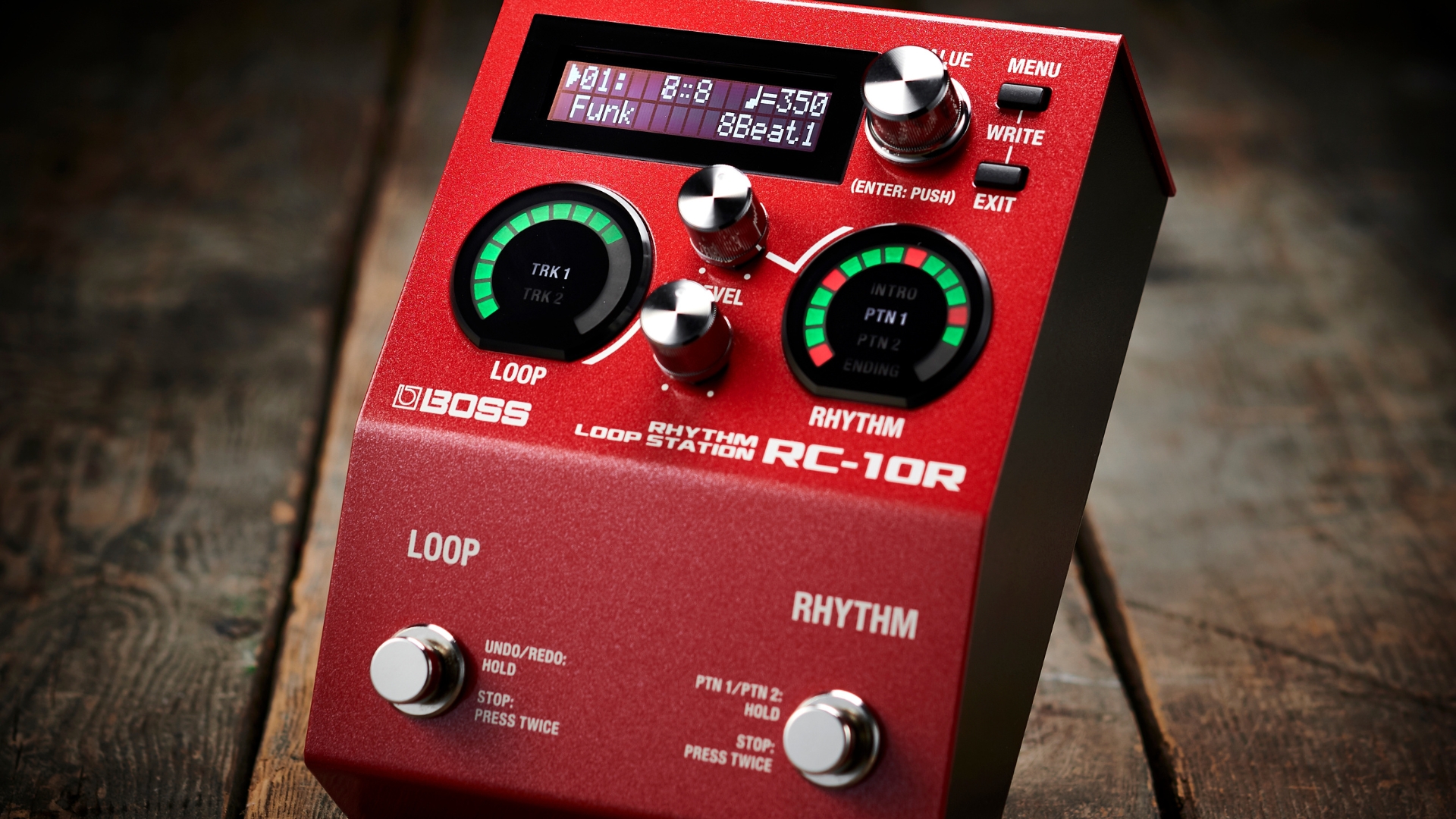

A looper pedal can turn one guitarist into a rhythm section, but only if the footswitches make sense when your hands are busy. The wrong pedal leaves you hunting through commands, losing the start of a phrase, or running out of memory just as an idea takes shape. Our Best best looper pedal picks separate one-button simplicity from deep looping systems with storage, rhythms, and external control.
The BOSS RC-1 Loop Station is the easiest recommendation for most players who want reliable record, playback, overdub, undo, and redo controls. The rest of the list ranges from tiny guitar-first loopers to the BOSS RC-5, Donner's rhythm-focused Circle, and multi-effects units that happen to include looping.
Comparison table
| # | Product | Award | Recording | Controls | Best for |
|---|---|---|---|---|---|
| 1 | BOSS RC-1 Loop Station | Best overall | 12 minutes, stereo | Record, playback, overdub, undo, redo | Straightforward practice and performance |
| 2 | LEKATO 9-Loop Pedal | Best long-memory simple looper | 40 minutes, 9 loops | Tuner, USB, unlimited overdubs | Players who need several saved ideas |
| 3 | BOSS RC-5 Loop Station | Best advanced looper | 13 hours, stereo | Rhythms, MIDI, USB, reverse | Live rigs and detailed arrangements |
| 4 | LEKATO 9-Loop Power Bundle | Best included-power setup | 40 minutes, 9 loops | Tuner, USB, unlimited overdubs | New pedalboard builders |
| 5 | BOSS RC-1 Bundle | Best RC-1 bundle | 12 minutes, stereo | 24-segment display, stereo I/O | Players wanting the RC-1 setup |
| 6 | MOOER GE100 | Best multi-effects looper | 180 seconds | 66 effects, drum machine | Guitarists building tones and loops |
| 7 | Donner Circle Looper | Best drum-machine looper | 160 minutes, 40 slots | 110 grooves, tap tempo, fade out | Solo performers needing accompaniment |
| 8 | Donner Triple Looper | Best three-loop layout | 90 minutes, 3 loops | Screen, undo, redo, true bypass | Song sections and layered parts |
| 9 | TC Electronic Ditto | Best minimalist looper | 5 minutes | Unlimited overdubs, undo, redo | Guitarists who want almost no menu |
| 10 | LEKATO Sync Looper | Best sync-focused looper | 18 minutes, 3 loops | Sync mode, tuner, USB | Players adding phrases during playback |
1. BOSS RC-1 Loop Station: Best Overall

Pros
- Clear 24-segment loop status indicator
- Stereo input and output
- Record, overdub, undo, and redo are easy to access
- Phrase remains in memory after power-off
Cons
- No built-in tuner or rhythm section
- Battery life is approximately 4.5 hours
- External power adapter is optional
Best for: guitarists who want a dependable looper without menus or deep setup.
The BOSS RC-1 Loop Station gets the important thing right: you can start making music immediately. Its single footswitch handles the basic sequence, while a level control keeps the loop from overwhelming the live instrument. The circular 24-segment LED indicator makes the current record, overdub, or playback state visible at a glance, which matters more on stage than a long list of hidden features.
There is enough recording room for extended practice phrases, with up to 12 minutes of stereo recording. Stereo input and output also make sense for keyboards, stereo effects chains, and amplifiers that use both channels. That flexibility gives the RC-1 a wider role than a guitar-only pedal, even though its controls remain deliberately spare.
Compared with the TC Electronic Ditto, the RC-1 gives you substantially more recording time and a more informative status display. The LEKATO 9-Loop Pedal offers much more memory and USB transfer, but the RC-1 is easier to understand without learning a second set of foot commands. Players who want a broader rig can pair it with other effects, and our guide to building a useful guitar effects signal chain covers how a looper fits around those pedals.
The limitation is just as clear. There is no tuner, rhythm accompaniment, USB import, or multi-loop memory, and running from a 9-volt alkaline battery gives approximately 4.5 hours of battery life. Skip it if you need stored song sections or drum patterns. For a player who wants to practice chord changes, build a live backing part, and keep the interface obvious, this remains the one we'd keep.
2. LEKATO 9-Loop Pedal: Best Long-Memory Simple Looper

Pros
- Nine loop memories
- Up to 40 minutes of total recording
- USB import and export for WAV files
- Built-in tuner
- Unlimited overdubbing
Cons
- One-button commands require practice
- No built-in drum machine
- Power adapter is not listed as included
Best for: players who want simple foot control with considerably more stored loop space.
The LEKATO 9-Loop Pedal is a practical step beyond a one-phrase looper. It stores up to nine loops, with as much as 10 minutes for a single recording and 40 minutes in total. That gives a songwriter room to keep a verse idea, a chorus, and several practice takes available rather than clearing the pedal every time a new idea appears.
Its audio specification is unusually concrete for a compact unit. The pedal records at 48 kHz and 24 bit, and its uncompressed audio design is paired with analog dry-through. In use, the useful part is that your direct guitar signal is not needlessly replaced by the looped signal. A built-in visual time indicator helps show where you are in the phrase, while the single knob controls playback volume.
USB import and export are the feature that changes the workflow. WAV loop files can move to and from a computer, so the pedal can serve as a small idea library rather than only a live scratchpad. The tuner is also useful on a crowded board because tuning does not interrupt the phrase in the way a separate, poorly placed tuner might.
This is less immediate than the BOSS RC-1, whose 24-segment display and basic commands are easier for a first session. The LEKATO's weakness is the learning curve around its one-button commands, especially when record, stop, erase, and undo depend on different foot actions. Choose it over the RC-1 when saved material and USB access matter more than absolute simplicity.
3. BOSS RC-5 Loop Station: Best Advanced Looper

Pros
- 13 hours of stereo recording
- 57 rhythms with A/B variations
- Seven drum kits
- 99 phrase memories
- MIDI, USB, and external control support
Cons
- More setup than a basic looper
- Mini TRS MIDI connections need an adapter cable
- Power adapter is optional
Best for: performers who need rhythms, phrase storage, and control over a more elaborate rig.
The BOSS RC-5 Loop Station is a compact pedal with the ambitions of a small loop station. It is still a single-track looper, but 13 hours of stereo recording and 99 phrase memories make it suitable for a repertoire rather than just one practice idea. The multicolor LCD gives the loop state and editing parameters a clearer home than the RC-1's ring of LEDs.
The processing is built around 32-bit AD/DA and 32-bit floating-point processing. That specification matters most to players who are repeatedly recording, overdubbing, and editing phrases, where a clean signal path and predictable response are more useful than a bare minimum interface. The reverse function adds a texture option for sound design and transitional parts.
Rhythm support is the major reason to choose this pedal. There are 57 rhythms, each with A/B variations, along with seven drum kits. MIDI I/O, USB connectivity, and support for an external footswitch or expression pedal give the RC-5 room to grow into a synchronized performance setup. Players who want a separate rhythm source may also find ways to choose drum patterns that fit a solo setup useful before deciding how much accompaniment should live inside the looper.
The price of that flexibility is attention. The BOSS RC-1 is much faster to operate when you only need a clean guitar loop, while the Donner Circle Looper offers a larger rhythm library on paper. The RC-5 is the better fit for someone who will use its memories, MIDI, rhythms, and editing tools. Skip it if a display and a few foot commands are all you want.
4. LEKATO 9-Loop Power Bundle: Best Included-Power Setup

Pros
- Nine loops with 40 minutes total recording
- Up to 10 minutes for one loop
- USB WAV import and export
- Built-in tuner
- Includes a 9V 0.6A power supply adapter
Cons
- Single-footswitch operation takes practice
- No rhythm or drum accompaniment
- Less compact than the smallest guitar loopers
Best for: a new pedalboard that needs looping, tuning, and a listed power adapter in one setup.
The LEKATO 9-Loop Power Bundle is closely related to the LEKATO model above, but its included 9V 0.6A pedal power supply changes the first-use experience. It is the version to consider when the pedal is going onto a new board and you do not already have a compatible supply. A USB cable is included for computer transfers as well.
The core looper features remain strong for this compact format. You get nine loops, a maximum single-loop recording duration of 10 minutes, and 40 minutes total recording time. The pedal supports unlimited overdubbing, while undo, redo, stop, and erase are reached through different foot commands. Its 48 kHz, 24 bit recording and analog dry-through keep the focus on preserving the instrument signal rather than adding processing.
The integrated high-sensitivity tuner is a useful companion feature. It can be switched continuously without creating an awkward interruption between phrases, which is handy during rehearsal. Loop playback volume is set with a single knob, and the visual time indicator provides the basic progress information missing from very stripped-back pedals.
The LEKATO 9-Loop Pedal is the closer match if you already own reliable pedal power, while the BOSS RC-1 Bundle is easier to operate and uses a more immediately readable status display. This LEKATO's weakness is not its memory, but its command system. A player who wants rhythm patterns, MIDI, or independent song sections should move up to the RC-5 or across to the Donner models.
5. BOSS RC-1 Bundle: Best RC-1 Bundle

Pros
- Same clear 24-segment RC-1 loop indicator
- 12 minutes of stereo recording
- Stereo inputs and outputs
- Includes power adapter and instrument cables
- Recorded phrase remains after power-off
Cons
- Heavier than the standard RC-1 listing
- No tuner, rhythms, or USB transfer
- Single 9-volt battery lasts approximately 4.5 hours
Best for: guitarists who want the RC-1 controls with a power supply and basic cabling included.
The BOSS RC-1 Bundle is fundamentally the same kind of straightforward looper as the first BOSS pick, but the package is aimed at someone starting with fewer accessories on hand. It includes a power adapter, a 10-foot instrument cable, a 6-inch patch cable, and picks. Those extras do not change how the pedal loops, but they can simplify putting it between an instrument and an amplifier.
The core operation remains appealingly direct. The 24-segment circular LED shows whether you are recording, overdubbing, or playing back, and the pedal supports up to 12 minutes of stereo recording. Stereo I/O gives it a place with keyboards and stereo effects as well as guitar and bass. The recorded phrase stays in memory when the pedal is turned off.
Against the standard BOSS RC-1 Loop Station, the important distinction is the package, not a new looping engine. The TC Electronic Ditto is smaller and even more stripped back, while the LEKATO choices offer longer memory and USB file management. If you want to pair looping with other effects, our notes on choosing pedals that complement a clean guitar signal can help shape the rest of the board.
The weakness is that this bundle does not solve the RC-1's feature limitations. There is still no tuner, rhythm section, or computer transfer, and the listed battery life is approximately 4.5 hours. Choose it when the included cables and power supply matter. Pick the standard RC-1 when you already have those accessories and want the same basic pedal without the bundle focus.
6. MOOER GE100: Best Multi-Effects Looper

Pros
- 66 effect types across eight modules
- 80 preset patches and 80 user patches
- 180-second looper
- Drum machine included
- Assignable expression pedal parameters
Cons
- Loop time is much shorter than dedicated loopers
- Larger floor footprint
- More complex than a single-purpose pedal
Best for: guitarists who need amp and effect sounds as well as a basic looper.
The MOOER GE100 is not a conventional looper pedal with extra features attached. It is a multi-effects floor unit whose looping function makes it useful for practice and songwriting. The reason to buy it is the combination: one device provides tones, expression control, a drum machine, and a looper instead of asking you to build every part separately.
Its effects engine includes eight modules and 66 effect types, with 80 preset patches and 80 user patches for storing preferred sounds. Six assignable expression pedal parameters allow the foot controller to influence different aspects of the tone. An adjustable output mode is also listed for getting a suitable tone when playing without an amplifier through the line output.
The looper records for 180 seconds, which is enough for a chord progression, a short arrangement, or a focused practice exercise. It is not competitive with the 40 minutes in the LEKATO 9-Loop Pedal, the 90 minutes in the Donner Triple Looper, or the long phrase storage of the BOSS RC-5. The built-in drum machine makes those shorter loops more useful by giving a player rhythmic context.
The GE100's real weakness is focus. Its 9.0551-inch length and 1.609-pound weight make it a larger floor unit than the dedicated pedals here, and navigating many effects is slower than stepping on an RC-1. Choose it if tone creation is central to your setup. Skip it if you already have effects and only need the cleanest possible looping workflow.
7. Donner Circle Looper: Best Drum-Machine Looper
Pros
- 110 drum grooves across 11 styles
- 40 memory slots
- 160 minutes of total recording
- Tap tempo and fade out
- USB import and export
Cons
- Power adapter is not included
- Each memory slot holds up to four minutes
- Larger enclosure than minimalist pedals
Best for: solo players who want drum accompaniment and many stored phrases.
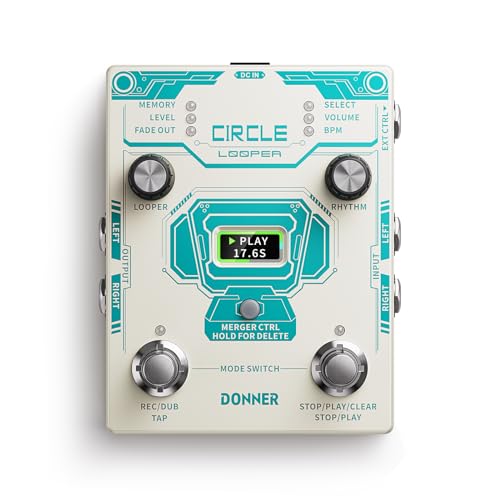
The Donner Circle Looper makes the most sense when a loop needs a beat behind it. This is a two-in-one looper and drum machine with 110 grooves spanning 11 music styles, plus 10 metronome settings. Tap tempo lets you set the pulse from the pedal, while fade out gives an ending that does not require an abrupt stop.
Storage is its strongest practical feature. There are 40 memory slots, each capable of holding four minutes, for 160 minutes of total recording capacity. The bright screen shows loop mode, time progress, and timing, so the player does not have to infer the state from a single light. Recorded files can be imported and exported over USB with editor software, and the unit can automatically save recordings when powered off.
The BOSS RC-5 offers more sophisticated control, MIDI, and phrase memory, but the Circle's large collection of drum grooves is more immediately useful for a solo rehearsal or street set. The MOOER GE100 also combines looping and rhythms, although its 180-second looper is aimed more at short practice ideas. The Circle is the better fit when accompaniment is the point rather than a supporting feature.
Power planning is the catch. The pedal needs a 9V DC, center-negative adapter with 500 mA current, and the adapter is not included. Its four-minute limit per memory slot also matters if you record long-form sections. Choose it for rhythm-led practice and performance, not for the simplest guitar-only loop.
8. Donner Triple Looper: Best Three-Loop Layout

Pros
- Three independent loop slots
- Up to 30 minutes per loop
- 90 minutes total recording
- Unlimited overdubs with undo and redo
- True bypass and automatic saving
Cons
- Power supply is not included
- No drum machine
- One footswitch handles many commands
Best for: songwriters who want separate verse, chorus, and solo material.
The Donner Triple Looper takes a different approach from the single-memory RC-1. It provides three independent loops, and each can hold up to 30 minutes, for 90 minutes of total recording. That layout is useful for keeping song sections distinct rather than stacking every idea into one continuously growing phrase.
A bright built-in screen shows loop status, recording progress, and timing. The pedal supports unlimited overdubs, undo, and redo, so a player can build a layered part and remove a mistake without clearing the whole idea. Automatic saving also means a stored phrase should remain available after the pedal is powered off, according to the listed features.
The true-bypass design is reassuring for a board where the looper is not always active. The LEKATO Sync Looper is more interesting if you want to enter recording during playback, while the Donner Circle Looper is the better choice when drum grooves and tap tempo matter. The Triple Looper wins on its division of memory into three sizeable song-oriented spaces.
It does not include a power supply and requires 9V DC, center negative, and 500 mA current. The one-footswitch design is approachable, but the player still needs to learn the timing of the different commands. Choose it over the RC-1 when separate sections matter. Skip it if you want rhythms, MIDI, or a simpler first encounter with looping.
9. TC Electronic Ditto: Best Minimalist Looper
Pros
- Very simple guitar-focused operation
- Unlimited overdubs
- Undo and redo
- True bypass
- Analog dry-through
Cons
- Five minutes of loop time
- No tuner, screen, USB, or rhythm section
- 9V power supply is not supplied
Best for: guitarists who want to record and layer without menus or extra functions.
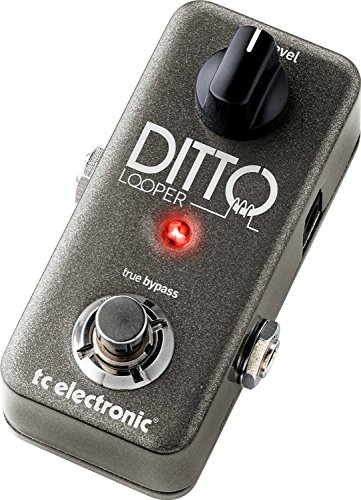
The TC Electronic Ditto is the purest expression of the one-job looper. It is designed around guitarists who want to press, play, layer, and stop without navigating a screen or a library of settings. That narrow focus makes it approachable, especially for practice sessions where extra features would only get in the way.
Five minutes of loop time is enough for chord cycles, riffs, and short arrangements, but it is the smallest capacity here aside from the brief 180-second looper in the MOOER GE100. Unlimited overdubs, undo, and redo give the Ditto the creative essentials. True bypass and analog dry-through are also important to a player who wants the unaffected guitar tone to remain intact when the pedal is bypassed.
The BOSS RC-1 is the stronger all-rounder because its 12-minute stereo capacity and 24-segment indicator provide more information and flexibility. The Ditto is smaller in spirit and less distracting, though its listed dimensions are 4 inches long, 3.9 inches wide, and 2.5 inches high. There is no tuner, rhythm section, screen, or computer transfer.
The pedal needs a 9V supply providing 100 mA or more, and that supply is not included. That is a real setup detail for a first-time buyer. Choose Ditto if you value a guitar-first interface above stored loops and accompaniment. If you play keys, need stereo routing, or build complete arrangements, move to the RC-1, RC-5, or Donner options.
10. LEKATO Sync Looper: Best Sync-Focused Looper

Pros
- Synchronous recording can begin during playback
- Three loops and 18 minutes total memory
- Built-in tuner
- USB WAV import and export
- Unlimited overdubbing and automatic saving
Cons
- Power supply is not included
- Less recording space than the nine-loop LEKATO models
- One-button command system takes practice
Best for: players who need to add a phrase during an active loop without waiting for a new cycle.
The LEKATO Sync Looper has one feature that separates it from the other compact LEKATO pedals: synchronous recording. The listed mode allows recording to begin at any point during playback, which can help when an idea arrives after the phrase has already started. That is particularly useful for live layering, where waiting for the next full cycle can mean missing the musical moment.
It provides three loops, with up to six minutes for a single loop and 18 minutes in total. The LED screen shows loop timing, while the built-in high-sensitivity tuner can be used without an interruption that throws off the phrase. The pedal also supports unlimited overdubs and uses one knob for loop playback volume.
USB import and export add a computer-based workflow, with WAV files moving to and from the unit. Automatic saving keeps recorded files available after power-off. Its 48 kHz, 24 bit uncompressed audio and analog dry-through are the same kind of signal-preservation features found on the longer-memory LEKATO models.
The LEKATO 9-Loop Pedal is better when you need nine memories and 40 minutes of total recording, while the Donner Triple Looper gives each of three loops considerably more time. The Sync Looper's weakness is capacity, not flexibility. Choose it for mid-playback entry and compact practice. Skip it if your songs require long sections or a large archive of stored loops.
How to choose best looper pedal
The right looper depends less on the biggest recording number than on how you create, control, and recall phrases while playing.
Recording time and memory
Short loop time is fine for a repeating chord progression, but extended arrangements need more room. The TC Electronic Ditto offers five minutes, while the BOSS RC-1 provides 12 minutes of stereo recording. The BOSS RC-5 reaches 13 hours and stores 99 phrase memories, and the Donner Circle uses 40 slots with four minutes per slot.
Look for multiple memories when you want to keep ideas between sessions. Look for independent loops when verse, chorus, and solo parts need separate control.
Footswitch commands
A looper should respond predictably when your hands are occupied. Basic pedals generally use one switch for record, playback, and overdub, with longer or repeated presses handling undo, redo, stop, and erase. That keeps the hardware compact but creates a learning curve.
The RC-1 is the clearest option for basic commands. LEKATO and Donner models provide more functions through one switch, so give yourself rehearsal time before using them in front of an audience.
The best loop capacity is useless if your foot cannot find stop, undo, and overdub without hesitation.
Audio routing
Stereo input and output matter for keyboards, stereo effects, and amplifiers with separate channels. The BOSS RC-1 and RC-5 list stereo operation, while the LEKATO models list uncompressed 48 kHz, 24 bit audio and analog dry-through.
True bypass is useful when the pedal is off and you want the signal path to remain direct. Analog dry-through helps preserve the direct instrument signal while a loop is playing.
Rhythm and synchronization
A drum machine can make a practice loop feel like a song instead of a metronomic exercise. The Donner Circle includes 110 grooves across 11 styles, while the BOSS RC-5 has 57 rhythms with A/B variations and seven drum kits. The MOOER GE100 includes a drum machine alongside its effects.
If you add phrases while a loop is already running, a sync mode can be more important than a huge memory. The LEKATO Sync Looper is the only pick here specifically described with synchronous recording during playback.
Connectivity and power
USB import and export let you move WAV loops between a pedal and computer. That feature appears on the LEKATO models, the Donner Circle, and the BOSS RC-5. MIDI and external footswitch support are more specialized, but they matter in a larger live rig.
Check the power requirement before mounting a pedal. Some picks need a 9V center-negative supply, and the Donner pedals specify 500 mA. The TC Electronic Ditto requires 9V at 100 mA or more, while the BOSS RC-1 can run from a 9-volt alkaline battery for approximately 4.5 hours.
Frequently asked questions
What is the easiest looper pedal to use?
The BOSS RC-1 is the simplest all-round choice because its basic commands and 24-segment status indicator are easy to understand. The TC Electronic Ditto is also very direct, but it offers less recording time and fewer connection options.
How much loop time do I need?
Five minutes is enough for short practice phrases and repeating progressions. Choose a pedal with several memories or longer individual loops if you want to save song sections, build arrangements, or keep ideas between sessions.
Can these loopers work with bass and keyboards?
The product features explicitly identify several models for electric guitar and bass, including the LEKATO and Donner pedals. The BOSS RC-1 lists guitar, bass, keyboards, and more, with stereo inputs and outputs that suit stereo instruments.
Do looper pedals include power supplies?
Not all of them do. The LEKATO 9-Loop Power Bundle lists a 9V 0.6A adapter, while the Donner Circle, Donner Triple Looper, TC Electronic Ditto, and LEKATO Sync Looper list power requirements without including a supply in their features.
What does unlimited overdubbing mean?
It means you can continue adding layers to the recorded phrase without a stated overdub limit. It does not mean the pedal has unlimited recording memory. The available loop duration and memory slots still determine how long the original phrase can be.
Is a tuner useful on a looper pedal?
A built-in tuner can reduce the number of pedals on a board and lets you check tuning without interrupting your workflow. The LEKATO 9-Loop Pedal, LEKATO 9-Loop Power Bundle, and LEKATO Sync Looper list tuner functions.
Should I choose a looper with drums?
Choose one with drums if you practice alone or want a rhythmic foundation without another device. The Donner Circle is the most rhythm-focused pick here, while the BOSS RC-5 and MOOER GE100 combine looping with their own rhythm features.
The bottom line
The BOSS RC-1 Loop Station is our first recommendation for the Best best looper pedal because its 12 minutes of stereo recording, clear 24-segment display, and uncomplicated foot control cover the needs of most guitarists. The LEKATO 9-Loop Pedal is the better choice for players who need USB transfer, a tuner, unlimited overdubs, and much more stored loop time.
Move to the BOSS RC-5 for MIDI, rhythms, reverse playback, and phrase memories, or choose the Donner Circle Looper when drum grooves and tap tempo are central to your performances. The TC Electronic Ditto remains a good fit for a guitarist who wants the fewest distractions.
If you are undecided, buy the BOSS RC-1 for simple looping or the BOSS RC-5 when you already know you need deeper control.
As an Amazon Associate we earn from qualifying purchases.