
A TV can look impressive in a showroom and still disappoint at home, especially when sunlight washes out dark scenes or fast sports turn into a blur. The Best qled tv options solve that problem in different ways, from simple Roku sets to Mini-LED models built for HDR and gaming.
The strongest choices here are not interchangeable. Some prioritize an easy streaming interface, some offer a 144Hz panel, and others use local dimming to create deeper contrast. We ranked all 10 models by their picture features, motion handling, smart platform, and fit for different rooms.
The Hisense U6 Pro 65-Inch is our top pick for its Mini-LED contrast, native 144Hz refresh rate, glare-free screen, and broad HDR support. The rest of the list covers straightforward Roku TVs, compact Hisense models, and larger screens for gaming, sports, and movie nights.
Comparison table
| # | Product | Award | Screen | Motion | HDR and smart platform | Best for |
|---|---|---|---|---|---|---|
| 1 | Hisense U6 Pro 65-Inch | Best overall | 65-inch Mini-LED Hi-QLED, 4K | Native 144Hz | Dolby Vision IQ, HDR10+, Fire TV | Bright rooms and gaming |
| 2 | TCL QM6K 65-Inch | Best contrast control | 65-inch QD Mini-LED, 4K | Native 144Hz | Dolby Vision, HDR10+, Google TV | Sports and dark scenes |
| 3 | Hisense E7 65-Inch | Best AI picture features | 65-inch Mini-LED Hi-QLED, 4K | Native 144Hz | Dolby Vision IQ, HDR10+ Adaptive, Fire TV | Mixed viewing |
| 4 | TCL T7 65-Inch | Best gaming connectivity | 65-inch QLED, 4K | 144Hz | Dolby Vision, HDR10+, Google TV | Console and PC gaming |
| 5 | Hisense E6 65-Inch | Best large-room simplicity | 65-inch Hi-QLED, 4K | Motion Rate 120, MEMC | Dolby Vision, HDR10+ Adaptive, Fire TV | General streaming |
| 6 | Roku 65-Inch Select | Best easy interface | 65-inch QLED, 4K | Not specified | HDR10, Roku TV | Simple everyday viewing |
| 7 | Hisense E6 50-Inch | Best medium-size Fire TV | 50-inch Hi-QLED, 4K | Motion Rate 120, MEMC | Dolby Vision, HDR10+ Adaptive, Fire TV | Bedrooms and apartments |
| 8 | Roku 55-Inch Select | Best mid-size Roku | 55-inch QLED, 4K | Not specified | HDR10, Roku TV | Straightforward streaming |
| 9 | Hisense E6 43-Inch | Best compact Fire TV | 43-inch Hi-QLED, 4K | Motion Rate 120, MEMC | Dolby Vision, HDR10+ Adaptive, Fire TV | Small rooms |
| 10 | Roku 50-Inch Select | Best compact Roku | 50-inch QLED, 4K | Not specified | HDR10, Roku TV | Small living rooms |
1. Hisense U6 Pro 65-Inch: Best Overall

Pros
- Mini-LED backlighting with precise light zones
- Native 144Hz refresh rate
- Anti-reflection and glare-free display
- Broad HDR format support
- Built-in subwoofer
Cons
- Heavy at 40.8 pounds
- Fire TV interface is busier than Roku TV
- No detailed port count is provided
Best for: viewers who want a large, bright-screen TV that can handle movies, sports, and gaming.
The Hisense U6 Pro 65-Inch is the set we would choose for a main living-room screen. Its Mini-LED backlight is the meaningful upgrade over ordinary QLED models here, because the backlight uses hundreds of precise light zones to improve the difference between bright highlights and dark areas. That gives HDR scenes more shape instead of making the entire screen glow evenly.
Motion is another reason it leads this group. The native 144Hz refresh rate is useful for fast console or PC games, but it also helps sports and rapid camera pans look more controlled. Hisense adds Motion Rate 480 processing, although the native panel refresh rate is the figure that matters most. The TV also supports Dolby Vision IQ, HDR10+ Adaptive, HDR10, and HLG, so it can work with a wide range of HDR sources.
The glare-free, anti-reflection screen makes the U6 Pro easier to place opposite windows than the Roku Select models. Its Hi-QLED color system is paired with Pantone validation, while the Hi-View AI Engine adjusts the picture for movies, sports, or games. The built-in subwoofer is a useful extra for dialogue and impact, though it does not remove the need for a soundbar if you want a genuinely cinematic system.
The trade-off is its weight and its Fire TV software. Roku TV is cleaner for someone who mainly wants to open streaming apps, while the U6 Pro is more capable but presents more recommendations and settings. It is also not the right pick for someone who wants a small bedroom screen. For a broad look at screen size and placement choices, how far back you should sit from a panel this size is worth settling before ordering.
Choose this model when picture contrast, glare control, fast motion, and HDR flexibility matter more than having the simplest possible interface. It is the most complete television in this group, with a weakness that is easy to understand before you buy.
2. TCL QM6K 65-Inch: Best Contrast Control

Pros
- QD Mini-LED combines quantum-dot color with local backlighting
- Halo Control is designed to reduce blooming
- Native 144Hz refresh rate
- Dolby Vision and HDR10+ support
- Google TV platform
Cons
- The listing does not provide a detailed port count
- Larger and heavier than the smaller models
- Google TV may feel less direct than Roku TV
Best for: movie watchers, sports fans, and gamers who want stronger contrast control on a 65-inch screen.
The TCL QM6K 65-Inch takes a more picture-focused route than the Roku Select sets. Its QD Mini-LED system combines Mini-LED backlighting with quantum-dot color, and TCL’s Halo Control system is intended to keep bright objects from creating distracting halos against dark backgrounds. That combination is especially relevant for letterboxed movies, night scenes, and games with bright menus over dark environments.
Its native 144Hz refresh rate puts it in the same gaming class as the Hisense U6 Pro and Hisense E7. TCL also lists Motion Rate 480, which combines motion-enhancement technologies and MEMC frame insertion. Native refresh and processing are not the same thing, so serious players should focus first on the 144Hz panel, then decide how much motion processing they want enabled for films and television.
HDR coverage is comprehensive. Dolby Vision, HDR10+, HDR10, and HLG are all supported, giving the QM6K the flexibility to handle current streaming and console formats. The TV uses Google TV, Dolby Atmos processing, and voice control through Alexa, Google Assistant, and Apple HomeKit. The listing also describes Onkyo audio, which gives the built-in sound a more ambitious starting point than a basic television speaker system.
The QM6K beats the TCL T7 when local dimming and black-level control are the priority. The T7 counters with four HDMI inputs, including one with eARC, which is a clearer advantage for a crowded gaming setup. The QM6K also lacks the Hisense U6 Pro’s stated glare-free treatment, so the Hisense is the safer choice for a room with direct reflections.
This is the right TCL for someone who watches a lot of dark films or fast sports and wants Google TV. Skip it if you strongly prefer a stripped-down home screen or need a fully documented connection layout before choosing a set.
3. Hisense E7 65-Inch: Best AI Picture Features

Pros
- Mini-LED backlighting with thousands of light zones
- Native 144Hz Game Mode
- AI Picture and AI Sports Mode
- Dolby Vision IQ and HDR10+ Adaptive
- AI light sensor
Cons
- Fire TV is not as uncluttered as Roku TV
- Weight is listed at 38.4 pounds
- No explicit glare-free treatment is listed
Best for: households that switch between movies, sports, television broadcasts, and games.
The Hisense E7 65-Inch is aimed at people who do not want to tune the picture every time the content changes. Its AI Picture system analyzes scenes and adjusts brightness, contrast, and color. The AI light sensor also reacts to ambient light, which can keep the image more comfortable when a room shifts from afternoon brightness to evening darkness.
Underneath those convenience features is a Mini-LED backlight with thousands of precise light zones. That is a serious step beyond the standard QLED backlighting used by the Roku Select models and gives the E7 a better foundation for deep shadows and bright highlights. Dolby Vision IQ, HDR10+ Adaptive, HDR10, and HLG cover the major HDR formats.
The native 144Hz Game Mode gives the E7 the speed needed for modern gaming and fast sports. Hisense also includes AI Smooth Motion with MEMC and an AI Sports Mode that recognizes sports content, adjusts the picture and sound, and boosts crowd audio. Those automated modes will appeal to casual viewers, although enthusiasts may prefer to make their own choices rather than let the TV adjust constantly.
Compared with the Hisense U6 Pro, the E7 offers a similar Mini-LED and 144Hz foundation but emphasizes scene recognition and sports tuning. The U6 Pro has the stronger stated case for bright rooms because it explicitly includes an anti-reflection, glare-free display. The TCL QM6K is the better alternative if local-dimming control and Google TV are more important than automated image adjustments.
The E7 is a sensible choice for a family room with mixed viewing habits. Skip it if you want a manually controlled picture with minimal processing, or if reflections are your biggest concern.
4. TCL T7 65-Inch: Best Gaming Connectivity

Pros
- 144Hz panel refresh rate
- Four HDMI inputs
- One HDMI input includes eARC
- Dolby Vision, HDR10+, HDR10, and HLG
- Height-adjustable feet
Cons
- Standard QLED rather than Mini-LED
- No local-dimming system is listed
- Motion Rate 480 should not be confused with native refresh rate
Best for: gamers who need several connected devices and a fast panel.
The TCL T7 65-Inch is the practical gaming pick. Its most useful feature is not the long list of image-processing terms, but the combination of a 144Hz panel and four high-speed HDMI inputs. One of those inputs includes eARC, so a console, streaming device, soundbar, and another source can stay connected without constant cable swapping.
TCL pairs the QLED panel with its AIPQ Pro processor, which optimizes color, contrast, and clarity for 4K HDR. The panel covers nearly the entire DCI-P3 color space according to the listing, and the TV supports Dolby Vision, HDR10+, HDR10, and HLG. That gives games and compatible films the format flexibility expected from a modern 4K set.
The T7 also includes MEMC frame insertion and Motion Rate 480. These features can make fast sports and television camera moves look smoother, but gamers should be careful with extra motion processing because it can alter the intended look or add unwanted artifacts. The native 144Hz panel is the reason to consider this model for gaming, while the processing features are best treated as optional tools.
The obvious limitation is contrast. The TCL QM6K, Hisense U6 Pro, and Hisense E7 all use Mini-LED backlighting, while the T7 is described as a QLED model without a listed local-dimming system. That makes the T7 less compelling for a dark home theater, though its four HDMI inputs give it a clear practical edge over the Hisense sets in this list.
Buy the T7 when connection flexibility matters as much as motion speed. If your setup has only one console and you care more about black levels than ports, the Mini-LED models are stronger choices.
5. Hisense E6 65-Inch: Best Large-Room Simplicity

Pros
- Dolby Vision and Dolby Atmos
- HDR10+ Adaptive, HDR10, and HLG
- AI light sensor
- AI 4K upscaler
- Wi-Fi 6
Cons
- No Mini-LED backlight is listed
- Motion specification is Motion Rate 120 rather than native 144Hz
- Large footprint for smaller rooms
Best for: everyday streaming and live television on a large screen.
The Hisense E6 65-Inch is less ambitious than the Mini-LED models, but it covers the basics thoughtfully. Its Hi-QLED color system gives the 4K panel a broad color-focused pitch, while Dolby Vision, HDR10+ Adaptive, HDR10, and HLG support make it ready for a mix of streaming services, discs, and broadcasts.
Its AI light sensor is useful in a family room where lighting changes throughout the day. Rather than leaving one brightness setting in place, the TV adjusts to the surrounding light. The AI 4K Upscaler is aimed at older or lower-resolution material, using processing to sharpen edges, improve textures, and reduce noise.
Motion is handled through AI Smooth Motion with MEMC and a highly responsive panel, with Motion Rate 120 listed in the product title. This is adequate for ordinary sports and television viewing, but it does not put the E6 in the same gaming tier as the native 144Hz TCL T7 or the Mini-LED Hisense models. The Fire TV interface brings live channels and apps together, with Alexa voice control available from the remote.
The E6 loses shadow depth compared with the Hisense U6 Pro and TCL QM6K because no Mini-LED backlight or local-dimming system is listed. It is also less compact than the 50-inch and 43-inch E6 versions, so measure the furniture rather than assuming a 65-inch panel will fit. Readers comparing larger displays with other panel types may also want to consider how bright a room the screen has to fight before settling on a model.
This is the E6 to choose when a large screen and straightforward Fire TV access matter more than advanced backlighting. It is not the pick for competitive gaming or a dedicated dark-room cinema.
6. Roku 65-Inch Select: Best Easy Interface

Pros
- Clean Roku TV home screen
- 4K resolution with QLED color
- HDR10 support
- Voice remote with lost remote finder
- AirPlay and voice-assistant support
Cons
- No native refresh rate is specified
- No Mini-LED backlight is listed
- Fewer advanced HDR formats than the Hisense and TCL models
Best for: viewers who want a large screen without a complicated smart-TV interface.
The Roku 65-Inch Select is the least demanding TV to live with in this group. Roku’s home screen is simple, app access is direct, and the enhanced voice remote can search across apps, set shortcuts, and help locate the remote. Those details matter when the television is shared by people who do not want to learn a new interface.
Picture features are straightforward. The 4K QLED screen uses HDR10, and Roku Smart Picture cleans up incoming signals, optimizes them, and selects a suitable picture mode. The set also aims for clear speech and louder built-in sound, while Bluetooth Headphone Mode lets one person listen privately without waking the rest of the house.
The 65-inch size makes this the most sensible Roku for a large seating area, but it is not the most technically capable screen here. The listing does not specify a native refresh rate, Mini-LED backlight, or local dimming. The TCL QM6K and Hisense U6 Pro are far better equipped for HDR contrast and high-frame-rate games.
Roku does regain ground with convenience. It supports Roku Voice, Siri, Alexa, Google Assistant, and Apple AirPlay, and automatic updates help keep the software current. The frameless design also keeps attention on the picture instead of a thick border. For another screen-size comparison, the room dimensions that make a 55-inch screen comfortable can help if 65 inches feels too dominant.
Choose this model for simple streaming, voice search, and a large uncluttered display. Skip it if you want advanced HDR formats, glare control, or a clearly specified gaming refresh rate.
7. Hisense E6 50-Inch: Best Medium-Size Fire TV

Pros
- Compact 50-inch 4K format
- Dolby Vision and Dolby Atmos
- AI light sensor
- AI 4K upscaling
- Wi-Fi 6
Cons
- No Mini-LED backlight is listed
- Motion Rate 120 is not a native 144Hz specification
- Smaller screen limits large-room impact
Best for: bedrooms, apartments, and living rooms where 65 inches is too large.
The Hisense E6 50-Inch has the same basic feature set as the 65-inch E6, but its size makes it easier to place. A 50-inch screen works well where a larger television would overwhelm a cabinet or leave viewers sitting too close. It still provides 4K resolution, Hi-QLED color, and a full Fire TV interface.
Its HDR support is unusually broad for a straightforward mid-size set. Dolby Vision, HDR10+ Adaptive, HDR10, and HLG are all included, while Dolby Atmos handles compatible audio. Those formats do not turn the E6 into a Mini-LED television, but they give supported content room to show richer highlights and more nuanced color.
The AI light sensor adjusts brightness as the room changes, and the AI 4K Upscaler is designed to make older broadcasts and lower-resolution video look cleaner. AI Smooth Motion with MEMC handles fast action, with Motion Rate 120 listed for the model. That is suitable for ordinary television and occasional gaming, but it is not a match for the 144Hz panels in the TCL T7, TCL QM6K, Hisense U6 Pro, or Hisense E7.
Compared with the Roku 50-Inch Select, this Hisense offers more HDR formats, Dolby Vision, Dolby Atmos, and Wi-Fi 6. The Roku counters with a simpler interface and a more direct setup experience. The E6 is the better fit for someone who uses Alexa and wants the Fire TV live-channel layout, while Roku is easier for an app-first household.
Pick the E6 50-Inch when its middle-sized footprint and Fire TV features fit your room. Do not choose it expecting Mini-LED contrast or top-tier gaming motion.
8. Roku 55-Inch Select: Best Mid-Size Roku

Pros
- Simple Roku TV interface
- 4K QLED display
- HDR10 support
- AirPlay and voice-assistant compatibility
- Bluetooth Headphone Mode
Cons
- Native refresh rate is not specified
- No Mini-LED or local-dimming system is listed
- Fewer HDR formats than the Hisense E6
Best for: uncomplicated streaming in a medium-size room.
The Roku 55-Inch Select is a comfortable middle ground for a living room, guest room, or apartment. It is large enough for a shared viewing space without the visual dominance of a 65-inch screen, and its frameless design keeps the set looking tidy on a stand or wall.
Roku’s strength is the software experience. The home screen is easy to navigate, apps launch quickly, and personalized picks reduce the time spent scrolling. Roku Voice handles searches, while shortcuts on the remote provide faster access to frequently used apps. AirPlay support is useful for sharing photos, video, and music from Apple devices.
Picture processing is basic but sensible. The QLED panel provides 4K detail and bright, accurate color, while HDR10 handles compatible high-dynamic-range content. Roku Smart Picture cleans up incoming signals and chooses a picture mode automatically. The set also focuses on clear speech and supports Bluetooth Headphone Mode for late-night viewing.
The Hisense E6 50-Inch is the more feature-rich alternative, with Dolby Vision, HDR10+ Adaptive, Dolby Atmos, an AI light sensor, and Wi-Fi 6. The Roku 55-Inch Select is the better choice for someone who values a clean interface over those image and connectivity extras. Neither model should be selected for a documented 144Hz gaming experience.
This is a good fit for the viewer who wants to unpack the TV, connect it, and start streaming without a long setup process. Skip it if your priority is deep HDR contrast, advanced motion handling, or a large collection of gaming inputs.
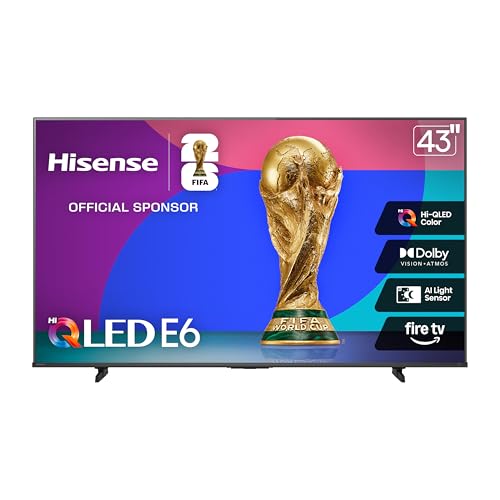
9. Hisense E6 43-Inch: Best Compact Fire TV
Pros
- Compact 43-inch screen
- 4K Hi-QLED color
- Dolby Vision and Dolby Atmos
- AI light sensor and AI upscaling
- Wi-Fi 6
Cons
- No Mini-LED backlight is listed
- Motion Rate 120 is not a native 144Hz specification
- Small screen is less suited to a large seating area
Best for: bedrooms, offices, dorm rooms, and compact apartments.
The Hisense E6 43-Inch is the most practical small TV here for viewers who want Fire TV rather than a separate streaming stick. Its 43-inch panel fits spaces where a 50-inch or 55-inch screen would be awkward, while 4K resolution keeps menus, streaming video, and compatible console games sharp at a closer distance.
The feature set is not stripped down simply because the screen is smaller. Hi-QLED color is joined by Dolby Vision, HDR10+ Adaptive, HDR10, and HLG. Dolby Atmos support adds compatible spatial audio processing, although the compact chassis still has physical limits compared with a dedicated sound system.
Hisense includes an AI light sensor, AI 4K Upscaler, and AI Smooth Motion with MEMC. The sensor can adjust brightness to changes in the room, while upscaling is useful for older television content. Motion Rate 120 is listed, but there is no native 144Hz claim, so this model is better for everyday viewing than competitive gaming.
The Roku 50-Inch Select is the closest rival in size and offers the cleaner Roku interface, voice search, AirPlay, and Bluetooth Headphone Mode. The Hisense wins on HDR format support and Fire TV features. If the screen will sit in a bright bedroom, the U6 Pro is a much stronger technical option, but its 65-inch size makes it unsuitable for most compact spaces.
Choose the E6 43-Inch when room dimensions are the deciding factor and you want a complete smart-TV platform. It is not the right model for a large family room or anyone chasing Mini-LED black levels.
10. Roku 50-Inch Select: Best Compact Roku

Pros
- Compact 50-inch size
- Easy Roku TV navigation
- 4K QLED picture
- HDR10 support
- Bluetooth Headphone Mode
Cons
- Native refresh rate is not specified
- No Mini-LED backlight is listed
- HDR support is narrower than the Hisense E6
Best for: small living rooms and viewers who prefer Roku’s interface.
The Roku 50-Inch Select is the simplest compact screen in the roundup. It keeps the same general Roku experience as the 55-inch and 65-inch versions, but the 50-inch format is easier to fit on a smaller media console. Its listed dimensions are 43.7 inches wide and 27.9 inches high, with a listed weight of 16.8 pounds.
The 4K QLED screen uses HDR10, and Roku Smart Picture adjusts incoming signals and picture modes automatically. That approach suits viewers who do not want to navigate through detailed calibration menus. Roku also emphasizes clear speech and louder sound, while Bluetooth Headphone Mode supports private listening.
Its streaming features are stronger than its advanced picture specifications. The home screen keeps apps, recommendations, and search in one place, and the enhanced voice remote adds personal shortcuts and a lost remote finder. Roku Voice, Siri, Alexa, Google Assistant, and Apple AirPlay are supported, making the TV easy to add to a mixed smart-home setup.
The Hisense E6 50-Inch is the better technical choice if Dolby Vision, HDR10+ Adaptive, Dolby Atmos, an AI light sensor, or Wi-Fi 6 matter to you. The Roku is easier for a household that wants a clean, familiar interface and does not need those additions. Like the other Roku Select models, its listing does not specify a native refresh rate.
Choose the Roku 50-Inch Select for a small room where simplicity matters more than cinema-grade contrast. If you want the same compact footprint with broader HDR support, the Hisense E6 50-Inch deserves a close look.
How to choose best qled tv
The right QLED television depends on the room, the content you watch, and how much picture control you want. Start with the backlight and motion system, then narrow the choice by screen size and smart platform.
Backlight and contrast
QLED describes the color layer, not the entire backlight system. Standard QLED models such as the Roku Select TVs use quantum-dot color but do not list Mini-LED or local dimming. The Hisense U6 Pro, Hisense E7, and TCL QM6K add Mini-LED systems designed to improve shadow depth and highlight control.
Quantum-dot color makes colors richer, but local dimming is what gives bright HDR objects a darker background.
For movies and HDR games, Mini-LED is the more important upgrade. It can make dark scenes look more convincing and reduce the flat gray appearance that can occur when a television illuminates the whole screen evenly.
Refresh rate and motion
A native 144Hz panel is the clearest choice for high-frame-rate gaming, quick sports, and fast camera movement. The Hisense U6 Pro, Hisense E7, TCL T7, and TCL QM6K list native 144Hz performance. The Hisense E6 models list Motion Rate 120 and MEMC, while the Roku models do not specify a native refresh rate.
Motion Rate numbers can combine several processing techniques, so they should not be treated as direct substitutes for native panel refresh. For gaming, look for the native figure first. For films and television, good processing can still help, but excessive smoothing may make content look artificial.
HDR formats
Dolby Vision, HDR10+, HDR10, and HLG are the main formats represented in this list. The Roku Select models list HDR10, while the TCL and Hisense models support a wider selection. Dolby Vision IQ and HDR10+ Adaptive can respond to scene or room conditions, depending on the content and the television’s processing.
More format support gives you better compatibility, but it does not guarantee stronger HDR by itself. A Mini-LED backlight with effective dimming generally matters more than a long format list on a standard backlight.
Screen size and viewing distance
A 65-inch screen makes the strongest impact in a larger living room, but it needs enough wall or stand width. The Roku 65-Inch Select, Hisense 65-inch models, and TCL 65-inch models are all roughly 57 inches wide, so the furniture needs room beyond the panel itself.
The 55-inch Roku is about 48.3 inches wide, while the 50-inch models are about 44 inches wide. The Hisense 43-Inch E6 is about 37.9 inches wide. Measure the actual stand, wall, and viewing position before choosing the size. A screen that is too large for the room can be tiring, while a screen that is too small can make subtitles and fine detail harder to enjoy.
Smart platform and connections
Roku TV is the most direct platform in this group, with an uncluttered home screen, voice search, AirPlay, and Bluetooth Headphone Mode. Fire TV adds live channels, Alexa control, watchlists, and recommendations. Google TV on the TCL models is a strong option for viewers already using Google Assistant and Google services.
Gamers should pay close attention to connections. The TCL T7 lists four HDMI inputs, including one with eARC, which is useful for several consoles and a soundbar. The other listings do not provide an equally detailed connection breakdown, so buyers with a complex setup should verify the layout before ordering.

Frequently asked questions
Is QLED better than regular LED?
QLED adds a quantum-dot color layer to an LED television, which can produce richer and more vibrant color. It does not automatically mean deeper blacks or better HDR. The backlight system matters too, so a Mini-LED QLED model can have a more substantial contrast advantage than a standard QLED model.
Which TV here is best for gaming?
The Hisense U6 Pro 65-Inch, Hisense E7 65-Inch, TCL T7 65-Inch, and TCL QM6K 65-Inch all list native 144Hz performance. The TCL T7 has the clearest connection advantage because it lists four HDMI inputs, including one with eARC. The Mini-LED Hisense and TCL models are stronger choices if contrast also matters.
Are the Roku Select TVs good for streaming?
Yes. Roku TV is easy to navigate, apps launch quickly, and the voice remote supports search and shortcuts. The Roku models also include AirPlay, voice-assistant compatibility, automatic updates, and Bluetooth Headphone Mode. Their picture specifications are simpler than those of the Mini-LED models.
Does Mini-LED matter for movies?
Mini-LED can matter a great deal in dark movie scenes because it uses many smaller backlight zones to control brightness across the screen. The Hisense U6 Pro, Hisense E7, and TCL QM6K are the Mini-LED choices here. They are better suited to a movie-focused room than the standard QLED Roku models.
Which model is best for a small room?
The Hisense E6 43-Inch is the smallest model in the roundup and offers Fire TV, Dolby Vision, HDR10+ Adaptive, and an AI light sensor. The Roku 50-Inch Select is another compact choice with a simpler interface. Pick based on whether Fire TV features or Roku navigation suits your household better.
Do all these TVs support Dolby Vision?
No. The Roku Select models list HDR10 but do not list Dolby Vision. The TCL T7 and TCL QM6K support Dolby Vision, and the Hisense E6, E7, and U6 Pro models support Dolby Vision variants. Content and picture performance still depend on the panel and backlight system.
The bottom line
The Best qled tv choice in this group is the Hisense U6 Pro 65-Inch. Its Mini-LED backlight, native 144Hz refresh rate, glare-free screen, built-in subwoofer, and wide HDR support give it the broadest ability to handle movies, sports, bright rooms, and games.
Choose the TCL QM6K 65-Inch if local-dimming control and Google TV are more appealing, or the TCL T7 65-Inch if four HDMI inputs are central to your gaming setup. For simple streaming, the Roku Select models remain easy to live with, while the Hisense E6 models make sense when you want Dolby Vision and Fire TV in a smaller or less demanding screen.
If you are undecided, choose the Hisense U6 Pro for picture performance, the TCL T7 for connection flexibility, or the Roku model that best fits your room.
As an Amazon Associate we earn from qualifying purchases.