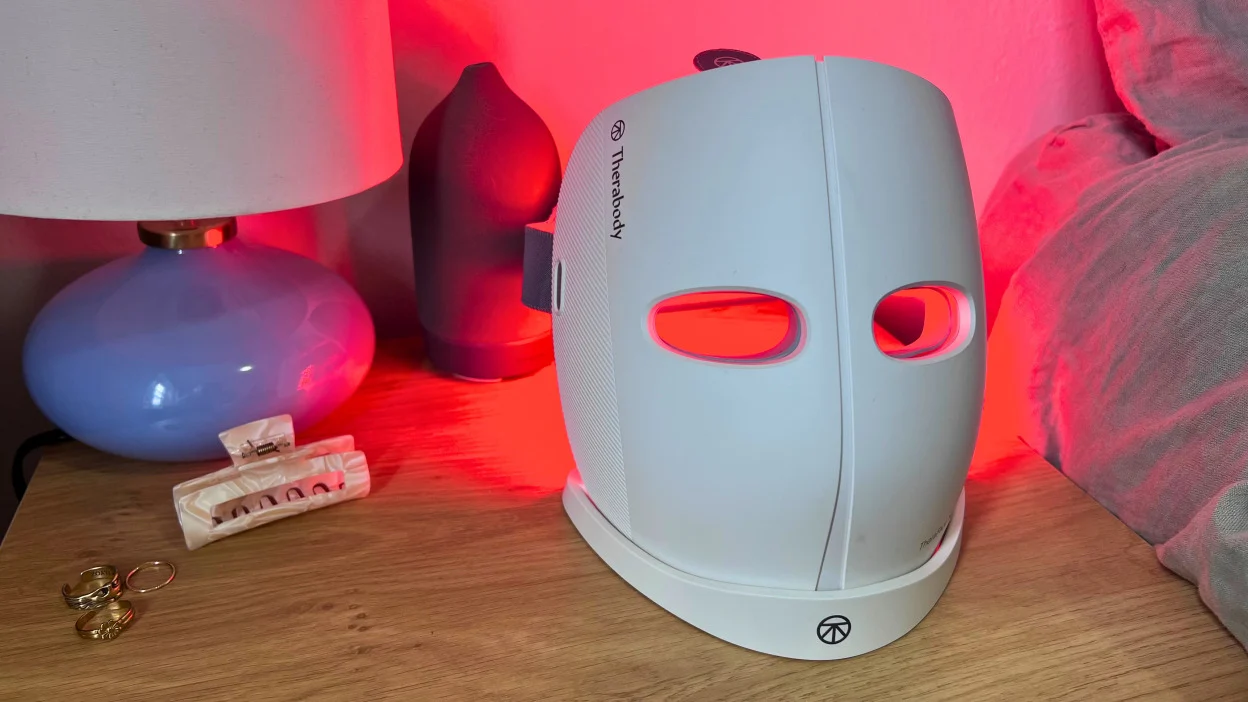

A red light mask is only useful if you will actually wear it often enough to build a routine. The awkward fit, bright LEDs, charging cable, and confusing mode buttons can turn a promising skincare device into a drawer ornament. We looked for masks that make regular sessions straightforward, while separating credible wavelength combinations from feature-heavy designs that do not explain enough.
The Best red light mask choices below range from compact face-only devices to flexible masks with neck coverage, blue light, amber light, and near-infrared treatment. Some use a cord for consistent power, while others add rechargeable controllers for moving around during a session.
For most people, the INTEO Face & Neck Mask is the best starting point, while the list also includes the strongest option for triple-wavelength treatment, the most refined premium design, and several flexible alternatives.
| # | Product | Award | Wavelengths | Coverage | Best for |
|---|---|---|---|---|---|
| 1 | INTEO Face & Neck Mask | Best overall | 660nm, 850nm, 600nm, 460nm | Face, neck, chest | Full-area cordless routines |
| 2 | INIA GLOW 4D | Best cooling design | Dual NIR, red, blue, amber | Full face | Comfortable multitasking |
| 3 | iRestore LED Face Mask | Best triple-wavelength pick | 635nm, 830nm, 415nm | Face | Wrinkles and blemishes |
| 4 | wavytalk Glow Time | Best for detailed controls | 630nm, 850nm, 415nm, 590nm | Full face | Targeted mode selection |
| 5 | Onisdin Face and Neck Mask | Best simple face and neck option | 630nm, 850nm | Face and neck | Straightforward sessions |
| 6 | MEGELIN Face and Neck Mask | Best multicolor mask | 420nm to 850nm | Face and neck | Broad mode variety |
| 7 | INIA 4 Mode Mask Pink | Best adjustable timing | 620nm, 630nm, 460nm to 470nm, 850nm | Face | Flexible treatment schedules |
| 8 | INIA 4 Mode Mask Black | Best everyday alternate | 620nm, 630nm, 460nm to 470nm, 850nm | Face | Daily skincare routines |
| 9 | CurrentBody Series 2 | Best premium wavelength set | 633nm, 830nm, 1072nm | Face | Advanced near-infrared coverage |
| 10 | NEWKEY 4D Mask | Best corded design | 630nm, 465nm | Face | Consistent plugged-in power |
1. INTEO Face & Neck Mask: Best Overall

Pros
- Covers the face, neck, and chest
- Combines red, near-infrared, orange, and blue light
- Rechargeable cordless controller
- Timer options from 10 to 30 minutes
- Soft silicone construction with light-blocking eye protection
Cons
- The larger coverage area can feel cumbersome
- The product information does not state irradiance
- The controller adds another piece to store and charge
Best for: someone who wants one cordless mask to cover more than the face.
The INTEO Face & Neck Mask makes a strong first impression because it tackles the part most face-only masks ignore: the skin below the jaw. Its soft silicone body is designed to sit across the face, neck, and chest, and the adjustable straps are intended to keep that larger panel in place. That broader footprint is its main reason for taking the top spot, but it also means this is not the smallest or least noticeable device in the group.
Its light selection is unusually broad. The primary red wavelength is 660nm, while near-infrared operates at 850nm. There is also a 600nm orange setting and a 460nm blue setting. Those options give the mask more flexibility than the simpler Onisdin Face and Neck Mask, especially for someone who wants to alternate between a red and near-infrared routine and the other available modes. The manufacturer says the mask uses 680 light beads, with coverage intended to reach the face, neck, and chest.
The rechargeable 2000mAh remote keeps the mask cordless, which matters when a session happens while moving around the house or traveling. The controller offers 10, 15, 20, 25, and 30-minute timer settings, and the mask shuts off when the selected session ends. The stated routine is 20 minutes, three to four times a week. That is an easy schedule to remember, though the claimed 120 minutes per week on one charge does not tell us how much reserve remains outside that use pattern.
The weakness is the lack of a stated power density or irradiance figure. LED count alone does not explain how much light reaches the skin, so readers who want a tightly documented treatment specification should look at the CurrentBody Series 2 or iRestore LED Face Mask instead. The INTEO design is also physically large, and the combination of face, neck, and chest coverage may be more mask than a face-only user wants.
Choose it if you want coverage and routine convenience ahead of a minimal silhouette. It is the most versatile all-around design here, especially for someone who does not want to treat the face while leaving the neck out of the routine.
2. INIA GLOW 4D: Best Cooling Design

Pros
- Flexible medical-grade silicone
- 320 LEDs for full-face coverage
- Dual near-infrared technology
- Four red, blue, amber, and combo modes
- Includes a magnetic cooling gel pad
Cons
- No treatment irradiance is provided
- Face-only coverage
- The cooling pad adds setup and cleaning considerations
Best for: someone who wants a flexible wireless mask with a cooling element.
The INIA GLOW 4D is aimed at users who dislike the rigid feel of many LED masks. Its flexible silicone is described as medical-grade and intended to conform around the forehead, cheeks, chin, and jawline. That shape should help it sit closer to facial contours than a flat panel, although the listing does not provide a measured light distance or a power density figure.
The defining feature is dual NIR technology. The mask uses multiple near-infrared channels rather than presenting a single red-only treatment, and it pairs those channels with four modes. Red is intended for a smoother and more radiant appearance, blue for clearer-looking skin, amber for tone, and combo for a wider routine. The 320 LEDs support the full-face design, but the number of LEDs should not be treated as a direct substitute for irradiance or dose information.
The magnetic cooling gel pad is an unusual inclusion. It is designed to soothe puffy eyes and reduce the sensation of warmth or redness around the eye area. That makes this a more comfort-conscious design than the corded NEWKEY 4D Mask. Wireless operation also lets you use it while watching television or doing light tasks without keeping a cable attached to the mask.
INIA says visible improvements in brightness, smoothness, and firmness often appear within two to four weeks of consistent use. That is a manufacturer claim rather than a guarantee, and a routine device still depends on fit and regular sessions. Buyers who want a more exact schedule, such as the 10-minute sessions specified by iRestore, may find the available product information less specific.
The GLOW 4D makes sense for someone who values flexibility, cooling, and a wireless routine more than a fully documented technical sheet. It is a more comfortable-feeling proposition than some basic masks, but the lack of stated irradiance keeps it behind the most transparent technical designs.
3. iRestore LED Face Mask: Best Triple-Wavelength Pick

Pros
- Red, infrared, and blue wavelengths are clearly identified
- 360 LEDs
- Quick 10-minute sessions
- Dual straps and eye coverage
- Designed for women and men
Cons
- Face-only treatment
- No irradiance figure is supplied
- The mask is heavier than some listed alternatives
Best for: users who want clearly separated red, infrared, and blue light modes.
The iRestore LED Face Mask is the clearest choice for readers who want three specific wavelength bands without sorting through a long list of loosely described colors. It uses red light at 635nm, infrared at 830nm, and blue light at 415nm. That makes the intended roles easy to understand: red and infrared for the appearance of lines and firmness, with blue included for blemish-focused routines.
Its 360 LEDs are arranged across a face-only mask, and iRestore says the design hovers over the face instead of pressing directly against it. The dual-strap construction is meant to hold the mask securely while keeping direct light away from the eyes. At 1.81 pounds, the listed weight is not especially light, so comfort will depend heavily on strap adjustment and how long the user wants to wear it.
The session design is refreshingly simple. The recommended treatment takes 10 minutes, three to five times a week, and the mask can be used alongside a favorite serum or moisturizer. A short session is easier to fit into a morning or evening routine than the longer 20-minute schedule associated with the INTEO Face and Neck Mask. It also makes it less tempting to skip treatment because the device feels like a major project.
The iRestore does not offer neck or chest coverage, and the product information does not state irradiance or a dose per session. That is a meaningful gap for readers comparing it with the wavytalk Glow Time, which does list a 40mW/cm² power density. The iRestore also costs more than the compact INIA 4 Mode Mask designs, but the attraction here is the clearer three-wavelength structure and the short routine, not a broad selection of decorative modes.
For a wider look at how face masks differ from other home devices, the treatment areas that change between facial and full-body devices can help put this face-only design in context. Pick the iRestore if your priorities are a defined red, infrared, and blue system, straightforward timing, and a mask that can be used by more than one person in a household.
4. wavytalk Glow Time: Best for Detailed Controls

Pros
- 456 LED chips
- Stated 40mW/cm² power density
- Red, near-infrared, blue, and amber modes
- 10, 15, and 20-minute timer settings
- 2500mAh rechargeable battery
Cons
- The required 5V/1A charger is not included
- Face-only coverage
- More settings can make the routine less simple
Best for: someone who wants technical light-output information and several targeted modes.
The wavytalk Glow Time is one of the more technically specific masks in this group. It lists 456 high-purity LED chips and a power density of 40mW/cm², giving the reader more useful context than a raw LED count alone. The liquid silicone body, adjustable straps, and light-sealing eye pads are designed for full-face coverage and hands-free use.
Its three treatment categories are easy to distinguish. Anti-fine-line mode combines 630nm red light with 850nm near-infrared. Anti-acne mode combines 415nm blue light with 630nm red light, while rejuvenation mode uses 590nm amber light. That arrangement is more purposeful than a generic seven-color menu, although the manufacturer does not provide a separate output figure for each mode.
The 2500mAh battery supports cordless sessions, and the timer can be set for 10, 15, or 20 minutes. The included USB-C cable is convenient, but the stated charging requirement is a 5V/1A charger, which is not included. That is a small but important ownership detail because a spare high-output phone charger should not automatically be assumed to be the right choice.
Wavytalk cites lab results for breakouts, fine lines, and radiance after 28 days. Those figures are claims from the product listing, not a promise that every user will see the same change. The stronger point is that this mask gives you a stated power density and a mode layout that matches common skincare goals. By contrast, the MEGELIN Face and Neck Mask offers more color choices but less clarity about what each setting does in practical treatment terms.
The drawback is choice overload. Someone who simply wants to press one button and follow a fixed routine may prefer the NEWKEY 4D Mask or iRestore LED Face Mask. The wavytalk is better for a user willing to choose a mode deliberately and keep a consistent schedule.
5. Onisdin Face and Neck Mask: Best Simple Face and Neck Option

Pros
- Face and neck coverage
- 630nm red light and 850nm near-infrared
- Five brightness levels
- Portable power storage
- Simple hands-free operation
Cons
- The listing gives few technical details
- No LED count or irradiance is stated
- Mode information is limited
Best for: someone who wants face and neck coverage without a complicated control system.
The Onisdin Face and Neck Mask is the least complicated design in this roundup. Its core treatment uses 630nm red light and 850nm near-infrared, with five brightness adjustments rather than a large collection of different colors. That makes it appealing to a user who would rather tune intensity than decide between several treatment categories.
The mask is designed to distribute light across the face and neck, and the product description calls out a lightweight, ergonomic construction. It also includes portable power storage, so the routine is not tied to a wall outlet. Those details put it closer to the INTEO Face and Neck Mask than to a compact face-only product, though INTEO provides much more information about its timers and additional wavelengths.
The problem is the limited technical documentation. Onisdin does not state how many LEDs are used, what irradiance reaches the skin, or how the brightness levels translate into treatment dose. The five settings may be useful for comfort, but they do not tell you how much energy each session delivers. That makes it difficult to compare directly with the wavytalk Glow Time, whose 40mW/cm² figure gives a more concrete point of reference.
This mask is also less flexible than models with blue or amber modes. If acne-focused light is important, the iRestore LED Face Mask or NEWKEY 4D Mask has a clearer blue-light option. If a user wants face, neck, and chest coverage, INTEO remains the more complete design.
The Onisdin is best for someone who values a simple red and near-infrared routine and does not need a detailed control panel. Skip it if you want to evaluate output using published power figures or if your routine depends on multiple wavelength choices.
6. MEGELIN Face and Neck Mask: Best Multicolor Mask

Pros
- Face and neck mask
- Seven light colors
- 288 face LEDs and 198 neck LEDs
- Flexible silicone construction
- Rechargeable and foldable
Cons
- No irradiance figure is stated
- The product does not identify each color's wavelength separately
- Cannot be used while charging
Best for: users who want a broad selection of color modes and neck coverage.
The MEGELIN Face and Neck Mask takes the broadest mode approach here. It offers seven colors across a stated wavelength range of 420nm to 850nm, with separate face and neck sections. The face portion uses 288 LEDs and the neck portion uses 198 LEDs, giving the device a substantial amount of light hardware across both treatment areas.
That broader selection may be useful for someone who likes to vary routines, but it also creates a documentation problem. The listing does not identify the exact wavelength assigned to each of the seven colors. By comparison, wavytalk clearly connects 630nm and 850nm to its anti-fine-line mode, and iRestore names 635nm, 830nm, and 415nm individually. More colors do not automatically mean more useful treatment.
The flexible silicone body is designed to fit different face shapes, and the adjustable straps help secure both sections. It is rechargeable, foldable, and includes eye pads intended to reduce discomfort from the LEDs. MEGELIN recommends sessions lasting 10 to 20 minutes, three to four times a week, and says the mask should not be used while charging. That last point makes planning more important than with a wired model.
MEGELIN provides a 365-day warranty, which is a useful ownership detail, but it does not replace missing output information. The lack of an irradiance figure means the reader cannot tell how the mask compares with the 40mW/cm² listed for wavytalk or the 75mW/cm² claimed by NEWKEY. Those published figures still need to be interpreted carefully, but they offer more information than LED count alone.
Choose this mask if face and neck coverage plus color variety are the main attractions. Readers who want a focused red and near-infrared treatment should choose Onisdin instead, while those who want the most precisely described mode set should move to iRestore or wavytalk.
7. INIA 4 Mode Mask Pink: Best Adjustable Timing
Pros
- Red, blue, and near-infrared options
- 220 LED chips
- Stated output up to 105mW/cm²
- Rechargeable 2600mAh controller
- 10, 20, and 30-minute timer settings
Cons
- Face-only coverage
- No neck treatment
- The product listing does not separate output by mode
Best for: someone who wants a rechargeable face mask with several timer choices.
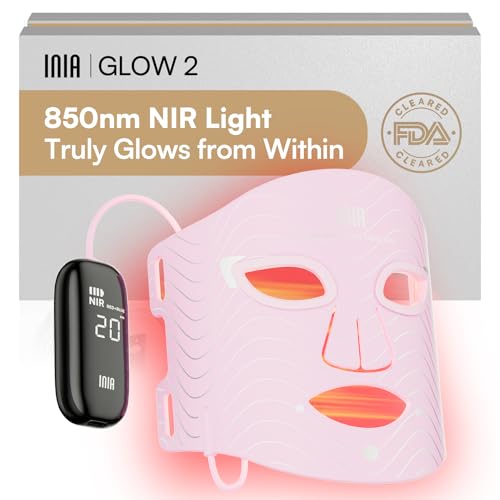
The INIA 4 Mode Mask Pink is a practical face-only design with a useful balance between control and simplicity. It has four light modes: Red-L at 620nm, Red-H at 630nm, blue at 460nm to 470nm, and a red plus blue setting covering 460nm to 630nm. Near-infrared can be activated with the NIR button, adding 850nm to the selected routine.
The mask uses 220 LED chips and claims output up to 105mW/cm². That is a high stated figure compared with several masks here, although “up to” does not explain whether the number applies uniformly across the face or to a particular operating mode. The listing also does not give a separate irradiance value for red, blue, and NIR operation, so the figure should be treated as useful context rather than a complete dose description.
A 2600mAh rechargeable controller powers the mask, and the timer offers 10, 20, or 30-minute sessions. The mask automatically shuts off at the end, which is helpful when the device becomes part of a regular evening routine. INIA recommends using it three to seven times a week for 10 to 30 minutes, giving users more scheduling freedom than the fixed 10-minute approach of the NEWKEY 4D Mask.
The main limitation is coverage. This is a face mask, not a face and neck system, so the Onisdin, MEGELIN, and INTEO designs are better suited to anyone concerned about the neck. It also has fewer LEDs than the 360-LED iRestore and 456-chip wavytalk, though those counts do not independently establish which mask will perform better.
The pink INIA version is a good fit for someone who wants a portable face-only device and appreciates the ability to select a short or longer session. The color is the only clear distinction from the black INIA 4 Mode Mask in this dataset, so choose between them based on the finish you prefer rather than expecting a different light system.
8. INIA 4 Mode Mask Black: Best Everyday Alternate

Pros
- 620nm and 630nm red settings
- 850nm near-infrared activation
- Blue and red plus blue modes
- 2600mAh rechargeable controller
- Automatic shutoff with three timer choices
Cons
- Face-only coverage
- No separate output figures for each mode
- Requires regular charging
Best for: users who want a familiar four-mode face mask in a black finish.
The INIA 4 Mode Mask Black has the same core design as the pink version, but it is worth treating it as its own listing because the two entries are separate products here. It combines 620nm and 630nm red settings with blue light at 460nm to 470nm. The red plus blue mode spans 460nm to 630nm, and the NIR button adds 850nm near-infrared to the selected treatment.
That set of controls is more useful than a generic color wheel. A user focused on a red-light routine can select one of the red settings, while someone building a blemish-focused routine can use blue or red plus blue. The NIR control adds another layer without forcing every session to use near-infrared. The product says consistent use over four or more weeks can improve the appearance of tone, elasticity, and texture, but individual results will vary.
The 220 LED chips are paired with a stated output of up to 105mW/cm². Again, that is a maximum claim and not a complete description of delivered dose. There is no separate output figure for each wavelength or an explanation of how the LEDs are distributed across the face. Readers who want more published power detail should consider wavytalk or NEWKEY.
The 2600mAh rechargeable controller gives the mask freedom from a wall outlet. Its 10, 20, and 30-minute settings and automatic shutoff suit users who do not want to watch a clock during treatment. The trade-off is that the controller must be charged, and the face-only shape leaves the neck untreated.
If you are comparing portable skincare devices, how cordless treatment changes daily use is a useful question to settle before choosing a mask. The black INIA is a sensible everyday option for someone who wants flexible timing and clearly labeled red, blue, and NIR controls without moving into a neck-covering design.
9. CurrentBody Series 2: Best Premium Wavelength Set

Pros
- Three named wavelengths
- Includes deep near-infrared at 1072nm
- Flexible liquid silicone design
- 236 LED bulbs
- Veritace NFC card included
Cons
- Face-only coverage
- No power density is listed
- Contraindications require careful review before use
Best for: users who want a refined flexible mask with an advanced wavelength layout.
The CurrentBody Series 2 stands apart through its wavelength combination rather than a long list of colors. Its 236 LED bulbs emit red light at 633nm, near-infrared at 830nm, and deep near-infrared at 1072nm. That third band is the distinctive feature, giving this mask a more ambitious light layout than the dual-wavelength INTEO and Onisdin designs.
CurrentBody says the flexible liquid silicone shape has been tested on thousands of faces for coverage and comfort. That kind of fit matters because a mask that sits unevenly can leave parts of the face farther from the LEDs. The product also includes a Veritace NFC card with information about how the individual mask delivers results, an unusual traceability feature that is not offered by the other products in this list.
The Series 2 is designed to improve the appearance of fine lines, wrinkles, redness, brightness, and smoothness. Its product information is less specific about session timing than the iRestore, INIA, and NEWKEY listings. It also does not state irradiance, so the sophisticated wavelength list should not be confused with a complete treatment-dose specification.
The mask is face-only, and its instructions include contraindications that should be reviewed before purchase and use. That caution is important with any light-based skincare device, especially for users taking photosensitizing medication or managing a light-sensitive condition. Someone who needs neck coverage should choose INTEO, MEGELIN, or Onisdin instead.
The CurrentBody makes sense for a buyer who cares about flexible construction, a named deep near-infrared wavelength, and added product-level information. It is less appealing for someone who wants blue light for blemishes, a clearly stated power density, or a quick, explicitly timed routine.
10. NEWKEY 4D Mask: Best Corded Design

Pros
- Red light at 630nm and blue light at 465nm
- 450 light-emitting chips
- Stated output up to 75mW/cm²
- Automatic 10-minute shutoff
- Wired design provides steady power
Cons
- The cable limits movement
- Face-only coverage
- No near-infrared mode is listed
Best for: someone who prefers consistent plugged-in operation over cordless convenience.
The NEWKEY 4D Mask takes a deliberately simple approach to power. It is corded, so there is no battery to charge and no concern that a session will end because the controller is low. That tether is inconvenient if you want to walk around, but it gives the device a predictable routine for someone who plans to sit upright or lie down for 10 minutes.
Its two named wavelengths are 630nm red and 465nm blue. Red is aimed at the appearance of wrinkles and overall skin tone, while blue is included for acne-focused treatment. The mask has 150 LEDs containing 450 light-emitting chips, and NEWKEY states output up to 75mW/cm². The 4D contour is designed to follow facial bone structure, with a stated 5mm light distance intended to improve coverage and reduce leakage.
The automatic 10-minute shutoff is one of the best features here. It removes the need to set a separate timer and fits neatly into the every-other-day, three-times-weekly routine described by the manufacturer. This is less adjustable than the INIA masks, which offer 10, 20, and 30-minute settings, but the fixed schedule may be exactly what helps a busy user stay consistent.
The trade-off is the missing near-infrared option. The INTEO Face and Neck Mask, iRestore LED Face Mask, and CurrentBody Series 2 all include infrared or near-infrared wavelengths, while NEWKEY stays with red and blue. It also covers only the face, and the cable makes it less portable than the rechargeable wavytalk Glow Time.
The NEWKEY is a sensible choice for someone who wants a defined 10-minute routine, steady wired power, and published output information. Skip it if cordless use, neck coverage, or near-infrared treatment matters more than avoiding a charging cycle.
How to choose best red light mask
The right mask is the one whose light setup, fit, and routine you can use consistently. Focus on the treatment area and the information the manufacturer actually provides, not just the largest LED number.
Wavelengths
Red light is commonly listed around 620nm to 660nm in this group, while near-infrared appears at 830nm, 850nm, or 1072nm. Blue light is generally positioned for blemish-focused routines, and amber or orange modes are offered for tone and radiance claims. A mask with several colors is not automatically more effective, especially when the listing does not identify the exact wavelength or output for each mode.
Irradiance and dose information
LED count tells you how many light sources are present, but it does not say how much light reaches the skin. Irradiance, expressed in mW/cm², gives more useful context, as seen with the stated figures for wavytalk, INIA, and NEWKEY. Be cautious with “up to” figures because they may describe a maximum rather than uniform output across the whole mask.
A high LED count is only useful when the mask explains how much light reaches your skin.
Coverage and fit
Face-only masks are smaller and usually easier to store, but they leave the neck out of the routine. Face and neck designs such as INTEO, Onisdin, and MEGELIN cover more area but can feel larger and heavier. Flexible silicone, adjustable straps, eye pads, and a shape that follows the face all matter because poor contact or uneven positioning can make regular use unpleasant.
Power and session timing
Cordless masks are easier to use away from an outlet, but they need charging. A wired model such as NEWKEY avoids battery interruptions while limiting movement. Timer choices also affect routine friction. Ten-minute automatic shutoff is simple, while 10, 20, and 30-minute options suit users who want to vary session length.
Mode controls
Choose controls that match your actual skincare goals. Red plus near-infrared is the central combination in many masks here, while blue light adds a blemish-oriented option. A seven-color system may sound comprehensive, but clearly labeled modes such as those on wavytalk and iRestore are easier to use intelligently.
Frequently asked questions
How often should you use a red light mask?
The products in this roundup generally suggest using a mask three to seven times a week, depending on the model. Session lengths range from 10 to 30 minutes. Follow the instructions for the specific device and keep the routine consistent rather than extending sessions without guidance.
Is near-infrared light important in a face mask?
Near-infrared is included in many of these masks at wavelengths such as 830nm and 850nm. It is intended to complement visible red light, but its presence does not by itself prove that a mask is better. Look for a clearly stated wavelength, output information, and a fit that keeps treatment coverage even.
Can a red light mask help with acne?
Some masks include blue light alongside red light for blemish-focused routines. The iRestore LED Face Mask, wavytalk Glow Time, INIA 4 Mode Mask, and NEWKEY 4D Mask all list blue light. Anyone with persistent or severe acne should still discuss treatment options with a qualified medical professional.
Do red light masks cover the neck?
Only some do. INTEO, Onisdin, and MEGELIN are designed for the face and neck, while the other products here are face-only. Check the shape carefully because a face-only mask will not treat the neck even if it includes near-infrared light.
Are cordless masks better than wired masks?
Cordless masks are more convenient for moving around and traveling, but they depend on a charged controller. A wired mask provides continuous power but keeps you near an outlet. The better design is the one that fits where you expect to complete your sessions.
Should you use skincare products before a light mask?
The product instructions vary. iRestore says its mask can be used with favorite serums or moisturizers, while other devices may have more specific instructions. Clean skin is a sensible starting point, and you should follow the supplied manual, especially if a product contains ingredients that increase light sensitivity.
What safety information should you check?
Review the contraindications and usage instructions before the first session. CurrentBody specifically directs buyers to review contraindications in the product description, and other masks advise reading the manual. Stop use if you experience unusual discomfort and seek professional advice if you have a light-sensitive condition or take photosensitizing medication.
The bottom line
The Best red light mask for most readers is the INTEO Face & Neck Mask because it combines face, neck, and chest coverage with red, near-infrared, orange, and blue modes, plus a rechargeable controller. Its missing irradiance figure is a real weakness, but its coverage and flexible routine make it the easiest all-around recommendation.
Choose the iRestore LED Face Mask if you want clearly named red, infrared, and blue wavelengths with quick 10-minute sessions. The CurrentBody Series 2 is the more advanced pick for a flexible premium design and a 1072nm deep near-infrared wavelength, while wavytalk is the better option for a published power-density figure and targeted controls.
If you are undecided, choose the mask with the coverage and session length you will use consistently, then treat extra colors as a bonus rather than the main reason to buy.
As an Amazon Associate we earn from qualifying purchases.