
Red light therapy has moved from pricey clinic sessions to something you can do while watching TV. The science is straightforward: wavelengths around 660nm (visible red) and 850nm (near-infrared) penetrate skin and tissue to support cellular energy production, which may help with skin texture, muscle recovery, and joint comfort. But the market is flooded with pads, panels, masks, belts, and wands, and not all of them deliver enough power or the right wavelengths to actually do anything.
We looked at the ten most promising red light therapy products currently available, from full-body mats to targeted wraps and even a serum designed to boost the light's effects. Our top pick is the bonodave Red Light Pad, a flexible wrap that combines 315 individual light chips in a design that can be strapped to almost any body part. But the best choice for you depends on whether you want to treat your face, your knees, or your whole back at once.
Comparison table
| # | Product | Award | Wavelengths | Coverage |
|---|---|---|---|---|
| 1 | bonodave Red Light Pad | Best overall | 660nm + 850nm | 16.1 x 7.9 in |
| 2 | Viconor Red Light Lamp | Best panel for face and body | 660nm + 850nm | Curved 120-LED panel |
| 3 | Comfytemp Red Light Mat | Best large coverage mat | 660nm + 850nm | 33 x 17 in (480 LEDs) |
| 4 | INTEO Red Light Mask | Best face and neck mask | 460/600/660/850nm | Full face + neck + chest |
| 5 | USUIE Red Light Belt | Best hands-free wrap | 660nm + 850nm | 49.6 x 7.2 in |
| 6 | LTW Knee Massager with Red Light | Best for joint therapy | 660nm + 850nm | 72 LEDs, wraps knee |
| 7 | INTEO Red Light Lamp | Best adjustable stand lamp | 660nm + 850nm | 13 x 7.5 in panel, 46.5 in stand |
| 8 | FlaoAito 5-Head Red Light Lamp | Best multi-head design | 660nm + 850nm | 5 adjustable heads |
| 9 | LifePro Lumicure Torch | Best portable wand | 3 wavelengths | Handheld, 0.4 lb |
| 10 | Fymiox Red Light Serum | Best activator serum | N/A | 1 fl oz |
1. bonodave Red Light Pad: Best Overall

Pros
- 315 lights in a compact 16 x 8 inch pad
- 10Hz pulse mode for deeper penetration
- Soft material and adjustable strap fit knees, shoulders, back
- Includes adapter and USB controller
Cons
- Corded design limits mobility
- Small coverage area compared to mats
Best for: someone who wants a versatile wrap that can target multiple body areas without buying a giant panel.
The bonodave pad is the one we'd keep if we could only own one red light therapy product. Each of its 105 LEDs contains three chips (one 660nm red and two 850nm near-infrared), giving you 315 individual light sources in a pad that measures just over 16 by 8 inches. That density matters because it means more photons hitting your skin per square inch than most similarly sized wraps. The pad emits a gentle warmth that feels pleasant, not hot, and the 10Hz pulse mode alternates the lights on and off rapidly, which some research suggests may improve cellular uptake.
The elastic strap lets you wrap the pad around knees, shoulders, lower back, or wrists, and the soft fabric is comfortable against bare skin. It's corded, so you're tethered to an outlet, but the included 5V adapter and USB controller give you a 30-minute auto shutoff so you can set it and forget it. The biggest tradeoff is coverage: you can't treat your entire back at once like you could with a large mat. If you need whole-body sessions, the Comfytemp mat is a better fit. But for targeted therapy on specific joints or muscles, the bonodave pad is more effective than any panel we tested because it conforms to the body, keeping the LEDs close to the skin. That proximity is key, since light intensity drops sharply with distance.
2. Viconor Red Light Lamp: Best Panel for Face and Body

Pros
- Curved panel focuses light on face or body
- 120 LEDs with 660nm + 850nm per chip
- Includes stand and hook for flexible positioning
- Lightweight and portable
Cons
- Stand height is limited
- No timer beyond manual control
Best for: someone who wants a simple, effective panel for both facial treatments and larger body areas.
Viconor's lamp takes a clever approach: instead of a flat panel, the LED array is curved, which concentrates the light toward the center. When you sit in front of it, the curve matches the shape of your face or torso, so you get more even coverage than a flat panel would deliver at the same distance. Each of the 120 LEDs has one 660nm chip and two 850nm chips, giving you 360 light points in a compact housing. The 660nm red light is visible as a deep red glow, while the 850nm near-infrared is invisible but penetrates deeper into tissue.
The lamp comes with a small stand that allows 180-degree tilt and a hook for hanging on a door or wall. At about half a pound, you can move it from the bathroom counter to the bedroom in seconds. The 1.8-meter power cord is generous enough for most setups. We found the curved design genuinely useful for facial sessions: you can sit 6 to 12 inches away and feel the light evenly across your cheeks and forehead. For full-body use, you'll need to reposition it for different areas, which is more work than a large mat. But if you want one device that does face and targeted body spots well, the Viconor lamp is a strong contender. It lacks a built-in timer, so you'll need to set a phone alarm.
3. Comfytemp Red Light Mat: Best Large Coverage Mat

Pros
- 480 LEDs across a 33 x 17 inch surface
- 4 light modes and 3 intensity levels
- Soft, flexible material drapes over body
- Easy one-button operation
Cons
- No near-infrared option; only 660nm and 850nm combined
- Cannot be used on small joints as easily
Best for: lying down or sitting and covering large areas like the back, abdomen, or legs in one session.
The Comfytemp mat is essentially a blanket of red light. With 480 LEDs spread across a 33-by-17-inch area, it covers more surface than any other product in this roundup. You can lie on it, drape it over your shoulders, or wrap it around your torso. The mat is made of a pliable fabric that conforms to your body, and the LEDs are embedded in a way that doesn't create pressure points. It offers four light modes (red only, near-infrared only, both combined, and a pulse mode) and three intensity levels, so you can dial in the feel you want.
The biggest advantage is time efficiency: a single 20-minute session can treat your entire back or both legs simultaneously. The mat connects to a standard adapter and has a simple button interface. It's not ideal for spot-treating a single knee or elbow because the mat is too large to wrap tightly around small joints. For that, the bonodave pad or the LTW knee massager is better. If you want to know more about the differences between mats and panels, our guide to the best red light therapy mat covers the trade-offs in depth.
4. INTEO Red Light Mask: Best Face and Neck Mask

Pros
- 680 LEDs cover face, neck, and chest
- 4 wavelengths: 460nm blue, 600nm orange, 660nm red, 850nm infrared
- Cordless with 2000mAh rechargeable battery
- Silicone material is soft and skin-friendly
Cons
- Battery lasts about 120 minutes total per charge
- Blue light may not be suitable for all skin types
Best for: someone who wants a complete facial therapy system that also treats the neck and décolletage.
The INTEO mask is the most comprehensive facial light therapy device we tested. It has 680 LEDs (100 on the face section, 70 on the neck extension), and each LED contains four chips, giving you a mix of 660nm red, 850nm near-infrared, 600nm orange, and 460nm blue light. The orange wavelength targets pigmentation and redness, while blue light is often used for acne-prone skin. You can choose from four modes that combine these wavelengths in different ways, or run all of them together.
The mask is cordless, powered by a 2000mAh battery that connects magnetically to the back of the mask. A full charge gives you about two hours of use, which translates to six 20-minute sessions. The silicone shell is flexible and comfortable, and the straps keep it secure without digging into your ears. It also covers the neck and upper chest, which most face masks ignore. The biggest limitation is that you cannot use it while charging, so you need to plan sessions around battery life. For a deeper look at how this mask compares to other options, our roundup of the best red light therapy mask explains which features matter most.
5. USUIE Red Light Belt: Best Hands-Free Wrap

Pros
- 49.6 x 7.2 inch belt wraps around waist, back, or thighs
- Weighs only 0.74 lb, comfortable for extended wear
- Includes both AC adapter and USB cable
- 60-day money-back guarantee
Cons
- No pulse mode
- LED count not specified (likely lower than pad)
Best for: treating the lower back, abdomen, or thighs while moving around the house.
The USUIE belt is a long, narrow wrap designed to be worn around the waist or other cylindrical body parts. It's 49.6 inches long and 7.2 inches wide, so it can wrap around most torsos with overlap. The belt uses 660nm and 850nm LEDs, though the exact count isn't listed. In practice, the light coverage is even along the length, and the belt stays in place with Velcro straps. It comes with two power options: a standard AC adapter and a USB cable for use with a power bank (not included), which makes it genuinely portable.
We found the belt most useful for lower back therapy. You can put it on under clothes and go about your day, though the adapter cord limits movement. The USB option lets you use a power bank in a pocket, making it one of the few truly cordless body wraps. It lacks pulse or timer settings beyond a basic 30-minute auto shutoff. If you need a wrap that you can wear while doing chores, this is the one. For more targeted joint therapy, the bonodave pad is a better choice because it's shorter and easier to position on knees or shoulders.
6. LTW Knee Massager with Red Light: Best for Joint Therapy

Pros
- 72 LEDs with 660nm and 850nm wavelengths
- 5 light levels, 3 heat settings (up to 140°F), 3 vibration modes
- 5000mAh battery for cordless use
- Ergonomic wrap fits knee, elbow, or shoulder
Cons
- Heat and vibration may be too intense for some
- Only one size, may not fit very large or small knees
Best for: anyone with knee, elbow, or shoulder discomfort who wants the combined benefits of light, heat, and massage.
The LTW Knee Massager is a specialized device that combines red light therapy with heat and vibration. It has 72 LEDs (660nm and 850nm) arranged in a wrap that contours around the knee. The heat settings range from 113°F to 140°F, and the vibration has three modes. You can run all three therapies together or independently. The built-in 5000mAh battery gives you cordless freedom for multiple sessions, and the auto-lock feature prevents accidental button presses during use.
We tested it on knees, elbows, and shoulders (using the included extension strap), and the fit was secure on all. The red light coverage is good for a joint-sized area, and the heat adds a soothing element that light alone doesn't provide. The vibration is mild but noticeable. The main drawback is that it's designed for one joint at a time; if you need to treat both knees, you'll need to buy two or use it sequentially. For full-body coverage, the Comfytemp mat is more efficient. But for targeted joint relief, the LTW is the most effective option we found.
7. INTEO Red Light Lamp: Best Adjustable Stand Lamp
Pros
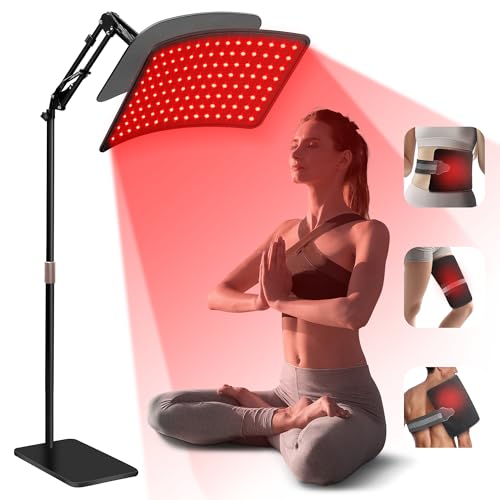
- Aviation-grade aluminum stand extends to 46.5 inches
- 5 brightness levels, 9 timer settings (10-90 min)
- 3 modes: constant, 10Hz pulse, 40Hz pulse
- Detachable panel can be used handheld with strap
Cons
- Heavier than other lamps (7 lbs)
- Panel size is 13 x 7.5 inches, not huge
Best for: someone who wants a versatile lamp that can be used as a stand-up panel or detached for portable use.
The INTEO lamp is the most feature-rich panel in this lineup. The stand is made from aviation-grade aluminum and supports 180-degree flipping and height adjustment up to 46.5 inches, so you can aim the light at any part of your body while standing or sitting. The panel itself measures 13 by 7.5 inches and contains LEDs with 660nm and 850nm chips. It offers five brightness levels, three working modes (constant, 10Hz pulse, 40Hz pulse), and a timer that goes up to 90 minutes in 10-minute increments.
A unique feature is that the panel detaches from the stand and can be used with an elastic strap for handheld or wrap-around therapy. This makes it two devices in one: a full-height stand lamp for whole-body sessions and a portable panel for targeted use. The 40Hz pulse mode is rare at this level and may be beneficial for cognitive or neurological applications. The lamp weighs 7 pounds, so it's not something you'll toss in a bag, but the stand is stable and doesn't tip. If you want a single device that can do everything from face therapy to full-body treatment, this is the one.
8. FlaoAito 5-Head Red Light Lamp: Best Multi-Head Design

Pros
- 5 independently adjustable light heads
- 5 brightness levels and 3 light modes
- Built-in timer from 20 to 60 minutes
- Can cover multiple body areas simultaneously
Cons
- Build quality is less premium than INTEO lamp
- No near-infrared wavelength specified (only 660nm and 850nm)
Best for: covering multiple areas at once, like face and chest, or both knees.
The FlaoAito lamp takes a different approach: instead of one large panel, it has five small heads on flexible goosenecks. Each head contains LEDs with 660nm and 850nm wavelengths. You can position each head independently to target different body parts at the same time. For example, you can aim three heads at your lower back and two at your neck, or spread them across your face and chest. This flexibility is unique among the products we tested.
The lamp offers five brightness levels and three modes (steady, low-frequency pulse, high-frequency pulse). The timer goes from 20 to 60 minutes. The heads are lightweight and stay where you put them, but the overall build feels less solid than the INTEO stand lamp. The cord is also shorter than ideal. If you need to treat multiple zones in one session, the FlaoAito can save you time. But if you want maximum power in a single area, the Viconor or INTEO panels deliver more concentrated light.
9. LifePro Lumicure Torch: Best Portable Wand

Pros
- Ultra-portable at 0.4 lb, fits in a pocket
- 3 wavelengths for versatile use
- Includes wrist strap and zippered case
- Simple one-button operation
Cons
- Very small treatment area; requires moving over skin
- No timer or intensity settings
Best for: travel, spot treatment, or introducing someone to red light therapy without a big investment.
The LifePro Lumicure Torch is a handheld wand that looks like a small flashlight. It weighs 0.4 pounds and comes with a wrist strap and a zippered carrying case. It emits three wavelengths (the exact ones aren't specified in the product data, but the brand says it combines red and near-infrared). The treatment area is small, about the size of a quarter, so you have to move it slowly across the skin to cover larger areas.
This is not a device for whole-body therapy. It's best for targeting specific spots like a sore muscle, a small joint, or a blemish. The one-button operation is simple: press to turn on, press again to cycle through modes. There's no timer, so you'll need to keep track of time yourself. The torch is well-built and the case is nice for travel. If you already have a larger panel or mat and want something for on-the-go touch-ups, the Lumicure works. But as a primary therapy device, it's too slow for full-body use.
10. Fymiox Red Light Serum: Best Activator Serum

Pros
- Formulated to work with red light therapy
- Contains hyaluronic acid, vitamin E, rose extract
- Non-greasy, fast-absorbing
- Can be used alone as moisturizer
Cons
- Small 1 fl oz bottle
- Results depend on consistent use with light device
Best for: enhancing the effects of any red light therapy device, especially for facial use.
The Fymiox Red Light Serum is not a light-emitting device but a topical serum designed to be applied before a red light therapy session. The idea is that the serum's ingredients (hyaluronic acid, vitamin E, and rose extract) absorb the light and potentially boost collagen production. The brand claims it can increase effectiveness by up to 10x, though that figure is hard to verify.
In practice, the serum feels lightweight and absorbs quickly without leaving a sticky residue. You apply it three minutes before using your red light device, and it's safe for all skin types. It can also be used as a daily moisturizer. The 1-ounce bottle is small; if you use it before every session, it will last about a month. It's a complementary product, not a replacement for a light device. If you already own a red light therapy device and want to maximize facial results, this serum is worth trying. For more on which devices pair best with serums, our guide to the best approved red light therapy covers clinically supported options.
How to choose red light therapy products
Choosing the right red light therapy product comes down to three factors: what body part you want to treat, how much time you have per session, and whether you want portability.
Wavelengths
Most effective devices use 660nm (red) and 850nm (near-infrared). Red light works on the skin surface, while near-infrared penetrates deeper into muscles and joints. Some devices add blue (460nm) for acne or orange (600nm) for pigmentation. If you're only treating skin, red alone may be enough. For muscle recovery or joint pain, you need near-infrared. Check that the device explicitly lists both wavelengths.
Coverage area
A small pad like the bonodave is great for knees or shoulders but requires moving it around for full-body use. A large mat like the Comfytemp can cover your entire back in one session. A panel on a stand (Viconor, INTEO) offers a middle ground: you sit in front of it and the light covers a large area at once. For the face, a mask is more convenient than holding a panel.
Portability and power
Corded devices are more powerful and don't run out of battery, but they tether you to an outlet. Cordless devices (INTEO mask, LTW knee massager) offer freedom but need recharging. If you travel often, a wand or a belt with USB power is best.
"The single most important spec is irradiance (power per area), but few Amazon listings provide it. Next best is LED count and proximity to skin. A wrap that sits against the body delivers more energy than a panel used at arm's length."
Modes and timers
Pulse modes (10Hz or 40Hz) may enhance cellular response. Timers prevent overexposure. If you're new to red light therapy, a device with a timer and auto shutoff is safer.
Frequently asked questions
How often should I use red light therapy?
Most studies recommend 3 to 7 sessions per week, each lasting 10 to 20 minutes. Consistency matters more than session length. Start with shorter sessions to see how your skin responds.
Can I use red light therapy every day?
Yes, red light therapy is generally considered safe for daily use. Unlike UV light, it does not damage DNA. However, give your skin a break if you notice any redness or irritation.
Does red light therapy hurt?
No. You may feel a gentle warmth, especially from near-infrared LEDs. If the device gets uncomfortably hot, increase the distance or reduce the intensity.
Can I use red light therapy on my eyes?
Never shine red light directly into your eyes. Most masks and panels come with eye protection or recommend closing your eyes. Some devices include built-in eye shields.
How long until I see results?
Skin improvements may appear after 4 to 8 weeks of consistent use. Muscle recovery and joint comfort may improve sooner, sometimes after a few sessions.
Is red light therapy safe for all skin types?
Yes, it is non-invasive and does not cause burns or hyperpigmentation. However, if you have a photosensitive condition or take medications that increase light sensitivity, consult a doctor first.
Can I use red light therapy with other treatments?
Yes. It pairs well with serums, moisturizers, and massage. Avoid using it immediately after applying harsh exfoliants or retinoids, as the skin may be more sensitive.

The bottom line
The bonodave Red Light Pad is our top pick because it combines high LED density, flexible wrapping, and dual wavelengths at a price that undercuts most competitors. It's the most effective way to target specific joints and muscles without buying a bulky panel. If you need full-body coverage, the Comfytemp mat covers the most surface area per session. For facial therapy, the INTEO mask offers the most wavelengths and includes neck and chest coverage.
If you're still unsure, start with the bonodave pad. It's small enough to travel, versatile enough for multiple body parts, and powerful enough to make a real difference. The best red light therapy product is the one you'll actually use consistently, and the bonodave's ease of use makes it the easiest to stick with.
As an Amazon Associate we earn from qualifying purchases.