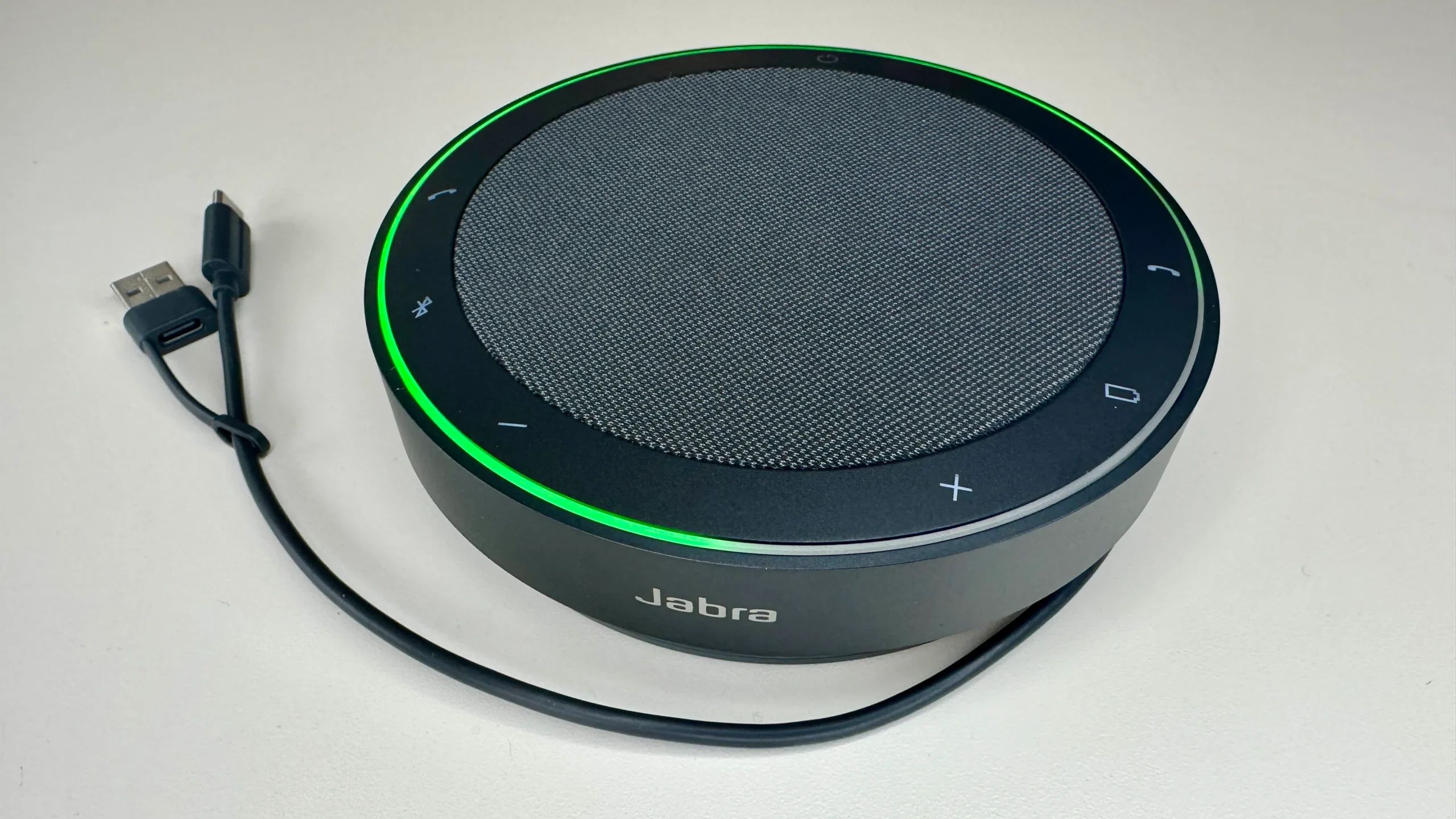

A laptop speakerphone can turn a routine Zoom call into a constant request to repeat yourself. Thin playback, keyboard noise, room echo, and a microphone that favors the person closest to the screen all make group meetings harder than they need to be. The best speaker for zoom meetings gives voices a clear path in both directions, without forcing everyone to crowd around one laptop.
The ten options here range from compact USB speakerphones to larger dual-unit systems for rooms of up to 20 people. Our top pick is the Anker PowerConf 5200mAh, while the Jabra Speak2 75 SE is the more capable premium option and the Yealink SP92 makes a particularly strong travel companion.
Comparison table
| # | Product | Award | Microphones or pickup | Battery | Best for |
|---|---|---|---|---|---|
| 1 | Anker PowerConf 5200mAh | Best overall | 6 microphones, 360° coverage | 24 hours | Home offices and flexible meetings |
| 2 | Yealink SP92 | Best for small meeting rooms | 13-foot pickup radius | 20 hours | Four to eight people |
| 3 | Jabra Speak2 75 SE | Best premium speakerphone | Intelligent audio pickup | 32 hours | Larger rooms and long sessions |
| 4 | Jabra Speak 510 2025 | Best compact Jabra | 360° microphone | Not specified | Portable individual workstations |
| 5 | Anker PowerConf 6700mAh | Best for longer wireless use | 6 microphones, 360° coverage | 24 hours | Cable-free home offices |
| 6 | Jabra Speak 510 UC | Best lightweight option | 360° microphone | Not specified | Travel and occasional meetings |
| 7 | Jabra Speak 510 2025 Teams | Best for Teams users | 360° microphone | Not specified | Microsoft Teams and Zoom |
| 8 | Jabra Speak 710 UC | Best for immersive audio | Omnidirectional microphone | Not specified | Calls and music for up to six |
| 9 | Ynoonvon Conference Speakerphone | Best plug and play USB pick | 360° pickup | Not specified | Simple desktop setups |
| 10 | SVN O1 Dual Conference Speaker | Best for large rooms | 4 microphones with beamforming | 8 hours | Meetings with 10 to 20 people |
1. Anker PowerConf 5200mAh: Best Overall

Pros
- Six microphones provide 360° coverage
- AI processing reduces noise and echo
- USB-C and Bluetooth connections
- 24 hours of call time
- Can charge another device
Cons
- Heavier than the smallest portable options
- The feature set may be more than one-person calls require
- Battery capacity is not otherwise a substitute for a wired connection
Best for: home-office users who want dependable room pickup and flexible wireless meetings.
The first thing that makes the Anker PowerConf 5200mAh easy to recommend is that it is designed around the messy reality of a shared table. Six microphones are arranged in a 360-degree array, so the person sitting away from the laptop is not automatically the quietest voice in the call. That makes it a better fit for a small group than a conventional portable Bluetooth speaker.
Anker pairs that array with Voice Radar 3.0, which uses AI processing to reduce background noise, cancel echo, and detect multiple speakers. The product also says it automatically balances voices based on volume and distance. That combination matters more than loud playback. A meeting speaker can be plenty loud and still be poor if the far side of the room keeps disappearing from the conversation.
Connection flexibility is another reason it takes the top spot. Use Bluetooth with a phone or connect to a computer through USB-C without installing drivers. It is Zoom certified and works with other popular online conferencing platforms. The built-in 5, 200mAh battery supports up to 24 hours of call time, and PowerIQ lets the unit charge another device, a useful emergency feature when a phone is running low.
The Yealink SP92 is a sharper choice for a defined four-to-eight-person room because its pickup coverage is specified more clearly. The Anker is easier to place in changing spaces, though, and its six-microphone array gives it a more convincing case for mixed home and office use. Compared with the Jabra Speak 510 2025, the Anker is less minimalist but much more ambitious about group voice pickup.
Its weakness is size and complexity. At 0.75 pounds, it is still portable, but it does not disappear into a bag as readily as the lightest Jabra models. Someone who only needs a personal speaker and microphone at a desk may not use the full array or wireless battery. For everyone else, this is the most balanced answer to the question of which speakerphone should sit in the middle of a small meeting table.
2. Yealink SP92: Best for Small Meeting Rooms

Pros
- 13-foot pickup radius
- AI noise cancellation filters more than 1, 000 noises
- Full-duplex audio and echo cancellation
- Bluetooth 5.3 and USB-C connectivity
- 20-hour battery
Cons
- The optional BT51C dongle is not included
- More room-focused than desk-focused
- Recharging takes 2.5 hours with a 5V/2A source
Best for: small conference rooms where several people need to speak naturally from around a table.
The Yealink SP92 feels purpose-built for a small meeting room rather than a single person on a laptop. Its omnidirectional microphone is rated for a 13-foot, or 4-meter, pickup radius, and Yealink positions it for rooms with four to eight people. That clear room-size guidance is helpful. You can place it in the center of a table and understand what the product is intended to handle.
Its audio processing is unusually specific. Real-time AI noise cancellation is said to filter more than 1, 000 noises, including keyboard taps and air-conditioning hum. Echo cancellation and full-duplex microphones are also included, allowing two people to talk at once without the unnatural cutoffs common with basic speakerphones. The 50mm speaker is intended to keep voices clear while also providing fuller music playback.
The SP92 offers three connection paths. Bluetooth 5.3 supports a stated range of 30 meters, USB-C works with the included C-to-A adapter, and the BT51C dongle is an optional route for compatible setups. It works with Zoom, Teams, Google Meet, Cisco Webex, Windows, macOS, and Android. The battery supports up to 20 hours of calls or music, and a full recharge takes 2.5 hours using a 5V/2A source.
The Anker PowerConf 5200mAh has more microphones, but the Yealink makes its room coverage easier to judge. The Jabra Speak2 75 SE is more powerful for larger or expandable spaces, yet the SP92 is smaller and lighter at 276 grams. Its supplied carrying case reinforces the travel-friendly design.
The missing BT51C dongle is the main catch. Bluetooth and USB-C are already available, so it is not a serious limitation for most laptops and phones, but buyers expecting every connection accessory in the box should take note. Choose the SP92 when predictable pickup around a small table matters more than maximum speaker size.
3. Jabra Speak2 75 SE: Best Premium Speakerphone

Pros
- 65mm speaker for stronger room-filling sound
- Up to 32 hours of battery life
- USB-A, USB-C, adapter, and Bluetooth options
- Two units can be linked
- Intelligent audio processing
Cons
- Heavier than the smaller Jabra speakers
- A single unit may be unnecessary for a personal desk
- The larger enclosure is less discreet in a small bag
Best for: people who need stronger audio now and the option to expand coverage later.
The Jabra Speak2 75 SE is the most ambitious speakerphone in this group. Its 65mm speaker gives voices more physical presence than the compact Speak 510 models, which is useful when several people are listening from different parts of a room. It is also better suited to music between calls, though voice clarity remains its main job.
Jabra focuses on intelligent audio that handles background noise, uneven speaking volume, simultaneous speech, and voice pickup. The practical benefit is less coaching during a meeting. Participants should not have to lean forward, raise their voices, or wait for a microphone to release one speaker before another can respond.
Connectivity is comprehensive. The unit can connect through Bluetooth, an adapter, or its integrated USB-A and USB-C cable, which is approximately 75cm long. It works with Zoom, Google Meet, and other major meeting platforms. Battery life is rated at up to 32 hours, the longest claim in this roundup, so it is a strong choice for people who move between rooms or use the speakerphone throughout a workday.
The standout feature is linking two Speak2 75 devices for larger spaces. That makes the Jabra more adaptable than the Yealink SP92 and more scalable than the Jabra Speak 710 UC. It is a serious advantage when a room may grow, but it also means the single unit can feel excessive for a quiet home office.
At 1.0275 pounds, the Speak2 75 SE is still portable, but it is not the featherweight option here. The Anker PowerConf 5200mAh is a more sensible center-table pick for many home offices, while this Jabra earns its place when audio reach, long battery life, and expansion matter. Skip it if your meetings are always one person at a desk. Choose it if the room and the meeting roster change often.
4. Jabra Speak 510 2025: Best Compact Jabra

Pros
- USB and Bluetooth connectivity
- Compact 4.72-inch footprint
- Weighs about 0.43 pounds
- Quick setup
- Works across meeting platforms
Cons
- Battery life is not specified
- Less room-focused than newer multi-microphone designs
- No stated noise-filtering system
Best for: a worker who wants a small, familiar speakerphone that can move between desk and travel bag.
The Jabra Speak 510 2025 is the uncomplicated pick. It is small enough to leave on a desk without taking over the workspace, yet it can travel when the meeting moves to another room. The 4.72-inch length and width, 1.3-inch height, and roughly 0.43-pound weight give it a compact footprint that is easy to live with.
Jabra describes the sound as clear for meetings and supports both USB and Bluetooth connections. That makes setup straightforward with a laptop, phone, desk phone, or softphone. The product is intended to work with online meeting platforms and streaming music, so it is not locked to one calling application.
The 360-degree microphone is the key feature for small groups. It gives people around a table a fairer chance of being heard than a laptop microphone placed at one end. Still, the listing does not provide a battery-life figure or a detailed noise-cancellation system, so buyers should not expect the same processing claims as the Anker PowerConf or Yealink SP92.
Its compactness is also its limitation. The Yealink SP92 offers a defined 13-foot pickup radius, a larger 50mm speaker, and up to 20 hours of calls, while the Jabra keeps things simpler and lighter. The Jabra Speak 510 2025 makes more sense for individual professionals who occasionally add a colleague to a call than for a full conference table.
This is the model to choose when portability and easy connections matter most. People working in noisy rooms or regularly hosting larger groups should move up to the Anker or Yealink options.
5. Anker PowerConf 6700mAh: Best for Longer Wireless Use

Pros
- Six-microphone 360° array
- Voice balancing for different distances
- Bluetooth and USB-C
- Up to 24 hours of call time
- Can charge other devices
Cons
- The listing does not name Voice Radar 3.0
- Weighs 0.75 pounds
- No detailed pickup radius is provided
Best for: wireless home-office meetings where all-day battery endurance matters.
The Anker PowerConf 6700mAh is closely related to the first Anker pick, but its emphasis is different. It uses six microphones arranged for 360-degree coverage and automatically balances voice clarity for differences in volume and distance. That is the behavior we want from a speakerphone placed in the middle of a table.
This version uses Anker's custom DSP algorithm to optimize voices in real time and reduce background noise. The listing does not make the same Voice Radar 3.0 claim as the other PowerConf entry, so we would not treat the two as identical in processing features. Both are Zoom certified, work with popular conferencing platforms, and connect to a computer by USB-C or to a phone over Bluetooth.
The built-in 6, 700mAh battery supports up to 24 hours of calls. That is ample for a sequence of meetings without keeping the unit tethered, and PowerIQ can charge another device. The dimensions are close to five inches across and the weight is 0.75 pounds, putting it in the portable middle ground rather than the ultra-light category.
The Anker PowerConf 5200mAh is the better pick if its named Voice Radar 3.0 processing is important to you. This version remains attractive for people who want the same basic six-microphone layout and a large battery. The Jabra Speak2 75 SE has longer claimed battery life and a more substantial 65mm speaker, but it is heavier and more elaborate.
The unclear pickup distance is the main weakness. Anker explains the microphone arrangement but does not state a room radius, so very large conference rooms are a poor match. For a home office or small table where wireless freedom is more useful than formal room coverage, it is a capable alternative.
6. Jabra Speak 510 UC: Best Lightweight Option

Pros
- Weighs 0.38 pounds
- USB and Bluetooth connections
- 360-degree microphone
- Carrying case and cable management
- Works with leading UC platforms
Cons
- Older design
- Battery life is not specified
- Listed condition is used
Best for: frequent travelers who want the lightest speakerphone in this selection.
The Jabra Speak 510 UC is the travel-first version of the classic Speak 510 design. At 0.38 pounds, it is the lightest product here, and its 6-inch length, 5-inch width, and 2-inch height still leave room for a protective case and integrated cable management. It is the kind of device that can stay in a work bag without becoming a burden.
The 360-degree microphone is intended to pick up voices from all angles, while Jabra promises clear conversations and compatibility with leading unified communications platforms. USB and Bluetooth give it two straightforward ways to connect to a laptop, phone, or desk phone. It is also certified for Zoom and Google Meet according to the listing.
The trade-off is that this is an older product design. There is no battery-life figure in the supplied information, and the listing does not describe the kind of AI noise filtering found on the Anker, Yealink, or SVN O1. The microphone should suit a quiet table or hotel room, but buyers working beside a noisy fan or open office should look higher in the list.
The newer Jabra Speak 510 2025 is slightly heavier but has the same compact family character, while the Yealink SP92 adds a specified 20-hour battery and more detailed noise control. The UC version has a strong case only if its lighter body and travel accessories matter more than newer processing.
The listed condition is another point to consider carefully. This is a useful compact option for occasional remote meetings and travel, but it is not the one we would choose for a permanent conference-room installation.
7. Jabra Speak 510 2025 Teams: Best for Teams Users
Pros
- USB and Bluetooth connectivity
- Compact 4.72-inch design
- Supports Microsoft Teams
- 360-degree microphone
- Works with multiple online meeting platforms
Cons
- Battery life is not specified
- No detailed noise-reduction claim
- Nearly duplicates the other 2025 Speak 510 entry
Best for: Microsoft Teams users who also need a portable Zoom speakerphone.
The Jabra Speak 510 2025 Teams is the clearest choice for a mixed Teams and Zoom workflow. Its listed size is 4.72 by 4.72 by 1.3 inches, and its weight is about 0.43 pounds. That compact shape works well beside a laptop and is easy to carry to a temporary workspace.
Like the other 2025 Speak 510 listing, it supports USB and Bluetooth. Jabra describes quick setup and compatibility with online meeting platforms, with Microsoft Teams called out specifically. The 360-degree microphone should help when a second person joins from across a small table rather than sitting directly beside the computer.
The product information does not specify battery capacity or call time. It also does not provide a pickup radius, microphone count, or a named noise-cancellation system. That makes it harder to recommend for a busy room than the Anker PowerConf 5200mAh, whose six-microphone array and AI processing are clearly described.
The distinction between this listing and the other Jabra Speak 510 2025 entry is mainly the platform positioning. The hardware image and physical specifications are the same in the supplied data, so expectations should remain modest. It is a practical plug-in speakerphone, not a major acoustic upgrade for a large conference table.
If Teams is part of your daily routine and you want a small device with Bluetooth as a backup, this is a sensible fit. If Zoom is the only concern, the standard 2025 Speak 510 is the simpler comparison, while the Yealink SP92 offers much stronger stated room coverage.
8. Jabra Speak 710 UC: Best for Immersive Audio

Pros
- Immersive sound for calls and music
- Coverage for up to six people
- USB and Bluetooth
- Link 370 adapter included
- Carry pouch and two-year warranty with registration
Cons
- Larger and heavier than the Speak 510
- Battery life is not specified
- More focused on sound quality than advanced microphone details
Best for: people who use one portable speakerphone for meetings, music, and small group calls.
The Jabra Speak 710 UC is the speakerphone to consider when meeting audio is only half the assignment. Jabra describes immersive sound for calls and music, with HD voice and an omnidirectional microphone. It covers up to six people, giving it a clearer group target than the compact Speak 510 models.
It connects to a laptop, phone, or tablet through USB or Bluetooth, and the included Link 370 adapter can simplify wireless computer connections. Setup is intended to be plug and play, with support for services including Google and Skype for Business. The travel pouch makes the larger body easier to carry and protects it between meetings.
The dimensions are approximately 6.2 by 6 by 2.2 inches, and the listed weight is 0.66 pounds. That is still portable, but it takes more room than the 510 family. Jabra also includes a two-year warranty with registration, which adds reassurance for someone planning to use it regularly.
The Jabra Speak2 75 SE is stronger on battery endurance and has a 65mm speaker plus the option to link two units. The Jabra Speak 710 UC remains appealing if music playback and a compact all-in-one conference speaker matter more than expansion. Readers comparing the audio side of these devices may also find that clearer room sound depends on speaker size and placement rather than on volume alone.
The missing battery figure is the biggest information gap. We would not choose it for a room of ten people, and the SVN O1 Dual is designed for a larger audience. For a small team that wants a portable speakerphone with more engaging playback than a basic meeting puck, the Speak 710 is the more enjoyable companion.
9. Ynoonvon Conference Speakerphone: Best Plug and Play USB Pick

Pros
- 360-degree voice pickup
- AI noise reduction and echo cancellation
- USB plug and play
- Full-duplex audio
- Touch controls and compact design
Cons
- Wired USB connection only in the supplied details
- Manual input and output selection may be needed
- No battery, dimensions, or microphone count is specified
Best for: a fixed home-office desk where simple USB setup matters more than wireless flexibility.
The Ynoonvon Conference Speakerphone is aimed at people who want to replace weak laptop audio without adding a complicated setup. Its USB connection is plug and play, and the speakerphone is described as compatible with Zoom and other common meeting platforms. Full-duplex audio is included, so both sides can speak and be heard at the same time.
Its high-sensitivity microphones provide 360-degree pickup for small to medium meetings. AI noise reduction and echo cancellation are designed to filter background distractions while keeping voices natural. That is useful in a home office, though the supplied information does not say how many microphones it uses or how far across a room those microphones can reliably reach.
There is an important setup note. A computer may not automatically switch from its built-in audio, so you might need to select “3-M6 USB AUDIO” manually as both the input and output device in the operating system's sound settings. That is still a simple fix, but it means the experience is not entirely automatic for every computer.
Compared with the Jabra Speak 510 2025, the Ynoonvon is more explicitly focused on USB desktop use and names AI noise reduction. The Jabra offers Bluetooth and a better-established portable design. The SVN O1 Dual Conference Speaker is the more suitable option for a large room, while this model is better kept close to the computer.
The absence of dimensions, battery information, and a formal pickup radius limits what we can promise. It is a straightforward choice for a stationary desk, especially if you want a speaker and microphone in one USB device. People who move between rooms should choose a wireless model instead.
10. SVN O1 Dual Conference Speaker: Best for Large Rooms

Pros
- Designed for meetings with 10 to 20 people
- Dual-unit wireless cascading up to 32 feet
- Four microphones with beamforming
- USB, Bluetooth 5.0, and optional dongle
- 5W speaker and full-duplex audio
Cons
- Eight-hour battery life is shorter than most portable picks
- Larger and heavier than single-unit designs
- The optional dongle is not included
Best for: large meeting rooms that need two linked speaker units and wider coverage.
The SVN O1 Dual Conference Speaker is the outlier here because it is built around room scale. Its dual-unit setup is intended for meetings with 10 to 20 people, and the units can cascade wirelessly up to 32 feet. That arrangement gives voices a better chance of reaching the microphone when a single speakerphone in the center of a long table would be too far away.
Each unit uses four microphones with beamforming and 360-degree omnidirectional pickup. AI noise cancellation is intended to filter sounds such as typing, fans, and traffic. The 5W speaker is rated at 82dB with less than 7% total harmonic distortion, while full-duplex and Hi-Fi audio are designed to keep two-way conversation natural.
Connectivity includes USB, Bluetooth 5.0, and an optional dongle. The listing says the device can switch between connection methods if one fails, which is useful for a room that cannot afford a dropped call. USB is described as plug and play, with automatic audio-device detection and no drivers required.
The drawback is portability relative to the rest of the list. The product weighs about 432 grams and has a listed size of approximately 5.12 by 2.99 by 4.72 inches. Its built-in 2, 400mAh battery lasts up to eight hours, shorter than the Yealink SP92, Anker PowerConf, and Jabra Speak2 75 SE. It is also more equipment than a small room needs.
The Jabra Speak2 75 SE is a better single-unit solution with longer battery life and an option to link two units, but the SVN O1 is explicitly organized around a dual large-room configuration. If you host meetings with ten to twenty participants and need sound distributed along a table, this is the specialist pick. For a home office, it is needlessly elaborate.

How to choose best speaker for zoom meetings
The right speakerphone depends less on maximum loudness than on where people sit, how noisy the room is, and whether you need wireless use.
Microphone coverage
A 360-degree microphone array is useful when participants sit around a table instead of directly in front of a laptop. Microphone count can help, but it does not tell the whole story. A stated pickup radius, such as the Yealink SP92's 13 feet, is more useful for judging a room than a vague claim of “long range.”
Choose the speakerphone by the farthest person who needs to speak, not the person sitting closest to the laptop.
Noise and echo control
Noise reduction removes distractions such as keyboard taps, fans, and traffic, while echo cancellation stops the speaker's output from returning through the microphone. AI processing can help in a busy room, but it cannot make a poor placement disappear. The Anker PowerConf, Yealink SP92, Ynoonvon, and SVN O1 all make explicit noise-control claims, while the Jabra Speak 510 listings provide less detail.
Connectivity
USB is the safest choice for a permanent desk because it avoids pairing problems and usually draws power from the computer. Bluetooth is more convenient for phones and cable-free meetings. A speakerphone with both options, such as the Anker, Yealink, or Jabra models, is easier to move between a home office and a meeting table.
Battery endurance
Battery life matters when the speakerphone moves around or when cables would cross a conference table. The Jabra Speak2 75 SE claims up to 32 hours, the Anker models claim up to 24 hours, and the Yealink SP92 claims up to 20 hours. The SVN O1's up to eight hours is adequate for a working day but less forgiving if recharging is forgotten.
Room size and speaker output
Small rooms can work well with a compact single-unit speakerphone. Larger rooms need a defined pickup radius, a stronger speaker, or multiple linked units. The SVN O1 is designed for 10 to 20 people, while the Jabra Speak 710 targets up to six and the Yealink SP92 targets four to eight. For a desk setup, the right way to balance a computer's audio and microphone is usually more important than room-filling volume.

Frequently asked questions
Can I use these speakerphones with Zoom?
Yes. The supplied listings identify Zoom compatibility for all ten products, with Zoom certification specifically stated for the Anker PowerConf models and several Jabra products. USB speakerphones may require you to select the device as the microphone and speaker inside Zoom.
Is USB or Bluetooth better for Zoom meetings?
USB is generally the simplest option for a fixed computer because it avoids wireless pairing and can keep the speakerphone powered. Bluetooth is more convenient for phones, tablets, and cable-free meetings. A model with both connection types gives you the most flexibility.
Do I need a 360-degree microphone?
You need one when people sit around the speakerphone rather than directly in front of it. A directional or laptop microphone can work for one person, but 360-degree pickup is more appropriate for small group meetings. The Anker, Jabra, Yealink, Ynoonvon, and SVN O1 models all describe room-wide pickup in some form.
Which speakerphone is best for a large conference room?
The SVN O1 Dual Conference Speaker is the most directly suited to a large room because it supports wireless cascading and meetings with 10 to 20 people. The Jabra Speak2 75 SE is a better single-unit alternative and can link two devices for larger spaces.
Will noise cancellation remove keyboard and fan sounds?
Noise reduction is designed to reduce those sounds, but performance depends on distance and room acoustics. The Yealink SP92 specifically mentions keyboard taps and air-conditioning hum, while the SVN O1 names typing, fans, and traffic. Keeping the speakerphone away from the loudest source still helps.
Can I use a conference speakerphone for music?
Most of these products can play music, but they are designed first for speech. The Yealink SP92 mentions a 50mm speaker and Virtual Bass, the Jabra Speak 710 emphasizes immersive sound, and the Jabra Speak2 75 SE uses a 65mm speaker. For music as the primary use, a dedicated speaker may be a better fit, and speaker placement can make a bigger difference to perceived clarity than many buyers expect.
The bottom line
The Anker PowerConf 5200mAh is our first recommendation for most people looking for the best speaker for zoom meetings. Its six-microphone 360-degree array, Voice Radar 3.0 processing, USB-C and Bluetooth connections, and 24-hour battery cover the situations that cause the most trouble in home offices and small group calls.
Choose the Yealink SP92 if your meetings usually involve four to eight people around a defined table and you want a clear 13-foot pickup target. Choose the Jabra Speak2 75 SE if you need stronger room audio, the longest stated battery life, or the ability to link two units as your meeting space grows.
If you are undecided, buy for the room's farthest speaker and choose USB plus Bluetooth when your setup changes often.
As an Amazon Associate we earn from qualifying purchases.