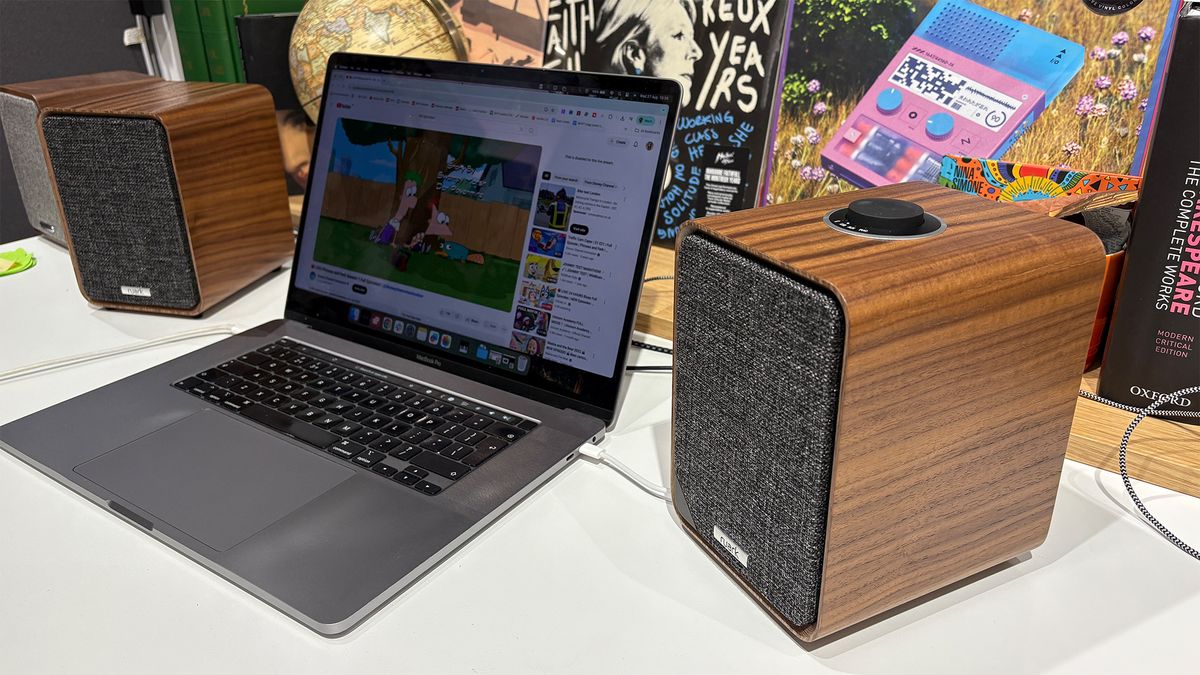

A laptop or desktop can have a perfectly capable processor and a disappointing sound system. Tinny dialogue, weak bass, and speakers hidden behind a monitor make games and music feel strangely flat. The right desktop speakers can fix that without taking over the entire workstation.
Our Best speakers for pc picks range from compact USB models to powerful stereo systems with Bluetooth, subwoofers, and gaming-focused lighting. Edifier M60 is the top pick, while the rest cover cramped desks, monitor mounting, wireless listening, deep bass, and immersive PC gaming.
Comparison of the Best Speakers for PC
| # | Product | Award | Configuration | Power | Inputs | Best for |
|---|---|---|---|---|---|---|
| 1 | Edifier M60 | Best overall | 2.0 stereo | 66W RMS | Bluetooth 5.3, USB-C, AUX | Music and everyday desktop use |
| 2 | Logitech G560 | Best for PC gaming | 2.1 with surround processing | 240W peak | Bluetooth, PC connection | Immersive gaming setups |
| 3 | OHAYO 60W | Best stereo power | 2.0 stereo | 60W total | Bluetooth 5.3, RCA, AUX, USB | Music and larger desks |
| 4 | Edifier G2000 | Best compact gaming set | 2.0 stereo | 32W peak | Bluetooth, USB, AUX | Gaming with RGB lighting |
| 5 | Creative Pebble V3 | Best compact USB speakers | 2.0 stereo | 8W RMS, 16W peak | USB-C, Bluetooth 5.0, AUX | Small desks and laptops |
| 6 | Logitech Z313 | Best with a dedicated subwoofer | 2.1 | 25W RMS | Wired PC connection | Movies and bass-heavy games |
| 7 | Logitech Z207 | Best for easy device switching | 2.0 stereo | Not specified | Bluetooth 4.2, 3.5mm | PC and mobile listening |
| 8 | XKX Monitor Soundbar | Best monitor-mounted design | Stereo soundbar | Not specified | USB, USB-C adapter | Desks with no spare width |
| 9 | LENRUE G11 | Best simple soundbar | Stereo soundbar | Not specified | USB, USB-C adapter, AUX | Plug-and-play desktop audio |
| 10 | Amazon Basics Stereo Speakers | Best basic USB pair | 2.0 stereo | Not specified | USB power, 3.5mm AUX | Basic computer audio |
1. Edifier M60: Best Overall
Pros
- 66W RMS output from a compact stereo pair
- Two-way design with dedicated tweeters and mid-low drivers
- USB-C, AUX, and Bluetooth 5.3 connectivity
- LDAC support for compatible Android devices
- Angled aluminum stands direct sound toward ear level
Cons
- Larger and heavier than basic desktop pairs
- Wireless high-resolution features depend on compatible devices
- Touch controls may not suit people who prefer physical buttons
Best for: listeners who want the most capable all-round stereo system for a desktop.
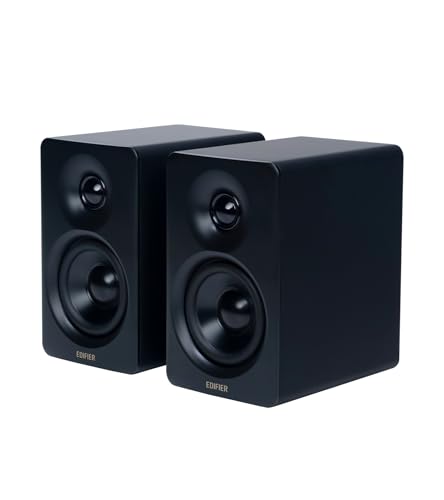
The Edifier M60 is the pair we'd choose when the computer is also a serious music source. It looks like a compact desktop speaker rather than an accessory, and the supplied aluminum stands help solve one of the usual problems with nearfield audio: sound firing below the listener's ears. The stands angle each speaker by 15 degrees, which makes the setup easier to position behind a keyboard or display.
Its two-way design is more ambitious than the single full-range drivers used by the Logitech Z207 and Creative Pebble V3. Each speaker has a 1-inch silk dome tweeter and a 3-inch long-throw aluminum diaphragm mid-low driver. The 66W RMS Class-D amplifier gives the system considerably more headroom than compact USB pairs, while the built-in DSP manages the two-way crossover and dynamic range. Those details matter when music has busy vocals, layered instruments, or a strong kick drum.
Connectivity is unusually complete for a desktop pair. USB-C and AUX cover a wired computer setup, while Bluetooth 5.3 supports wireless playback. The LDAC codec can reach transmission rates up to 990 kbps and supports audio up to 24-bit/96kHz from Android devices running version 8.0 or later. That is a specialized feature, not a universal benefit, but it gives compatible listeners a stronger wireless option than the Bluetooth 4.2 connection on the Logitech Z207.
The M60's weakness is physical rather than acoustic. At 100mm wide, 168mm high, and 147mm deep per speaker, it needs a deliberate place on the desk, and the pair weighs about 9.7 pounds. The touch-sensitive control panel is clean, though it is less immediate than a conventional knob. Skip it if your desk cannot accommodate two substantial speakers. For everyone else, the M60 is the most complete stereo choice here.
2. Logitech G560: Best for PC Gaming

Pros
- 240W peak output for a large, energetic sound
- DTS:X Ultra surround processing on Windows PCs
- LIGHTSYNC RGB with four customizable lighting zones
- Bluetooth support for computers and mobile devices
- Designed specifically around gaming immersion
Cons
- Large system needs more desk and floor space
- DTS:X is not supported on Mac OS X
- Lighting and surround features are more specialized than most users need
Best for: Windows PC gamers who want room-filling sound and reactive lighting.
The Logitech G560 is not a subtle desktop audio system. Its appeal is the sense of scale it brings to games, with powerful output, a separate subwoofer, surround processing, and RGB lighting that reacts to supported game audio. It is the pick for a gaming station where speakers are part of the visual setup, not just a way to hear notifications.
The headline specification is 240W peak power, and Logitech lists a maximum sound pressure level of 97 decibels. Those figures explain why this system is better suited to a spacious room or a player who wants dramatic impact than to a quiet shared office. DTS:X Ultra processing creates 3D positional audio on Windows PCs, giving compatible games a wider directional presentation than the straightforward stereo pairs in this roundup.
LIGHTSYNC adds four speaker lighting zones with front and rear projection and a choice of 16.8 million colors through Logitech software. That is a meaningful distinction from the fixed blue LED on the Amazon Basics pair or the simpler lighting controls on the LENRUE G11. Bluetooth also lets the system handle audio from compatible smartphones and tablets when the PC is off.
The trade-off is size and platform dependence. The system weighs about 12.1 pounds and has a footprint that includes a separate subwoofer, so it is not a sensible match for a shallow or crowded desk. Mac users should also know that DTS:X is not supported on Mac OS X. If immersive Windows gaming is the priority, the G560 earns its place. If you mainly listen to music or need a compact setup, Edifier M60 is the better fit.
3. OHAYO 60W: Best Stereo Power

Pros
- 30W per channel for strong stereo output
- Dedicated tweeter and 3-inch full-range driver
- Bluetooth 5.3, RCA, AUX, and USB inputs
- MDF enclosure helps reduce cabinet resonance
- Front volume control is easy to reach
Cons
- Larger cabinets need a generous desktop
- No surround processing
- Input selection is less streamlined than on some compact sets
Best for: listeners who want powerful conventional stereo sound and many connection options.
The OHAYO 60W is the most traditional stereo system in this group. Its two bookshelf-style cabinets are noticeably more substantial than the Creative Pebble V3, and that extra cabinet volume gives the system a natural role in music, films, and games that benefit from a broad left and right presentation. It is also a practical choice for a computer that shares audio with other equipment.
Each speaker uses a 0.75-inch carbon fiber silk dome tweeter and a 3-inch carbon fiber full-range driver. The specification lists 30W per channel, for 60W total, with a rear bass port to add low-end depth. An integrated independent sound card is included in the design. The MDF wooden enclosure is intended to reduce box resonance, which is useful when the speakers are playing at a higher level and cabinet vibration could blur detail.
The connection panel is one of the strongest reasons to consider this pair. Bluetooth 5.3 handles wireless playback, while RCA, AUX, and USB provide wired options. That is more flexible than the Edifier G2000's already useful Bluetooth, USB, and 3.5mm arrangement, and it is a better match for a desk that also connects to a turntable, receiver, or other audio source.
The downside is that the OHAYO is not a compact monitor accessory. Its listed dimensions are about 11.5 inches high, 6.9 inches deep, and 9.4 inches wide, so measure the area beside the display before choosing it. It also lacks the G560's surround processing and the M60's LDAC support. Choose the OHAYO when strong, uncomplicated stereo and broad input support matter more than gaming effects.
If music is the central use, the choice depends on room and desk placement. The differences between cabinet styles, driver arrangements, and connection options are explored in this guide to what shapes a more detailed listening setup.
4. Edifier G2000: Best Compact Gaming Set

Pros
- 2.75-inch full-range drivers
- 32W total peak output
- Game, Music, and Movie sound modes
- Bluetooth, USB sound card, and AUX inputs
- Twelve RGB lighting effects
Cons
- Less powerful than the OHAYO 60W and Logitech G560
- Compact design cannot create the same scale as a subwoofer system
- RGB lighting may be distracting outside gaming
Best for: gamers who want compact speakers with multiple inputs and customizable lighting.
The Edifier G2000 gets the balance right for a gaming desk that has some room for speakers but not for a full 2.1 system. Its column-shaped cabinets are angled upward by 10 degrees, and the anti-slip feet keep them planted. The matte panels and metal engraving give it a more considered look than a generic desktop pair, while twelve RGB effects provide the visual gaming cue many buyers want.
Inside, each speaker uses a 2.75-inch full-range driver, with 16W RMS and 32W total peak power listed for the system. The rear bass port is designed to reinforce low frequencies, and a subwoofer output is included for users who later want more low-end weight. That gives the G2000 a useful upgrade path, though it cannot match the physical impact of the dedicated subwoofer bundled with the Logitech Z313.
The three sound modes are a practical touch. Game, Music, and Movie settings let the system change its presentation for different activities without requiring a separate equalizer. Connectivity is equally straightforward: USB works as a sound card, while Bluetooth and 3.5mm AUX cover wireless devices and conventional analog sources.
Its main limitation is scale. The G2000 is more engaging than a basic USB pair, but the 32W peak figure and compact enclosure place it below the OHAYO 60W for broad music playback and below the G560 for room-filling gaming. The RGB system also adds visual emphasis that may not suit a work-focused desk. Pick it over the Creative Pebble V3 when gaming features and output matter, but choose Edifier M60 when accurate, fuller-range listening is the priority.
5. Creative Pebble V3: Best Compact USB Speakers

Pros
- USB-C audio with a USB-A adapter included
- Bluetooth 5.0 and 3.5mm AUX support
- 2.25-inch full-range drivers
- Clear Dialog processing for spoken content
- 45-degree elevated drivers
Cons
- AUX cable is not included
- Output is modest beside the larger stereo systems
- Gain mode requires a 10W USB-C or USB-A port
Best for: laptop users and anyone working with limited desk space.
The Creative Pebble V3 is the easiest recommendation for a small desk. It keeps the familiar compact Pebble shape but uses larger 2.25-inch custom-tuned full-range drivers, 45-degree elevated acoustics, and a longer cable between the left and right speakers. That angled design aims sound toward the listener instead of across the desktop, which is a sensible choice when the speakers sit close to a monitor.
Creative lists 8W RMS output and up to 16W peak power. A built-in gain switch can amplify the output when the speaker is connected to a 10W USB-C or USB-A port. The switch gives the Pebble V3 more flexibility than a basic USB-powered pair, although it cannot turn a compact 2.0 system into the larger OHAYO or G560.
USB-C carries both power and audio, which reduces cable clutter on newer computers. The included USB-C to USB-A converter keeps it compatible with older PCs. Bluetooth 5.0 handles wireless playback, and a 3.5mm AUX input is available for analog devices, though Creative says the AUX cable is not included. Clear Dialog processing is particularly useful for YouTube, films, and television dialogue because it emphasizes intelligibility without removing background effects.
The Pebble V3's weakness is predictable: small speakers have limited physical authority. Bass is more present than the size suggests, but listeners wanting deep impact should look to the Logitech Z313 or a larger stereo pair. The speaker dimensions are compact enough for almost any workstation, and the 2.03-pound pair is easy to place. It is the one we'd choose for a laptop desk, dorm workspace, or office where clean setup matters more than maximum volume.
A compact desk often forces a choice between separate stereo speakers and a bar below the display. The practical question is how much room a desktop audio setup needs before the speakers start crowding the keyboard and mouse.
6. Logitech Z313: Best With a Dedicated Subwoofer

Pros
- Dedicated compact subwoofer
- 25W RMS system output
- Separate control pod for volume access
- Simple 2.1 arrangement
- Familiar fit for films and games
Cons
- Subwoofer takes extra floor or desk space
- Connectivity is less flexible than Bluetooth-equipped picks
- No wireless playback listed
Best for: desktop users who want more bass than a small 2.0 pair can provide.
The Logitech Z313 is built around one clear idea: a separate subwoofer makes computer audio more satisfying. The two satellite speakers handle the stereo image while the compact subwoofer supplies the low-end weight that small full-range drivers struggle to produce. For films, action games, and music with a strong bass line, that arrangement can feel more substantial than the Creative Pebble V3 or Amazon Basics Stereo Speakers.
Logitech lists 25W RMS output for the system. That is lower than the 66W RMS Edifier M60 and the 60W total specified for the OHAYO, but power figures alone do not describe the effect of moving bass duties into a dedicated cabinet. The Z313's compact subwoofer is the defining hardware feature, not a secondary extra.
A wired control pod makes volume adjustment easy from the chair or keyboard area. The system is deliberately simple, which helps when the computer is the only source. There is no Bluetooth feature listed, so mobile playback is not as convenient as it is with the Logitech Z207, Creative Pebble V3, or Edifier G2000.
The trade-off is the additional piece of hardware. The listed system dimensions reach about 12.9 inches in length, 9.4 inches in width, and 6.2 inches in height, so the subwoofer needs a planned location. It also lacks the input variety and tuning options of the modern Edifier models. Choose it when bass is the reason you are replacing built-in computer speakers, and skip it if a clean, minimal desk is more important than low-frequency impact.
7. Logitech Z207: Best for Easy Device Switching

Pros
- Bluetooth and 3.5mm wired connections
- Easy-Switch device switching
- On-speaker headphone jack
- Dedicated volume and pairing controls
- Passive radiator in each speaker
Cons
- Bluetooth 4.2 is older than several rivals
- No dedicated subwoofer
- Tall cabinets need space beside the monitor
Best for: people who switch audio between a computer and mobile devices.
The Logitech Z207 is a useful middle ground for a desk shared by a PC, phone, or tablet. It avoids the extra subwoofer of the Z313 while adding wireless playback and an on-speaker headphone jack. The main attraction is not raw output. It is the ease of keeping more than one device connected.
Logitech's Easy-Switch feature lets the listener pause audio on one device and press play on another. The speakers support Bluetooth 4.2 and also accept a 3.5mm cable, so a computer can stay wired while a mobile device uses Bluetooth. That flexibility is more useful in everyday work than a lighting effect, especially for a desk that serves both as a workstation and a casual listening area.
Each speaker has one active powered driver for full-range audio and one passive radiator for bass extension. That gives the Z207 more low-end presence than an ultra-basic pair, but it remains a 2.0 design. It will not produce the separate bass foundation of the Logitech Z313 or the headroom of the Edifier M60.
The speakers are about 9.5 inches high, 3.5 inches wide, and 4.9 inches deep according to the listed size, so they need vertical clearance beside a monitor. Their older Bluetooth version is another limitation when compared with Bluetooth 5.3 models such as the M60 and OHAYO. Choose the Z207 when quick switching and a headphone jack matter more than newer wireless standards or maximum power.
8. XKX Monitor Soundbar: Best Monitor-Mounted Design
Pros
- Clips to the top, side, or bottom of a monitor
- Adaptive channel switching with a G-sensor
- USB connection with USB-C adapter included
- Touch controls for mute and volume
- Passive radiators support bass response
Cons
- Incompatible with monitors, televisions, and projectors as audio sources
- USB audio depends on a working computer port and correct settings
- Less flexible than separate Bluetooth speakers
Best for: small desks where speakers must stay attached to the display.
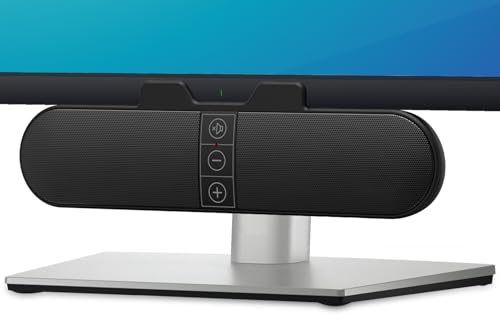
The XKX Monitor Soundbar solves a physical problem rather than chasing hi-fi performance. Its clamp can attach to the top, side, or bottom of a monitor, leaving the desk surface clear for a keyboard, mouse, and other equipment. The clamp can also be placed on the desk, so it is not limited to monitor mounting.
The soundbar uses dual ultra-magnetic drivers and dual passive radiators. The product description emphasizes loud sound and deep bass, but no power rating is specified, so it should be judged as a compact USB desktop design rather than compared directly with the 66W RMS Edifier M60 or 240W peak Logitech G560. Its 9.17-inch width makes it long enough to sit beneath many displays without requiring two separate speaker positions.
A G-sensor provides adaptive channel switching, keeping left and right channels correctly positioned when the unit is mounted above or below the monitor. That is a thoughtful detail that most single-bar designs ignore. Three front touch buttons control mute and volume, keeping the controls reachable without searching behind the display.
The connection limits are important. It works with Windows, macOS, ChromeOS, and Linux computers, and the built-in USB-C to USB adapter supports newer USB-C devices. The listing specifically says it is not compatible with monitors, televisions, or projectors as source devices, so a USB port on the computer is required. Choose it over the LENRUE G11 when monitor mounting and channel orientation are the deciding factors.
9. LENRUE G11: Best Simple Soundbar

Pros
- Long soundbar shape fits beneath a monitor
- USB power and 3.5mm audio connection
- USB-C adapter included
- Top volume knob
- Touch-controlled angular lighting
Cons
- No Bluetooth
- No headphone jack or microphone
- Not compatible with TVs or headphones
Best for: users who want a straightforward wired soundbar under a monitor.
The LENRUE G11 is designed to disappear beneath the monitor. Its long, low profile measures about 14.96 inches wide and 2.55 inches high, making it a better fit under a display than tall stereo speakers such as the Logitech Z207. The cables are joined to reduce desk clutter, and a volume knob sits on top for quick adjustments.
LENRUE describes the G11 as using four large amplifier IC horns for stereo sound with reduced distortion and noise. It also includes angular game lighting that can be switched on or off with a touch. Those features make it more expressive than a plain office speaker, but the listing does not provide a power rating, so there is no responsible way to place it beside the higher-output systems by loudness alone.
Setup is simple. The speaker needs USB power and a 3.5mm audio connection, with a USB-C adapter included for compatible computers. The product information lists support for Windows, Mac OS, and Chrome OS, and the plug-and-play design does not require a driver. That makes it a sensible replacement for weak built-in monitor audio when the computer has the necessary ports.
The missing features are decisive for some buyers. There is no Bluetooth, headphone port, or microphone, and the listing says it is not compatible with TVs or headphones. The XKX Monitor Soundbar is the more adaptable monitor-mounted option because its clamp can attach in several positions and its sensor maintains channel orientation. Pick the G11 when a wired under-monitor bar, physical volume knob, and simple setup are all you need.
10. Amazon Basics Stereo Speakers: Best Basic USB Pair

Pros
- Compact pair for PCs and laptops
- USB-powered operation
- 3.5mm AUX input
- Inline volume control
- Bottom radiator adds bass response
Cons
- No Bluetooth
- No dedicated subwoofer
- Limited control and connection features
Best for: basic computer audio in a small, uncomplicated setup.
The Amazon Basics Stereo Speakers are the simplest product here, and that simplicity is their main reason to exist. The pair is intended to amplify audio from a PC or laptop, drawing power from a USB port while receiving sound through a 3.5mm AUX connection. An inline volume control keeps adjustment within reach without adding a separate control pod.
Each speaker measures about 3.94 inches long, 2.6 inches wide, and 2.88 inches high. That makes the pair easy to place beside a laptop or a compact monitor. A bottom radiator is intended to give the small enclosure a springier bass response, while the padded base helps protect the desk and keeps the cabinets from sliding.
The blue LED lights and metal finish add a little visual character, but the feature set remains focused on basic stereo playback. There is no Bluetooth, USB audio, dedicated subwoofer, or headphone output listed. Compared with the Creative Pebble V3, the Amazon Basics pair gives up Bluetooth and USB-C convenience. Compared with the LENRUE G11, it takes more horizontal positions because it uses two separate speakers rather than one bar.
That makes this a narrow recommendation, but an honest one. It suits a computer that only needs clearer audio than its built-in speakers and has both USB and 3.5mm connections available. Skip it if you want wireless playback, strong gaming effects, or a cinematic bass response. The Creative Pebble V3 is the more capable compact option, while the Amazon Basics pair wins on uncomplicated placement.

How to choose best speakers for pc
The right desktop speaker depends on where the speakers will sit, what the computer can connect to, and how much low-frequency impact the room needs.
Speaker configuration
A 2.0 system uses two stereo speakers, while a 2.1 system adds a dedicated subwoofer. Separate stereo speakers usually make dialogue and music easier to position across the desk. A 2.1 system such as the Logitech Z313 can produce more physical bass, but the subwoofer needs its own location.
A soundbar is the most space-efficient arrangement. The XKX and LENRUE models sit beneath or near a monitor, though they do not offer the same left and right separation as two cabinets placed apart.
Power and drivers
Power ratings can suggest headroom, but they do not tell the whole story. The Edifier M60 combines 66W RMS with a two-way driver layout, while the Creative Pebble V3 lists 8W RMS and uses compact full-range drivers. Larger drivers and separate tweeters can produce fuller sound, but they also require more desk space.
Look for a dedicated subwoofer when bass impact is central to films or games. For speech, background music, and normal desktop listening, driver placement and tonal balance matter more than a large peak figure.
Choose the speaker configuration first, then compare power. A large number cannot compensate for a system that does not fit the desk or the way you listen.
Wired and wireless inputs
USB-powered speakers are convenient, but USB power is not always the same as USB audio. The Creative Pebble V3 carries both power and audio over USB-C, while the Amazon Basics pair uses USB for power and 3.5mm AUX for sound. The LENRUE G11 also requires USB power plus a 3.5mm audio connection.
Bluetooth is useful for phones and tablets, especially when the speakers serve more than one device. The Edifier M60 and OHAYO use Bluetooth 5.3, while the Logitech Z207 uses Bluetooth 4.2. Check the available ports on the computer before choosing a wired-only model.
Desk placement
Measure the space beside or below the monitor. Tall speakers such as the Logitech Z207 need vertical clearance, while the LENRUE G11 uses a long soundbar profile. The XKX soundbar is the most flexible for a crowded desk because its clamp can attach to the top, side, or bottom of a monitor.
Angled drivers or stands can improve listening position. The Creative Pebble V3 uses 45-degree elevated drivers, and the Edifier M60 includes 15-degree aluminum stands. Those details help direct sound toward the listener rather than at the desktop.
Gaming and lighting features
Gaming speakers can add sound modes, surround processing, and reactive lighting. The Logitech G560 is the only model here with DTS:X Ultra surround processing, and its feature set is aimed at Windows gaming. The Edifier G2000 offers Game, Music, and Movie modes with twelve RGB effects in a smaller enclosure.
Lighting does not improve audio quality, so treat it as a design feature. If games are not the primary use, the M60, OHAYO, or Creative Pebble V3 put more emphasis on everyday listening and straightforward connectivity.

Frequently asked questions
Do PC speakers need a subwoofer?
No. A 2.0 pair can provide clear stereo sound without a separate bass cabinet. A subwoofer adds more low-frequency impact, which is useful for films, action games, and bass-heavy music, but it also takes up extra space.
Are USB speakers better than 3.5mm speakers?
Neither connection is automatically better for every setup. USB can reduce dependence on the computer's analog audio output, while 3.5mm AUX works with a wide range of devices. Some models use USB only for power and still need a separate 3.5mm audio cable, so check the connection design carefully.
Can these speakers connect to a phone?
The Edifier M60, Logitech G560, OHAYO 60W, Edifier G2000, Logitech Z207, and Creative Pebble V3 include Bluetooth. The Amazon Basics pair, LENRUE G11, and XKX Monitor Soundbar rely on wired computer connections listed in their product information.
Are monitor soundbars suitable for gaming?
They can work well when desk space is limited and game audio mainly needs to be clear. The XKX model adds adaptive channel switching when mounted above or below a monitor. Separate stereo speakers usually create a wider left and right image, while a 2.1 system can provide stronger bass.
Which speakers are easiest to set up?
The Amazon Basics pair, LENRUE G11, and Creative Pebble V3 are straightforward choices. The Amazon Basics and LENRUE models use USB power with a wired audio connection, while the Creative Pebble V3 can carry audio and power over USB-C. Bluetooth and software features add flexibility but may require a few more setup steps.
Do RGB speaker lights affect sound?
No. RGB lighting is a visual feature. The Logitech G560 uses LIGHTSYNC effects, and the Edifier G2000 offers twelve RGB effects, but those systems should be chosen for their audio and gaming features first.
Can the Logitech G560 surround mode work on a Mac?
The product information says DTS:X is not supported on Mac OS X. The system can still work with Bluetooth-enabled devices, but buyers using a Mac should not expect the same surround feature set as on a Windows PC.

The bottom line
The Best speakers for pc start with Edifier M60 for most serious desktop listeners. Its 66W RMS two-way design, USB-C, AUX, Bluetooth 5.3, LDAC support, and angled stands give it the broadest combination of sound hardware and practical features. Choose Logitech G560 instead when Windows gaming, DTS:X Ultra, powerful output, and reactive RGB lighting matter more than compact placement.
For smaller desks, Creative Pebble V3 is the sensible compact pick, while Logitech Z313 remains the better choice when a dedicated subwoofer is the main requirement. The OHAYO 60W is a strong alternative for conventional stereo sound with many inputs.
If you are undecided, choose Edifier M60 for music and everyday use, Logitech G560 for immersive Windows gaming, or Creative Pebble V3 when the desk itself is the limiting factor.
As an Amazon Associate we earn from qualifying purchases.