
A 1440p monitor has to do more than show a sharp desktop. The good ones make text easier to read, keep fast games clean, and give a graphics card enough room to show detail without demanding the performance of 4K. The bad ones compromise with a weak stand, limited motion handling, or a panel that looks impressive only in a dark room.
Our Best 1440p monitors range from fast OLED displays to sensible IPS screens and high-contrast HVA panels. There is also one Full HD Dell here that misses the resolution brief but makes an interesting case for very high refresh gaming. Samsung Odyssey OLED G6 is the top pick for buyers who want the clearest motion and richest picture, while the Samsung Odyssey G5 is the more versatile all-rounder.
| # | Product | Award | Panel | Refresh rate | Stand or standout feature | Best for |
|---|---|---|---|---|---|---|
| 1 | Samsung Odyssey G5 | Best overall | QHD, HDR10 | 180Hz | Height, tilt, and pivot adjustments | Mixed gaming and everyday use |
| 2 | Samsung Odyssey OLED G6 | Best OLED | QD-OLED, HDR10 | 240Hz | Glare Free screen and OLED Safeguard | Competitive gaming and cinematic play |
| 3 | KTC H27T27S 144Hz | Best high-contrast HVA | QHD, HVA | 144Hz | 4000:1 contrast, HDMI and DisplayPort | Dark-room gaming |
| 4 | KTC H27S5C Curved | Best curved display | QHD, 1500R | 144Hz | HDR400 and two HDMI 2.0 ports | Immersive gaming |
| 5 | ASUS TUF VG27AQ3A | Best motion handling | Fast IPS, HDR10 | 180Hz | ELMB Sync and built-in speakers | Fast IPS gaming |
| 6 | Acer Nitro KG271U | Best color-focused IPS | IPS, QHD | 180Hz | DCI-P3 95% coverage | Gaming and creative work |
| 7 | Dell SE2726HG | Best 240Hz Full HD | Fast IPS, Full HD | 240Hz | FreeSync Premium and HDMI VRR | High-frame-rate esports |
| 8 | LG UltraGear 27GX704A | Best HDR OLED | OLED, TrueBlack 400 | 240Hz | HDMI 2.1 and adjustable stand | Premium PC and console gaming |
| 9 | ViewSonic VS2725-2K | Best for office work | QHD, LED | 100Hz | Frameless design and eye-care modes | Work and casual gaming |
| 10 | KTC H27T27S Contrast | Best simple HVA monitor | QHD, HVA | 144Hz | 4000:1 contrast and three-sided bezels | Everyday gaming and productivity |
1. Samsung Odyssey G5: Best Overall

Pros
- QHD resolution gives a crisp 27-inch desktop
- 180Hz refresh rate suits fast games
- Height, tilt, and pivot adjustments
- HDR10 and Black Equalizer modes
Cons
- No panel technology is specified in the available details
- AMD FreeSync is the only named adaptive-sync technology
- More restrained HDR than the OLED models
Best for: someone who wants one 27-inch monitor for gaming, work, and general use.
The Samsung Odyssey G5 is the monitor we would put in the middle of the most desks. It does not chase a single extreme, and that is exactly why it works. The 27-inch screen gives QHD enough pixel density to make documents and game worlds look clean, while the 180Hz refresh rate leaves plenty of headroom for quick shooters and racing games. It feels like a practical upgrade from a basic 1080p display without turning the monitor into a specialist gaming accessory.
The resolution is 2560 by 1440, which puts 1.7 times the pixel density of Full HD to work on a screen size that remains comfortable at a normal desk distance. HDR10 adds brighter highlights and more nuanced shadows, though the listing does not provide a brightness figure or a panel type, so we would not buy this specifically for reference HDR work. The Black Equalizer is more useful in daily gaming. It lets you lift dark areas so enemies and environmental details are easier to see in shadowed scenes.
Motion is handled by a 180Hz refresh rate and a listed 1ms response time. AMD FreeSync is included to reduce tearing and stutter when the graphics card is not producing a perfectly steady frame rate. That combination makes the G5 more agile than the ViewSonic VS2725-2K and gives it a small speed advantage over the two 144Hz KTC models. It cannot match the 240Hz Samsung Odyssey OLED G6 for competitive play, but it asks less of the graphics card and is a more balanced choice for mixed use.
The stand is a real reason to choose this model. Height, tilt, and pivot adjustment are all listed, rather than just a basic tilt hinge, so it is easier to line up the screen with your posture or rotate it for a second-screen setup. The weakness is its incomplete picture on paper: the available details do not identify the panel type, brightness, or port count. Skip it if you need OLED contrast or detailed connectivity information. For everyone else, this is the straightforward starting point among the Best 1440p monitors.
2. Samsung Odyssey OLED G6: Best OLED

Pros
- QD-OLED panel with vivid color and deep blacks
- 240Hz refresh rate and 0.03ms response time
- Glare Free technology
- Height, swivel, tilt, and pivot adjustments
- OLED Safeguard technology
Cons
- OLED protection features still require sensible desktop habits
- HDR brightness is not specified in the available details
- Less general-purpose than a conventional IPS display for bright static work
Best for: competitive players and movie lovers who want OLED contrast with very fast motion.
The Samsung Odyssey OLED G6 is the obvious choice when the display itself is the priority. Its QD-OLED panel gives dark scenes a depth that the Odyssey G5 cannot reproduce in the same way, while bright colors have a clean, saturated look. Games with night levels, space scenes, or strong lighting effects benefit most. It is also the most convincing monitor here for someone who moves between competitive games and cinematic single-player titles.
Samsung pairs QHD resolution with a 240Hz refresh rate and a stated 0.03ms response time. The refresh rate makes rapid camera movement look exceptionally smooth when the computer can feed it enough frames, and the response figure points to very little panel latency or smearing. AMD FreeSync Premium handles variable refresh, so frame-rate changes do not have to turn into obvious tearing. The ASUS TUF VG27AQ3A and Acer Nitro KG271U are quick IPS alternatives, but neither has the same OLED pixel behavior.
Color is a major part of the appeal. The display is Pantone Validated and is described as reproducing more than 2, 100 lifelike colors and more than 110 skin tone shades. HDR10 adds brighter highlights and nuanced shadows. Samsung also includes Glare Free technology, which is useful because reflections can undermine an OLED's contrast in a bright room. Its OLED Safeguard system uses thermal modulation to help prevent burn-in, but no protection system makes a static desktop image risk-free. Users who keep taskbars and application windows fixed for long hours should take the OLED care features seriously.
The stand is unusually flexible for this group, with height adjustment, tilt, swivel, and pivot movement. That makes it easier to position the screen for either a low gaming posture or upright productivity. The drawback is that OLED remains a more specialized choice than the Samsung Odyssey G5. If your work involves a lot of static interfaces and you do not want to think about pixel care, choose the G5 or Acer instead. If you want the fastest, most dramatic screen here, the G6 is the one we'd keep.
3. KTC H27T27S 144Hz: Best High-Contrast HVA

Pros
- QHD resolution on a 27-inch HVA panel
- 4000:1 contrast ratio
- 129% sRGB color gamut
- FreeSync and G-SYNC compatibility
- HDMI, DisplayPort, and headphone output
Cons
- Stand adjustment is limited to tilt
- Brightness is listed at 300 nits
- HVA motion is not as ambitious as the 180Hz and 240Hz picks
Best for: a gamer who wants strong native contrast and broad device compatibility.
The first KTC H27T27S 144Hz stands out because it is not trying to win with the highest refresh rate. Its HVA panel and 4000:1 contrast ratio are the story. Dark game scenes look more layered than they typically do on a conventional IPS display, and that extra separation is useful in horror games, space environments, and night races. It is a more interesting choice than a generic fast screen if you play in a dim room.
The 27-inch QHD panel runs at 2560 by 1440 and supports 144Hz. That is a sensible match for a midrange graphics card, giving a noticeably smoother desktop and game image than 60Hz without requiring the frame rates expected by a 240Hz panel. FreeSync and G-SYNC compatibility are listed, allowing the monitor to follow the graphics card's output and reduce tearing. The Samsung Odyssey G5 is faster at 180Hz, while the KTC H27T27S Contrast uses the same headline contrast figure, so the choice between these two KTC entries is less about speed than about the rest of their feature sets.
Color coverage is also unusually ambitious for this class, with 129% sRGB, 8-bit color, and 300 nits of brightness listed. That should produce vivid game and video color, though a wide gamut is not the same thing as calibrated accuracy. The monitor includes low-blue-light and flicker-free modes, which matter when the same screen handles work documents during the day and games at night. HDMI, DisplayPort, and a headphone output make it easy to use with a computer, laptop, or console.
The limitation is the stand. It tilts from minus 5 to 15 degrees, but the listing does not include height, swivel, or pivot movement. That is a meaningful step down from the Samsung monitors and the LG UltraGear 27GX704A. The listed dimensions also describe a larger package than some of the other 27-inch entries, so check the desk before mounting it. Choose this model when deep HVA contrast and useful connections matter more than a highly adjustable stand.
4. KTC H27S5C Curved: Best Curved Display

Pros
- Immersive 1500R curve
- QHD resolution and 144Hz refresh rate
- HDR400 support
- 129% sRGB and 110% DCI-P3 coverage
- Two HDMI 2.0 ports and DisplayPort 1.4
Cons
- Tilt-only stand
- Curvature is less suitable for some precision-focused work
- No response-time figure is provided
Best for: someone who wants a curved 27-inch screen for immersive games and films.
The KTC H27S5C Curved is the easy pick for a desk where immersion matters more than a flat, neutral presentation. Its 1500R curve wraps the edges toward the viewer without making the 27-inch panel feel enormous. In a racing game or a wide exploration scene, the curve helps the screen feel more enveloping. For spreadsheets and design work, it is more subjective. Some people like the consistent viewing angle, while others prefer a flat canvas.
The panel runs at QHD resolution, 144Hz, and 16:9. That gives text and fine game detail the same useful sharpness as the other 27-inch 1440p displays, while 144Hz keeps scrolling and camera movement fluid. Adaptive-Sync is listed for tear-free gameplay, although the available details do not name a specific response-time figure. The ASUS TUF VG27AQ3A and Acer Nitro KG271U provide clearer motion credentials on paper, so competitive players should lean toward one of those models.
KTC gives this screen a broad color specification. It supports 129% sRGB and 110% DCI-P3 coverage, with 16.7 million colors listed. HDR400 support is meant to increase the sense of contrast with brighter highlights and deeper-looking dark areas. That can add impact to games and movies, but the listing does not provide a sustained brightness figure or local dimming information. Treat HDR here as a useful enhancement rather than a replacement for the much stronger contrast control of the Samsung Odyssey OLED G6 or LG UltraGear 27GX704A.
Connectivity is one of its better practical features. Two HDMI 2.0 ports and one DisplayPort 1.4 can serve multiple devices, and the screen supports 100 by 100 millimeter VESA mounting. The V-shaped metal base tilts from minus 5 to 20 degrees, but it does not offer height adjustment. Skip it if your desk setup requires a fully adjustable stand or if you do color-critical work that benefits from a flat reference surface. It makes sense for the player who wants a curved, colorful screen without moving up to an OLED.
5. ASUS TUF VG27AQ3A: Best Motion Handling

Pros
- Fast IPS panel with 180Hz refresh rate
- ELMB Sync combines blur reduction with variable refresh
- FreeSync Premium and G-SYNC compatibility
- HDR10 support
- Built-in speakers
Cons
- Stand specifications are not detailed beyond the available dimensions
- IPS contrast is unlikely to match the HVA or OLED options
- The listed response time is 1ms, but no brightness figure is given
Best for: competitive players who want a fast IPS panel with flexible adaptive sync.
The ASUS TUF VG27AQ3A is built around a very specific gaming problem: keeping fast movement sharp without giving up variable refresh. Its Fast IPS panel is a sensible middle ground for players who want wide viewing angles and responsive motion, but do not want the stronger image-retention considerations of OLED. The screen feels more purpose-built for competitive games than the ViewSonic or either office-friendly KTC model.
The panel has QHD resolution, a 180Hz refresh rate, and a listed 1ms response time. That makes it a close rival to the Samsung Odyssey G5, but ASUS adds ELMB Sync, which allows its extreme low motion blur mode to operate alongside variable-refresh technology. In theory, that reduces the familiar choice between a stable frame rate and a sharper moving image. FreeSync Premium, G-SYNC compatibility, and AdaptiveSync support give it broad graphics-card compatibility.
HDR10 support adds more range between bright and dark areas, but the data does not give a brightness figure, contrast ratio, or dimming system. This is still primarily a fast SDR gaming monitor, not the screen to choose for deep HDR blacks. The 130% sRGB figure in the full title suggests a wide color gamut, but the provided features do not explain calibration behavior. The built-in speakers are useful for system sounds, casual video, or a console setup, though serious gaming will still call for headphones or dedicated speakers.
ASUS includes a DisplayPort cable, power accessories, and an L-shaped screwdriver, which makes setup less troublesome. The weakness is less about performance than about missing detail around the stand and ports. The available information confirms HDMI and DisplayPort but does not specify counts or adjustment range. The Samsung Odyssey G5 is the safer mixed-use pick because its height, tilt, and pivot adjustments are clearly listed. Choose the ASUS when motion clarity and ELMB Sync are the features you will actually use.
6. Acer Nitro KG271U: Best Color-Focused IPS

Pros
- QHD Fast IPS-style gaming setup
- 180Hz refresh rate
- Up to 0.5ms GTG response time
- DCI-P3 95% coverage
- Zero-frame design
Cons
- Stand features are not specified in the available details
- HDR support is not listed
- FreeSync is named, but not G-SYNC compatibility
Best for: gamers who also need strong wide-gamut color for creative work.
The Acer Nitro KG271U is the most convincing hybrid for someone who plays games but also cares about color. Its 27-inch IPS display is built around QHD detail and wide viewing angles, while the zero-frame design keeps the image visually open. It is not as dramatic as the OLED models, but it should be easier to live with as an everyday work screen.
Acer lists a 180Hz refresh rate and up to 0.5ms GTG response time. The first number makes a real difference when panning across a game world or scrolling through a long page. The response figure is presented as a maximum capability rather than a promise that every transition will behave identically, so it should not be read as a complete measure of motion quality. AMD FreeSync synchronizes the display and graphics card to reduce tearing and stutter.
Color is the distinctive feature. The display supports DCI-P3 95%, a useful target for photo, video, and design work when a wide range of saturated colors matters. That also gives games more vivid scenery, although the supplied details do not state whether the panel is factory calibrated or provide a brightness number. The ASUS TUF VG27AQ3A offers a similar fast IPS idea and adds ELMB Sync, while Acer is the better match for a buyer who puts more weight on the color gamut.
Acer's biggest omission is the stand information. The available product details describe the 27-inch size and physical dimensions but do not identify height, swivel, pivot, or tilt adjustments. HDR is not listed either, so buyers wanting bright highlights and explicit HDR support should look at the Samsung Odyssey G5 or KTC H27S5C Curved. For someone who wants fast QHD gaming and a broad color space without moving to OLED, the Nitro is a clean, sensible option.
7. Dell SE2726HG: Best 240Hz Full HD
Pros
- 240Hz refresh rate
- Fast IPS technology
- 0.5ms response time
- FreeSync Premium and HDMI VRR
- 99% sRGB coverage
Cons
- Full HD resolution does not meet the 1440p brief
- Tilt-only adjustment is listed
- Less desktop detail than every QHD monitor here
Best for: esports players who prioritize frame rate and response over resolution.
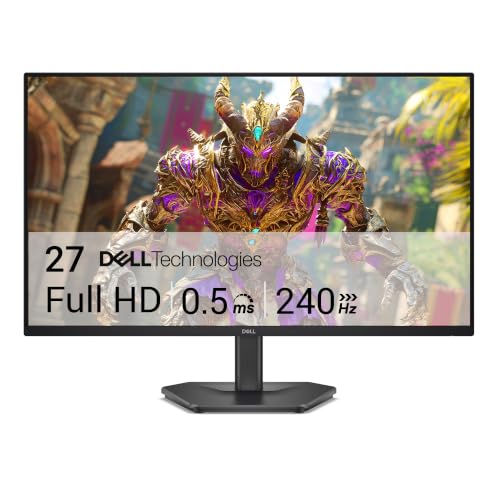
The Dell SE2726HG is the outlier in this group. It is a 27-inch Full HD display, not a 1440p monitor, but its 240Hz refresh rate gives it a legitimate reason to appear as an alternative. A competitive player who runs a high frame rate and wants the least demanding resolution for a graphics card may prefer its priorities. A buyer searching specifically for sharper QHD text should remove it from the shortlist.
Its fast IPS panel is listed with a 0.5ms response time, 240Hz refresh rate, and 99% sRGB coverage. That combination favors quick shooters and esports games where smooth tracking matters more than dense scenery. FreeSync Premium and HDMI VRR help keep the image synchronized with the source, reducing tearing when the frame rate changes. The ASUS TUF VG27AQ3A and Samsung Odyssey OLED G6 also offer serious motion performance, but both give you QHD detail that the Dell does not.
The lower resolution has a practical advantage. Full HD is easier to drive at 240 frames per second than QHD, especially on a modest gaming PC. It also leaves more graphics headroom for competitive settings. The trade-off is obvious on a 27-inch desktop: text, interface elements, and fine textures will not look as dense as they do on the 1440p Samsung Odyssey G5 or ViewSonic VS2725-2K.
Dell includes two HDMI ports and DisplayPort 1.4, while the stand tilts for basic positioning. The TÜV Rheinland three-star certification is intended to lower blue light while preserving color quality, which may help during long sessions. Skip this model if you want the article's core resolution, sharper productivity text, or a more adjustable stand. Pick it only when 240Hz Full HD gaming is the point rather than a compromise.
8. LG UltraGear 27GX704A: Best HDR OLED

Pros
- OLED contrast with VESA DisplayHDR TrueBlack 400
- 240Hz refresh rate and 0.03ms response time
- Dual HDMI 2.1 ports
- G-SYNC Compatible and FreeSync Premium Pro
- Height, swivel, tilt, and pivot adjustments
Cons
- OLED care remains important for static desktop use
- Standard brightness is listed at 275 nits
- Heavier than several other 27-inch models
Best for: premium gaming setups that need OLED contrast, high refresh, and modern console connections.
The LG UltraGear 27GX704A is the most complete premium gaming display in the list. Its OLED panel gives every pixel independent control, so black areas can stay genuinely dark beside bright effects. That is particularly effective in games with night scenes and high-contrast lighting. The Samsung Odyssey OLED G6 is the closer rival, but LG makes a stronger case for a mixed PC and console setup through its HDMI 2.1 connections.
LG lists a 240Hz refresh rate and 0.03ms response time. Those figures put it alongside the Samsung Odyssey OLED G6 for fast competitive play, with the OLED panel helping maintain clean transitions. G-SYNC Compatible and AMD FreeSync Premium Pro support reduce tearing across different graphics hardware. The monitor is QHD, although the supplied title contains an unusual pixel-width figure, so we would rely on the stated QHD designation rather than repeat that inconsistency.
HDR is where the LG becomes especially compelling. It supports VESA DisplayHDR TrueBlack 400, has a listed 1.5 million to 1 contrast ratio, and can reach a stated peak of 1300 nits, with standard brightness listed at 275 nits. It also covers up to 98.5% of DCI-P3. Those specifications explain why explosions, bright interfaces, and dark corners can coexist with more punch than on the IPS and HVA displays. OLED protection features include automatic pixel care cycles and settings intended to reduce image retention.
The stand adjusts in height, swivel, tilt, and pivot, matching the flexibility of the Samsung Odyssey OLED G6. Dual HDMI 2.1, DisplayPort 1.4, USB 3.2 upstream, and two USB 3.2 downstream ports make it better equipped for a busy desk or next-generation console. It weighs 15.9 pounds, so the stand and mounting hardware need a little more planning. As with every OLED here, skip it if your day is mostly a static desktop and you do not want to manage protection features. For the premium gaming buyer, it is difficult to beat.
9. ViewSonic VS2725-2K: Best for Office Work

Pros
- QHD resolution for a sharp work area
- 100Hz refresh rate
- Frameless design suits multi-monitor setups
- Variable Refresh Rate
- Flicker-Free and blue-light filter modes
Cons
- Lower refresh rate than every gaming-focused QHD pick
- Stand details are not specified
- No HDR feature is listed
Best for: office work, browsing, and casual gaming on a clean 27-inch screen.
The ViewSonic VS2725-2K is the quiet, sensible monitor in this roundup. It does not lead with esports speed or dramatic HDR. Instead, it gives office users a sharp 27-inch QHD workspace, a thin frameless design, and enough refresh rate to make scrolling feel smoother than a conventional 60Hz display. It is a good fit for a desk where games are occasional rather than the main event.
The 2560 by 1440 resolution gives documents, timelines, browser windows, and code more room than Full HD. At 100Hz, cursor movement and page scrolling should feel more immediate, while casual games benefit from smoother motion. Variable Refresh Rate is included to reduce image tearing, but the listing does not specify a response-time figure or a named FreeSync or G-SYNC standard. The KTC H27T27S 144Hz is the better gaming choice, while ViewSonic is easier to justify for general productivity.
The frameless edge-to-edge design is helpful for a multi-monitor arrangement because there is less visual interruption between screens. HDMI and DisplayPort inputs cover the usual laptop, desktop, and Mac connections. ViewSonic also includes Flicker-Free technology and a blue-light filter for long work sessions. Those features do not eliminate the need for sensible brightness and viewing-distance adjustments, but they are more relevant to an office monitor than cosmetic gaming lighting.
The weakness is its limited gaming ambition. It runs at 100Hz, not 144Hz or 180Hz, and HDR is not listed. The stand's adjustment range is also not provided in the available data, so check the intended mounting or desk position before ordering. If your priority is a high-frame-rate gaming setup, choose the Samsung Odyssey G5 or ASUS TUF VG27AQ3A. If you need a clear QHD work screen with occasional gaming ability, this is the calmest choice.
10. KTC H27T27S Contrast: Best Simple HVA Monitor

Pros
- HVA panel with 4000:1 contrast
- QHD resolution and 144Hz refresh rate
- 129% sRGB and 109% DCI-P3 coverage
- Two HDMI 2.0 ports and DisplayPort 1.4
- Three-sided thin bezels
Cons
- Tilt-only stand
- No named HDR certification
- No response-time figure is supplied
Best for: everyday gaming and productivity where contrast matters more than advanced extras.
The second KTC H27T27S is close enough in name to the earlier KTC model that the distinction matters. This version is the contrast-focused entry, with an HVA panel and a native 4000:1 contrast ratio. It is aimed at buyers who want a 27-inch QHD monitor that can handle work during the day and darker games after hours without needing OLED.
Its 144Hz refresh rate is a good fit for casual shooters, strategy games, and general desktop use. The QHD panel gives spreadsheets, code, and game textures more room than Full HD, with the listing describing 77% more pixels than 1080p. Adaptive sync is mentioned as part of the gaming feature set, though the available details do not name FreeSync or G-SYNC compatibility. That makes the KTC H27T27S 144Hz model a slightly safer pick if named compatibility is important.
KTC lists 129% sRGB, 109% DCI-P3, 8-bit color, and factory-calibrated color reproduction. Those figures suggest a vivid image with broad gamut coverage, though the listing does not provide a brightness number or a formal HDR certification. The 4000:1 contrast ratio is the more meaningful differentiator. It should give dark scenes more separation than a typical IPS display, while the ViewSonic VS2725-2K is a simpler office alternative with a lower 100Hz refresh rate.
The monitor has two HDMI 2.0 ports, one DisplayPort 1.4 port, and tilt adjustment from minus 5 to 15 degrees. Its three-sided thin bezels suit a multi-screen desk, and the listing includes a three-year warranty and customer support. Height adjustment is absent from the supplied features, so plan on using a riser or monitor arm if the default position is not right. Choose this version for contrast and basic connectivity, not for a highly adjustable ergonomic setup.
How to choose best 1440p monitors
The right 1440p monitor depends on the balance between motion, contrast, connectivity, desk comfort, and the work you do outside games.
Resolution and screen size
QHD resolution is most useful at 27 inches, where 2560 by 1440 provides a sharp workspace without making text excessively small. It gives spreadsheets, timelines, browser windows, and game environments more detail than Full HD. The Dell SE2726HG is the exception here, using 1920 by 1080, so it should be considered only when high frame rates matter more than desktop sharpness.
A 27-inch screen is the common size in this group. Check viewing distance before choosing a curved model, since a 1500R curve can feel immersive for games but less neutral for image editing or straight-line design work. If you are deciding between screen sizes for a compact desk, how far back you should sit from a panel this size is a practical question to settle first.
Panel technology
OLED provides the deepest blacks and the fastest pixel transitions, as shown by the Samsung Odyssey OLED G6 and LG UltraGear 27GX704A. It is also the panel type that demands the most care around static desktop elements. IPS panels such as those in the ASUS and Acer options offer wide viewing angles and strong motion performance, while HVA panels in the KTC monitors emphasize native contrast.
There is no universally superior panel. Choose OLED for dark-room gaming and HDR impact, IPS for a flexible work and gaming display, and HVA when shadow depth matters but you want a conventional desktop monitor. For more context on the trade-offs between resolution and panel type, how bright a room the screen has to fight can matter as much as the panel label.
Refresh rate and response time
A 100Hz display is already smoother than 60Hz for scrolling and casual games. Moving to 144Hz or 180Hz makes fast camera movement cleaner, while 240Hz is aimed at players with a system capable of producing very high frame rates. The Dell reaches 240Hz but uses Full HD, while both OLED Samsung and LG models pair 240Hz with QHD.
Response-time claims need context. The LG and Samsung OLED models list 0.03ms, Acer lists up to 0.5ms GTG, ASUS lists 1ms, and the KTC HVA options do not provide a response figure. Those numbers do not tell the whole story, but they help identify which displays are designed around motion clarity. Variable refresh support is just as important, since it helps prevent tearing when actual frame rates move up and down.
Buy the refresh rate your graphics card can use, but do not trade away QHD sharpness for 240Hz unless competitive play is the main reason for the monitor.
Contrast and HDR
Contrast controls how convincing dark scenes look. OLED has the strongest black-level advantage, while the KTC H27T27S models list a 4000:1 native contrast ratio. IPS displays can look excellent in bright scenes but generally do not provide the same shadow depth based on the supplied specifications.
HDR labels vary in usefulness. Samsung lists HDR10, KTC lists HDR400 on the curved model, and LG lists VESA DisplayHDR TrueBlack 400 with a stated peak brightness of 1300 nits. Look for brightness, contrast, and certification details together. A label without enough brightness or local contrast information should not be treated as proof of a dramatic HDR experience.
Stand and connections
A monitor is easier to live with when the stand matches your desk. Height, pivot, swivel, and tilt adjustment are all available on the Samsung Odyssey G5, Samsung Odyssey OLED G6, and LG UltraGear 27GX704A. The KTC models list tilt adjustment and VESA support, but not height movement. Several other entries do not provide a complete adjustment range in the available details.
Count the connections if you regularly switch between a PC, laptop, and console. The LG has dual HDMI 2.1, DisplayPort 1.4, and USB ports. The KTC H27S5C has two HDMI 2.0 ports and DisplayPort 1.4, while Dell provides two HDMI ports and DisplayPort 1.4. For a second screen or a console-heavy setup, the connections that make a monitor easier to share are more important than a decorative feature.

Frequently asked questions
Is 1440p noticeably better than Full HD?
Yes. At the 27-inch size used by most of these monitors, QHD provides more workspace and finer detail than 1920 by 1080. Text, game textures, and interface elements look sharper, though the Dell SE2726HG can be easier to drive at very high frame rates because it uses Full HD.
Is 144Hz enough for a gaming monitor?
For most players, 144Hz is a strong middle ground. It makes motion much smoother than 60Hz and does not demand as many frames from the graphics card as 240Hz. The Samsung Odyssey G5 and both KTC models are aimed at this level, while the 180Hz and 240Hz models suit players who prioritize competitive motion.
Should I choose OLED or IPS?
Choose OLED if deep blacks, HDR impact, and very fast pixel response matter most. Choose IPS if the monitor will show a static desktop for long periods or if you prefer a more conventional panel. The Samsung Odyssey OLED G6 and LG UltraGear 27GX704A include OLED protection features, but users still need to pay attention to static content.
Do I need FreeSync or G-SYNC compatibility?
Adaptive sync is useful for reducing tearing when the graphics card's frame rate does not match the monitor's refresh rate. FreeSync and G-SYNC compatibility can make that synchronization easier across different systems. Check your graphics card and connection before choosing, since support varies by model and setup.
Is a curved 1440p monitor better for work?
That depends on the type of work. The KTC H27S5C's 1500R curve can make games and wide content feel more immersive, but a flat screen may be preferable for straight-line design, spreadsheets, and multi-monitor alignment. Curvature is a preference rather than a resolution advantage.
Does HDR make a large difference on a monitor?
HDR can make bright highlights and dark scenes more convincing, but only when the display has enough brightness and contrast. The LG UltraGear 27GX704A has the strongest HDR specification here, while the Samsung monitors list HDR10. A basic HDR label alone does not guarantee a dramatic improvement.
Can a 1440p monitor work with a console?
Yes, provided the console and monitor support a compatible resolution and refresh rate. The LG UltraGear 27GX704A is especially well equipped for current console setups because it includes HDMI 2.1. HDMI and DisplayPort connections on the KTC, ASUS, Acer, and ViewSonic displays cover common PC and laptop arrangements.

The bottom line
The Best 1440p monitors start with the Samsung Odyssey OLED G6 if gaming performance, OLED contrast, and 240Hz motion are the priorities. It has the most impressive image in the group, a flexible stand, Glare Free technology, and OLED protection features. The LG UltraGear 27GX704A is the alternative for buyers who need HDMI 2.1, USB connectivity, and especially strong HDR support.
For a more balanced desk, choose the Samsung Odyssey G5. Its 180Hz refresh rate, QHD sharpness, HDR10, Black Equalizer, and fully adjustable stand make it easier to recommend for work, games, and everyday use. The ASUS TUF VG27AQ3A is the sharper motion-focused alternative, while the Acer Nitro KG271U is the stronger fit for wide-gamut color work.
If you are undecided, buy the Samsung Odyssey G5 for mixed use, or move to the Samsung Odyssey OLED G6 when contrast and competitive speed matter most.
As an Amazon Associate we earn from qualifying purchases.