
A laptop can handle serious multitasking, but a single display still turns research, writing, messaging, and spreadsheets into a constant cycle of window switching. A portable monitor or laptop screen extender changes that immediately, although the right design depends on your laptop's ports, weight tolerance, and available desk space.
The Best laptop and monitor setup options here range from a simple standalone 15.6-inch display to full triple-screen extenders and a dual-monitor riser. ZUMWALT P7 is our top pick for a complete portable workstation, while the other seven make stronger cases for lighter travel, simpler connections, flexible positioning, or a permanent desk.
Comparison table
| # | Product | Award | Display or capacity | Weight | Best for |
|---|---|---|---|---|---|
| 1 | ZUMWALT P7 | Best overall | Two 15.6-inch FHD screens, 280 nits | 4 lb | A complete triple-screen travel setup |
| 2 | MNN 15.6-inch Portable Monitor | Best standalone display | 15.6-inch FHD IPS, 60Hz, HDR | 1.53 lb | A simple second screen |
| 3 | Vixtan 14-inch Triple Extender | Best lightweight triple screen | 14-inch FHD IPS, 300 nits | 3 lb | Frequent travelers |
| 4 | Miesebe 15.6-inch Extender | Best slim aluminum extender | Two 15.6-inch FHD IPS screens, 60Hz | 3.9 lb | Large screens in a thin chassis |
| 5 | Omiodo 15.6-inch Monitor | Best adjustable standalone monitor | 15.6-inch FHD IPS, 60Hz | 1.32 lb | Flexible desk and travel use |
| 6 | BONTEC Dual Monitor Riser | Best desk organizer | Adjustable from 31.5 to 42.5 inches | 7.28 lb | A fixed dual-monitor workstation |
| 7 | VueForge 15.6-inch Extender | Best cable-conscious extender | Two 15.6-inch FHD IPS screens | Not listed | Fast triple-screen setup |
| 8 | Redalf 15.6-inch Detachable Extender | Best detachable design | Two 15.6-inch FHD IPS screens | 2.1 lb per side | Presentations and modular use |
1. ZUMWALT P7: Best Overall

Pros
- Two large 15.6-inch FHD displays
- Uses two USB-C cables with compatible laptops
- Aluminum shell and included carrying bag
- Extend, mirror, and portrait modes
- Fits laptops from 13 to 17.3 inches
Cons
- Heavier than the smaller triple-screen options
- M1, M2, and M3 MacBooks need an additional H5-T cable
- Requires full-featured USB-C ports for the cleanest setup
Best for: professionals who want the most complete portable triple-screen workstation.
The ZUMWALT P7 is the most convincing all-in-one answer for someone who wants a laptop to become a three-screen workstation without assembling separate stands and displays. Its two attached 15.6-inch panels give the setup a proper desktop feel, while the aluminum shell and included leather carrying bag keep it suited to travel. At 4 pounds, it is not a casual accessory, but that weight reflects the larger panels and more substantial construction.
The screens use 1920 by 1080 resolution and are rated at 280 nits with 178-degree viewing angles. Those numbers suit documents, browser windows, code, and video calls rather than color-critical production work. The large panels make text and tool palettes easier to spread out than the 14-inch displays on the Vixtan 14-inch Triple Extender. Portrait mode is useful for long documents or coding, and mirror mode gives presentations a straightforward fallback.
Connectivity is at its best when the laptop has full-featured USB-C. ZUMWALT says two USB-C to USB-C cables can carry the display signal and power in that arrangement, keeping the desk relatively clean. Windows, Chrome, Mac, Android, and Switch compatibility is listed, but MacBook M1, M2, and M3 models need an H5-T cable, plus HDMI and USB-A power in the alternative connection method. That caveat matters more than the broad compatibility headline.
The ZUMWALT P7 beats the Miesebe 15.6-inch Extender on cable simplicity and edges the VueForge 15.6-inch Extender with a clearly specified brightness figure and carrying bag. Its weakness is bulk. A 4-pound screen extender can make a small laptop bag feel crowded, and the laptop itself must support the right video output. Skip it if you mainly need one lightweight second display. For a mobile worker who genuinely uses three screens, this is the one we'd keep.
2. MNN 15.6-inch Portable Monitor: Best Standalone Display

Pros
- 15.6-inch FHD IPS screen
- 60Hz refresh rate
- Two full-featured USB-C ports
- HDR mode and multiple display modes
- Smart cover doubles as a stand
Cons
- Not an attached triple-screen extender
- USB-C video requires DP Alt Mode or Thunderbolt 3
- Glossy screen may reflect bright surroundings
Best for: anyone who wants a conventional portable second monitor without attached side panels.
The MNN 15.6-inch Portable Monitor is the uncomplicated pick in this group. It is a single display with its own smart cover, so it works beside a laptop rather than hanging from its lid. That makes it easier to place at a comfortable angle and more useful when you want a screen for a console, phone, or desktop as well as a laptop.
Its 15.6-inch IPS panel runs at 1920 by 1080 and 60Hz. The 178-degree viewing angle should keep the picture consistent when the monitor sits off to one side, while HDR mode is available for brighter highlights and more vivid-looking content. MNN also lists eye-care features such as reduced blue light and flicker control. The panel is glossy, though, so a window or strong lamp behind you can be more distracting than with an anti-glare display.
The two full-featured USB-C ports are the key practical feature. With a compatible laptop that supports Thunderbolt 3 or USB 3.1 Type-C DP Alt Mode, one USB-C cable can carry both power and display signal. HDMI and other connection options broaden device support, but they may require separate power. At 1.53 pounds and 0.3 inches thick, the MNN is much easier to pack than any attached dual-screen extender.
This design is less immersive than the ZUMWALT P7 because it adds one screen instead of two. It is also more adaptable: the cover stand lets you use it in landscape or portrait mode without putting extra weight on the laptop hinge. Readers comparing portable displays can also consider how a second screen changes the space around a laptop before choosing an attached model.
The main reason to skip the MNN is simple. It does not create a triple-screen setup on its own. For research, chat, documents, and a second browser window, however, the restrained design makes more sense than carrying two attached panels. It is the right choice for a portable desk that needs one dependable extra display.
3. Vixtan 14-inch Triple Extender: Best Lightweight Triple Screen

Pros
- 3-pound travel weight
- 14-inch FHD IPS display
- 300 nits brightness and 100% sRGB listed
- Height-adjustable stand with 180-degree rotation
- Includes USB-C and HDMI cables
Cons
- Smaller panels than the 15.6-inch extenders
- M1, M2, and M3 MacBooks support only one screen without DisplayLink
- May need a separate 5V/3A adapter for flicker or low brightness
Best for: commuters and remote workers who want three screens without the heaviest chassis.
The Vixtan 14-inch Triple Extender makes a strong case for accepting smaller side panels in exchange for easier travel. At 3 pounds and 0.3 inches thin according to the product description, it is notably lighter than the ZUMWALT P7 and Miesebe 15.6-inch Extender. The reinforced stand, non-slip pads, and rear support are meant to keep the attachment steady across laptops from 13 to 17.3 inches.
The 14-inch IPS screens have 1920 by 1080 resolution, 300 nits brightness, and a claimed 100% sRGB color gamut. The extra brightness should help in brighter rooms, while the anti-glare coating is more travel-friendly than a glossy surface. A 178-degree viewing angle, eye-care technology, and support for landscape, portrait, mirrored, and extended modes make it a versatile workspace rather than a one-position accessory.
Vixtan includes two USB-C cables, a USB-C to USB-A cable, and HDMI. Plug and play is available without drivers on supported systems, but the power requirements still deserve attention. The product says a 5V/3A or higher adapter may be needed if the picture flickers or brightness is low. MacBook M1, M2, and M3 models support only one screen directly, with a DisplayLink adapter required for two screens.
The smaller size is both the appeal and the compromise. Compared with the Miesebe 15.6-inch Extender, the Vixtan gives up screen area but is easier to carry and has a more explicit height-adjustment design. It is also a better travel proposition than the Redalf 15.6-inch Detachable Extender, though Redalf has more unusual positioning options.
Skip this one if large side-by-side panels are essential for detailed spreadsheets or design work. Choose it if a three-screen layout matters more than matching the laptop's screen size. For a student, consultant, or digital nomad moving between locations, the Vixtan is the most sensible lightweight triple-screen option.
4. Miesebe 15.6-inch Extender: Best Slim Aluminum Extender

Pros
- Two 15.6-inch FHD IPS panels
- Aluminum alloy construction
- 0.16-inch screen thickness listed
- 180-degree side-screen adjustment
- 60Hz refresh rate and 100% sRGB listed
Cons
- Weighs 3.9 pounds
- M1 through M4 MacBooks need an H5-T connection method
- H5-T cable is not included
Best for: users who want large triple-screen panels in a thin, polished enclosure.
The Miesebe 15.6-inch Extender is built around screen size and a slim profile. Its two 15.6-inch panels match the generous dimensions of the laptop screen extenders above, but the product emphasizes a 0.16-inch screen thickness and aluminum alloy construction. The complete unit weighs 3.9 pounds, so it is portable in the broad sense, though it belongs in a structured bag rather than a thin sleeve.
Each display uses 1920 by 1080 resolution, a 60Hz refresh rate, 280 nits brightness, and a 1000:1 contrast ratio. Miesebe also lists 100% sRGB coverage and IPS viewing angles. That combination is well suited to office work, browsing, and video, with enough image consistency for side-by-side windows. The 0 to 180-degree side-screen angle and 0 to 90-degree kickstand tilt give more control than a rigid attachment.
The two-cable connection is the central convenience. Windows, macOS, Android, and Chrome OS are listed, with support for devices that offer HDMI output. A full-featured USB-C port keeps the setup cleaner, but laptops without one need H5-T, HDMI, and USB-A power, plus driver installation. The compatibility note specifically includes M1 through M4 MacBooks, and the H5-T cable is not included, so owners of those machines should confirm the connection path before ordering.
Miesebe is more substantial than the Vixtan 14-inch Triple Extender and offers a larger working area, but Vixtan is easier to justify for frequent air or rail travel. Compared with ZUMWALT P7, Miesebe has similar screen proportions and a slightly thinner stated screen design, while ZUMWALT makes the cable arrangement and bag contents clearer.
The weakness is that thin does not mean light. At 3.9 pounds, this is a serious piece of kit, and the compatibility caveats can turn a two-cable promise into a more involved setup. It suits someone who values large panels and aluminum construction more than minimum luggage weight.
5. Omiodo 15.6-inch Monitor: Best Adjustable Standalone Monitor

Pros
- 15.6-inch FHD IPS panel
- 360-degree rotating magnetic stand
- Separate desktop stand raises the screen
- USB-C and Mini HDMI connectivity
- Protective sleeve included
Cons
- Adds one display, not two
- Mini HDMI is less convenient than full-size HDMI
- Stand flexibility takes more desk space than a laptop attachment
Best for: laptop users who want a portable monitor that can sit independently at a useful height.
The Omiodo 15.6-inch Monitor solves a problem that attached extenders often create: screen height. Its dedicated foldable stand can raise the display above the laptop, reducing the need to look down at a low second panel. That matters during long writing or spreadsheet sessions, especially when the monitor is being used as the main reference screen.
The panel is a 15.6-inch IPS display with 1920 by 1080 resolution, a 60Hz refresh rate, 1000:1 contrast, and a 16:9 aspect ratio. Those are familiar office and entertainment specifications, with the IPS panel helping maintain clarity from wider angles. The magnetic stand rotates 360 degrees, allowing portrait or landscape use, while the included sleeve makes the monitor easier to protect in transit.
Omiodo uses USB-C and Mini HDMI for connection and is listed as compatible with laptops, Macs, PCs, smartphones, Switch, PS4, PS5, and Xbox. The one-cable claim applies when the connected device and cable support the needed signal and power arrangement, so HDMI setups may still need power. The product also includes a 12-month warranty and lifetime technical support, which is useful when a portable display is being moved between devices.
This is a different proposition from the ZUMWALT P7 or VueForge 15.6-inch Extender. Those products turn the laptop into a three-screen unit, while Omiodo behaves like a small conventional monitor that can be placed wherever the desk allows. The right monitor position for comfortable long sessions is easier to achieve with Omiodo's independent stand.
The trade-off is desk footprint. A laptop plus a separate stand-mounted display needs more surface area than an attached panel, and it cannot provide the same three-window layout without another screen. Choose Omiodo when height, rotation, and independent placement matter more than maximum screen count.
6. BONTEC Dual Monitor Riser: Best Desk Organizer
Pros
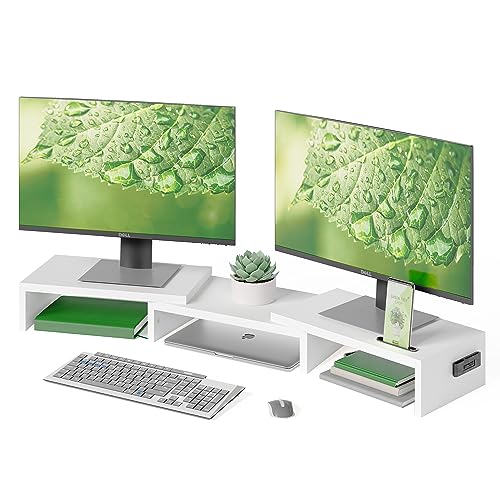
- Width adjusts from 31.5 to 42.5 inches
- Swivel shelves suit straight, angled, or corner layouts
- Three open storage compartments
- Phone holder and cable-management opening
- Non-slip base and simple assembly
Cons
- Designed for a permanent desk
- Wooden riser is heavier than a portable display
- Does not include monitors
Best for: building a tidy fixed workstation around two separate monitors.
The BONTEC Dual Monitor Riser is the outlier here, and that is precisely why it deserves a place in the roundup. It does not add a screen to a laptop. Instead, it gives two existing monitors a raised, organized platform and creates space underneath for a keyboard, mouse, documents, or a docking station.
Its width adjusts from 31.5 to 42.5 inches, allowing it to fit a smaller desk or spread across a wider one. The side shelves swivel for straight, angled, or corner layouts, which gives more freedom than a fixed shelf. Raising two displays can also put them closer to eye level, helping reduce the neck and shoulder strain that comes from working at a low screen.
The riser includes three open compartments, a smartphone slot, and a cable-management opening. The wooden structure weighs about 7.28 pounds and uses a non-slip base. Assembly is described as taking about two minutes with the included screws. Those details point to a stable desk accessory rather than something intended to move between offices.
BONTEC makes more sense alongside the MNN 15.6-inch Portable Monitor or Omiodo 15.6-inch Monitor than with an attached extender. It is also a better starting point for readers considering how two displays should be arranged on a desk rather than on a laptop lid. The adjustable side shelves are particularly useful when a corner desk is the only practical location.
The limitation is obvious but important: the riser is only a platform. It cannot replace a display, solve a laptop's port limitations, or create a travel workstation. Pick it for a settled home office where monitor height, cable order, and storage matter more than portability.
7. VueForge 15.6-inch Extender: Best Cable-Conscious Extender

Pros
- Two 15.6-inch FHD IPS displays
- Two-cable plug-and-play design
- 180-degree screen rotation
- 90-degree stand adjustment
- Aluminum alloy exterior and included power adapter
Cons
- Laptop must have two compatible USB-C ports or USB-C plus HDMI
- M1, M2, and M3 MacBooks need H5-T
- Weight is not listed
Best for: users prioritizing a clean two-cable connection for a large triple-screen layout.
The VueForge 15.6-inch Extender focuses on reducing the cable tangle that can make portable multi-screen setups annoying. It connects two displays with two cables on compatible laptops, with each monitor receiving an independent video signal while sharing power. There are no top clips, so removal should be less awkward and puts less pressure on the laptop hinge.
The two screens are 15.6-inch FHD IPS panels, and each can rotate through 180 degrees. The rear bracket helps stabilize the laptop and screen assembly, while the stand adjusts from 0 to 90 degrees. Landscape and portrait modes give the layout some flexibility, and the display controls allow independent adjustment of brightness, volume, language, and other settings.
Compatibility requires careful reading. VueForge lists laptops from 13 to 17.3 inches and support for Mac, Windows, Chrome, and Switch. The laptop needs two USB-C ports with DisplayPort support, or one such USB-C port plus HDMI. MacBook M1, M2, and M3 models need an H5-T cable, which is not included. If the screens flicker or seem too dim, the product recommends a 5V/3A adapter or higher.
The VueForge is close in concept to the Miesebe 15.6-inch Extender, but it puts more emphasis on cable reduction and independent controls. ZUMWALT P7 is the more thoroughly specified option, with a stated weight and brightness figure, while VueForge's advantage is the straightforward two-cable design and lack of a top cover.
No listed weight makes packing decisions harder, and the port requirements may exclude some laptops. This is a good fit for a user who has verified the ports and wants a large triple-screen workspace that can be assembled without four or five separate cables.
8. Redalf 15.6-inch Detachable Extender: Best Detachable Design

Pros
- 235-degree horizontal rotation
- Detachable sides can work independently
- 15.6-inch FHD IPS screens
- Supports landscape, portrait, and stacked layouts
- Built-in speakers and eye-care features
Cons
- Compatibility excludes several base M-series MacBook chips
- HDMI connection needs separate USB-A to USB-C power
- More moving parts than a simple standalone monitor
Best for: presenters and creators who want to separate the two screens when needed.
The Redalf 15.6-inch Detachable Extender is the most flexible physical design in the group. Its stand supports 235-degree horizontal rotation and 90-degree vertical rotation, allowing landscape, portrait, and stacked configurations. More unusually, the two sides can detach and be used independently, with each side weighing 2.1 pounds.
Both panels are 15.6-inch 1920 by 1080 IPS displays. Redalf lists built-in speakers, anti-glare treatment, low-blue-light design, and flicker-free operation. The detachable format can be useful during a presentation, when one screen needs to face an audience, or when two people need to view separate displays without leaning over the laptop.
The product supports USB-C, USB-A, and HDMI connections without drivers in the listed plug-and-play arrangement. HDMI requires an additional USB-A to USB-C cable for power on the same extender. Compatibility includes Windows, Chrome, Android, Linux, Dex, and some higher-end M-series Mac configurations, but it specifically does not support the base M1, M2, and M3 chips. That is a significant check before ordering.
Redalf's movement range exceeds the 180-degree adjustment on the Miesebe 15.6-inch Extender and VueForge 15.6-inch Extender. It is also more versatile than the MNN 15.6-inch Portable Monitor because the two detachable sides can serve separate purposes. ZUMWALT P7 remains the simpler recommendation for a conventional triple-screen workday.
The cost of that flexibility is complexity. More hinges and detachable parts create more setup decisions, and the Mac compatibility list is narrower than some rivals. Choose Redalf when independent screens and unusual viewing angles are central to the job. Skip it if you want the least complicated portable second screen.
How to choose best laptop and monitor setup
The right setup depends less on screen count than on how your laptop connects, how much weight your bag can handle, and whether the screens need to travel or stay on a desk.
Screen arrangement
A standalone monitor adds one independent display and can sit at a better height than the laptop. Attached extenders add two screens and create a three-screen workspace, but they put more weight on the laptop area and need a suitable surface behind the machine. A riser such as BONTEC is for two separate monitors, not for adding panels to a laptop.
Resolution and brightness
Full HD, or 1920 by 1080, is the common resolution here and is appropriate for documents, browser windows, chat, and general work on 14-inch to 15.6-inch panels. Brightness matters when working near windows or outdoors. The Vixtan is listed at 300 nits, while ZUMWALT P7 and Miesebe are listed at 280 nits. A 60Hz refresh rate is sufficient for ordinary work and console use, but none of these products is positioned as a high-refresh desktop gaming monitor.
Port compatibility
USB-C is not automatically a video connection. The laptop needs full-featured USB-C with DisplayPort Alt Mode, or a compatible Thunderbolt connection. HDMI can work, but it often needs a separate USB cable for power. Several extenders require an H5-T cable or DisplayLink adapter for certain MacBook models, so identify the exact laptop chip and available ports before choosing.
A triple-screen design is only convenient when the laptop can power and drive all three displays without a cable workaround.
Weight and portability
The Vixtan weighs 3 pounds, ZUMWALT P7 weighs 4 pounds, and Miesebe weighs 3.9 pounds. The MNN and Omiodo standalone monitors are much lighter at 1.53 pounds and about 1.32 pounds respectively. Redalf's detachable sides weigh 2.1 pounds each, which helps when carrying one panel but does not make the complete system a lightweight option.
Positioning and ergonomics
Look for rotation and a stable rear support if the displays will be used in portrait mode or in cramped spaces. Omiodo's 360-degree stand is useful for independent placement, while Redalf offers 235-degree horizontal movement and detachable panels. BONTEC raises two desktop monitors and adds storage. The best arrangement is the one that puts the frequently used screen near eye level without forcing the laptop or side panels into an awkward angle.
Frequently asked questions
Can these products turn a laptop into three screens?
The attached extenders from ZUMWALT, Vixtan, Miesebe, VueForge, and Redalf are designed to create a triple-screen setup. The MNN and Omiodo add one standalone display, while BONTEC is a riser for two separate monitors. Actual triple-screen operation depends on the laptop's graphics and port support.
Do USB-C laptop ports always work with these monitors?
No. The USB-C port must support video output through DisplayPort Alt Mode or a compatible Thunderbolt connection. A USB-C port that handles charging and data only may not drive the display.
Which setup is easiest to carry?
The MNN 15.6-inch Portable Monitor and Omiodo 15.6-inch Monitor are the lightest complete display options listed here. Among triple-screen extenders, Vixtan is the lightest listed at 3 pounds.
Can these extenders work with MacBooks?
Support varies by MacBook model. Vixtan requires a DisplayLink adapter for two screens on M1, M2, and M3 MacBooks, while ZUMWALT, Miesebe, and VueForge list H5-T connection requirements for certain M-series models. Redalf excludes the base M1, M2, and M3 chips, so MacBook owners should check the compatibility note for the exact computer.
Is a standalone monitor better than an attached extender?
A standalone monitor is easier to position, usually lighter, and works with more types of devices. An attached extender provides two additional screens in one travel unit, but it is heavier and more dependent on the laptop's ports and power capabilities.
Can the screens be used vertically?
Yes. ZUMWALT, MNN, Vixtan, Miesebe, Omiodo, VueForge, and Redalf list portrait or vertical use in their features. The exact angle and stability depend on the stand or attachment design.
Is BONTEC a monitor?
No. BONTEC is a dual monitor riser and desk organizer. It raises two existing monitors, adjusts from 31.5 to 42.5 inches, and provides storage and cable-management features, but it does not include display panels.
The bottom line
For the Best laptop and monitor setup, ZUMWALT P7 is the strongest all-around pick because it combines two large 15.6-inch FHD panels, a relatively clean two-cable connection, multiple display modes, and a carrying bag. Vixtan 14-inch Triple Extender is the better travel choice when keeping the complete triple-screen unit close to 3 pounds matters more than having the largest side displays.
Choose MNN 15.6-inch Portable Monitor or Omiodo 15.6-inch Monitor when one independently positioned second screen is enough. For a permanent office, BONTEC Dual Monitor Riser creates the cleanest foundation, while Redalf 15.6-inch Detachable Extender is the specialist pick for presentations and modular screen placement.
If you are undecided, verify your laptop's USB-C video support first, then choose the lightest setup that gives you the number of screens you will actually use.
As an Amazon Associate we earn from qualifying purchases.